Part of "How It Gets Built" — Buildermuse's series on the machinery behind modern construction.
On June 25, 2025, the City of Hastings, Minnesota opened bids on a raw watermain for its new treatment plant and asked every bidder to price the same 2,181 feet two ways: 14-inch HDPE pulled in by directional drill, or 12-inch PVC pulled in by directional drill. The five bidders put the HDPE bore between $222.00 and $266.00 per linear foot and the PVC bore between $223.00 and $289.07, against an engineer's estimate of $240.00 for either. On the same tab, 125 feet of 24-inch steel casing installed by directional drill drew unit prices from $200.00 to $3,047.55 per foot. That fifteen-fold spread on one line item, from five contractors who all read the same boring logs, is the whole trenchless business in a single row: the pipe is cheap, the ground is not, and nobody agrees on what the ground will do.
This is the eleventh part of the series, and the first on work that happens entirely out of sight. Four methods carry most of the market: horizontal directional drilling (HDD) for pressure pipe and conduit, microtunneling for gravity sewer on precise grade, pipe bursting for replacing a failed line in its own alignment, and cured-in-place pipe (CIPP) for relining one that is structurally sound enough to keep. Each has its own rig, crew, standard, and failure mode, and each shows up on public bid tabulations with prices that are easier to find than most contractors think.
Which Method the Ground and the Pipe Pick
The choice is rarely about preference. Diameter, depth, required accuracy, and what the pipe carries narrow the field quickly, and the Texas Transportation Institute's unit-cost framework for utility installations (Report 0-4998-1, prepared for TxDOT in October 2006 and published March 2007) still has the cleanest summary table of what each method physically covers. Its Table 41 puts mini HDD at 2 to 12 inches and 600 feet with a typical maximum depth of 15 feet; midi HDD at 12 to 24 inches, 1,000 feet, and 75 feet of depth; and maxi HDD at 24 to 48 inches, bores to 6,000 feet, and depths to 200 feet. Microtunneling covers 10 to 136 inches, drives of 500 to 1,500 feet between shafts, and a typical accuracy of plus or minus 1 inch. CIPP in the same report's renewal table runs 4 to 108 inches and up to 3,000 feet per installation.
Accuracy is what separates the two installation methods. An HDD pilot bore steers by a sonde in the drill head read from the surface, and the same TTI table describes exit-point error of 10 feet left or right and minus 10 to plus 30 feet along the axis as "not unusual." That is fine for a pressure water main or a fiber conduit that can go anywhere in the right-of-way, and it is why HDD is the standard tool for the BEAD-funded broadband builds now reaching rural counties. It is useless for a gravity sewer that needs a continuous fall of a few tenths of a percent. That job goes to a microtunnel boring machine (MTBM) jacked from a shaft on a laser line, which is why microtunneling is priced per drive and sewer interceptors are its bread and butter.
Pipe bursting and CIPP are rehabilitation, not new installation. Bursting splits the old pipe and pulls new HDPE through the hole it leaves, which lets an owner upsize a 6-inch clay sewer to 8-inch without a trench; CIPP leaves the host pipe in place and cures a resin tube inside it. Both are covered in our guide to sewer line replacement cost per foot, and the Hayward, California engineer's estimate quoted below shows how a design engineer prices them against open cut on the same street.
| Method | Diameter range (TTI Table 41/42, 2007) | Max length | What it is for | Governing documents |
|---|---|---|---|---|
| Mini / midi / maxi HDD | 2–12 in / 12–24 in / 24–48 in | 600 / 1,000 / 6,000 ft | Pressure pipe, conduit, river and road crossings | ASTM F1962-25A; NASTT HDD Good Practices Guidelines, 5th ed. |
| Microtunneling | 10–136 in | 500–1,500 ft per drive | Gravity sewer and storm on grade, casings under rail | ASCE/CI 36 (2001 ed.; 2015 revision) |
| Pipe bursting | Host pipe upsized one or two sizes | Manhole to manhole | Replace failed sewer or water main in place | NASTT Pipe Bursting Good Practices Guidelines, 3rd ed. (2019); IPBA Guideline (Jan 2012) |
| CIPP | 4–108 in | 3,000 ft | Reline structurally usable host pipe | ASTM F1216 (inversion; 2–108 in) |
How an HDD Bore Is Actually Executed
Pilot, ream, pullback
The City of Albany, Oregon's HDD specification for its Washington Street Area Improvements contract (ST-23-01, Appendix B) is a typical municipal spec, and it describes the sequence the way an inspector sees it. The rig drills a pilot hole along the designed profile while the crew plots actual horizontal and vertical position at intervals no greater than 25 feet. The pilot must land within the spec's tolerances: elevation plus zero, minus five feet; alignment plus or minus two feet; and an exit point within 10 feet of planned length and 5 feet left or right on bores up to 1,000 feet, loosening to 40 feet of length on longer bores. The engineer approves the as-built pilot before anything else happens, and can order a new pilot if it misses.
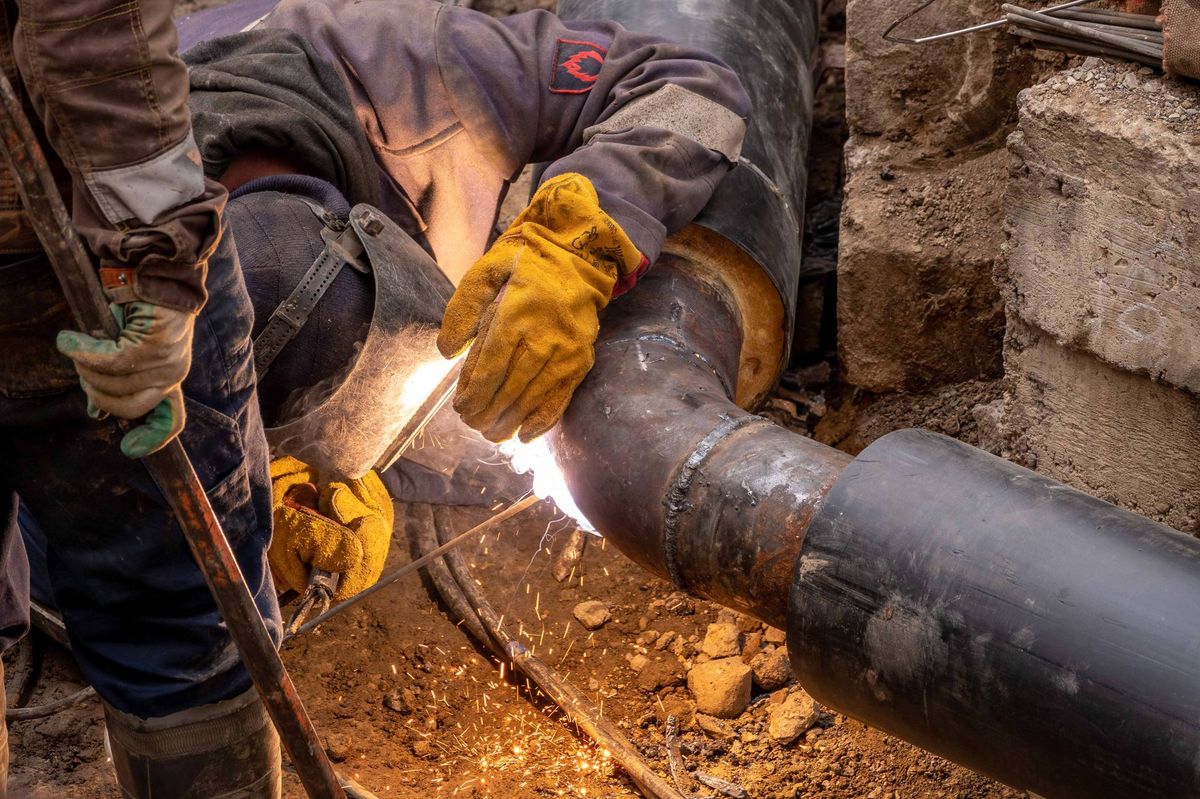
Then the hole is opened. A back reamer is attached where the drill string exits and pulled back toward the rig, in as many passes as the ground requires, until the final hole is at least 40 percent larger than the outside diameter of the product pipe, per the Albany spec. The product pipe, HDPE butt-fused into a single string and laid out on rollers spaced no more than 60 feet apart, is attached behind the reamer through a swivel so the rotation of the string does not twist the pipe. Pullback, once started, continues without interruption until the pipe is in, because a stalled pipe in a collapsing hole is the most expensive thing that can happen on the job. The pull force is measured continuously and capped at the pipe manufacturer's limit, the end of the pipe is closed, a tracer wire goes in with it, and the pipe sits for a manufacturer-specified relaxation period before tie-in. Albany's acceptance test is a hydrostatic hold at 150 psi.
Drilling fluid and where it goes
None of that works without drilling fluid. Bentonite meeting API Specification 13A is mixed and pumped down the hollow drill string to cool the head, carry cuttings back to the entry pit, and hold the hole open while the reamer and pipe pass. Returns come back to a solids control plant that the Albany spec requires as a minimum: sumps, pumps, tanks, desilter and desander, and centrifuges, with the cuttings dewatered for landfill and the water treated to permit before disposal. The pits are lined with sealed plastic sheeting so fluid does not migrate into groundwater.
The failure everyone plans for is the inadvertent return, or frac-out: drilling fluid finding a path to the surface, a basement, or a creek instead of the entry pit. The Albany spec treats it exactly as other municipal specs do. The contractor keeps booms, hay bales, absorbent pads, and earth-moving equipment on site for that eventuality, encloses work areas next to waterways with a boom, and cleans up any return "to the satisfaction of, and at no additional expense to, the City." The spec also requires the contractor to measure fluid flow and pressure continuously during the pilot, because annular pressure exceeding what the overburden can hold is the mechanism, and the only early warning is a drop in returns at the pit.
The standards behind the spec
ASTM F1962, in its current 2025 edition (F1962-25A), is the Standard Guide for Use of Maxi-Horizontal Directional Drilling for Placement of Polyethylene Pipe or Conduit Under Obstacles, Including River Crossings, and it is the design document most engineers cite for bore path geometry and pipe stress. NASTT's HDD Good Practices Guidelines, now in a fifth edition that the association's February 2025 course describes as recently released, is the contractor-side reference; the new edition expanded geotechnical investigation and bend-radius guidance, added U.S. Army Corps of Engineers requirements for crossings under levees, and rewrote the pilot-hole tracking and intersect-method sections.
Microtunneling: Jacking Pipe Behind a Machine Nobody Rides
ASCE's microtunneling standard, first issued as ASCE/CI 36-01 in 2001 and revised in 2015, defines the method by four features rather than by size: the boring machine is remote controlled from a panel on the surface, a laser guidance system is used, a jacking system provides thrust, and continuous pressure is applied to the face of the excavation to balance groundwater and earth pressure. The standard is explicit that the North American definition "does not impose size limitations on that method."
In practice the machine is a slurry MTBM. Herrenknecht's AVN line, the one most often named on North American job logs, is offered from 0.4 to 4.8 meters outside diameter, with a cutterhead matched to the ground (a mixed-soil head for soft and mixed ground, disc cutters for rock), a cone crusher in the excavation chamber that breaks cobbles small enough to pump, and a closed slurry circuit that supports the face hydraulically and carries muck to a separation plant on the surface, per the manufacturer's product page. Bentonite is injected into the annulus to cut friction, and on drives over 1,000 meters, intermediate jacking stations split the pipe string so no single section carries the full thrust.
The shaft is the job. A jacking frame in the launch shaft pushes the MTBM and then each pipe section (reinforced concrete, polymer concrete, vitrified clay, GRP, or steel casing) behind it, against a thrust wall. Pipe comes in standard lengths, each one lowered, seated against the previous joint, and jacked, and the laser target in the machine tells the operator in the control container where the head is to within the accuracy the TTI table quotes. The machine is recovered at the reception shaft. Trenchless Technology's August 2026 North American Microtunneling Job Log records what a typical municipal job looks like: for the Bergen County Utilities Authority's Edgewater force main and gravity sewer, CRS Contractors ran three drives of 879, 984, and 204 feet with a 60-inch OD Herrenknecht AVN1200 TB through soft clay silts, on a project the log values at $5 million, completed January 2026.
We did not find a 2024 or 2025 public bid tabulation with a microtunneling line item priced per foot that we could read directly, and we are not going to quote a per-foot range from vendor marketing pages. If you need one, the owner's bid tab for a specific interceptor is the only honest source, and the shafts, dewatering, and mobilization will be separate line items that matter as much as the drive.
Pipe Bursting and CIPP: Replacing Versus Relining
Bursting
A bursting head, pulled by a hydraulic unit set in the downstream manhole or an exit pit, splits the host pipe and pushes the fragments into the surrounding soil while towing a fused HDPE string behind it. The method is governed on the contractor side by NASTT's Pipe Bursting Good Practices Guidelines, third edition (2019), and the International Pipe Bursting Association's Guideline for Pipe Bursting (January 2012). Laterals are the hidden cost: every service connection is excavated and reconnected, and on a residential street those pits outnumber the manholes ten to one.
Rogers Water Utilities in Arkansas bids an annual bursting program, and its tabs show how the unit prices and the lateral prices trade against each other. On the 2025 Pipe Bursting Sewer Rehab tabulation (posted October 2024), the engineer estimated 3,614 feet of 6-inch-to-8-inch bursting at $130.00 per foot and the two bidders came in at $120.00 (Horseshoe Construction) and $110.00 (Bennett, Inc.); the 779 feet of 8-inch-to-8-inch bursting was priced $135.00, $120.00, and $110.00 the same way. Lateral reconnections on that tab ran $1,200 to $2,000 each, and manhole setups $1,000 to $4,800. On the prior year's tab (2024 program, posted October 2023), five bidders priced the same 6-to-8-inch item between $110.00 and $150.00 per foot against an engineer's estimate of $281.25, with laterals from $1,350 to $2,917 each.
Relining
CIPP by inversion is ASTM F1216 (the 2026 edition is current): a resin-impregnated felt or fiberglass tube is inverted into the host pipe with water or air pressure, cured with hot water, steam, or UV light, and the laterals are reopened from inside with a robotic cutter. The result is a continuous, tight-fitting pipe inside the old one, which is why it costs a fraction of replacement when the host pipe still holds its shape.
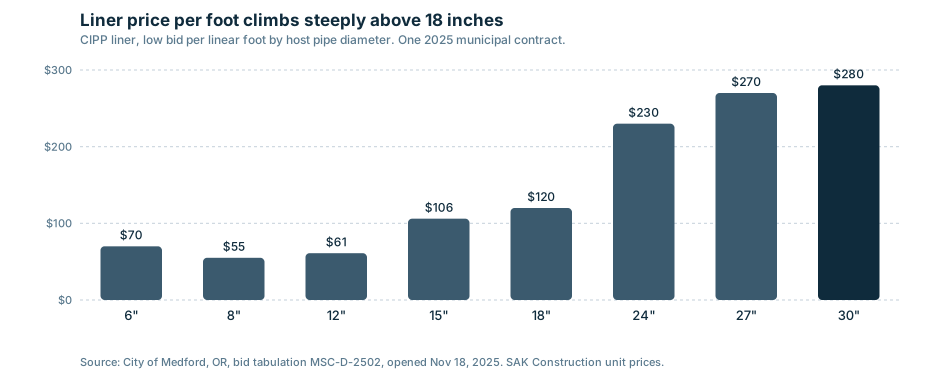
Two 2025 tabs bracket the small-diameter price. Hastings, Minnesota opened its 2025 Sanitary Sewer Lining Program on April 18, 2025, and four bidders priced 2,451 feet of 8-inch lining between $42.25 (Hydro-Klean, the low bidder) and $53.87 (Insituform Technologies) per foot against an estimate of $50.30; 10-inch ran $50.00 to $60.71, 15-inch $59.50 to $105.25, and 24-inch $154.00 to $197.00. Medford, Oregon opened its 2026 Wastewater Collection and Storm Drainage Systems Rehabilitation Project (MSC-D-2502) on November 18, 2025, and low bidder SAK Construction priced 8-inch at $55.00 per foot, 12-inch at $61.00, 15-inch at $106.00, 18-inch at $120.00, 24-inch at $230.00, and 30-inch at $280.00; the four total bids ran from SAK's $1,888,535.20 to Iron Horse's $2,199,734.90, and dividing the other bidders' 8-inch extensions by the 4,862.5-foot quantity gives $45.00 (Insituform), $64.00 (Whitaker) and $70.00 (Iron Horse).
What Owners Pay Per Foot
Public bid tabulations are the only trenchless prices worth repeating, and they are worth repeating precisely because they disagree. The figures below are ranges across all bidders on the tab, not the low bid alone, and each comes from the agency's own posted tabulation.
| Item | Unit price range, per linear foot | Source and date |
|---|---|---|
| HDD, 14-in HDPE DR 11 water main, 2,181 LF | $222.00 to $266.00 (est. $240.00) | City of Hastings, MN, raw watermain bid tab, bids received June 25, 2025 |
| HDD, 12-in PVC C900 DR 18 water main, 2,181 LF | $223.00 to $289.07 (est. $240.00) | Same tab |
| HDD, 24-in steel casing, 125 LF | $200.00 to $3,047.55 (est. $2,100.00) | Same tab |
| HDD, 8-in HDPE wetland/creek crossing, 170 LF | $295.91 to $500.00 | Montgomery County, VA PSA, Plum Creek–Bethel–Riner interconnection, bid tabs May 25, 2023 |
| Open-cut 8-in water main on the same job, 21,393 LF | $130.00 to $140.00 | Same Montgomery County tab |
| Pipe bursting, 6-in to 8-in sewer | $110.00 to $120.00 (est. $130.00) | Rogers Water Utilities, AR, 2025 program tab (posted Oct 2024) |
| Pipe bursting, 6-in to 8-in sewer, five bidders | $110.00 to $150.00 (est. $281.25) | Rogers Water Utilities, 2024 program tab (posted Oct 2023) |
| CIPP, 8-in sanitary sewer | $42.25 to $53.87 (est. $50.30) | City of Hastings, MN, lining program, opened April 18, 2025 |
| CIPP, 8-in sanitary sewer | $45.00 to $70.00 | City of Medford, OR, MSC-D-2502, opened November 18, 2025 |
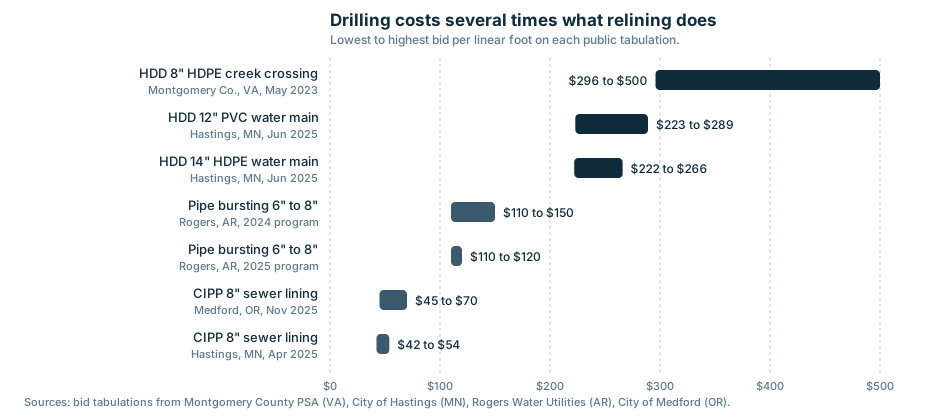
Three things stand out. First, the Montgomery County tab puts HDD and open cut side by side for the same 8-inch HDPE main: $130 to $140 a foot in the trench, $296 to $500 a foot under the creek. Trenchless is not cheaper per foot of pipe; it is cheaper than the permit, the restoration, and the lane closure a trench would have cost at that crossing. Second, the 24-inch casing bore on the Hastings tab, where one bidder priced $200 and another $3,047.55 for the same 125 feet, is what an unbalanced bid looks like from the outside: somebody expected to make the money elsewhere, and somebody else priced the risk of a rock ledge. Third, the engineer's estimates on the Rogers tabs dropped from $281.25 in 2023 to $130.00 a year later, a sign the utility's engineer had started reading its own bid history.
For a design-side cross-check, the City of Hayward, California's 90 percent-design Engineer's Opinion of Probable Construction Cost, prepared by HydroScience Engineers in March 2022, carried 8-inch sewer at $360 per foot open cut and $240 by pipe bursting, 12-inch at $540 open cut and $360 by bursting, 15-inch at $675 open cut and $450 by bursting, and 8-inch CIPP lining at $160 per foot. Those are Bay Area estimates, not bids, and they ran two to three times the Arkansas and Minnesota bid prices, which is the usual gap between a West Coast engineer's contingency-laden estimate and a competitive Midwestern letting.
Rigs, Crews, and the People Who Call 811
The rigs
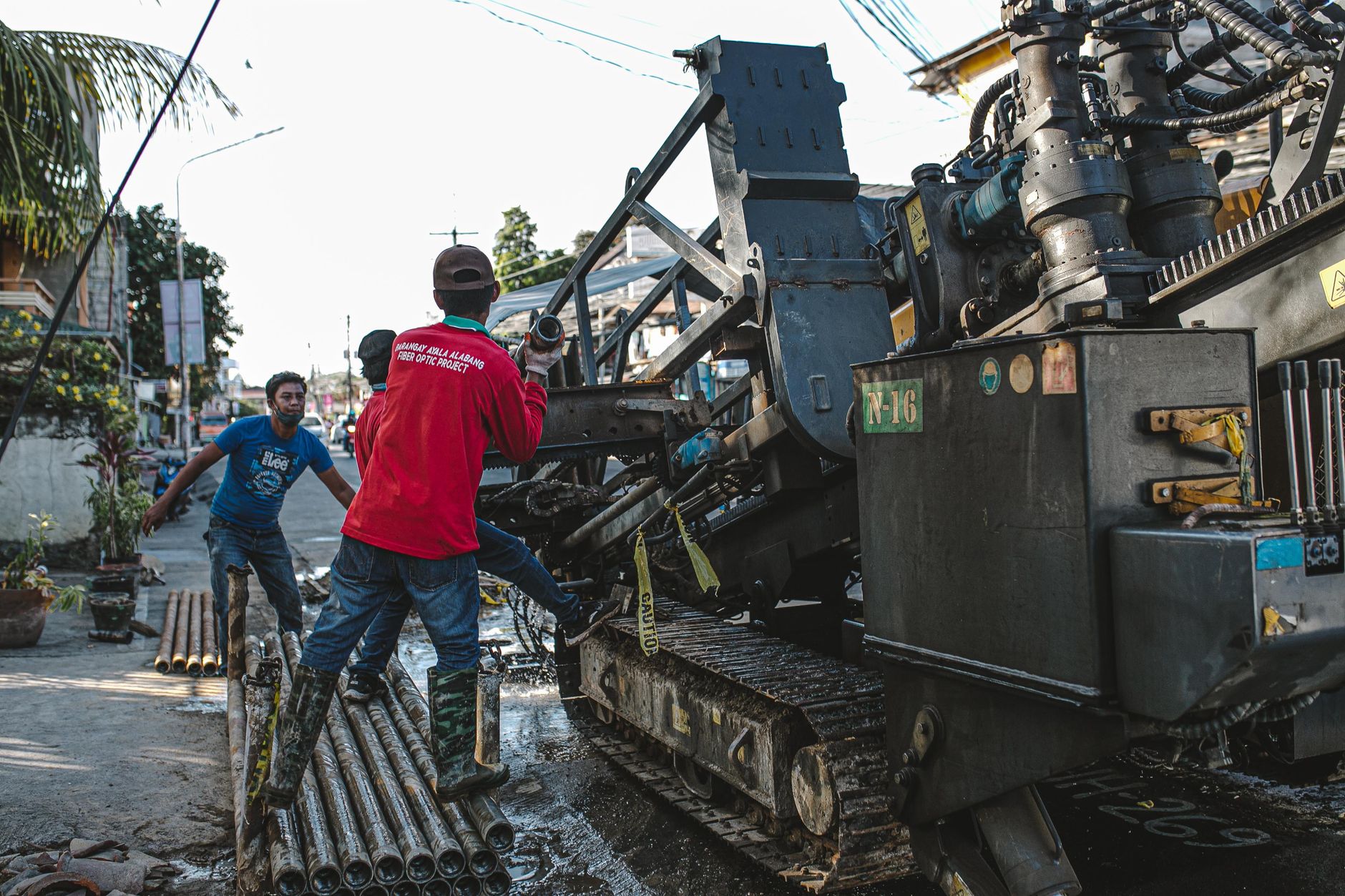
The industry sorts HDD rigs by pullback. Underground Construction's annual large-rig census has used the same threshold for years: a large rig is one with "a minimum pullback force greater than 100,000 pounds," per its 2017 edition, and the 2015 census counted 283 such rigs among North American contractors, led by Michels Directional Crossings with 25 and topping out at a 1,700,000-pound machine at Laney Directional Drilling. At the top of the catalog today, Vermeer's D550 spec sheet (September 2025) lists 550,000 pounds of thrust and pullback, 100,000 foot-pounds of spindle torque, a 599-horsepower Caterpillar C18, and an operating weight of 95,000 pounds without the vise. The utility-contractor workhorse is an order of magnitude smaller: Ditch Witch's JT40, as Construction Equipment reported at its February 2017 launch, carries 40,000 pounds of thrust and pullback, 5,500 foot-pounds of torque, a 160-horsepower Cummins, and 600 feet of pipe on board. The difference between those two machines is the difference between a fiber drop down a residential street and a 36-inch gas line under the Mississippi.
The crews
A small HDD crew is three or four people: a rig operator, a locator walking the bore path with a receiver over the sonde, and one or two laborers on the mud system and the pipe string, with an excavator operator opening the pits. A maxi-rig river crossing is a different operation: a drilling superintendent, operators on the rig and the mud plant, a steering engineer reading a wireline or gyro survey tool rather than a walkover locator, pipe fusion crews building the string, side booms holding it in the air during pullback, and an environmental monitor walking the alignment for returns. Microtunneling crews split between the surface control container, the separation plant, the crane and the shaft, and pipe bursting crews are an excavation crew with a hydraulic bursting unit added. Name-brand contractors on the tabs cited above are instructive: SAK Construction, Insituform, Visu-Sewer, Hydro-Klean, and Iron Horse on the lining jobs; Horseshoe Construction and Bennett on the bursting program; CRS Contractors on the Bergen County microtunnel. Lining and bursting are specialty markets with a short bidder list, and the same five or six names show up on tabs from Oregon to Minnesota.
Locating, and what goes wrong when it is skipped
Every one of these methods starts with a locate request. The Pipeline Safety Improvement Act of 2002 required a national three-digit call-before-you-dig number, the FCC designated 811 for it on March 10, 2005, and the Common Ground Alliance and U.S. Transportation Secretary Mary Peters launched the number nationally on May 1, 2007; a Roads & Bridges report from March 2005 noted that the state one-call centers then handled 15 million to 20 million calls a year. The underlying problem has not gone away. CGA's 2024 DIRT Report, released in August 2025, reviewed nearly 197,000 damage reports and traced 24.54 percent of damages to failure to notify 811, 16.07 percent to excavators failing to maintain clearance after marks were verified, 11.94 percent to facilities not marked because of locator error, and 8.58 percent to inaccurate marks; it also found excavators faced a 38 percent chance of delay from incomplete locate responses.
For a trenchless crew the stakes are specific. An HDD head cannot see the gas service it is about to cross, the sonde depth reading is only as good as the calibration, and a bursting head will split whatever is in its way. Most trenchless specs, Albany's included, make the contractor responsible for locating and exposing every crossing utility by potholing before the pilot goes under it, and for all damage to anything the bore touches. The CGA numbers say the single most common way to wreck a job is to not have asked.
Failure modes worth a line in the estimate
Frac-outs are the public failure, and the one that brings the state environmental agency. The private ones are hydrolock, when a stalled pullback lets the hole close on the pipe and the string has to be cut and abandoned; a pilot that misses tolerance and has to be redrilled at the contractor's cost, which the Albany spec explicitly allows the engineer to order; a bursting head that stalls on a repair clamp or concrete encasement nobody recorded; a CIPP liner that wrinkles or fails to cure because the resin was out of its temperature window; and, for microtunneling, a boulder the cone crusher cannot pass or a shaft that floods. Every one of those is a geotechnical surprise in disguise, which is why the series' deep-foundations installment and this one end in the same place: the boring logs, the pay items for obstructions, and the differing-site-conditions clause decide who pays.
Where the Work Is
Water utilities facing the lead service line replacement mandate are using small HDD rigs and bursting heads to pull new services without tearing up every front yard; the aging mains behind the $26 billion-a-year water main break problem are the next market for HDD-installed HDPE. Sewer authorities with consent decrees bid CIPP programs by the tens of thousands of feet every spring. Broadband is the volume play for compact rigs. And every one of those owners posts its bid tabulation.
Frequently Asked Questions
How much does trenchless pipe installation cost per foot?
It depends entirely on method and diameter, and only a bid tab is honest about it. On 2025 public tabulations, 8-inch CIPP lining ran $42.25 to $70.00 per foot (Hastings, Minnesota, April 2025; Medford, Oregon, November 2025), 6-to-8-inch pipe bursting $110 to $120 (Rogers, Arkansas, 2025 program), and directionally drilled 14-inch HDPE water main $222 to $266 (Hastings, June 2025). An 8-inch HDPE creek crossing by HDD drew $295.91 to $500 per foot on a May 2023 Montgomery County, Virginia tab where the same pipe in a trench was $130 to $140.
Is HDD cheaper than open cut?
Not per foot of pipe. The Montgomery County tab above shows HDD at two to four times the open-cut price for the same 8-inch main. HDD wins where a trench is impossible or where restoration, traffic control, and environmental permitting would cost more than the bore premium, which is why it is used for crossings and dense streets rather than for whole mains in open ground.
What is a frac-out?
An inadvertent return: drilling fluid escaping the bore to the surface, a waterway, or a structure because annular pressure exceeded what the ground could hold. Municipal HDD specs such as Albany, Oregon's ST-23-01 Appendix B require continuous pressure and flow monitoring, containment materials on site, and cleanup at the contractor's expense.
What is the difference between microtunneling and HDD?
HDD steers a fluid-assisted pilot bore from the surface and pulls flexible pipe back through a reamed hole; it is for pressure pipe and conduit, with exit-point tolerances measured in feet. Microtunneling, under ASCE/CI 36, jacks rigid pipe behind a remote-controlled, laser-guided, slurry-pressurized machine from shaft to shaft; it holds grade to about an inch, which gravity sewers require.
What standards govern trenchless pipe installation?
ASTM F1962-25A for maxi-HDD of polyethylene pipe; NASTT's HDD Good Practices Guidelines, fifth edition; ASCE/CI 36 for microtunneling; NASTT's Pipe Bursting Good Practices Guidelines, third edition (2019), and the IPBA Guideline for Pipe Bursting (2012); and ASTM F1216 for inversion CIPP. State one-call law and 811 notification apply to all of them.
Who installs trenchless pipe?
Specialty contractors with a short bidder list. On the tabs cited here: SAK Construction, Insituform, Visu-Sewer, Hydro-Klean, and Iron Horse for lining; Horseshoe Construction and Bennett for bursting; CRS Contractors for microtunneling; and general utility contractors such as A-1 Excavating, Ryan Contracting, and S.M. Hentges self-performing or subcontracting the HDD alternates on water main jobs.
Your Action Item for This Week
Pull the last three lining, bursting, or water main tabulations your nearest city or county posted and build a per-foot table by method and diameter, with the engineer's estimate in its own column. Where the estimate sits above every bid, as Rogers' did in 2023, the owner is still learning its market and the second-year bid will be tighter. Then check live solicitations on Buildermuse for "directional drill," "CIPP," "pipe bursting," and "microtunnel" to see what is on the street now.
More from the How It Gets Built desk
Edited by Ray Kowalski, Methods & Machines desk. New teardowns weekly.