Part of "How It Gets Built" — Buildermuse's series on the machinery behind modern construction.
Every bridge pier, high-rise core, and 345 kV monopole in the country stands on something nobody will ever see again, and its price was set by a soil boring log drilled months before the contractor showed up. Drilled shaft cost per foot on recent Texas DOT bid tabulations runs from about $190 per linear foot for a 30-inch shaft under a light pole to $412 per linear foot for a 48-inch bridge shaft, and the same diameter can double between two counties because one has rock at 20 feet and the other at 90. Driven steel H-piles on New York Thruway tabs go for $40 to $50 per foot furnished, plus $20 to $46 per foot to drive on comparable New Jersey work. The spread between those numbers is the entire business of deep foundations.
Estimates built on Deep Foundations Institute and ADSC (the International Association of Foundation Drilling) data put annual U.S. deep foundation demand at roughly $4 billion across more than 800 specialty contractors. This article covers how the four main systems get chosen, how a shaft and a pile actually get built, what each costs per foot, and why the geotechnical report decides whether anyone makes money.
Four Ways to Reach Bearing
The choice among drilled shafts, driven piles, continuous flight auger (CFA) piles, and micropiles comes down to the soil profile, the load per element, whether the neighbors will tolerate vibration, how much room the rig has, and what the local contractor base builds cheaply.
Drilled shafts (caissons)
A drilled shaft is a hole bored with a rotary rig, filled with a rebar cage and concrete, and sized from 18 inches to 12 feet in diameter. FHWA's Drilled Shafts manual, Geotechnical Engineering Circular No. 10 (FHWA-NHI-18-024), is the reference the U.S. industry designs and inspects against. Shafts win when one element must carry a very large load, when bearing is on rock a driven pile would refuse against before design depth, and when vibration is unacceptable; a single 8-foot shaft socketed into rock replaces a dozen piles and their cap. The weakness is that a shaft is only as good as the hole, and the hole is invisible.
Driven piles
Driven piles — steel H-sections, steel pipe, and prestressed precast concrete — are manufactured off site and hammered in. The quality control is the driving record: every blow is counted, and capacity can be verified on the spot. Piles are the default in soft coastal soils and on highway bridges where DOTs hold decades of local driving data. They lose when rock is shallow, when overhead clearance is limited, and when anyone nearby owns a building with plaster walls.
CFA piles and micropiles
A CFA pile is drilled with a continuous hollow-stem auger and grouted through the stem as the auger withdraws, then a cage is pushed into the wet column. No open hole, no casing, no slurry, so production is fast, and CFA has become the workhorse of warehouse, mid-rise, and data center foundations in the Southeast and Mid-Atlantic. Its limits are diameter (rarely above 36 inches), depth (rig torque runs out near 100 feet), and quality that rests on automated grout-volume monitoring rather than anything an inspector can see. A micropile is a 5- to 12-inch drilled and grouted element with a high-strength bar at its center; per Deep Foundations Institute data, micropiles have grown to about 18 percent of deep foundation contractor revenue on retrofit and underpinning work where a full-size rig cannot fit. They are the most expensive per ton of capacity.
| System | Typical diameter | Typical depth | Best soil fit | Vibration | Capacity per element |
|---|---|---|---|---|---|
| Drilled shaft | 24 in to 12 ft | 30 to 250 ft | Rock socket, hard clay, mixed strata | Very low | 500 to 5,000+ tons |
| Driven H-pile / pipe pile | HP 10 to HP 14; 12 to 42 in pipe | 30 to 150 ft | Soft clay, sand, end bearing on dense layer | High | 50 to 300 tons |
| Precast concrete pile | 12 to 30 in square | 30 to 120 ft | Coastal sands, soft marine clay | High | 60 to 250 tons |
| CFA / auger cast | 12 to 36 in | 30 to 100 ft | Sand, silt, stiff clay without cobbles | Very low | 50 to 400 tons |
| Micropile | 5 to 12 in | 20 to 150 ft | Anything, including rubble and rock | Low | 30 to 200 tons |
Vibration often decides it in cities. Caltrans' Transportation and Construction Vibration Guidance sets 0.5 inches per second peak particle velocity as the limit for structurally sound modern buildings, with tighter thresholds for historic ones. An impact hammer can exceed that within 50 to 100 feet in some soils, which is why Manhattan, Boston, and Seattle are shaft and CFA towns while rural interstate bridges remain pile-driving country.
How a Drilled Shaft Gets Built
Drilling and holding the hole
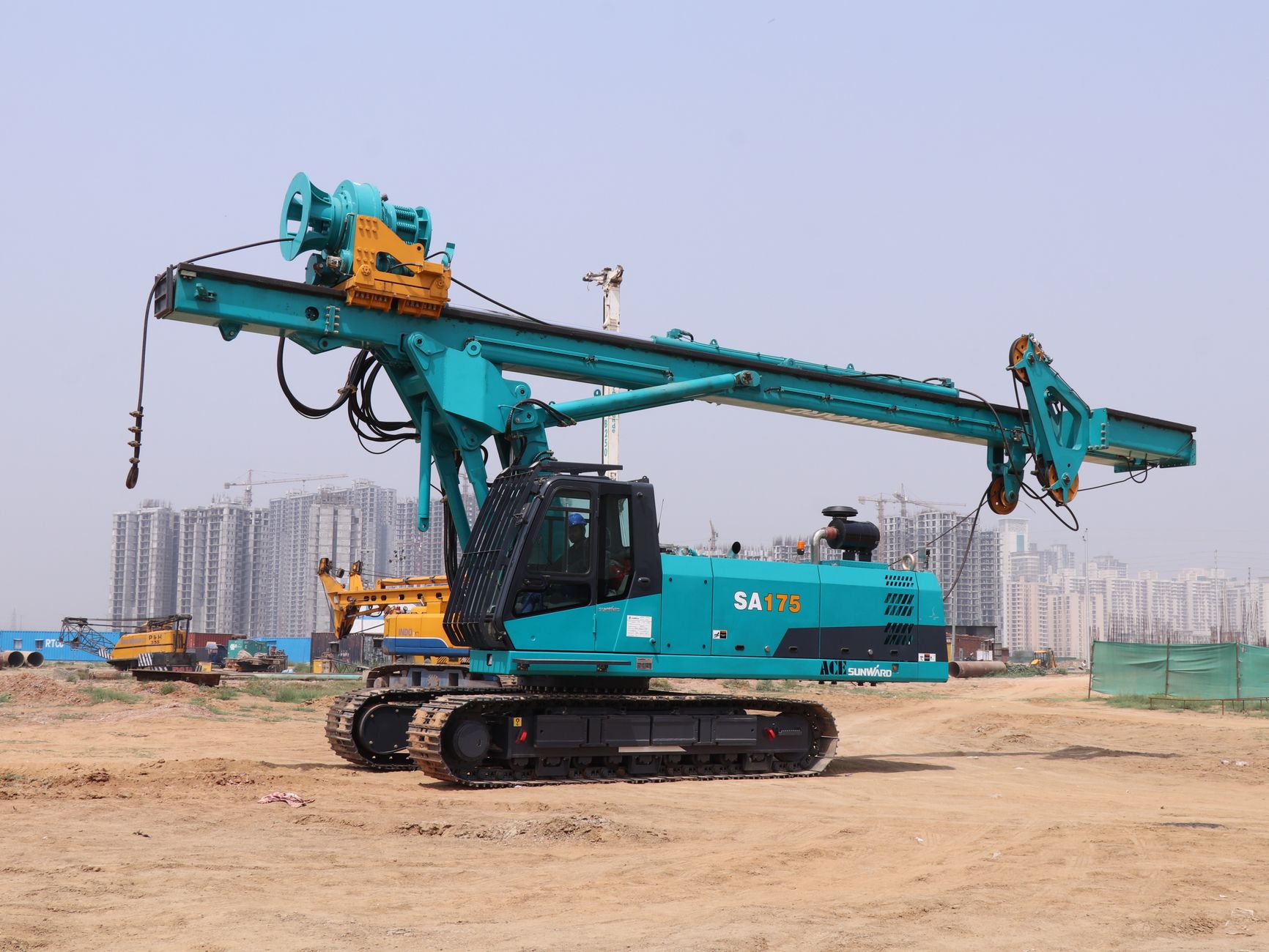
The rig — a Bauer BG, Soilmec, Liebherr, or Watson with 150,000 to more than 400,000 foot-pounds of torque — advances with a soil auger, then a rock auger or core barrel as strata change. In dry cohesive soil the hole stands open. In anything else, the contractor oscillates temporary steel casing down ahead of the drilling or fills the hole with bentonite or polymer slurry to hold the walls. GEC 10 and most DOT specifications require slurry to test out before concrete — density under about 1.15 grams per cubic centimeter, sand content under 4 percent at the base — because sand settling on the bottom is the most common reason a shaft fails its load test.
Cleanout, cage, and tremie
The base is cleaned with a bucket or airlift until the owner's inspector confirms no more than about half an inch of sediment over half the base, the GEC 10 benchmark. The rebar cage — 30 to 60 tons of steel on a large bridge shaft, with CSL tubes tied inside — is set with the service crane, and concrete goes in through a tremie, an 8- to 12-inch pipe kept buried 5 to 10 feet in the rising concrete so the mix never touches slurry. A 7-foot by 150-foot shaft takes about 215 cubic yards, 20-plus trucks on a continuous schedule, because a tremie pour cannot stop.
Integrity testing
Crosshole sonic logging (CSL, ASTM D6760) sends an ultrasonic pulse between pairs of water-filled tubes; a delay flags a void or soil inclusion. Thermal integrity profiling (TIP, ASTM D7949) reads hydration heat through wires on the cage during the first 24 to 48 hours; cold spots mean missing concrete, and the method also shows cage position and cover, which CSL cannot. An Illinois DOT study (FHWA-ICT-22-013) found the two comparable in cost, on the order of a few thousand dollars per shaft.
How a Driven Pile Gets Built
Hammers, driving, refusal, and cutoff
Diesel impact hammers are ubiquitous on DOT bridge work; hydraulic hammers run quieter with controlled energy; vibratory hammers run a pile into sand quickly but cannot prove capacity, so an impact hammer finishes the drive. Before driving, a wave equation analysis (GRLWEAP is the industry standard) shows the hammer can reach the required capacity without overstressing the pile. The inspector then records blows per foot, and per inch near the end, against a driving criterion such as 240 tons nominal resistance at 10 blows per inch with a named hammer and stroke. Practical refusal is typically 10 to 20 blows per inch over several consecutive inches; drive harder and you damage the pile. H-piles come in 40- to 60-foot lengths and are spliced in the leads when the ground runs deeper, which is why DOT pay items separate "furnish" from "drive" and carry a splice item; when a pile makes capacity above planned cutoff, the extra is burned off.
Load testing
A pile driving analyzer (PDA, ASTM D4945) bolts strain gauges and accelerometers to the pile head and reads force and velocity on every blow; a CAPWAP analysis turns that into static capacity. An Ohio DOT program review found dynamic testing cost the department about 2 percent of total pile cost per year, and the confirmation lets designers use a higher LRFD resistance factor and fewer or shorter piles. Static load tests (ASTM D1143), where a reaction frame and jacks load a pile to twice design, remain the gold standard and typically run $50,000 to $150,000 each based on published DOT project costs. For big shafts, the Osterberg cell (ASTM D8169), a hydraulic jack cast into the shaft that pushes up and down against the shaft itself, is the only practical way to prove 3,000 or 5,000 tons; Iowa State University's Institute for Transportation puts an O-cell test at roughly $100,000.
What Deep Foundations Cost Per Foot
The unit prices below come from public bid tabulations and contractor-published ranges. They are ranges because the 48-inch shaft that bids at $300 per foot in dry Dallas clay bids at $700 through a slurry hole into Austin limestone.
| Element | Furnished and installed, per linear foot | Source basis |
|---|---|---|
| Drilled shaft, 30 in | $190 to $300 | TxDOT 2025 tab ($188.81/LF); Collin County tabs |
| Drilled shaft, 36 in | $110 to $300 | TxDOT ($247.20/LF); Collin County ($108 to $175/LF) |
| Drilled shaft, 48 in | $300 to $775 | TxDOT ($412/LF); other Texas tabs $620 to $775/LF in rock |
| Drilled shaft, 72 to 96 in, rock socket | $800 to $2,500+ | Contractor and DOT ranges; highly site dependent |
| Steel H-pile, HP 14x89 | $40 to $55 furnished, plus $20 to $46 to drive | NY Thruway and NJDOT 2024 to 2025 tabs |
| Steel pipe pile, 42 in | $200 to $330 furnished | NJ Turnpike Authority 2026 tab |
| Prestressed concrete pile, 14 to 24 in | $60 to $150 | DOT bid ranges, Southeast and Gulf |
| CFA pile, 12 to 18 in | $20 to $60 | NJ tabs ($51 to $190/LF for 18 in); ADSC-published ranges |
| CFA pile, 30 to 36 in | $60 to $120 | Contractor-published ranges |
| Micropile, 7 to 10 in | $150 to $350 | Oregon DOT bids ($154 to $240/LF, 2007 to 2008) escalated; WSDOT tabs |
Three things to read out of that table. First, per foot is not per ton: a 72-inch rock-socketed shaft at $1,500 per foot carrying 3,000 tons is cheaper per ton than an H-pile at $90 per foot carrying 150. Second, mobilization is its own line: moving a 150-ton rig with oscillator and a 275-ton service crane onto a site runs $50,000 to $250,000 depending on distance and whether a barge is involved, and a pile crane with leads and hammer runs $25,000 to $100,000. Rigs in the Bauer BG 40 class rent for roughly $2,000 to $5,000 per day bare per dealer and rental listings, and contractors who own them quote all-in crew-and-rig rates of $12,000 to $25,000 per shift. Third, testing is its own budget: two O-cell tests, CSL on every shaft, and a full-time third-party inspector can add 5 to 10 percent to a bridge foundation line.
Production rates drive the price
Texas DOT's published production rates span about 33 to more than 200 linear feet of shaft per day depending on diameter and ground; a crew on 36-inch shafts in dry clay finishes four to six a day, while a crew on 8-foot slurry shafts into rock finishes one every two to three days. Malcolm Drilling has published a program of 7-foot shafts to 145 feet running two Bauer BG 50 rigs with oscillators at up to 10 shafts per week; Keller has published a shallow dry-hole program of 244 shafts in 29 working days. Driven piles move faster: one crane and hammer on 60-foot H-piles typically drives 8 to 15 piles per shift, or 500 to 900 feet per day, and CFA rigs routinely place 20 to 40 piles a day. The estimator's question is not what the hole costs but how many days the rig sits at $15,000 each.
The Geotechnical Report Is the Bid
Every number above is conditional on a report the owner commissioned from borings spaced 100 to 300 feet apart. The contractor bids on those borings, and what happens when the ground between them is different is the main thing a deep foundation contract is about.
Unit price versus lump sum
Public agencies bid deep foundations by the unit — dollars per linear foot of shaft or pile, with separate items for test piles, splices, rock sockets, obstructions, and load tests — and pay on measured quantity. If rock comes in 15 feet shallower than the borings suggested, the quantity underruns and the contractor spreads its fixed cost over fewer feet, which is why standard DOT specifications include a renegotiation trigger when a major item varies more than 25 percent from plan. Private owners and design-builders prefer lump sum, which pushes the risk onto the specialty sub, who responds by pricing a contingency, writing a geotechnical baseline into the proposal (the ASCE Geotechnical Baseline Report framework was built for tunnels and is increasingly borrowed for foundations), and demanding separate pay items for obstructions and rock.
Differing site conditions
On federal work, FAR 52.236-2 entitles the contractor to an equitable adjustment when subsurface conditions differ materially from what the contract indicated (Type I) or from what is normally encountered in that kind of work (Type II), provided notice is given before the condition is disturbed. Most state DOT and AIA-based contracts carry an equivalent clause. The practical rules are simple and often ignored: keep a daily log for every shaft or pile recording strata, water, and tooling changes, and send written notice the day the ground changes. The case law is full of contractors who hit a boulder field, kept drilling at a loss for a month, and lost on notice. Driven pile contracts manage the uncertainty with test piles driven ahead of production to set order lengths; shaft contracts use a technique shaft, built with the production method, to prove slurry, cleanout, and tremie procedure before the first real pour.
Who Does the Work, and Where It Is
The contractors and the labor
Keller North America, the U.S. arm of London-listed Keller Group, ranked first in ENR's deep foundations category on the 2025 Top 600 Specialty Contractors list, with $1.38 billion in reported 2023 revenue; it folded Hayward Baker, Case Foundation, and McKinney Drilling into one name in 2020 and reported North American revenue up about 5 percent in 2025 against a 2 percent decline in the broader U.S. construction market, with 120 data center projects completed that year. Malcolm Drilling, privately held in San Francisco, ranked second at $573 million. Berkel & Company dominates auger cast work in the Southeast and Midwest; Nicholson Construction anchors the Northeast; Schnabel Foundation, Condon-Johnson, Anderson Drilling, and dozens of regional firms fill out the field. Heavy-civil generals such as Kiewit and Traylor often self-perform pile driving on bridges but subcontract large shafts.
Two union crafts split the field work. Pile drivers are chartered under the United Brotherhood of Carpenters — Pile Drivers Local 34 in the Bay Area, Local 56 in Boston, Local 2375 in Los Angeles — and handle rigging, setting, splicing, and cutting. Rig and crane operators belong to the Operating Engineers. The Bureau of Labor Statistics' May 2024 Occupational Employment and Wage Statistics put pile driver operators (SOC 47-2072) at a national median of $33.90 per hour, with the 90th percentile at $121,990 a year, and counted only 3,040 of them nationwide. Prevailing wage runs higher: Ohio's 2025 carpenter pile driver rate is $37.98 base plus $28.84 fringe, $66.82 total, and Northern California determinations for pile drivers and rig operators land in the $90 to $120 per hour fully loaded range.
Where the work is
Bridges are the steadiest demand: the IIJA replacement wave covered in our tracker of every major bridge project in the U.S. puts shafts or piles under nearly every pier. Data centers are the fastest-growing segment, as the concrete and foundation demands of hyperscale campuses push owners toward CFA piles and rammed aggregate piers by the thousand; Michels has published a Missouri hyperscale job with 10,940 aggregate piers. Transmission is the sleeper: drilled pier foundations under a 345 kV or 500 kV monopole run 5 to 12 feet in diameter and 20 to 60 feet deep per the Department of Energy's environmental review for the North Plains Connector line, and a single line carries thousands of them. Every substation dead-end structure sits on a drilled pier too.
Frequently Asked Questions
How much does a drilled shaft cost per foot in 2026?
Public bid tabulations put 30- to 36-inch shafts at roughly $110 to $300 per linear foot, 48-inch shafts at $300 to $775, and large rock-socketed bridge shafts of 6 to 8 feet at $800 to $2,500-plus.
Are driven piles cheaper than drilled shafts?
Per linear foot, yes: an HP 14x89 furnished and driven runs $60 to $100 per foot against several hundred for a shaft. Per ton of capacity, often not, because one large shaft replaces many piles and their cap. Piles also lose where rock is shallow and where vibration limits such as Caltrans' 0.5 inch per second PPV guideline rule out an impact hammer.
What is the difference between CSL and TIP testing?
Crosshole sonic logging (ASTM D6760) sends ultrasonic pulses between access tubes after the concrete cures and finds anomalies inside the cage. Thermal integrity profiling (ASTM D7949) reads hydration heat during the first one to two days and evaluates the full cross-section, including cover outside the cage. Illinois DOT found their costs comparable; many agencies accept either.
How many drilled shafts can a crew build in a day?
Small shafts in dry cohesive soil run four to six per day per rig. Large slurry or oscillated shafts into rock run one every one to three days. Texas DOT's production guidance spans roughly 33 to 200-plus linear feet per day.
What is a differing site conditions claim?
On federal contracts, FAR 52.236-2 gives an equitable adjustment when subsurface conditions differ materially from the contract documents (Type I) or from normal conditions for that work (Type II). Recovery depends on written notice before the condition is disturbed and on daily logs documenting what changed.
Who installs deep foundations?
Specialty contractors: Keller North America (ENR's top deep foundations firm in 2025), Malcolm Drilling, Berkel & Company, Nicholson, Schnabel Foundation, and a large regional field. Crews are union pile drivers from Carpenters locals and operating engineers on rigs and cranes.
Your Action Item for This Week
Pull the last three bid tabulations your state DOT posted for bridge projects with drilled shaft or pile items and build a spreadsheet of unit prices by diameter and pay item. Compare the low bidder's foundation prices against the second and third; the spread tells you who read the boring logs. Then check live solicitations on Buildermuse for "drilled shaft," "pile," and "foundation" to see what is on the street now. The contractors winning this work price the geotech report, not the plan quantity.
More from the How It Gets Built desk
Edited by Ray Kowalski, Methods & Machines desk. New teardowns weekly.