Part of "How It Gets Built" — Buildermuse's series on the machinery behind modern construction.
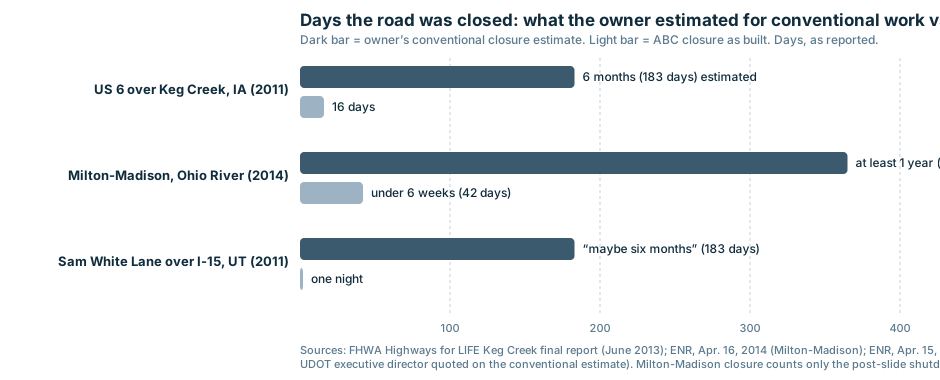
Just after 11 p.m. on Saturday, March 26, 2011, a 354-foot bridge started rolling across eight lanes of Interstate 15 in American Fork, Utah, riding on four trains of 24 axles each. It traveled about 500 feet and was set on its abutments around 4 a.m., three hours ahead of UDOT's estimate, according to ENR's April 15, 2011 account of the Sam White Lane move. UDOT's executive director at the time, John Njord, told ENR the point was closing the freeway for one night rather than "maybe the six months" a traditional replacement would take.
That trade is the whole of accelerated bridge construction. The bridge itself is ordinary: steel or concrete girders, a deck, two abutments. What changes is where it is built and how long the road underneath is closed. This article covers why state DOTs pay for the method, what the methods actually are, how an SPMT move and a lateral slide run hour by hour, what UHPC does at the joints, who is on the crew, and what the public record says the method costs against conventional work. Every figure comes from the FHWA case files, DOT releases, and trade coverage cited in the sentence that carries it.
Why Owners Pay to Close the Road for a Weekend Instead of a Year
FHWA's accelerated bridge construction program page (last updated April 13, 2021) defines ABC as bridge construction that uses "innovative planning, design, materials, and construction methods" to reduce the onsite construction time of building, replacing, or rehabilitating bridges. The same page states that roughly one-fourth of the nation's 600,000 bridges need rehabilitation, repair, or replacement, and that the direct and indirect costs of detours during a conventional replacement can exceed the cost of the structure itself. FHWA sorts projects into mobility impact tiers running from Tier 1, traffic affected within a day, to Tier 6, an overall schedule cut by months or years.
The federal push came through Every Day Counts. According to FHWA's PBES research page (last modified August 6, 2018), the EDC initiative began in October 2010, and by the time that page was written, 40 states, the District of Columbia, Puerto Rico, and all three Federal Lands Highway divisions had elected to put prefabricated bridge elements and systems into their programs, with more than 600 bridges designed or built with PBES. The same page cites an FHWA cost study finding that PBES combined with innovative contracting saved $30 million across nine bridge replacement projects. FHWA's EDC-2 ABC page (last modified March 8, 2018) says DOTs using the methods "can replace bridges within 48 to 72 hours."
The user-cost arithmetic is easiest to see on a small job. FHWA's Highways for LIFE final report on the US 6 bridge over Keg Creek in Pottawattamie County, Iowa (June 2013) records a road with 3,890 vehicles a day, 9 percent trucks, and a 21-mile detour. The report values truck time at $25.67 per hour in 2011 work-zone road user cost terms and an average detour of 24.67 minutes per vehicle, which works out to $674,215 in commercial delay cost over a 183-day conventional closure versus $58,948 over the 16-day ABC closure. On a rural two-lane road, the delay differential alone was $615,267. On the I-93 corridor in Medford, Massachusetts, which MassDOT's presentation to an FHWA work-zone peer exchange (June 2012) put at 200,000 vehicles per day, the same arithmetic runs to numbers that make the construction premium look small.
The IIJA bridge wave covered in our tracker of every major bridge project in the U.S. is where most of this work is headed: thousands of short- and medium-span replacements on roads that cannot be closed for a season.
The Methods, and When Each Gets Chosen
ABC is a family of techniques, not one. FHWA's EDC-2 ABC page (March 2018) describes PBES as structural components built offsite or adjacent to the alignment, and slide-in bridge construction as a new bridge built on temporary supports parallel to the existing one, then slid into place after the old structure is demolished or moved aside. FHWA's Manual on Use of Self-Propelled Modular Transporters to Remove and Replace Bridges (FHWA-HIF-07-022, sponsored by FHWA, AASHTO, NCHRP, and the Florida DOT) covers the third approach: build the whole superstructure off the alignment, lift it on computer-steered transporters, and drive it in.
| Method | What it is | Where it fits | Closure pattern |
|---|---|---|---|
| Prefabricated elements (PBES) | Precast decks, pier caps, columns, abutments, full-depth deck panels, modular girder-and-deck units | Any bridge where an onsite pour schedule is the bottleneck; stackable with the other methods | Staged, nights, or weekends |
| Lateral slide | New span built on temporary falsework beside the old one, then jacked sideways onto the permanent substructure | Room exists alongside the alignment; substructure can be reused or built under traffic | One weekend, typically Friday night to Monday morning |
| SPMT move | Superstructure built in a staging area, carried by self-propelled modular transporters to the piers | A haul route exists; staging land is available; bridge weighs up to several thousand tons | Hours overnight to one weekend |
| GRS-IBS | Geosynthetic-reinforced soil abutments with closely spaced reinforcement; the superstructure sits directly on the mass | Low-volume single-span crossings | Days to weeks, no closure-window engineering needed |
GRS-IBS belongs in the list because FHWA's EDC-2 page (March 2018) calls it 25 to 60 percent more cost effective than conventional construction, a claim FHWA makes for no other ABC method. For the rest, FHWA's own framing is that the method must be judged against delay-related user costs, not construction cost alone.
The choice among slide, SPMT, and staged precast is mostly a question of real estate. A slide needs a strip of ground beside the bridge for falsework and a straight push onto the permanent bearings. An SPMT move needs a haul path with grades and turns the transporters can handle, which is why so many moves happen on wide freeway rights-of-way like I-15. When neither exists, as under an urban interchange, the owner falls back to precast elements set by crane in night closures. Cianbro's account of the I-295 Veranda Street replacement in Portland, Maine (April 3, 2023) shows the choice being made on safety as much as geometry: the team considered a lateral slide with slide jacks and chose SPMTs because building the span closer to the ground and farther from live traffic was safer for the crew.
How an SPMT Move Runs, Hour by Hour
A self-propelled modular transporter is a platform trailer with hydraulically steered and leveled axle lines, run from a handheld controller. FHWA's SPMT manual (FHWA-HIF-07-022) sets the minimum specification a DOT should write: each axle line with at least 25 to 30 tons of capacity depending on unit width, units either 8 feet wide with four wheels per axle or 10 feet wide, axle spacing no more than 5 feet, and loaded travel at no less than 3 miles per hour. The modern fleet runs well above that floor; Scheuerle's maker, TII Group, lists its SPMT at up to 60 tonnes per axle line, and Mammoet's Ludo Mous told KHL that full capacity is not always usable because the resulting tire pressure can exceed what the ground will bear. The manual's executive summary promises traffic impacts of "minutes to a few hours" against the months of conventional onsite construction.
The move itself is the shortest part of a long sequence. Before the weekend:
- The superstructure is built complete on temporary supports in a staging area, deck poured, barriers set, and often paved, so the bridge that rolls in is the bridge the public drives on Monday.
- The permanent abutments and piers are finished under traffic, with bearings set and surveyed.
- The haul path is graded, compacted, and proof-rolled, because ground bearing is the limit on axle loading, and any utility crossing is bridged with mats or plate.
- A mock lift confirms the transporter arrangement, the jacking frames, and the deflection the span will see when picked at points it was never designed for.
On the Sam White Lane move, ENR (April 15, 2011) reports the sequence that followed: I-15 was closed on a Saturday night, the SPMT trains of Belgium-based Sarens lifted the 354-foot bridge just after 11 p.m., drove it about 500 feet across the freeway, lowered it onto the abutments, and had it set around 4 a.m., with UDOT having estimated 7 a.m. The general contractor was Provo River Constructors, a joint venture of Fluor, Ames Construction, Wadsworth Brothers, and Ralph L. Wadsworth, on the $1.1 billion I-15 CORE reconstruction; the design and move team included HDR, Jacobs, Baker, and Sarens.
The Veranda Street job shows the same choreography on an older interstate. MaineDOT's March 5, 2021 release lists an $18.1 million construction contract with Cianbro and a total of about $20.8 million including engineering, with a planned 60-hour closure of I-295. Cianbro's April 3, 2023 account says the highway closed at 7 p.m. on Friday, April 22, 2022, 17 excavators started demolition, Mammoet's remote-controlled SPMTs rolled the new bridge in, and traffic resumed four hours before the 7 a.m. Monday deadline. RIDOT's August 22, 2024 release on the $85 million Cranston Canyon project describes the same model on a smaller span: the 230-foot, 2.5-million-pound Providence Street Bridge demolished and replaced over the weekend of August 16, with SPMTs scheduled for the Route 37 to I-295 ramp bridge under closures running Friday 8 p.m. to Monday 5 a.m.
How a Lateral Slide Runs
A slide swaps transporters for jacks. The new span is built on falsework parallel to the old one, at final elevation, often with the permanent substructure extended sideways to carry it. On the weekend, the old superstructure is cut free and either demolished in place or slid out onto its own falsework, the bearings are prepared, and the new span is pushed or pulled sideways on Teflon-and-stainless slide shoes or rollers.
Speed is slow and deliberate. CT Public's October 19, 2023 report on the I-95 Saugatuck Avenue replacement in Westport, Connecticut, describes crews working around the clock from Friday night toward a 6 a.m. Monday reopening, with the span taking nearly a full hour to move three feet. CTDOT spokesperson Josh Morgan put the alternative plainly: "Instead of 12 months of congestion and lane closures, we are packing it into two weekends," one for each direction.
The biggest slide on record in North America was the Milton-Madison bridge over the Ohio River between Kentucky and Indiana. ENR's April 16, 2014 report says Walsh Construction's design-build team, with Buckland & Taylor and Burgess & Niple, slid a 30-million-pound, 2,428-foot, four-span steel truss 55 feet laterally in one piece on April 10, 2014, on a $104 million project, with Michael Baker as construction manager for co-owner INDOT; the full bridge with approaches ran 3,181 feet. The crossing was closed for less than six weeks, against at least a year under conventional methods. ENR's January 21, 2015 profile of Walsh project manager Charlie Gannon records that the pull was done with strand jacks. Strand jacks and synchronized hydraulic push-pull jacks are the two standard drives; both are run from a central control that keeps every jacking point within a tolerance of its neighbors so the span moves square.
The bid math on a slide is heavy on temporary works. Falsework to carry a full span at grade, slide tracks, jacks, the extended substructure or temporary piers, and the demolition sequence are all paid for by the owner whether the bridge is 100 feet or 2,400, which is why the method was priced at a premium by the Vermont Agency of Transportation when it planned two I-91 slides over U.S. 5 in Hartford, Vermont. VTDigger's May 28, 2014 story (from the Valley News) quotes VTrans's Kristin Higgins estimating lateral slide construction "could cost 10 percent to 20 percent more" than conventional replacement, at about $3 million per bridge, $6 million total, with PCL Construction building and weekend detours running from 6 p.m. Friday to early Monday.
Weekend Swaps at Scale: 93 Fast 14
The project that convinced Northeast DOTs the method could be industrialized was MassDOT's 93 Fast 14. FHWA's Focus newsletter for October 2011 (FHWA-HRT-12-007) describes the $98 million design-build job replacing 14 bridges on I-93 in Medford over 10 weekends between June and August 2011, with closures beginning at 8 p.m. Friday and I-93 reopened by 5 a.m. Monday, rapid-setting concrete at the closure pours, a $1 million Highways for LIFE grant, and three years cut from a conventional schedule. MassDOT's June 2012 presentation to FHWA's work-zone peer exchange adds the operating detail: notice to proceed on February 7, 2011, a 55-hour construction window, I-93 held to two lanes each direction through the weekend, two reserve weekends held as float, no work on the July 4 weekend, and a conventional alternative estimated at a minimum of four years in as many as five stages. Dewberry, the designer, describes the modular units as two steel girders with a precast concrete deck, set whole.
ENR's November 14, 2011 report names the contractor as J.F. White-Kiewit, a joint venture of J.F. White Contracting and Kiewit Construction, on a $98.1 million design-build contract that allowed a 55-hour closure over 12 summer weekends; the team used 10, started construction June 3, and had earned $6.9 million of an expected $7 million in schedule incentives by the time of the story. That is the commercial engine of ABC on a busy interstate: the owner prices the closure window and pays the contractor to give hours back.
UHPC: The Joint That Makes Precast Behave Like a Pour
Prefabrication only works if the joints between elements are at least as good as the elements. Conventional grouted or cast-in-place closure pours need long lap splices and wide pockets, which defeats the point of a precast deck. Ultra-high performance concrete changed that. FHWA's Design and Construction of Field-Cast UHPC Connections TechNote (FHWA-HRT-19-011, February 2019) defines UHPC as a fiber-reinforced, portland cement-based composite with a water-to-cementitious-materials ratio below 0.25, compressive strength above 21.7 ksi (150 MPa), and sustained post-cracking tensile strength above 0.72 ksi (5 MPa). The design guidance in it applies to deformed bars No. 8 and smaller embedded in UHPC with 2 percent steel fiber by volume, and it defines 14 ksi (97 MPa) as the strength at which a connection can take early construction loads, so a joint poured Saturday can carry traffic before the full strength arrives.
The TechNote reports that since 2006 nearly 300 bridges in North America have been built with field-cast UHPC connections joining precast elements, and that a 2012 field review of more than 40 of them in Ontario, Iowa, and New York found the connections performing well. The common steel fiber is a straight high-strength wire with a specified minimum tensile strength of 290 ksi, produced domestically since 2013. Precast faces at the joint get an exposed-aggregate finish for bond; the material arrives as a proprietary or non-proprietary premix, is mixed in high-shear mixers on site, and flows into narrow pockets without vibration.
The Keg Creek report (FHWA, June 2013) shows what that looks like on a crew: the contractor worked long shifts filling pier and deck joints with UHPC, built a custom wooden funnel to place the mix into narrow joints over crowded reinforcing, secured wood strips along both sides of each joint to contain the fluid mix, and had rehearsed on a mockup before the closure. The bridge was the first fully prefabricated bridge installed in Iowa and, per the report, in the United States.
Crews, Trades, and Equipment
An ABC weekend puts more trades on a bridge at once than any conventional pour. The demolition crew works with excavators and hydraulic breakers against the clock; Cianbro put 17 excavators on the Veranda Street demolition, per its April 2023 account. Ironworkers set precast elements and tie closure-joint reinforcing; pile drivers and carpenters strip falsework and set bearings; cement masons and laborers handle the UHPC pours; operating engineers run the cranes and, on a slide, the jacks; the heavy-haul specialist's own technicians run the SPMTs. Survey crews hold the span's line and grade through the move, and the DOT's inspectors sign off the bearings before anyone pours. Behind them are the traffic control contractor, state police, and the public-information staff who run the 511 alerts, all working to the same hour-by-hour plan.
The equipment that defines the method belongs to a short list of specialists. SPMT fleets in North America are concentrated in Mammoet, Sarens, and a handful of domestic heavy-haul firms, which is why the same names appear on bridge moves from Utah to Maine. Strand jacks and synchronized hydraulic systems for slides come from the same heavy-lift world. The precast comes from regional PCI-certified plants, and the general contractors that have built a track record are the heavy-civil firms that already self-perform bridge work: Walsh, Kiewit, Cianbro, PCL, and the regional contractors on state DOT prequalification lists. The foundations under all of it are the same drilled shafts and driven piles covered in our deep foundations article, with the difference that ABC pushes owners toward precast pier caps and columns set on them.
What ABC Costs Against Conventional, From the Record
The honest answer is that the construction cost is usually higher and the total cost, with user delay counted, is usually lower, and the public record has only a few projects where both numbers were worked out.
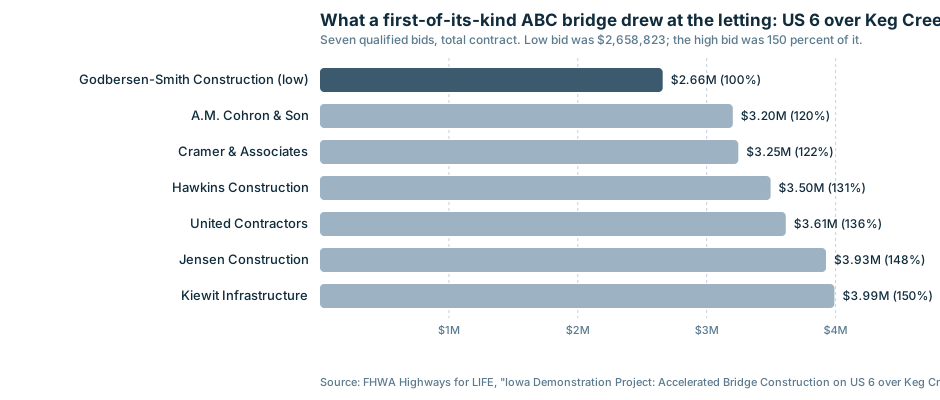
The best-documented is Keg Creek. FHWA's June 2013 Highways for LIFE report lists seven qualified bids, from Godbersen-Smith Construction's low bid of $2,658,823.35 to Kiewit Infrastructure's $3,990,723.50, 150 percent of the low. The bridge portion alone bid at $2.3 million, which the report calls "essentially double the estimated cost of a similar three-span conventional bridge." The as-built contract total of $2,680,823 compared with a $1,511,530 estimate for the conventional baseline, a $1,169,293 construction premium; the Iowa DOT offset part of that with a $400,000 Highways for LIFE grant and $250,000 from SHRP 2. Counting user costs, the report concludes the project saved road users about $0.44 million, roughly 29 percent less than conventional construction. The contractor earned one day of incentive pay, $22,000, after the DOT extended the 14-day closure to 16 for a post-tensioning retrofit.
The other data points are coarser. Vermont's 10 to 20 percent slide premium (VTDigger, May 2014) is an owner's planning estimate. The $30 million saved across nine PBES projects (FHWA PBES page, 2018) is a program-level study. Fast 14's $98.1 million and $7 million in incentives (ENR, November 2011) tell you what MassDOT was willing to pay to compress four years into one summer, not what a conventional job would have bid. FHWA's slide-in program page (updated May 16, 2024) links a Slide-In Bridge Construction Cost Estimation Guidelines document and an Excel estimating tool developed with UDOT for exactly this comparison. Read those, then pull your own state's bid tabs for the temporary-works items that separate ABC from conventional: falsework, jacking, SPMT mobilization, UHPC by the cubic yard, and the incentive/disincentive clause.
The same tension plays out at the top of the market. The Brent Spence corridor and the other megaprojects in our tracker are staged conventionally because a river crossing of that size cannot be prefabricated whole, but their approach spans and the interstate work around them are where PBES and night closures show up in the bid documents.
Specs and Standards
AASHTO's LRFD Guide Specifications for Accelerated Bridge Construction, 1st edition, was released October 25, 2018, per AASHTO's 2018 editorial calendar and the AASHTO Journal's October 26, 2018 announcement, which describes it as compiling recommended design and construction specifications for prefabricated bridge elements and systems. It grew out of the NCHRP report Recommended AASHTO Guide Specifications for ABC Design and Construction, published by the National Academies Press in 2018, whose chapters cover design specification development and construction specification development; AASHTO's bridge committee adopted the recommended specifications at its 2017 annual meeting, according to ABC-UTC's event listing for its 2020 training webinar on the document. The FHWA companion manuals are Engineering Design, Fabrication and Erection of Prefabricated Bridge Elements and Systems (FHWA-HIF-17-019) and Contracting and Construction of ABC Projects with Prefabricated Bridge Elements and Systems (FHWA-HIF-17-020), both linked from FHWA's ABC page. For UHPC joints, the governing document is FHWA-HRT-19-011 (February 2019), which superseded FHWA-HRT-14-084; the first field-cast UHPC connection on a U.S. bridge, on Route 31 in Lyons, New York, is documented in FHWA-HRT-12-038 (April 2012).
The research hub is the Accelerated Bridge Construction University Transportation Center at Florida International University. Iowa State's InTrans announced on October 28, 2013 that the center had been established that year under a two-year, $2,828,200 USDOT grant, led by FIU with Iowa State's Bridge Engineering Center and the University of Nevada, Reno as partners. ABC-UTC runs the monthly webinar series and the project database that most DOT engineers use to find a comparable job before they write a closure window into a contract.
Frequently Asked Questions
What is accelerated bridge construction?
FHWA defines ABC as bridge construction that uses innovative planning, design, materials, and construction methods to reduce the onsite construction time of building, replacing, or rehabilitating bridges (FHWA ABC program page, updated April 2021). In practice it means prefabricated elements, lateral slides, and SPMT moves that compress months of road closure into nights or weekends.
How long does an SPMT bridge move take?
The move itself takes hours. ENR reported (April 15, 2011) that the 354-foot Sam White Lane bridge over I-15 in Utah was lifted just after 11 p.m. and set by about 4 a.m. Cianbro's Veranda Street replacement on I-295 in Maine closed the highway at 7 p.m. Friday, April 22, 2022 and reopened it before the 7 a.m. Monday deadline, about 60 hours including demolition (Cianbro, April 3, 2023).
Does ABC cost more than conventional bridge construction?
In construction cost, usually yes. FHWA's June 2013 Keg Creek report put the as-built contract at $2,680,823 against a $1,511,530 conventional estimate, with the bridge portion essentially double. Counting user delay, the same report found the ABC approach saved about $0.44 million, roughly 29 percent. Vermont's VTrans estimated lateral slides at 10 to 20 percent more than conventional (VTDigger, May 2014).
What is UHPC and why is it used in ABC joints?
Ultra-high performance concrete is a steel-fiber-reinforced cement composite with compressive strength above 21.7 ksi and post-cracking tensile strength above 0.72 ksi, per FHWA-HRT-19-011 (February 2019). Its bond lets precast elements be connected with short, narrow field-cast joints that can carry construction loads at 14 ksi; nearly 300 North American bridges have used the detail since 2006.
What is the AASHTO standard for ABC?
The AASHTO LRFD Guide Specifications for Accelerated Bridge Construction, 1st edition, released October 25, 2018. It is paired with FHWA's PBES design manual (FHWA-HIF-17-019) and contracting manual (FHWA-HIF-17-020) and, for joints, FHWA's UHPC connections TechNote (FHWA-HRT-19-011).
What was the largest lateral bridge slide in North America?
The Milton-Madison bridge over the Ohio River: a 30-million-pound, 2,428-foot four-span steel truss slid 55 feet on April 10, 2014 by Walsh Construction's design-build team on a $104 million project, per ENR (April 16, 2014).
Your Action Item for This Week
Pull one ABC bid tabulation from your state DOT, ideally a lateral slide or SPMT job, and isolate the pay items that would not exist on a conventional bridge: temporary falsework and slide tracks, jacking systems, SPMT mobilization, UHPC closure pours, and the incentive/disincentive schedule. Then do the user-cost arithmetic the way FHWA did it at Keg Creek: AADT, truck share, detour minutes, and days closed. If the delay dollars dwarf the premium, you have the owner's reasoning; if they do not, you have a question to ask at the pre-bid. Check live solicitations on Buildermuse for "bridge replacement," "accelerated," and "precast" to see which agencies are writing closure windows into contracts right now.
More from the How It Gets Built desk
Edited by Ray Kowalski, Methods & Machines desk. New teardowns weekly.