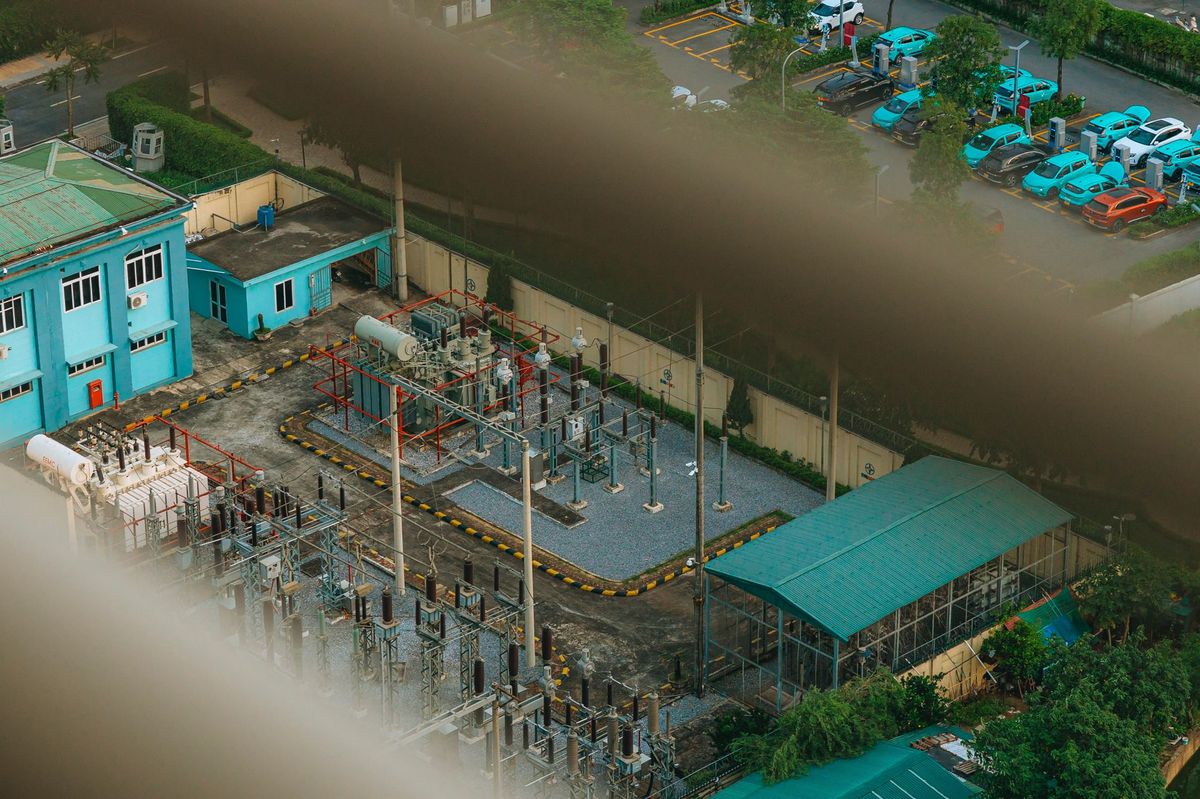
Part of "How It Gets Built" — Buildermuse's series on the machinery behind modern construction.
The single longest-lead item on a substation project is a steel tank full of oil and copper that now takes up to four years to arrive. The U.S. Department of Energy's 2024 supply chain assessment put large power transformer (LPT) lead times at 120 to 210 weeks — roughly two and a half to four years — up from 50 weeks in 2021. Prices for those units climbed 60 to 80 percent over the same window. Every other line item on a substation schedule now organizes itself around that one purchase order, and every contractor in the niche has learned to read a transformer delivery date the way a farmer reads a weather forecast.
That matters because the country is about to build substations at a pace it hasn't attempted since the 1970s. Lawrence Berkeley National Laboratory's "Queued Up" report counted roughly 2,600 gigawatts of generation and storage capacity waiting in interconnection queues at the end of 2023 — about twice the entire installed capacity of the existing U.S. grid. Nearly every one of those projects needs at least one new substation or a major expansion of an existing one. This article tears down what these projects cost, the sequence they follow, who does the work, and why the trade contractors who learn this niche now will be busy for a decade.
What a Substation Actually Costs
Substation construction cost is one of the most opaque numbers in heavy construction, partly because utilities rarely publish itemized budgets and partly because "substation" covers everything from a rural 5-MVA distribution yard to a 500 kV switching station the size of eight football fields. The ranges below come from utility rate filings, FERC Form 1 data, and published EPC cost studies.
Distribution substations: $5 million to $15 million
A typical distribution substation — stepping transmission voltage (usually 69 kV or 115 kV) down to distribution voltage (12.47 kV or 34.5 kV) — runs $5 million to $15 million turnkey. The apparatus tells the story: a 20-MVA power transformer that cost roughly $800,000 in 2020 now quotes at $1.4 million to $1.6 million, per DOE's supply chain data. Add $300,000 to $600,000 per circuit breaker bay, $1 million to $2 million in protection and control equipment, and $1.5 million to $3 million in civil and structural work, and the budget fills up fast. On a per-MVA basis, distribution substations land between $250,000 and $500,000 per MVA of transformation capacity.
Transmission substations: $20 million to $50 million and up
A 230 kV or 345 kV transmission substation starts around $20 million and climbs past $50 million without much effort. A single 345/138 kV autotransformer bank can exceed $8 million delivered — before the 18 months of foundations, firewalls, and oil containment built to receive it. Gas-insulated switchgear (GIS) substations, which compress the footprint by roughly 70 percent for urban sites, carry a 30 to 50 percent equipment premium over conventional air-insulated designs. The Electric Power Research Institute and utility filings put 500 kV stations at $75 million to $150 million-plus depending on breaker count and land work.
Where the money goes, line by line
Across voltage classes, the cost stack is remarkably consistent. Major apparatus — transformers, breakers, switchgear — absorbs 35 to 45 percent of the budget. Electrical construction labor takes 40 to 50 percent of the field cost. Civil work (grading, drainage, foundations, the ground grid) runs 15 to 20 percent. Steel erection is 5 to 10 percent. Testing and commissioning claims 3 to 5 percent, which sounds small until you realize it's the last 3 to 5 percent, performed under the most schedule pressure, by the scarcest labor on the project. For a deeper look at why these numbers keep moving, see our earlier coverage of substation construction cost escalation.
The Build Sequence: Six Phases, 18 to 36 Months of Field Work
The field schedule for a substation is 18 to 36 months, but the project timeline is longer — often 5 to 7 years from utility planning approval to energization, with equipment procurement now the pacing item. Here is the sequence once shovels hit dirt.
Phase 1: Civil and grading (months 1–4)
The site gets cleared, graded to a 1 to 2 percent drainage slope, and compacted to 95 percent Proctor density. The buried copper ground grid — often 10,000 to 40,000 feet of 4/0 bare copper conductor on a 10-to-20-foot mesh, exothermically welded at every intersection — goes in before anything else, because IEEE Standard 80 step-and-touch-potential limits govern the entire yard design. At current copper prices near $4.50 per pound, the ground grid alone can be a $250,000 to $700,000 line item on a transmission station. Oil containment for the transformers — concrete pits sized per the Spill Prevention, Control, and Countermeasure rule at 40 CFR Part 112 — is poured in this phase.
Phase 2: Foundations (months 3–7)
A transmission substation can require 80 to 200 separate concrete foundations: drilled piers for dead-end structures resisting 20,000 to 50,000 pounds of conductor tension, spread footings for breakers and switches, and a massive mat — sometimes 4 to 6 feet thick with 100-plus cubic yards of concrete — under each transformer. Foundation tolerances are tight; NEMA and manufacturer specs typically demand anchor bolt placement within 1/8 inch, because a 230 kV breaker does not get field-modified to fit a misplaced bolt pattern.
Phase 3: Steel erection (months 6–9)
Galvanized lattice and tubular steel structures — dead-end A-frames, bus supports, equipment stands, static masts for lightning shielding — get erected by ironworker crews, typically 100 to 400 tons of steel per transmission station. This is the fastest phase and the cheapest per dollar of budget, but it gates everything electrical behind it.
Phase 4: Major apparatus setting (months 8–14)
The transformer arrives on a Schnabel railcar or a 20-axle hydraulic platform trailer, weighing anywhere from 100,000 to 400,000 pounds, and gets jacked-and-slid or crane-set onto its pad over one to three days. Then it sits for weeks of assembly: radiators, bushings, conservator tank, and vacuum oil filling — a 200-MVA unit holds 10,000 to 15,000 gallons of mineral oil that must be processed to under 10 parts per million moisture. Breakers, switches, instrument transformers, and surge arresters set in parallel.
Phase 5: Protection and control (months 10–20)
The control house — usually a prefabricated building delivered at $300,000 to $1 million — gets populated with protective relay panels, SCADA remote terminal units, batteries, and communications gear. Wireman crews then pull and terminate the yard's nervous system: 20,000 to 100,000-plus individual conductor terminations connecting every device in the yard back to the relays. This phase employs the most electricians for the longest stretch and produces the most punch-list items, at roughly zero visual progress per week from the owner's fence line.
Phase 6: Testing and commissioning (months 18–24)
Independent testing firms — typically accredited by the InterNational Electrical Testing Association (NETA) — verify every piece of apparatus against manufacturer and ANSI/NETA ATS acceptance criteria: insulation power factor on the transformer, timing tests on breakers, current-injection tests through every relay. A transmission substation commissioning package can run 2,000-plus discrete tests. NETA-certified technicians bill $150 to $250 per hour and are booked out months in advance; a failed transformer test at this stage can add six figures and half a year.
The Transformer Crisis Is the Schedule
No teardown of substation construction is honest without dwelling on the transformer problem, because it has inverted how these projects are planned.
The numbers, per DOE and NERC
DOE's 2024 assessment found LPT lead times of 120 to 210 weeks and distribution transformer lead times that jumped from 2–4 months pre-2020 to 1–2 years. Roughly 80 percent of large power transformers installed in the U.S. are imported, with domestic capacity meeting only about 20 percent of demand. The constraint underneath the constraint is grain-oriented electrical steel — the specialized core material — which has exactly one domestic producer, Cleveland-Cliffs' operation in Butler, Pennsylvania. The North American Electric Reliability Corporation (NERC) has flagged transformer availability as a reliability risk in consecutive reliability assessments, noting that the average age of installed U.S. LPTs is 40-plus years against a 40-year design life.
What it means on the ground
Utilities now order transformers before engineering is finished — sometimes before siting is final — and design the substation around whatever unit they can secure. Contractors see the effects directly: projects bid with owner-furnished apparatus and contractor-installed scopes, schedules with 12-month gaps between civil completion and apparatus setting, and liquidated-damages clauses rewritten because nobody will guarantee a date a factory in South Korea controls. Some utilities are paying 25 to 40 percent premiums for slot reservations at manufacturers. For field contractors, the practical takeaway is that mobilization dates slip but scopes don't shrink — and standby, remobilization, and phased-completion terms belong in every bid.
Who Does the Work — and Who Awards It
The trade breakdown
Electrical contractors carry the largest scope, 40 to 50 percent of field cost: bus work, equipment connections, grounding, conduit and cable trench, control wiring, and terminations. On utility work this is heavily union territory — IBEW outside construction agreements — with journeyman lineman and substation technician packages running $90 to $130-plus per hour fully loaded in most markets. Civil contractors take grading, drainage, foundations, and containment at 15 to 20 percent of cost. Ironworkers erect the steel. NETA testing firms close out the job. Specialty niches orbit the core trades: transformer assembly crews, oil processing outfits, relay technicians, and heavy-haul riggers who charge $100,000 to $500,000-plus to move a single transformer the last 50 miles.
The award structure
Three buyer types dominate. Investor-owned utilities award through master service agreements (MSAs) — multi-year alliance contracts where two to five prequalified contractors receive a program of stations rather than one-off bids; getting onto an MSA is the whole game, and prequalification (safety record, OSHA rates, bonding, utility references) takes 6 to 18 months. Second, EPC firms — Burns & McDonnell, Black & Veatch, Kiewit, Quanta Services subsidiaries — take turnkey scope on large transmission programs and subcontract civil and specialty work; Quanta alone reported over $9 billion in annual electric infrastructure revenue. Third, and fastest-growing: private developers. Data center operators increasingly fund and build dedicated substations — a single hyperscale campus can demand 300 MW to 1 GW, equivalent to several transmission substations — and they procure like commercial clients, faster and with fewer prequalification hurdles than utilities. Our teardown of the top 20 data center construction contractors shows how much of that spend flows through firms that barely touched utility work five years ago.
Note the wage rules: utility-owned work on private land generally follows the MSA's labor terms, but substations tied to federally funded transmission projects, DOE grid resilience grants, or public power agencies trigger Davis-Bacon prevailing wage requirements under 40 U.S.C. § 3141–3148. IRA-era energy projects claiming full tax credits also carry prevailing wage and apprenticeship requirements under Internal Revenue Code Section 45(b)(7). Bid the wrong wage determination and the margin is gone before the ground grid is in.
Why this is the decade's steadiest niche
The demand math is hard to argue with. EIA projects U.S. electricity consumption to hit record highs through 2026 and beyond, driven by data centers, manufacturing reshoring, and electrification. LBNL's 2,600-GW queue won't all get built — historical completion rates run near 20 percent — but even a fifth of it implies hundreds of new substations. NERC forecasts summer peak demand growth of over 130 GW over the next decade, a tenfold acceleration from the 2010s. Meanwhile the existing fleet is aging out on schedule: those 40-year-old transformers need replacement regardless of whether a single new data center breaks ground. Substation work is the rare niche with both a growth story and a replacement story, and the labor pool — linemen, substation wiremen, relay techs, NETA technicians — is short in every region.
Frequently Asked Questions
How much does a substation cost to build in 2026?
Distribution substations run $5 million to $15 million; transmission substations run $20 million to $50 million and up, with 500 kV stations exceeding $75 million. On a capacity basis, expect $250,000 to $500,000 per MVA for distribution-class work. Equipment — led by the transformer — is 35 to 45 percent of the total.
Why do transformers take so long to get?
DOE data puts large power transformer lead times at 120 to 210 weeks. About 80 percent of U.S. LPTs are imported, domestic factory capacity covers only about 20 percent of demand, and grain-oriented electrical steel has a single domestic producer. Demand from grid expansion and fleet replacement is rising faster than manufacturing capacity.
How long does substation construction take?
Field construction runs 18 to 36 months depending on voltage class and scope. The full project cycle — planning, permitting, procurement, construction, commissioning — now runs 5 to 7 years, with equipment procurement typically the pacing item rather than field labor.
Which trades get the biggest share of a substation project?
Electrical contractors carry 40 to 50 percent of field cost, followed by civil at 15 to 20 percent, steel erection at 5 to 10 percent, and testing/commissioning at 3 to 5 percent. Specialty scopes — transformer assembly, oil processing, heavy haul, NETA testing — are small in dollars but critical-path in schedule.
Do substation projects pay prevailing wage?
It depends on the funding. Federally funded transmission work and public power projects carry Davis-Bacon requirements, and IRA tax-credit projects require prevailing wage and apprenticeship compliance under IRC Section 45(b)(7). Investor-owned utility MSA work follows the agreement's labor terms, which in most regions means IBEW scale.
How do contractors get into substation work?
Two main doors: utility MSA prequalification (expect 6 to 18 months of safety, bonding, and reference vetting) or subcontracting to EPC firms like Burns & McDonnell, Black & Veatch, and Quanta subsidiaries on large programs. Data-center-driven private substations offer a third path with commercial-style procurement and faster award cycles.
Your Action Item for This Week
Pull the interconnection queue for your state's regional grid operator (each ISO/RTO publishes it free) and count the projects within 100 miles of your shop — every one of them implies substation, civil, or line work that will bid within the next three years. Then search live federal and utility solicitations on Buildermuse for "substation," "switchyard," and "transformer" to see what's already on the street. The contractors winning this work in 2029 are the ones getting prequalified in 2026 — the transformer backlog guarantees the pipeline isn't going anywhere.
More from the How It Gets Built desk
Edited by Ray Kowalski, Methods & Machines desk. New teardowns weekly.