The Environmental Protection Agency's revised Lead and Copper Rule Improvements (LCRI), finalized in October 2024, mandate the replacement of all lead service lines in the United States within 10 years. With an estimated 9.2 million lead service lines still in use across the country, the rule creates one of the largest mandated construction programs in American history — a job that water utilities, construction contractors, and state governments estimate will cost $45 to $60 billion to complete.
The numbers tell a different story than the simplified "replace the lead pipes" narrative. Lead service line replacement (LSLR) is a complex construction operation involving property-by-property coordination with homeowners, trenchless and open-cut excavation in established residential neighborhoods with mature trees and landscaping, and navigating a patchwork of ownership structures that vary by state and municipality. Understanding the construction logistics is essential for contractors considering entry into this rapidly growing market segment.
The Scale: 9.2 Million Lines in 10 Years
According to EPA estimates used in the LCRI rulemaking, approximately 9.2 million lead service lines (LSLs) remain in use across the United States. These service lines — typically 3/4-inch to 1-inch diameter lead pipes — connect water mains in the street to individual buildings, running from the corporation stop at the main tap through the curb stop at the property line to the building's internal plumbing connection.
The geographic distribution is heavily concentrated in older cities in the Midwest and Northeast, reflecting the widespread use of lead pipe from the 1880s through the 1950s. States with the largest inventories include Illinois at 1.4 million (Chicago alone has 400,000), Ohio at 650,000, Michigan at 500,000, New York at 480,000, Pennsylvania at 400,000, New Jersey at 350,000, Wisconsin at 340,000, Indiana at 300,000, Missouri at 250,000, and Minnesota at 220,000.
These ten states account for roughly 4.9 million LSLs — over half the national total. This geographic concentration will create intense competition for underground utility construction workers in the Midwest and Northeast.
To meet the 10-year deadline (approximately 2034), utilities must replace an average of 920,000 service lines per year. The entire US water utility sector replaced approximately 250,000 to 350,000 service lines per year from 2020 to 2025, including both lead and non-lead replacements. The mandate requires a 3x to 4x increase in annual volume — an unprecedented ramp-up.
Construction Costs: The Per-Line Economics
Lead service line replacement costs vary significantly based on line length (typically 30 to 60 feet), depth below grade (4 to 6 feet in most jurisdictions), soil conditions, surface restoration requirements, and construction method.
Data compiled from utility LSLR programs nationwide shows an average full LSLR cost of $5,000 to $12,000 per line for both public and private sides. The median cost across all reported programs is $7,500 per line. Low-end replacements (short lines, favorable soil, no pavement restoration) come in at $3,000 to $4,000. High-end replacements (long lines, rock excavation, full concrete street restoration) can reach $15,000 to $25,000 or more.
The detailed cost breakdown for a typical full replacement includes excavation and pipe removal at $2,500 to $5,000 (40 to 50% of total), new copper or cross-linked polyethylene (PEX) service line installation at $1,000 to $2,000 (15 to 20%), surface and landscape restoration at $1,000 to $3,000 (15 to 25%), traffic control and safety at $300 to $800 (5 to 8%), permitting, inspection, and program administration at $500 to $1,500 (8 to 12%), and internal plumbing modifications at the building connection at $200 to $500 (2 to 5%).
At the national scale — 9.2 million LSLs at a weighted average of $6,000 to $8,000 per line reflecting programmatic efficiencies — the total construction cost reaches $45 to $60 billion over the compliance period. This makes LSLR one of the largest mandated categories of infrastructure construction spending in American history.
Open-Cut Excavation: The Workhorse Method
Open-cut excavation remains the most common LSLR method, used in approximately 70 to 80% of replacements. The process involves excavating a trench from the water main in the street to the building foundation, exposing the existing lead pipe along its full length, disconnecting and removing the lead pipe, installing new copper or PEX service line, making connections at the corporation stop and curb stop, backfilling and compacting the trench in controlled lifts, and replacing pavement, sidewalk, curbing, and landscaping.
A typical open-cut LSLR requires a trench 24 to 48 inches wide and 48 to 72 inches deep, extending 30 to 60 feet from the main to the building. In urban settings, this trench crosses sidewalks, tree lawns, driveways, and sometimes private gardens and patios — each requiring careful protection during excavation and meticulous restoration after installation.
The equipment spread for an open-cut LSLR crew typically includes a compact excavator (5 to 10 ton class) for trenching, a vacuum excavation truck for potholing near existing utilities, a skid steer for material handling and backfill, vibratory compaction equipment, a concrete saw for pavement cutting, and a dump truck for spoil removal. A well-organized open-cut crew of 4 to 6 workers can complete 3 to 5 replacements per day in favorable conditions.
Trenchless Methods: The Productivity Advantage
Trenchless LSLR methods — primarily pipe bursting, pipe pulling, and horizontal directional drilling — are gaining significant market share, particularly where surface restoration costs are high or surface structures limit open-cut access.
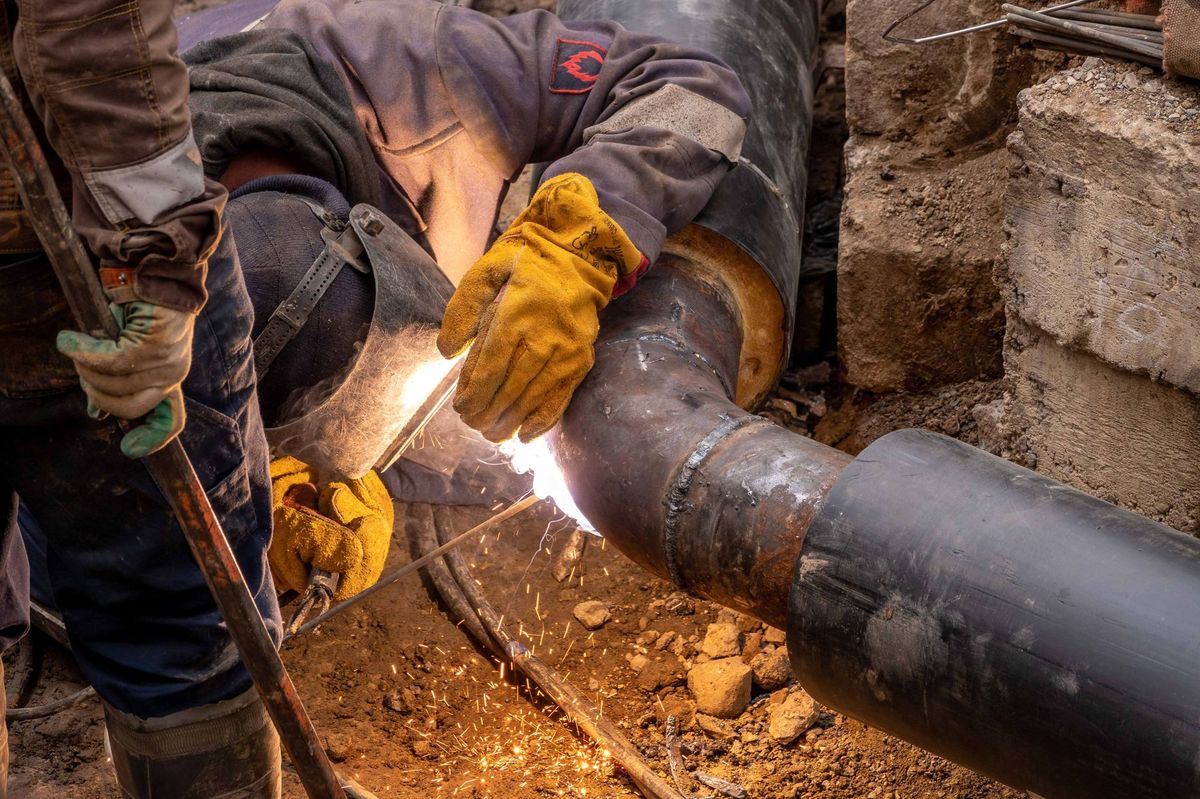
Pipe bursting involves pulling a bursting head through the existing lead pipe, fracturing it outward into the surrounding soil while simultaneously pulling new HDPE or copper pipe into the void created behind the bursting head. This method preserves existing surface features — sidewalks, driveways, landscaping — and can reduce total restoration costs by 50 to 70%. The equipment includes small-footprint pipe bursting machines ($25,000 to $60,000), access pit excavation equipment, and pulling cables and tooling.
Pipe pulling (also called static pull) removes the existing lead pipe by attaching a cable and pulling it out of the ground, then pulling new pipe through the existing soil path. This works well for straight, short service lines without significant bends, offsets, or fittings.
Horizontal directional drilling (HDD) is used less frequently for LSLR due to the short distances involved, but is valuable for crossings under driveways, roads, or other structures where surface disruption must be avoided.
Trenchless methods typically cost 10 to 20% more than open-cut for the pipe installation phase alone, but total project costs can be lower when surface restoration savings are factored in. In locations with expensive pavement restoration (concrete streets, brick sidewalks, mature trees with protected root zones), trenchless methods reduce total LSLR cost by 15 to 30% compared to open-cut. A skilled trenchless crew can complete 6 to 10 replacements per day — roughly double the open-cut rate — generating significant productivity advantages for programmatic LSLR contracts.
The Workforce Challenge
The required 3x to 4x increase in annual replacement volume demands a corresponding surge in qualified workers. AWWA estimates the LCRI mandate requires 45,000 to 65,000 additional construction workers dedicated to LSLR programs during peak years from 2027 to 2032.
Key workforce categories include underground utility operators at 15,000 to 20,000 additional needed, pipe fitters and plumbers at 8,000 to 12,000 additional, compact equipment operators at 5,000 to 7,000 additional, laborers for trenching, backfill, and restoration at 10,000 to 15,000 additional, and project coordinators for homeowner scheduling and logistics at 2,000 to 3,000 additional.
The geographic concentration of LSLs amplifies the challenge. Chicago with 400,000 LSLs needs sustained crews capable of replacing 40,000+ lines per year, requiring 600 to 800 dedicated workers in a single city. Newark, NJ demonstrated the feasibility of aggressive LSLR timelines by replacing 23,000 lines in under 3 years — but at peak, the program required over 200 workers focused solely on LSLR in a city of 300,000 people.
Funding: Mobilizing $45 to $60 Billion
Multiple funding sources are being assembled to pay for the national LSLR mandate. The EPA Drinking Water State Revolving Fund received $15 billion specifically for LSLR under the Bipartisan Infrastructure Law, including $11.7 billion in grants and forgivable loans for disadvantaged communities. Approximately $8 billion has been allocated to states, with $5.2 billion committed to utility programs.
The WIFIA loan program provides low-cost federal financing for large LSLR programs exceeding $100 million. ARPA funds contributed approximately $4 billion directed to water infrastructure. At least 18 states have dedicated LSLR funding programs providing $3 to $5 billion in state-level grants and loans. Utility rate increases are covering the remainder, with typical impacts of $5 to $15 per customer per month.
Market Strategy for Contractors
The LSLR mandate creates a distinct, durable market segment. Large utilities are shifting to multi-year program contracts — typically 3 to 5 years with annual replacement targets — providing revenue predictability for contractors who invest in dedicated crews and equipment. Chicago's program has awarded $400 million in zone-based contracts. Denver, Milwaukee, Pittsburgh, and dozens of other cities are establishing similar programmatic approaches.
Contractors investing in trenchless technology gain competitive advantages: higher daily productivity, lower surface restoration costs, and the ability to work in constrained urban environments where open-cut is impractical or prohibited. The equipment investment is modest — $100,000 to $200,000 for a complete trenchless LSLR spread — compared to the revenue potential of a multi-year program contract.
Quality requirements are significant. LSLR work involves handling lead-contaminated materials requiring EPA lead RRP compliance, working in occupied residential neighborhoods requiring strong customer service skills, OSHA trenching and excavation compliance (Subpart P), and post-replacement water sampling to verify lead reduction. Utilities increasingly require contractor-specific safety certifications and dedicated LSLR training programs before crews can begin work.
For construction firms, the LSLR mandate represents a $45 to $60 billion market sustained over a full decade. The work is steady, programmatic, recession-resistant, and funded through mandated regulatory compliance that utilities cannot defer or avoid. Contractors who establish LSLR capabilities now — trenchless equipment, trained crews, homeowner coordination processes, and utility program management relationships — will be positioned to capture predictable, well-funded work for the next ten years.
Case Study: Newark's Accelerated LSLR Program
Newark, New Jersey provides the most compelling case study for accelerated LSLR at scale. Following the 2019 discovery of elevated lead levels in the city's water supply, Newark launched an emergency LSLR program that replaced approximately 23,000 lead service lines in under 3 years — far exceeding the pace of any previous US LSLR program.
Key metrics from Newark's program: peak replacement rate of 800+ lines per month (approximately 40 per working day), average cost per replacement of $4,200 (below national averages due to standardized construction approach and competitive multi-contractor procurement), workforce of approximately 200 dedicated LSLR workers at peak, construction method mix of approximately 65% open-cut and 35% trenchless (pipe pulling), zero-cost to residents (fully funded through state and city sources), and water quality results showing significant lead level reductions at 12 months post-replacement.
Newark's success demonstrates that accelerated LSLR is technically feasible but requires dedicated program management, adequate funding, multi-contractor deployment, and strong community engagement to coordinate property access. The program serves as a blueprint for other cities facing large-scale LSLR mandates under the LCRI.
Material Supply Chain Considerations
LSLR programs require steady supply of copper tubing (Type K or Type L, typically 3/4-inch or 1-inch diameter), corporation stops and curb stops (brass or lead-free bronze), compression couplings and adapters, and backfill materials. Copper prices remain volatile, trading between $3.50 and $4.50 per pound in recent years. A typical 40-foot copper service line requires approximately 8 to 12 pounds of copper, making material costs sensitive to copper price fluctuations. Large LSLR programs negotiate annual supply agreements with copper distributors to manage price risk and ensure availability.
Emerging Technologies for LSLR
Several emerging technologies are being piloted to improve LSLR construction efficiency and reduce costs:
Machine Learning-Based Pipe Identification uses data from water quality testing, historical construction records, customer complaint patterns, and geographic information to predict which service lines are most likely to be lead, helping utilities prioritize replacements before physical verification. This technology reduces the number of unnecessary excavations at non-lead service lines — current field verification programs find that 10 to 30% of suspected lead service lines are actually copper, galvanized, or other materials when excavated, representing wasted construction effort.
Robotic Pipe Inspection using miniaturized crawlers with cameras and sensor arrays can inspect service line material from inside the water main without excavation. Companies like RedZone Robotics and Pure Technologies are developing inspection tools that can identify lead service line connections from main-line inspections, allowing utilities to map their lead inventory more accurately and avoid costly exploratory excavations.
Advanced Trenchless Methods continue to evolve. Pneumatic pipe bursting using high-frequency impact rather than static pull force can navigate bends and offsets that limit conventional pipe bursting. Pipe relining with spray-on structural coatings may eventually provide an alternative to full replacement for some service line conditions, though regulatory acceptance of lining as a permanent lead remediation solution remains uncertain.
Digital Project Management platforms designed specifically for LSLR programs are streamlining the customer coordination, scheduling, permitting, and quality documentation challenges that make LSLR programs operationally complex. These platforms integrate with geographic information systems (GIS), utility asset management databases, and customer communication tools to manage thousands of individual replacements as a coordinated construction program.
Health Equity and Environmental Justice Considerations
The LCRI includes specific provisions addressing environmental justice in LSLR construction. Disadvantaged communities — defined using the EPA's EJScreen tool or state-specific criteria — receive priority for LSLR construction scheduling and are eligible for enhanced funding through DWSRF principal forgiveness and LSLR-specific grant programs.
These provisions affect construction planning and execution. Contractors working in disadvantaged communities must often meet local hiring requirements (10 to 30% of workforce hours from target neighborhoods), provide community engagement and education services beyond standard construction notification, offer flexible scheduling to accommodate residents' work schedules for interior plumbing connections, and coordinate with lead hazard remediation programs addressing interior lead paint in addition to service line replacement.
Meeting these requirements adds 5 to 10% to program management costs but ensures that LSLR construction serves the communities facing the greatest lead exposure risks. For construction firms, demonstrating capability in community-responsive construction management is increasingly a competitive advantage in LSLR program procurement.
Frequently Asked Questions
How much federal funding goes to lead pipe replacement construction?
Federal and state data confirm that lead pipe replacement construction continues to be a major factor in 2026 construction planning. The latest available figure of $45 provides a useful baseline, though actual costs vary by region, project scope, and market conditions. Contractors should request updated quotes from suppliers and subcontractors before finalizing bids.
Which states benefit most from lead pipe replacement construction?
Regional analysis of lead pipe replacement construction reveals uneven distribution across U.S. markets. The data point of $60 billion highlights the scale of activity, with Sun Belt and high-growth metro areas generally leading in volume. Contractors expanding into new territories should evaluate local demand indicators before committing resources.
What is the timeline for lead pipe replacement construction projects?
Compared to prior periods, lead pipe replacement construction has moved significantly. Current data showing 400,000 indicates the direction of the market, and contractors who adjust their strategies accordingly will be better positioned for profitability. Monitoring monthly updates from BLS and Census Bureau data releases is recommended.