The Invisible Infrastructure
When people think about data center construction, they think about servers, cooling towers, and backup generators. They think about the electrical systems and the fiber-optic cables. Almost nobody thinks about the concrete. And that is a mistake, because the foundation systems underneath modern data centers are among the most demanding and expensive concrete installations in commercial construction — and they are getting bigger, heavier, and more complex with every generation of facility.
A hyperscale data center campus can consume 50,000 or more cubic yards of concrete — enough to pave about 15 miles of two-lane highway. Individual data hall slabs run 12 to 18 inches thick, reinforced with dense rebar mats on 6-inch to 8-inch centers, poured to tolerances that would make a highway contractor nervous. The generator yards alone can contain 5,000 to 10,000 cubic yards of heavily reinforced concrete, with each generator pad designed to support 30,000 to 50,000 pounds while isolating vibration frequencies that could damage sensitive computing equipment hundreds of feet away.
And the problem is getting worse. As data center power densities increase to support AI computing, the equipment gets heavier, the cooling infrastructure gets larger, and the foundation systems must grow to match. What was adequate five years ago is insufficient today, and the foundation designs being engineered for the next generation of hyperscale facilities push the boundaries of conventional concrete construction practice.
For concrete contractors, this represents a significant and growing market opportunity. For general contractors and project managers, understanding the unique requirements of data center foundation construction is essential for accurate estimating, effective scheduling, and successful project delivery.
Why Data Center Foundations Are Different
Data center foundations differ from those of conventional commercial buildings in several fundamental ways.
Floor Loading
The floor loads in a data center are dramatically higher than in a typical office building or even most warehouse and industrial facilities.
A standard office building is designed for live loads of 50 to 80 pounds per square foot (psf). A warehouse might be designed for 125 to 250 psf. A data center data hall, depending on the computing equipment configuration, must support live loads of 200 to 500 psf — and in some AI-focused facilities, individual areas may need to support loads exceeding 600 psf.
These loads are not uniformly distributed. Server racks concentrate enormous weight on small footprints — a fully loaded high-density computing rack can weigh 3,000 to 5,000 pounds supported by four leveling feet, each with a contact area of only a few square inches. Battery rooms are even more extreme, with lithium-ion battery cabinets weighing 6,000 to 10,000 pounds each, arranged in dense rows that create floor loads approaching 1,000 psf.
Supporting these concentrated loads requires thick slabs with dense reinforcement. While a conventional office building might have a 4 to 6 inch slab on grade with light rebar, a data center data hall typically requires a 12 to 18 inch slab with heavy rebar on 6 to 8 inch centers in both directions, often with supplemental reinforcement under equipment locations.
Flatness and Levelness
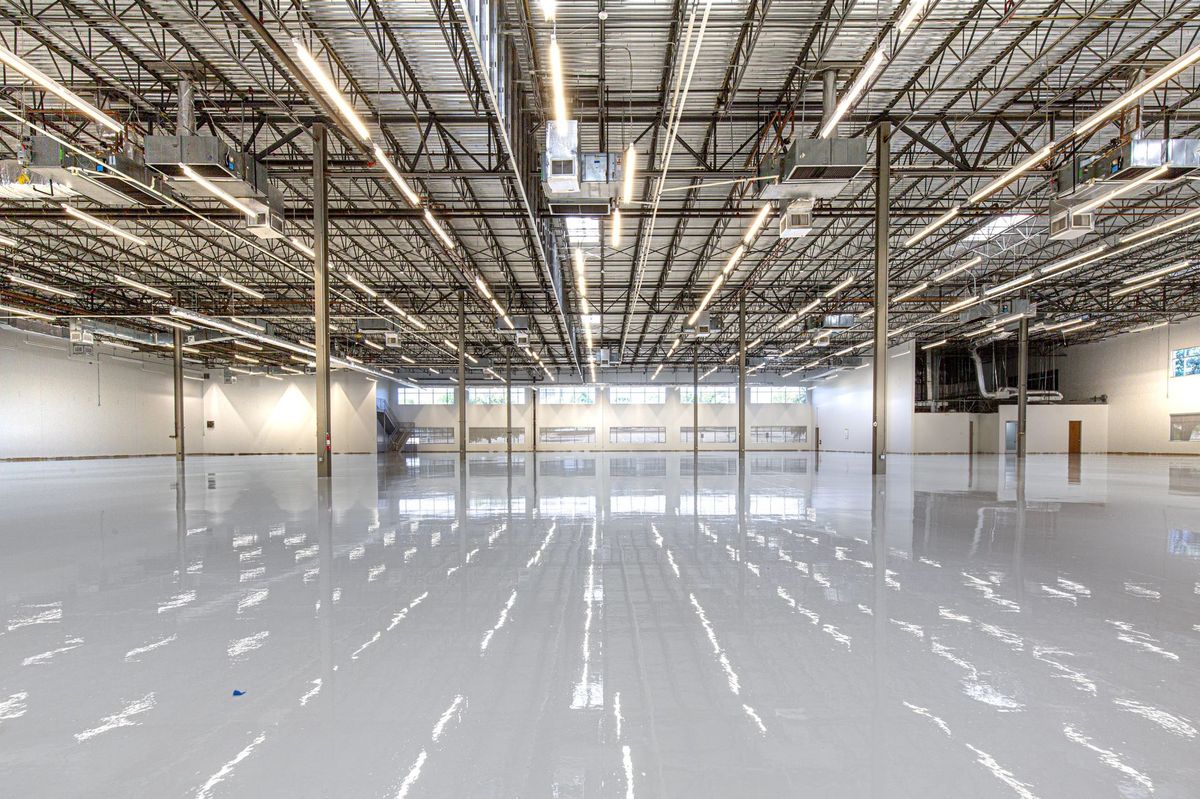
Data center floors must meet stringent flatness and levelness requirements that exceed standard commercial construction tolerances. This is particularly true for facilities with raised access floors, where the supporting pedestals require a substrate that is flat to within 1/8 inch over 10 feet.
The standard specification for data center floor flatness is FF 50 / FL 30 or better (using the F-number system), compared to FF 25 / FL 20 for typical commercial floors. Achieving these tolerances requires experienced concrete crews, precision laser screeding equipment, and careful control of concrete mix design and placement procedures.
Floor flatness matters for reasons beyond raised floor installation. Server racks must be level to within close tolerances to ensure proper airflow, equipment function, and seismic performance. In liquid-cooled facilities, floor level affects coolant flow and system performance. Even in slab-based designs without raised floors, the flatness requirements are significantly more demanding than conventional commercial construction.
Vibration Isolation
Perhaps the most distinctive requirement of data center foundation design is vibration isolation. Computing equipment — particularly hard disk drives and, increasingly, precision optical networking equipment — is sensitive to vibration. Floor vibrations caused by mechanical equipment (chillers, pumps, air handlers), backup generators, or even external sources (traffic, adjacent construction) can degrade computing performance or cause equipment failures.
The vibration requirement is typically specified as a velocity limit measured in micro-inches per second (mips) at specific frequencies. For standard data centers, the specification is often VC-A or VC-B (per the Vibration Criterion standard), which corresponds to maximum velocities of 2,000 to 1,000 mips, respectively. High-performance facilities supporting sensitive computing or optical equipment may require VC-C (500 mips) or even VC-D (250 mips), which approaches the standards used for semiconductor fabrication facilities and electron microscopy labs.
Meeting these vibration specifications requires careful attention to foundation design, including:
Mass. Heavier slabs attenuate vibration more effectively than lighter ones, which is one reason data center slabs are so thick. The mass of a 16-inch slab provides significant vibration damping compared to a standard 6-inch slab.
Isolation. Equipment that generates vibration (generators, chillers, pumps) must be isolated from the data hall slab using vibration isolation devices — springs, elastomeric pads, or inertia blocks — that prevent vibration from transmitting through the structure. The design and installation of these isolation systems is a specialty that requires coordination between the structural engineer, the mechanical engineer, and the concrete contractor.
Separation. In some designs, the data hall slab is physically separated from the building structure through construction joints that prevent vibration from transmitting between the two. This "floating slab" approach adds complexity and cost to the concrete work but provides superior vibration performance.
Soil conditions. The geotechnical characteristics of the site — soil type, density, water table depth, and bedrock location — significantly affect vibration behavior. Sites with soft or unconsolidated soils may require deep foundations (piles or drilled shafts) to reach stable bearing strata, adding significant cost and time to the foundation program.
The Numbers — Concrete Volumes by Project Type
The volume of concrete required for data center projects is consistently surprising to contractors who are accustomed to conventional commercial construction.
Single Data Hall
A single hyperscale data hall — 200,000 to 400,000 square feet, one story — typically requires 8,000 to 15,000 cubic yards of structural concrete. This includes the main floor slab (12 to 18 inches thick), foundation walls, equipment pads, and loading dock areas.
At current concrete prices of $150 to $200 per cubic yard (delivered, placed, and finished), the concrete cost for a single data hall ranges from $1.2 million to $3 million, excluding reinforcing steel ($0.80 to $1.10 per pound installed) which can add another $1 million to $2.5 million.
Generator Yard
The generator yard for a large data center — supporting 15 to 25 diesel generators, each weighing 30,000 to 50,000 pounds — requires 3,000 to 8,000 cubic yards of concrete. Each generator pad is individually designed for the specific generator weight and vibration characteristics, and typically features 18 to 24 inches of reinforced concrete with vibration isolation systems cast in.
Central Utility Plant
The central utility plant housing chillers, cooling towers, and distribution pumps requires its own substantial foundation system, typically consuming 2,000 to 5,000 cubic yards of concrete. Chiller pads must support equipment weighing 40,000 to 80,000 pounds each, and cooling tower basins require waterproof concrete construction.
Campus Totals
A full hyperscale campus with four to six data halls, a central utility plant, generator yards, an administration building, and site infrastructure (roads, parking, utility tunnels) can easily consume 50,000 to 75,000 cubic yards of concrete over the multi-year construction program. At a total installed cost of $300 to $450 per cubic yard (including forming, reinforcement, placement, finishing, and curing), the concrete work on a campus of this scale represents $15 million to $35 million in subcontract value.
For context on how concrete material costs are affecting these budgets, see our analysis of concrete and cement cost trends, which tracks the year-over-year price increases that are compounding the cost of data center foundation construction.
Concrete Supply Chain Challenges
The volume of concrete required for data center construction creates supply chain challenges that must be carefully managed.
Batch Plant Capacity
A single hyperscale data hall pour can require 2,000 to 3,000 cubic yards of concrete delivered in a single day for a continuous placement. This requires 200 to 300 truckloads of concrete, arriving at consistent intervals over a 12 to 18 hour period. Most commercial batch plants can sustain a delivery rate of 15 to 20 trucks per hour, which means a single large pour can consume the full output of a batch plant for an entire day.
On a campus where multiple buildings are under construction simultaneously, the concrete demand can exceed the capacity of nearby batch plants, requiring concrete to be sourced from multiple plants or necessitating the construction of a dedicated on-site batch plant. Several hyperscale data center projects have set up temporary batch plants on the campus for the duration of the concrete program.
Ready-Mix Supply
The ready-mix concrete industry in many data center markets is already operating at or near capacity, serving residential, commercial, and infrastructure projects. The addition of a large data center campus to a market's concrete demand can strain supply and push up prices. In Northern Virginia, contractors report that data center projects have contributed to ready-mix price increases of 8 to 12 percent over the past two years.
Reinforcing Steel
The rebar requirements for data center foundations are substantial. A typical data hall slab requires 100 to 200 pounds of reinforcing steel per cubic yard of concrete, compared to 50 to 80 pounds per cubic yard for a typical commercial slab. For a campus consuming 50,000 cubic yards of concrete, this translates into 2,500 to 5,000 tons of reinforcing steel — a significant order that can affect local rebar supply and pricing.
Specialty Concrete
Some data center foundation applications require specialty concrete mixes — high-strength concrete (5,000 to 8,000 psi) for heavily loaded areas, shrinkage-compensating concrete for large unreinforced areas, or fiber-reinforced concrete for improved crack control. These specialty mixes are typically more expensive than standard mixes and may require longer lead times for procurement.
Construction Sequencing
The concrete program on a hyperscale data center project is schedule-critical, because virtually every other construction activity depends on having a finished slab to work on. Understanding the typical sequencing is important for project planning.
Site Preparation and Earthwork
Before any concrete can be placed, the site must be prepared. This typically involves mass grading to establish finish elevations, installation of underground utilities (storm drainage, sanitary sewer, water, electrical ductbanks), and preparation of the subgrade to meet the structural engineer's bearing capacity requirements.
On sites with poor soil conditions, ground improvement measures — compaction grouting, vibro-stone columns, or deep soil mixing — may be required before foundations can be placed. These ground improvement programs can add weeks or months to the schedule and significant cost to the project.
Foundation Installation
The foundation system is installed in a sequence that typically follows this pattern:
- Footings and foundation walls for the building perimeter and interior bearing walls
- Under-slab utilities including electrical conduit, plumbing, and in some cases chilled water piping
- Vapor barrier and insulation installed over the prepared subgrade
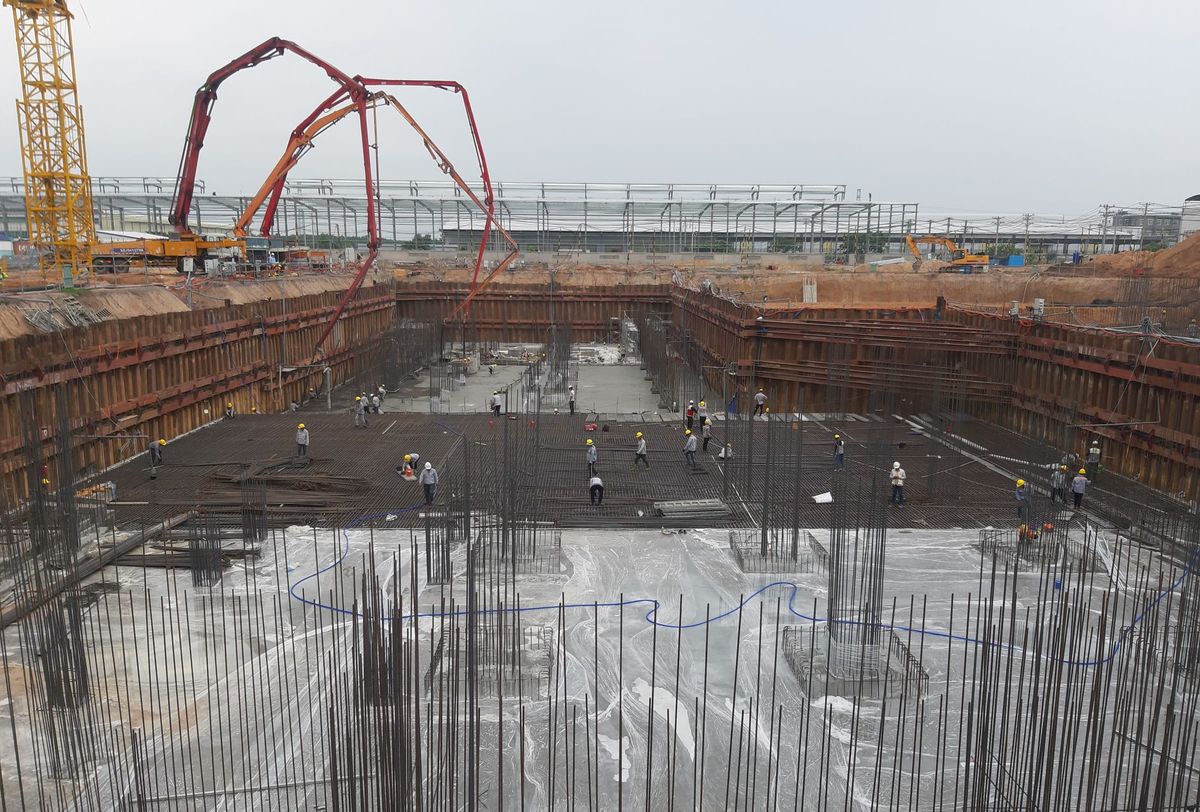
- Reinforcing steel placed and inspected before concrete placement
- Concrete placement using pump trucks for interior slabs and direct discharge for exterior areas
- Finishing using laser screeds for flatness control, followed by power troweling for surface durability
- Curing using liquid membrane curing compounds or wet curing methods for a minimum of 7 days
Quality Control
Quality control during concrete placement is intensive on data center projects. Testing typically includes:
- Slump and air content tests at the point of discharge
- Compressive strength test cylinders cast at required intervals
- Temperature monitoring during and after placement
- Flatness and levelness measurements using F-number profilers
- Crack surveys at 7, 14, and 28 days after placement
Any concrete that does not meet specification must be removed and replaced — a costly and time-consuming process that can delay the entire project.
What Concrete Contractors Need
For concrete contractors evaluating the data center market, several capabilities are essential.
Precision. The flatness and levelness requirements for data center floors demand expertise with laser screeding, stringless placement, and precision finishing techniques. Contractors who can consistently deliver FF 50 / FL 30 or better floors are in high demand.
Volume capacity. Data center pours are large and must be continuous. Contractors need sufficient crew size, equipment capacity, and batch plant relationships to sustain high-volume pours over extended periods.
Quality assurance. The documentation and testing requirements for data center concrete exceed those of most commercial projects. Contractors need robust QA/QC programs with experienced testing personnel and thorough record-keeping.
Vibration awareness. Understanding vibration isolation requirements and the construction practices that affect vibration performance is essential for data center foundation contractors. This includes knowledge of isolation joint details, equipment pad design, and the relationship between slab mass and vibration attenuation.
Self-performance depth. Data center owners and GCs prefer concrete contractors who can self-perform the full range of foundation work — forming, reinforcement, placement, finishing, and curing — rather than relying on sub-tier contractors for individual activities.
The Growing Complexity
As data center power densities increase and the equipment gets heavier, foundation requirements are trending in one direction: more. More thickness, more reinforcement, more mass, more precision. The 12-inch slab that was standard for a conventional data center five years ago is giving way to 16- and 18-inch slabs for high-density AI facilities. The generator pads designed for 2-megawatt units are being replaced by pads for 3- and 4-megawatt units with proportionally greater weights and vibration forces.
This trend means that concrete work is becoming a larger share of total data center construction cost and a more important determinant of project schedule and quality. For concrete contractors, data center construction represents one of the most technically demanding and financially rewarding segments of the commercial concrete market.
For a comprehensive view of data center construction spending and the market forces driving these projects, see our 2026 construction spending forecast, which projects data center construction as one of the fastest-growing segments of the $2.1 trillion U.S. construction market.
The Bottom Line
The concrete that nobody sees is becoming one of the most critical elements of data center construction. As buildings get bigger, equipment gets heavier, and vibration requirements get tighter, the foundation systems underneath data centers are evolving into some of the most demanding concrete work in the commercial construction industry.
For concrete contractors, this evolution creates a market that rewards precision, capacity, and specialization. For general contractors and project managers, understanding the unique requirements of data center foundation construction is essential for successful project delivery. And for the data center industry as a whole, the "concrete problem" — securing enough skilled concrete crews and enough concrete supply to support the construction boom — is one more constraint that must be managed in an industry that seems to find new ones every year.
The foundations of the digital world are made of concrete. And they are getting massive.
READ NEXT: Where Every Major Data Center Is Being Built in 2026 — A State-by-State Tracker · Why European data centers cost 20-40% more per MW — Eurocode design standards and different concrete supply economics change the foundation package entirely.
FAQ
Q: A full hyperscale campus can consume 50,000-75,000 cubic yards of concrete at $300-450 per installed cubic yard — how does a concrete contractor realistically secure batch plant supply for a single pour requiring 200-300 trucks in one day? A: Lock in a batch plant supply agreement before submitting your bid, not after winning the work. For pours exceeding 1,500 cubic yards in a single placement, you need a dedicated pour day commitment from at least two batch plants — one primary and one backup. Most ready-mix plants can sustain 15-20 trucks per hour, so a 2,500-yard pour needs 10-12 hours of continuous delivery from a plant running at full output. In active data center markets like Northern Virginia, where plants are already near capacity, start plant conversations 4-6 months before the pour date.
Q: Battery rooms require floor loads approaching 1,000 PSF from lithium-ion cabinets weighing 6,000-10,000 pounds each — what concrete specification does a contractor need to meet that load and what does it cost versus a standard data hall slab? A: Battery room slabs typically require 8,000 PSI high-strength concrete, 18-24 inches thick, with rebar on 4-6 inch centers in both directions — compared to 5,000 PSI and 12-15 inches for a standard data hall slab. Installed cost runs $400-550 per cubic yard versus $300-400 for standard data hall concrete, a 25-40% premium. On a 10,000 SF battery room with an 18-inch slab, expect 550-600 cubic yards at $250,000-$330,000 in concrete cost alone, before rebar, which adds another $120,000-$180,000.
Q: The flatness spec for data center floors is FF 50 / FL 30 — what happens to a concrete contractor's schedule and cost if they miss that spec on a completed slab? A: Missing FF 50 / FL 30 requires grinding or shot-blasting high spots and applying a polymer-modified leveling overlay on low spots — a remediation process that takes 2-4 weeks and costs $8-20 per square foot. On a 200,000 SF data hall floor, partial remediation on 10-15% of the area can run $300,000-$600,000 in rework cost and push the construction schedule by 3-4 weeks. More significantly, remediation delays the MEP rough-in and raised floor crews that are waiting on the finished slab, creating a cascading schedule impact worth multiples of the direct repair cost.
Q: Northern Virginia concrete costs have increased 8-12% over two years from data center demand pressure — how should a contractor in an emerging Midwest market like Columbus or Indianapolis price concrete escalation risk on a 2026-2027 campus project? A: Ohio and Indiana are replicating Virginia's 2022-2024 pattern — rapid data center construction volume is beginning to strain ready-mix supply in Columbus and Indianapolis metro markets. For a contract awarded in 2026 with concrete work extending into 2027, include a material escalation clause tied to PPI for ready-mix concrete (BLS series WPU1322) with a 5% annual base escalation and a true-up provision if PPI moves more than 8%. Without that clause, a 10% price increase on 10,000 yards of structural concrete erodes $150,000-$200,000 from your concrete subcontract margin.