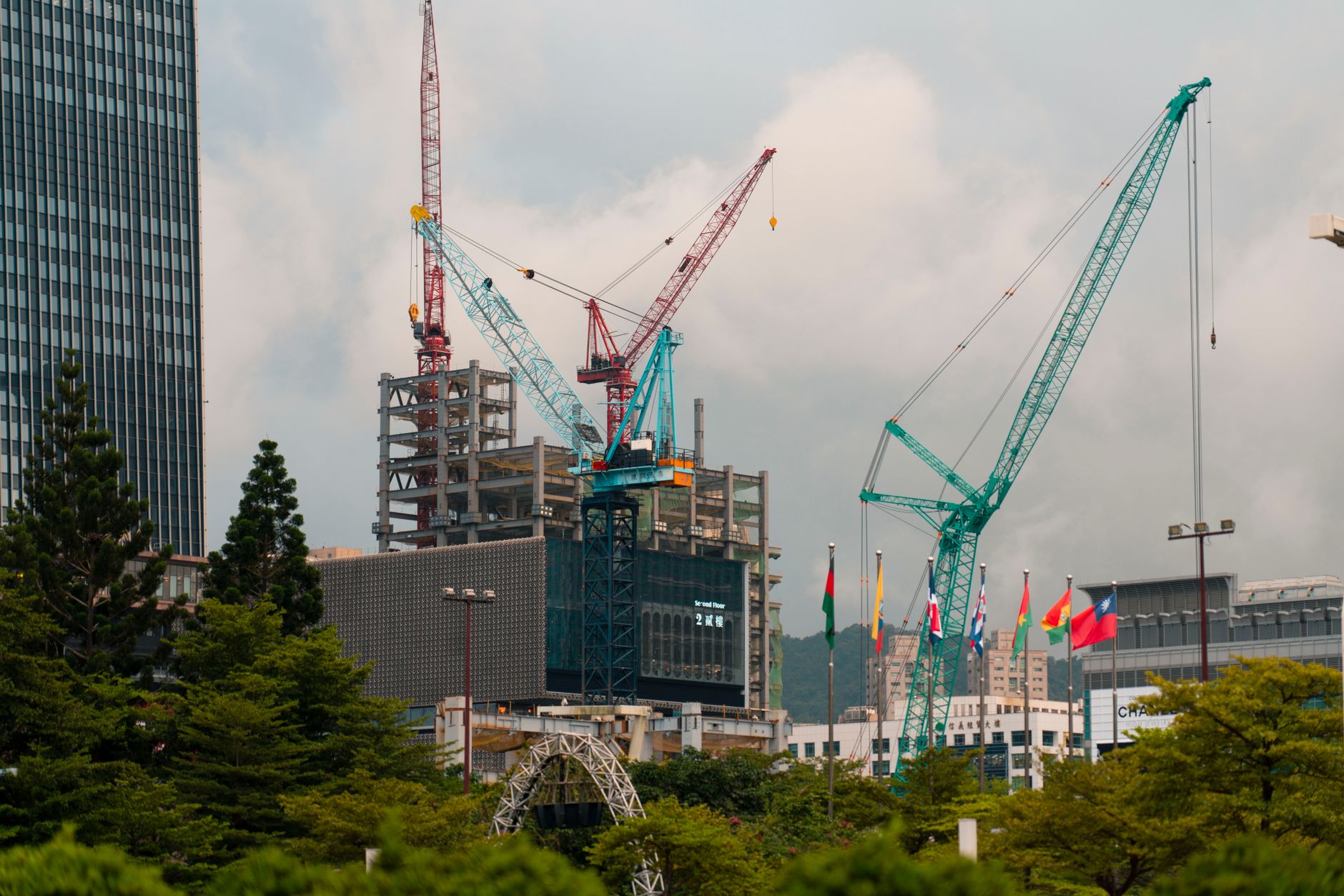
On July 9, 2026, crews placed the first structural concrete for Fab 1 at Micron's Clay, New York campus. Micron and Gilbane both described the milestone as more than a quarter ahead of plan. Both statements are accurate. Both also require a footnote, because the plan being beaten is not the plan Micron published when it announced the project.
That distinction matters if you are a subcontractor, a supplier, or a regional fabricator trying to decide how much capacity to commit to Central New York over the next fifteen years. Here is the whole picture.
What is actually being built
Micron is building a leading-edge DRAM manufacturing complex on the 1,400-acre White Pine Commerce Park in the Town of Clay, north of Syracuse. The full program is up to four fabs. Each fab carries 600,000 square feet of cleanroom, for 2.4 million square feet in total, which the Commerce Department has called the largest amount of cleanroom space ever announced in the United States, roughly the footprint of 40 football fields.
Micron's stated New York commitment is approximately $100 billion over two decades. In its July 2026 announcement the company put its broader U.S. investment plan at more than $250 billion through 2035. On the public-money side, Commerce finalized $6.165 billion in CHIPS Act direct funding for Micron in December 2024, split $4.6 billion to New York and $1.5 billion to Idaho.
At full buildout the complex is projected to support roughly 9,000 Micron jobs and about 50,000 jobs across New York. Peak construction is put at more than 4,500 craft workers.
The schedule reset behind the headline
In November 2025, Micron's final environmental impact report re-baselined the entire program. Construction of the first fab, previously slated to start before the end of 2025, moved to the second quarter of 2026. First production moved from 2028 to 2030. Fab 2 construction was pushed to a Q4 2030 start with a Q4 2033 finish. Fab 3 slid roughly two years to a Q3 2035 start. Fab 4 moved a quarter. The full four-fab program now runs in phases through 2041.
So when Micron says it is more than a quarter ahead of plan, that is measured against the reset baseline, not the 2022 announcement. Ground actually broke in January 2026, and the transition from mass earthwork to vertical construction happened in under six months. That is genuinely fast execution against the current schedule. It is not a recovery of the two years that came out of the program last fall.
For anyone building a backlog forecast, the practical read is this: the near-term work is real and moving, the mid-decade work between Fab 1 topping out and Fab 2 mobilization has a visible gap, and the tail of this program extends past most contractors' current business plans. Model your escalation accordingly, because a fifteen-year program prices very differently than a three-year one. Our escalation calculator is a reasonable starting point for that math.
The delivery split: three firms, three very different contracts
This project uses a split-delivery structure that is worth understanding on its own terms, because it is a template other megaprojects are copying.
Gilbane on the dirt
Gilbane Building Company holds preconstruction and site infrastructure. Its scope runs across 680 acres of the campus and is essentially a heavy-civil program disguised as a building project: clearing trees and brush, stripping unsuitable soil and replacing it with processed aggregate, producing and hauling that aggregate to bring the site to rough grade, building stormwater basins and drainage, and installing permanent perimeter fencing with security features.
That is a lot of earthmoving, aggregate production, trucking, and erosion-control work before a single fab column is set. It is also the phase where local firms get in first, which is exactly what the award data shows.
Bechtel on EPC
Micron named Bechtel its engineering, procurement and construction partner for the first phase in June 2026. Bechtel's scope covers the initial fab plus the critical infrastructure that makes it operable: a central utility building, process support systems, hazardous materials systems, wastewater treatment, probe facilities, equipment yards, and the above-ground and below-ground utility and trestle network.
An EPC contract puts engineering, procurement, and field execution under one accountable party. On a fab, that consolidation exists for a reason. The tool-install schedule is unforgiving, and the ability to buy long-lead process equipment and switchgear against your own engineering, on your own float, is worth more than the competitive tension you give up.
Gilbane is also partnering with Bechtel on subsequent EPC phases, so the two firms are not strictly sequential.
Jacobs on design
Jacobs is the architectural and engineering design partner for the complex.
What 2.4 million square feet of cleanroom actually demands
Fab construction is not commercial construction at larger scale, and that holds across all $42 billion of active US semiconductor fab construction, not just this campus. Bechtel's own description of the work names the difference: cleanroom systems, ultra-high-purity process infrastructure, advanced electrical systems, vibration-sensitive foundations, and tightly controlled manufacturing environments.
Three of those deserve a contractor's attention.
Vibration-sensitive foundations. Lithography tools have vibration criteria that make a normal industrial slab useless. That drives deep foundations, thick waffle slabs, isolated equipment pads, and flatness tolerances that force different placement crews, different finishing equipment, and different acceptance testing than a warehouse floor. The first concrete pour in July was the start of that system, not a symbolic ribbon-cutting.
Ultra-high-purity process piping. UHP stainless, high-purity welding, orbital weld documentation, passivation, and particle testing. This is a specialty trade with a shallow national bench, and a four-fab program consumes it for years.
MEP-to-structure coordination. A fab is a machine with a building around it. The subfab, the interstitial levels, the waffle slab penetrations, and the utility trestle network all have to be coordinated before steel is fabricated, not after. Late model coordination on a fab does not cost you rework, it costs you tool-install dates.
That coordination load is the reason the program is running EPC rather than a hard-bid general contract.
Where the money has gone so far
As of the July 2026 update, Micron reported approximately $675 million already directed to New York-based contractors, suppliers, and subcontractors, spread across Syracuse, Buffalo, Rochester, Watertown, and other cities. Gilbane put that figure at more than half of the total value awarded on the project to date, which tells you the local-content share on early site work has been high, not token.
Micron also reported that more than 80% of workers on site to date have been New York residents. Early earthwork and site utilities are exactly the scopes a regional workforce can staff. The harder question is what happens when the cleanroom fit-out packages release and the required trades are UHP pipefitters, cleanroom envelope installers, and high-purity electrical crews. Those specialties travel, and per-diem competition with other fab and data center programs is already tight. If you are tracking regional demand shifts, the state dashboards are the fastest way to see where federal and private capital is concentrating.
What to watch next
Subcontract package releases. The pivot from Gilbane's site-enabling work to Bechtel's first-phase EPC is when the bid list widens: structural steel and metal deck, deep foundations, process piping, electrical distribution, and the central utility building mechanical package. Firms that want on those lists should be prequalifying now, not when the invitation shows up. Federal and public solicitations tied to the surrounding infrastructure show up on our bid board.
Structural steel exposure. A four-fab program with a central utility building and a trestle network is a serious steel consumer over a long window, and mill pricing over a fifteen-year horizon is not something you can flat-line in a bid. Track the structural steel index if you are carrying that risk.
The Fab 2 gap. Under the revised timeline, Fab 2 construction does not start until Q4 2030. That is a real demobilization risk for firms that scale up for Fab 1 and have nothing to roll onto. Plan the off-ramp before you plan the ramp.
Questions contractors are asking
Is Micron's New York project delayed or ahead of schedule? Both, depending on the baseline. Micron pushed first production from 2028 to 2030 in its November 2025 environmental report, and pushed first-fab construction start to Q2 2026. Against that revised schedule, the project is running more than a quarter ahead, having broken ground in January 2026 and poured first structural concrete on July 9, 2026.
Who is the general contractor on the Micron Clay fab? There is no single GC. Bechtel holds engineering, procurement and construction for the first phase. Gilbane Building Company holds preconstruction and site infrastructure across 680 acres and is partnering with Bechtel on later EPC phases. Jacobs is the architectural and engineering design partner.
How much construction work is left? Nearly all of it. Only the first of four fabs is in vertical construction. Under the current phasing, the program runs through 2041.
When does the first fab produce chips? 2030, under Micron's revised schedule. The original target was 2028.