There are currently 14 tunnel boring machines (TBMs) actively excavating across 8 US cities, making this the most intensive period of mechanized tunneling in American construction history. From water conveyance tunnels beneath New York to transit tunnels under Los Angeles, the combined investment in active TBM-driven projects exceeds $38 billion — a number that reflects both the extraordinary cost of underground construction in American cities and the growing recognition that surface-level solutions simply cannot meet 21st-century infrastructure demands in dense urban environments.
The numbers tell a different story than typical mega-project headlines. While individual tunnel projects attract attention for their billion-dollar price tags and dramatic engineering, the aggregate scale of US tunneling activity reveals a construction sub-sector with sustained demand, extremely specialized workforce requirements, and barriers to entry that create significant pricing power for firms possessing genuine underground construction expertise.
Active TBM Projects: City by City
New York City — 4 Active TBMs. New York leads the nation, reflecting both the age of its underground infrastructure and the impossibility of expanding surface capacity in the country's densest urban environment.
The Gateway Program Hudson Tunnel is the highest-profile active tunneling project in the country. Two TBMs will excavate twin rail tunnels beneath the Hudson River connecting New Jersey to Penn Station in Manhattan. The tunneling contract, awarded to a joint venture led by Dragados, is valued at approximately $6.4 billion for 2.4 miles of twin tube tunnel — approximately $1.3 billion per mile of twin tunnel. This extraordinary per-mile cost reflects the extreme technical difficulty of tunneling beneath a tidal river in soft, water-saturated ground under pressures exceeding 4 atmospheres. The project requires pressurized-face slurry TBMs operating in compressed-air intervention mode for cutter head maintenance — conditions that demand the highest-skilled tunnel workers in the industry.
The Second Avenue Subway Phase 2 has a TBM excavating the northward extension from 96th Street to 125th Street in Harlem. The $7.7 billion project includes 1.6 miles of new tunnel, 3 new underground stations, and connections to existing subway infrastructure. Per-mile costs approaching $2.4 billion (including stations) make this one of the most expensive transit construction projects per mile globally, driven by New York's combination of complex geology, dense utility networks, strict settlement controls to protect surface buildings, and high labor costs under the Metropolitan Transportation Authority's Project Labor Agreement.
A TBM is completing the Delaware Aqueduct Bypass Tunnel — a 2.5-mile bypass replacing a leaking section of the 85-mile Delaware Aqueduct, the longest continuous tunnel in the world. The $1.6 billion project will restore full capacity to the aqueduct system supplying 50% of New York City's drinking water. The bypass tunnel required a hard-rock TBM operating at depths exceeding 700 feet below the Hudson River, boring through competent but fractured bedrock requiring careful ground support.
Los Angeles — 3 Active TBMs. The Purple Line Extension Sections 2 and 3 have two TBMs named Harriet and Ruth excavating the westward extension from Century City to the VA Medical Center in Westwood. The combined contracts total approximately $7.3 billion for 5 miles of twin tunnel and 4 underground stations. Per-mile cost of approximately $730 million reflects challenging geology including methane-bearing tar sands from the La Brea Tar Pits formation and the need to tunnel beneath active commercial districts in Beverly Hills and Westwood requiring strict settlement controls.
The Sepulveda Transit Corridor, while still in procurement, represents the next major Los Angeles tunneling project — a 12-mile transit tunnel connecting the San Fernando Valley to the Westside through the Santa Monica Mountains, with an estimated cost of $10 to $15 billion.
San Francisco Bay Area — 2 Active TBMs. The Silicon Valley BART Extension Phase 2 has a large-diameter TBM excavating a 5-mile tunnel beneath downtown San Jose. The $12.2 billion project uses a single-bore design with a TBM approximately 46 feet in diameter — one of the largest ever used for a US transit project. The single-bore approach accommodates both tracks within one tube, reducing the number of TBM drives but requiring massive specialized equipment. The tunneling portion accounts for approximately $4.5 billion of the total project cost.
Seattle — 1 Active TBM. The Ship Canal Water Quality Project uses a 19-foot-diameter TBM for a 2.7-mile combined sewer overflow (CSO) storage tunnel beneath Ballard and Wallingford. The $570 million project creates a tunnel capable of holding 87 million gallons of combined sewage during storm events, preventing discharges into the Ship Canal and Salmon Bay.
Washington, DC — 1 Active TBM. The Northeast Boundary Tunnel is completing final segments of a 5-mile, 23-foot-diameter CSO tunnel designed to reduce overflows to the Anacostia River. The $580 million tunnel is the centerpiece of DC Water's $2.7 billion Clean Rivers Project.
Miami, Dallas, and Chicago each have 1 active TBM on water infrastructure and flood control tunnel projects, with combined investment of approximately $2.6 billion.
TBM Technology and Costs
The TBMs operating across US projects represent three primary technology categories:
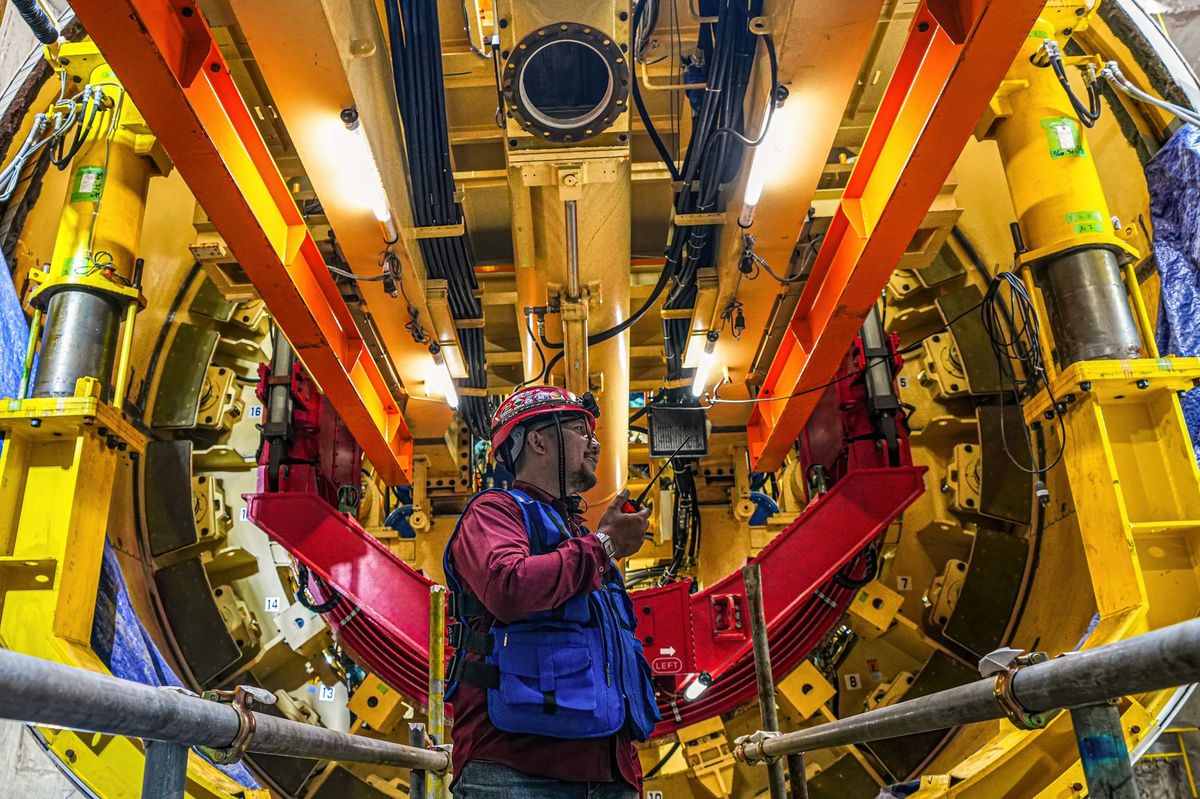
Earth Pressure Balance (EPB) TBMs manage soft ground by using excavated material as face support. EPB machines range from 19 feet diameter for utility tunnels to 46 feet for the San Jose BART project. New EPB TBMs cost $40 to $80 million depending on diameter. EPB machines dominate US transit tunneling because most American cities are built on soft sedimentary ground.
Slurry TBMs use pressurized bentonite slurry for face support in high-water-pressure conditions, particularly river crossings. The Gateway Hudson Tunnel TBMs use slurry technology to manage extreme hydrostatic pressure beneath the Hudson. Slurry TBMs cost $60 to $100 million and require surface-level slurry treatment plants that add to project costs and real estate requirements.
Hard Rock TBMs use disc cutters to break competent rock formations. Used for the Delaware Aqueduct bypass and planned for future water conveyance and highway tunnel projects. Hard rock TBMs cost $30 to $70 million and can achieve higher advance rates than soft-ground machines in favorable geology.
TBM costs represent only 5 to 15% of total project costs. The dominant cost categories are labor, materials (particularly precast concrete tunnel lining segments), muck removal and disposal, station construction (for transit projects), and systems installation. For transit tunnels, TBM excavation accounts for 30 to 40% of total cost, with stations and fit-out comprising the remainder.
Why US Tunneling Costs Are So High
US tunnel construction consistently costs 2x to 4x more than comparable projects in Europe and Asia. Typical per-mile costs for twin transit tunnel in the US range from $500 million to $1.3 billion, compared to $150 to $400 million internationally. Contributing factors include extended environmental review timelines that increase project duration and inflation exposure, conservative engineering standards resulting in heavier linings and more robust support systems, station designs that are larger and more complex than international counterparts, project labor agreements and prevailing wage requirements that increase labor costs 20 to 40% above open-shop rates, change order and claims environments that increase contingency reserves, and limited competition among qualified tunneling contractors driving up bid prices.
Contractor Landscape and Workforce
The US tunnel construction market is dominated by a small number of firms with the necessary specialized equipment, trained workforce, and bonding capacity. Key players include joint ventures typically led by Dragados, Skanska, Traylor Bros., Kiewit, Barnard, Michels, Jay Dee, and Southland. European firms — particularly Spanish and Italian companies with extensive metro tunneling portfolios — frequently partner with American firms.
A large-diameter TBM operation requires 30 to 50 workers per shift, running 24 hours per day, 5 to 7 days per week, for total crew requirements of 100 to 200 workers per TBM. Key positions include TBM operators earning $45 to $65 per hour, miners and tunnel laborers at $35 to $55 per hour, segment erectors at $38 to $50 per hour, surveyors and alignment specialists at $50 to $70 per hour, and maintenance technicians at $40 to $55 per hour.
The 14 active TBMs collectively employ an estimated 4,000 to 6,000 tunnel workers, with an additional 8,000 to 12,000 engaged in station construction, systems installation, and support activities. Total direct construction employment across all active TBM projects approaches 15,000 to 18,000 workers. For firms with underground construction expertise, the pipeline represents sustained, high-value work for a decade or more.
The Future TBM Pipeline
Beyond the 14 currently active TBMs, at least 8 to 12 additional TBM projects are in procurement or advanced planning, with construction expected to begin between 2027 and 2030:
Los Angeles Sepulveda Transit Corridor: The proposed 12-mile transit tunnel through the Santa Monica Mountains would be the longest transit tunnel in the United States. The estimated $10 to $15 billion project would require 2 to 4 TBMs operating simultaneously. The project is currently in procurement with a contract award expected in 2027.
New York Penn Station Access: Additional tunneling is planned to bring Metro-North commuter rail service to Penn Station, requiring new tunnel connections beneath the Bronx and Harlem River crossings.
Chicago Red Line Extension: The CTA's proposed 5.6-mile southward extension of the Red Line would require TBM tunneling through the far south side of Chicago, with an estimated project cost of $3.6 billion.
San Francisco Central Subway Extension: A potential northward extension of the recently opened Central Subway would require additional TBM tunneling beneath North Beach and Fisherman's Wharf.
Water Conveyance Tunnels: Multiple water utilities are planning large-diameter water conveyance tunnels, including LADWP's planned 18-mile water supply tunnel and San Antonio's Vista Ridge pipeline segments.
Safety Considerations in Tunnel Construction
Tunnel construction remains among the most hazardous construction activities. OSHA's construction fatality data shows tunnel workers face fatality rates approximately 3x higher than surface construction workers. Key hazards include ground collapse and cave-in during TBM interventions and cross-passage construction, compressed air work exposure for workers entering the pressurized face chamber during cutter head maintenance, fire risk from hydraulic systems and electrical equipment in the confined tunnel environment, water inrush during tunneling through water-bearing ground, and exposure to naturally occurring gases including methane and hydrogen sulfide.
Safety management systems for TBM operations are sophisticated, including real-time gas monitoring throughout the tunnel, compressed air medical surveillance programs for workers performing hyperbaric interventions, emergency refuge chambers positioned at regular intervals along the tunnel, and fire suppression systems on TBMs and at the tunnel portal. These safety requirements add significant cost — typically 8 to 12% of the tunnel construction budget — but are essential for worker protection in this inherently hazardous environment.
Cost Reduction Strategies
Several approaches are being explored to reduce US tunneling costs toward international benchmarks:
Standardized Station Designs could reduce station construction costs by 20 to 30%. European and Asian transit systems use standardized station layouts with repetitive designs, prefabricated finishes, and simplified architectural treatments. US transit stations, by contrast, are typically designed as unique architectural statements with custom finishes, public art programs, and complex geometric configurations that increase construction costs without proportional ridership benefits.
Larger-Diameter Single-Bore Tunnels (like the approach being used for BART in San Jose) can reduce per-mile costs compared to twin-bore tunnels by eliminating the need for cross-passages, reducing the number of TBM drives, and simplifying the construction logistics. The trade-off is that single-bore tunnels require larger TBMs (which are more expensive) and must accommodate both tracks within a single tube (requiring more complex internal fit-out).
Improved Procurement Practices including earlier contractor involvement in design (progressive design-build), risk-sharing mechanisms that reduce contingency requirements, and longer-term procurement processes that allow contractors to optimize construction methods before pricing. The USDOT's Project Delivery Center of Excellence has studied international procurement practices and is developing guidance for US transit agencies seeking to reduce tunnel construction costs.
Prefabrication and Modularization of station components — stairs, escalators, mechanical rooms, and architectural finishes — can reduce on-site construction time and improve quality. Japanese and Korean metro systems routinely prefabricate station interior fit-out components in factories and install them as modular assemblies in completed station shells, compressing the station fit-out schedule from 18 to 24 months to 8 to 12 months.
Environmental and Community Impact Management
Tunnel construction in urban environments generates significant environmental and community impacts that require active management. Noise from TBM operations — particularly the vibration transmitted through the ground during excavation — affects residents and businesses along the tunnel alignment. Vibration monitoring using arrays of geophones and accelerometers installed in surface buildings provides real-time data that allows TBM operators to adjust advance rates and excavation parameters to maintain vibration levels below threshold values.
Muck (excavated material) disposal is a major logistics challenge. A large-diameter TBM produces 2,000 to 5,000 cubic yards of excavated material per day, which must be transported from the tunnel portal to disposal or reuse sites. In urban environments, this requires coordinating hundreds of truck trips per day through residential and commercial neighborhoods, with routes, schedules, and dust control measures specified in construction permits.
Settlement monitoring is critical in soft-ground tunneling, where TBM excavation can cause ground surface settlements of 0.5 to 2 inches in the zone directly above and adjacent to the tunnel alignment. Real-time settlement monitoring using automated total stations and ground-mounted prisms allows early detection of excessive settlement, triggering corrective actions including grouting and TBM parameter adjustments before damage occurs to surface structures.
These environmental management requirements add significant cost — typically 8 to 15% of tunnel construction budgets — but are essential for maintaining community acceptance and regulatory compliance during the multi-year construction periods that characterize major tunnel projects.
Frequently Asked Questions
How much federal funding goes to tunnel boring construction projects us?
Industry analysts tracking tunnel boring construction projects us report that 2026 has brought measurable shifts. With data showing $38 billion, the trend line suggests continued movement through the remainder of the year. Builders should factor this into both current bids and forward-looking project estimates.
Which states benefit most from tunnel boring construction projects us?
Regional analysis of tunnel boring construction projects us reveals uneven distribution across U.S. markets. The data point of $6.4 billion highlights the scale of activity, with Sun Belt and high-growth metro areas generally leading in volume. Contractors expanding into new territories should evaluate local demand indicators before committing resources.
What is the timeline for tunnel boring construction projects us projects?
Compared to prior periods, tunnel boring construction projects us has moved significantly. Current data showing $1.3 billion indicates the direction of the market, and contractors who adjust their strategies accordingly will be better positioned for profitability. Monitoring monthly updates from BLS and Census Bureau data releases is recommended.