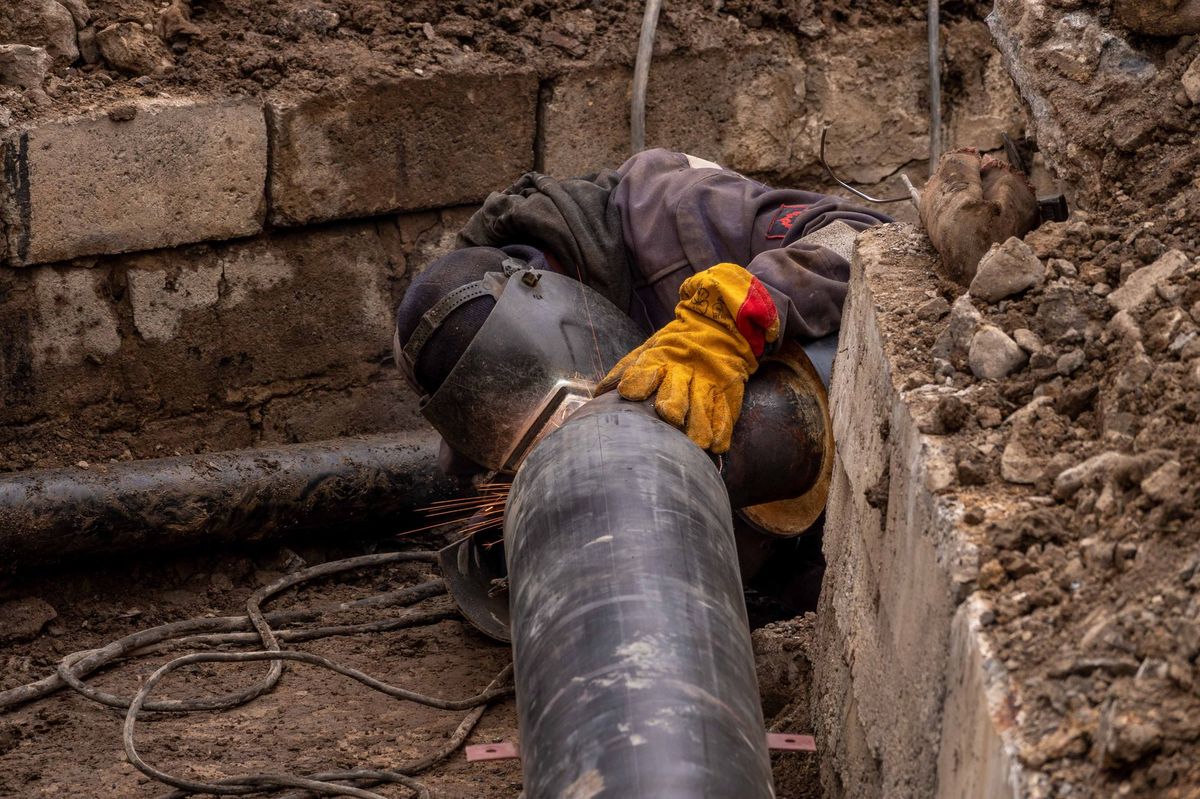
A water utility crew opened a 12-foot valve vault in February 2026 to swap a stuck gate valve. The lead worker dropped in without atmospheric testing — the vault had been opened the week before and seemed fine. He lost consciousness within 90 seconds. His coworker climbed down to pull him out and collapsed on top of him. Both men died of hydrogen sulfide poisoning before the third crew member could call 911. OSHA cited the contractor for willful violations of 29 CFR 1926.1203, 1926.1204, and 1926.1205. Proposed penalty: $468,000.
This is the pattern confined space entry osha construction 2026 enforcement is built around. Subpart AA of 29 CFR 1926 — the construction-specific confined spaces standard — has been on the books since 2015, but the 2026 enforcement memo from OSHA's Directorate of Construction treats Subpart AA as a priority for infrastructure work: water and wastewater utilities, telecom vaults, electrical manholes, tunnels, pipelines, and lift stations. Crews need to know what the rule actually says, not what their foreman remembers from a 2018 toolbox talk.
What Subpart AA Covers
29 CFR 1926 Subpart AA — Confined Spaces in Construction — applies to any construction work in a space that meets three criteria: it is large enough for a worker to enter and perform work, has limited means of entry or exit, and is not designed for continuous human occupancy. That definition pulls in a long list of infrastructure features: manholes, vaults, sewer lines, water tanks, lift stations, pump rooms, pipelines, tunnels, boilers, silos, hoppers, ductwork, and any unventilated crawlspace under a building.
The standard splits confined spaces into two categories. A non-permit confined space has no potential to contain any hazard capable of causing death or serious physical harm. A permit-required confined space has one or more of the following: a hazardous atmosphere, engulfment potential, a converging-walls or downward-sloping floor configuration, or any other recognized serious safety hazard.
The classification determines what the employer owes the worker. Permit-required spaces require a written program, entry permits, atmospheric testing, attendants, rescue capability, and training. Most citations under Subpart AA come from contractors who treated a permit-required space as a non-permit space — usually because the previous crew did the same thing and got away with it.
Atmospheric Testing Requirements
Under 29 CFR 1926.1204(e), the employer must perform atmospheric testing before each entry into a permit-required confined space and must continue monitoring during the entry. The required test sequence is fixed and cannot be reordered:
- Oxygen content first. Acceptable range is 19.5% to 23.5%. Below 19.5% is oxygen-deficient; above 23.5% is oxygen-enriched and creates a fire hazard.
- Flammable gases and vapors second. The lower explosive limit (LEL) reading must be below 10%. Anything 10% or above triggers immediate evacuation.
- Toxic air contaminants third. This includes hydrogen sulfide, carbon monoxide, methane, and any other substance specific to the work being performed. Permissible exposure limits are set in 29 CFR 1910 Subpart Z.
The oxygen-first sequence matters because a flammable-gas sensor will not read accurately in an oxygen-deficient atmosphere. Many of the cited fatalities involve workers who tested a vault, got an "all clear" on combustibles, and entered — only to discover that the LEL reading was meaningless because the space was already at 15% oxygen and the sensor could not function.
Direct-reading instruments must be calibrated per manufacturer specifications. OSHA inspectors will ask for the calibration log. A bump test before each shift is the minimum; full calibration is typically required every 30 days. Borrowed meters with no documented calibration are a citation themselves.
The Permit System
A written entry permit is required for every entry into a permit-required confined space. The permit must be completed by the entry supervisor before entry begins and must document the space identified, purpose of entry, date and duration, names of authorized entrants, attendants, and supervisors, atmospheric test results and the equipment used, communication procedures, and rescue and emergency services available.
The permit must be canceled when entry operations are complete or when a condition not allowed under the permit arises. Canceled permits must be retained for at least one year and reviewed annually to update the program. OSHA inspectors regularly ask to see permit logs going back at least 12 months, and a missing or incomplete log raises the citation severity.
Attendant and Entry Supervisor Duties
29 CFR 1926.1209 spells out attendant duties in detail. The attendant must remain outside the space during the entire entry, maintain accurate count of authorized entrants, monitor for hazards inside and outside the space, communicate with entrants to monitor their status, order evacuation when conditions warrant, summon rescue when needed, and perform non-entry rescue when possible.
The attendant cannot perform other duties that would interfere with monitoring the entrants. This is where many crews get cited — the attendant is also operating equipment, running a saw, supervising other work, or stepping away to grab supplies. An attendant who is unable to immediately respond is functionally not an attendant, and OSHA treats it that way.
The entry supervisor — who can be the same person as the attendant if duties allow, but often is not — has separate obligations under 29 CFR 1926.1210. The supervisor must verify all permit conditions are met before authorizing entry, terminate entry when authorized work is complete or unauthorized conditions develop, verify rescue services are available, and remove unauthorized individuals.
Retrieval Systems
Each authorized entrant must use a chest or full-body harness with a retrieval line attached at shoulder level or above. The other end attaches to a mechanical device or fixed point outside the permit space in a manner that allows immediate rescue retrieval.
Mechanical retrieval devices — tripods with winches — are required for vertical entries deeper than 5 feet. The tripod base must be rated for the working load, the winch must have a positive locking mechanism, and the cable must be inspected before each use for kinks, cuts, and bird-caging. Field-built tripods made from scaffold tube are not compliant. Manufactured systems from Honeywell Miller, MSA, or 3M Protecta with documented load ratings are the defensible option. The 1926.1211(a) retrieval exception is narrowly construed — inspectors expect a written justification on file before claiming it.
What Inspectors Are Citing in 2026
Based on enforcement data published by OSHA's Directorate of Construction for FY2025 and the regional priority memos circulating for FY2026, the most frequently cited Subpart AA provisions on infrastructure work are:
Failure to identify permit-required confined spaces (1926.1203(a)). Contractors performing valve replacement, pipeline tie-ins, and lift station repair are routinely treating permit-required spaces as non-permit spaces with no documented evaluation. This is a serious classification at $16,550 per instance.
Failure to provide written program (1926.1203(d)). A site-specific written confined space program is required when permit-required spaces will be entered. Generic safety manuals downloaded from trade association websites without site-specific adaptation do not satisfy this requirement.
Inadequate atmospheric testing (1926.1204(e)). Skipping the oxygen-first sequence, failing to test all entrant breathing zones, or relying on uncalibrated equipment. This was the most common citation in the FY2025 enforcement summary for water and sewer contractors.
Untrained attendants (1926.1207). Attendants who cannot describe their evacuation, communication, and rescue summoning duties when asked by an inspector. Training records must be kept on site.
No rescue plan or unprepared rescue service (1926.1211). Relying on the local 911 fire department without verifying that the department has confined space rescue capability and has been briefed on the site. Many fire departments will not perform confined space rescue and will stage outside while a worker dies inside.
Multi-Employer Worksite Responsibility
Most infrastructure jobs involve a general contractor, a specialty sub doing the confined space work, and sometimes a third firm providing rescue standby. OSHA's multi-employer citation policy means citations can be issued to any combination of these employers depending on role.
The controlling employer (typically the GC) is responsible for ensuring the prime sub has a compliant program before entry begins. The exposing employer (the sub whose workers enter) has direct compliance responsibility for their own crew. The creating employer (whoever introduced the hazard — often a utility owner who left a contaminated vault) can also be cited. In the Texas fatality cited earlier, OSHA cited both the plumbing subcontractor for willful violations and the municipality that owned the system for failing to disclose known hydrogen sulfide accumulation. When work involves city-owned utility infrastructure, pre-entry information needs to be in writing on the entry permit.
Citation Cost Structure for 2026
OSHA's January 2026 penalty adjustment puts maximum penalties at $16,550 per serious violation, $165,514 per willful or repeat violation, and $16,550 per day for failure to abate.
A confined space fatality investigation typically generates 6 to 12 related citations. A willful classification on three of those puts exposure over $500,000 before any criminal referral, civil litigation, or insurance impact. Browse active federal bids on water and sewer work and the contract value rarely covers the cost of a single fatality citation, let alone the workers' compensation and litigation tail. Confined space enforcement also triggers parallel citations under lockout/tagout, respiratory protection, and the general duty clause — aggregate cost grows fast.
What Infrastructure Contractors Should Do Now
The 2026 enforcement emphasis on water, sewer, and underground utility work means contractors in those trades should not be relying on programs written before 2020. Specific steps that hold up in an inspection:
- Audit every recurring work location for permit-required vs non-permit classification, signed and dated by a competent person
- Replace any 4-gas meter without current calibration documentation
- Train every attendant and entry supervisor with site-specific scenarios, not generic e-learning
- Pre-qualify a rescue service that can be on site within 5 minutes — or set up in-house non-entry retrieval capability
- Build hydrogen sulfide and methane testing into every wastewater entry permit by default
The same exposure that drives trench safety citations shows up in confined space work — workers entering hazardous environments on the assumption that nothing has changed since last time. For broader context on how confined space citations rank, see OSHA's top 10 construction citations for 2026 — confined space made the FY2025 list at #8 for the first time since the standard was promulgated.
Frequently Asked Questions
What is the difference between OSHA general industry confined space and construction confined space rules?
General industry confined spaces fall under 29 CFR 1910.146, which has been in place since 1993. Construction confined spaces fall under 29 CFR 1926 Subpart AA, finalized in 2015. The construction standard includes specific provisions for multi-employer worksites, continuous monitoring during entry, and pre-entry information exchange between controlling and exposing employers. A contractor performing construction work in a manhole follows Subpart AA, not 1910.146, even if the host facility is otherwise general industry.
Is a sewer or water vault always a permit-required confined space?
Not automatically, but in practice almost always. A vault is permit-required if it has the potential to contain a hazardous atmosphere, an engulfment hazard, or any other recognized serious hazard. Sewer infrastructure routinely accumulates hydrogen sulfide and methane from biological activity, even when no obvious source is present. Water vaults can develop oxygen deficiency from rusting metal, microbial activity, or displacement by other gases. The defensible position for any below-grade utility vault is permit-required classification, with atmospheric testing on every entry.
How often does the entry permit need to be renewed?
The permit applies to one specific entry operation. When the work is complete, the permit is canceled. When conditions change — different workers, different task, atmospheric conditions outside acceptable limits — entry stops and a new permit is required. OSHA has cited "blanket" permits authorizing multiple entries over a time period as a violation of 1926.1205.
Does the entrant need to wear a harness if the space is shallow?
Under 29 CFR 1926.1211(a), each authorized entrant must use a chest or full-body harness with a retrieval line unless the employer can demonstrate that retrieval equipment would not contribute to rescue or would create additional hazard. For vertical entries below 5 feet where mechanical retrieval is not feasible, a written justification is required. The default is harness use for every permit-required entry. Skipping the harness because "it's not that deep" is one of the most common citation scenarios.
What happens if our designated rescue service can't actually respond in time?
29 CFR 1926.1211 requires that the rescue service be capable of responding in a time frame appropriate to the hazards identified. For an immediately dangerous to life and health atmosphere, that response time is typically measured in minutes, not the 10 to 20 minutes a municipal fire department needs to mobilize. If the local fire department cannot perform confined space rescue or cannot respond within the time required by the hazard, the employer must provide an alternative — either contracted rescue standby on site or in-house rescue capability with trained team members and documented drills. OSHA verifies rescue service availability during inspections by asking the rescue service directly.