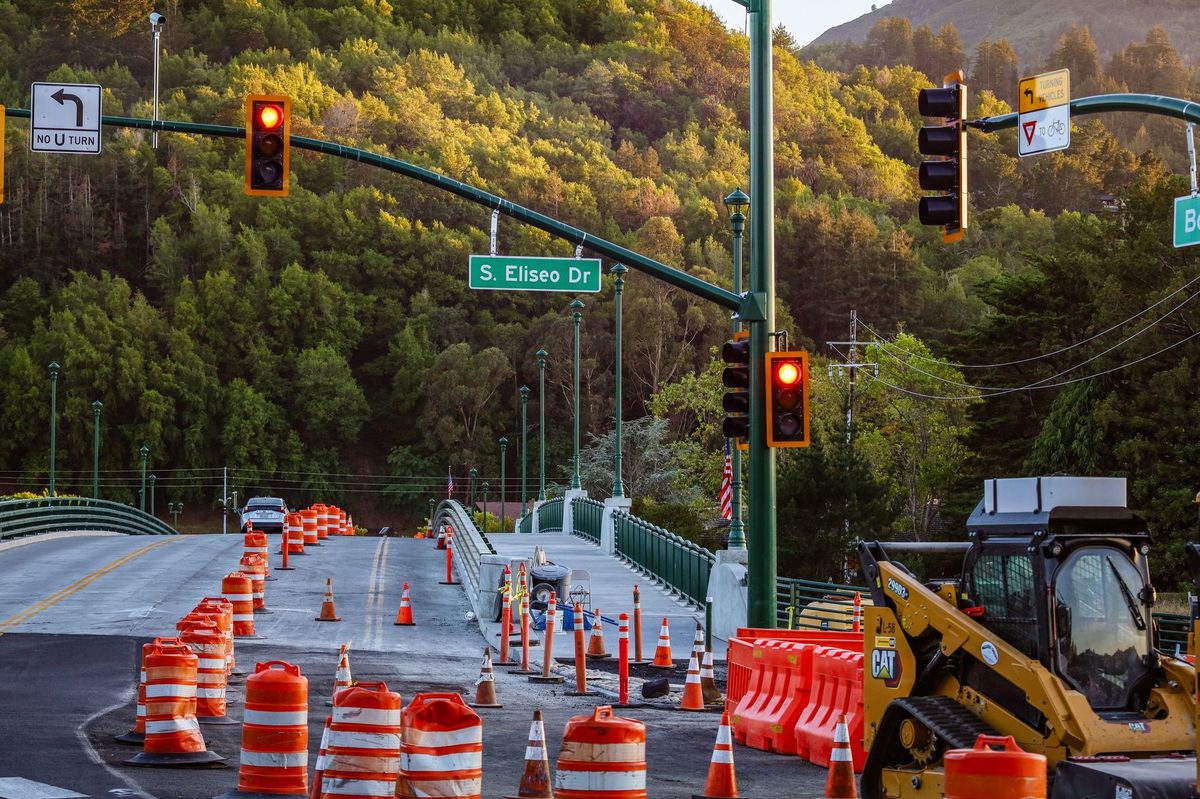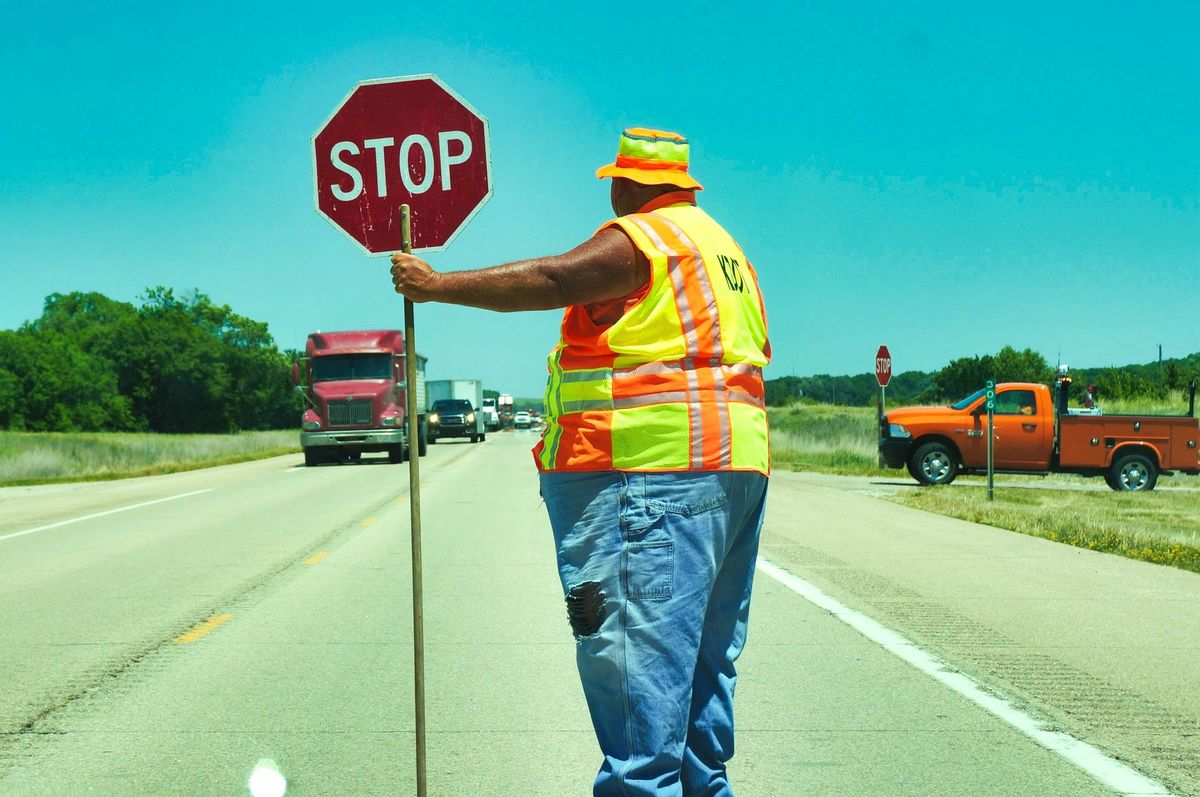
A flagger holds a slow/stop paddle 18 inches from a Caterpillar 980 loader for 10 hours and gets paid less than the apprentice grading the shoulder behind them. That math is breaking on Infrastructure Investment and Jobs Act work zones. Highway flagger wages 2026 are moving — the national average has climbed to $24.50 to $28.50 per hour on non-federally-funded work, and Davis-Bacon prevailing wage rates on federal-aid projects in high-cost states now exceed $42 per hour, with New York City and Bay Area metro determinations hitting $58 per hour. State DOTs that struggled to staff flagger crews during the 2024 IIJA ramp-up are paying for that problem now.
This is what the wage picture looks like in 2026, what certification is required to legally hold a paddle, and why struck-by fatalities keep rising despite better visibility apparel and slower posted speeds. Contractors bidding work zone projects in the second half of 2026 need to price labor at the rates the market is paying — not the rates that worked two years ago.
National Wage Range and Davis-Bacon Floors
BLS tracks flaggers under SOC 47-4051 (Highway Maintenance Workers) for contractor crews. The May 2025 Occupational Employment and Wage Statistics put the median hourly wage at $22.40 nationally, with the 75th percentile at $28.10 and the 90th percentile at $34.50. Flagger-specific roles within that category typically pay 5 to 10 percent below the median because the work requires less equipment operation.
That national picture changes sharply on federally funded work. Davis-Bacon Act requirements under 40 USC 3142 apply to federal-aid highway construction, which means the prevailing wage published by DOL for the specific county and job classification governs the minimum rate.
Selected 2026 Davis-Bacon flagger wage determinations published on SAM.gov:
- New York County, NY (Highway Construction): $58.42/hour base + $34.18 fringe = $92.60 total package
- San Francisco County, CA (Highway Construction): $54.10/hour base + $32.40 fringe = $86.50 total package
- King County, WA (Heavy Highway): $42.18/hour base + $24.80 fringe = $66.98 total package
- Cook County, IL (Highway Construction): $38.50/hour base + $26.40 fringe = $64.90 total package
- Harris County, TX (Highway Construction): $24.85/hour base + $9.40 fringe = $34.25 total package
- Maricopa County, AZ (Highway Construction): $26.18/hour base + $11.60 fringe = $37.78 total package
- Mecklenburg County, NC (Highway Construction): $19.85/hour base + $7.20 fringe = $27.05 total package
The spread between the highest determinations (Northeast and West Coast metros) and the lowest (Southeast non-metro counties) exceeds 3x. Contractors operating across regions need to pull the WD-1 or WD-3 wage determinations for each county before bidding because the rates are not transferable. Running labor burden calculations at the wrong wage tier turns a winning bid into a money-losing job within the first two weeks.
State DOT work that is not federally funded uses the state prevailing wage law where one exists. California, New York, Illinois, Washington, Massachusetts, New Jersey, Hawaii, Minnesota, and 21 other states have their own prevailing wage statutes covering state-funded highway construction. The state-determined rates are often within a few dollars of the federal Davis-Bacon rate for the same county.
ATSSA Certification Requirements
The American Traffic Safety Services Association (ATSSA) Flagger Training Program is the most widely accepted credential for highway flagger work in the United States. As of 2026, 31 state DOTs require flaggers on state highway projects to hold a current ATSSA certification or an equivalent recognized by the state's traffic engineer.
Certification covers:
- Federal MUTCD (Manual on Uniform Traffic Control Devices) Part 6 requirements for work zones
- Standard signaling techniques — paddle use, hand signals, escort vehicle coordination
- Worker positioning relative to traffic and equipment
- High-visibility apparel requirements (ANSI/ISEA 107 Class 2 minimum daytime, Class 3 for nighttime)
- Emergency procedures and incident response
Training cost runs $75 to $150 per worker, with the higher end reflecting bilingual instruction and on-site delivery. The certification is valid for 4 years. ATSSA also offers a Traffic Control Supervisor (TCS) credential at $350 to $500 for crew leaders. Many state DOTs require at least one TCS-certified supervisor on every work zone above a defined threshold (typically any zone with three or more flaggers or any zone on a road posted above 45 mph).
In the 19 states that do not require ATSSA specifically, OSHA's general duty clause still requires that flaggers be trained in the work being performed. A worker holding a paddle in traffic with no documented training is a citation in itself, even before any incident occurs. Most state DOTs that do not require ATSSA accept the National Safety Council Flagger Training certificate or an equivalent state-administered program.
Crew Composition on a Standard DOT Work Zone
A daytime lane closure on a two-lane state highway with bidirectional traffic involves more than two flaggers and a foreman. MUTCD Part 6 typical applications specify minimum personnel:
- Two flaggers — one at each end of the closed work area, positioned with an escape route from approaching traffic
- One pilot or lookout — when flaggers cannot maintain direct radio communication or when a pilot car escorts vehicles through a one-lane closure
- One traffic control supervisor — responsible for the temporary traffic control plan and device placement
- One work crew foreman — separate from the TCS, supervising the actual roadway work
This 5-person crew structure means flagger-related labor costs can represent 30 to 40 percent of the work zone budget before any equipment or material costs. On urban interstate work where the spec calls for intrusion alarms, positive protection (barriers), and law enforcement officers, the work zone overhead can exceed the cost of the underlying construction work for short-duration projects.
A $4-per-hour wage increase across a 5-person crew on a 240-day project adds $42,000 in direct labor cost. Run those numbers through a proper labor burden calculator and the all-in impact is closer to $60,000 — often exceeding the contractor's contingency line.
Struck-By Fatality Trends
The Federal Highway Administration tracks work zone fatalities annually through its Work Zone Safety Information Clearinghouse. The most recent data for calendar year 2024, published in October 2025, recorded 968 fatalities in or near work zones nationwide. Of those, 132 were workers — pedestrians on foot inside the work zone — and approximately 25 were flaggers specifically. The remainder were motorists and passengers in vehicles passing through or crashing into the work zone.
Flagger struck-by fatalities have remained in the 22 to 30 per year range for the past decade despite high-visibility apparel improvements, retroreflective signage upgrades, and slower posted speeds in active work zones. The primary causes have not shifted:
- Driver inattention/distraction — 38% of work zone fatalities. Cell phone use, in-vehicle technology, and fatigue are the dominant factors.
- Speeding — 27%. Posted work zone speed limits are systematically ignored, particularly on rural arterials at night.
- Driver impairment — 18%. Alcohol- or drug-impaired drivers account for nearly 1 in 5 work zone fatalities.
- Misjudging gap or speed — 11%. Drivers who attempt to thread through narrow lane shifts or merge late.
- Other — 6%.
The FHWA's 2026 strategic plan emphasizes positive protection — physical barriers between workers and traffic — for any work zone with a duration exceeding 24 hours on roads with posted speeds above 45 mph. That guidance is not yet in the rule, but several state DOTs (Texas, California, Florida, Pennsylvania) have begun specifying portable concrete barrier (PCB) systems by default in their work zone special provisions. The cost adds $40 to $80 per linear foot to the project, but contractors bidding this work need to verify the spec because the barriers are no longer optional on many state contracts. The full highway work zone safety federal rules framework lays out which states have moved fastest on positive protection requirements.
Why IIJA Drove Wages Up
The Infrastructure Investment and Jobs Act authorized $350 billion for federal-aid highway programs over five years (FY2022-FY2026). The funding hit peak deployment in 2024 and 2025 and is now in the back half of the authorization with concurrent state DOT bond programs adding to the pipeline.
State DOTs in Texas, Florida, North Carolina, Georgia, and Arizona — the states with the largest IIJA disbursements relative to existing workforce — reported flagger shortages of 18 to 32 percent below required staffing during the 2024 construction season. Contractors responded with wage increases of $3 to $6 per hour over 2023 levels and signing bonuses of $500 to $2,000 for ATSSA-certified workers committing to a full season. Some primes began offering year-round employment with paid winter training to retain certified flaggers.
The shortage has eased somewhat in 2026 as wages caught up and additional training cohorts came online, but the structural issue remains: flagger work is physically demanding, weather-exposed, and dangerous, with limited career progression. Contractors who treat flaggers as fungible labor at the lowest wage continue to experience high turnover. Those who pay above prevailing wage and invest in retention have stabilized their crews.
Retention Strategies That Work
Firms that have stabilized their flagger workforce report several common practices: pay above the local Davis-Bacon determination by 8 to 15 percent; provide year-round employment with paid offseason training in equipment operation, TCS certification, or CDL acquisition; cover full ATSSA recertification cost every four years; and provide quality high-visibility apparel beyond the minimum spec.
Some general contractors negotiate dedicated flagger crews from regional traffic control specialists (Roadsafe Traffic Systems, AWP Safety, Area Wide Protective). The hourly bill rate is higher than direct-hire labor, but the specialist firm absorbs certification, training, and recruiting costs. For contractors who bid work zone projects intermittently, that model often pencils out better than maintaining an in-house flagger workforce.
For context on how flagger wages compare across other trades, the construction wages beating inflation top trades breakdown shows flaggers are still below the median construction laborer wage but the gap has narrowed materially since 2022.
Frequently Asked Questions
Do federal-aid highway projects always require Davis-Bacon wages for flaggers?
Yes. Any construction work performed on federal-aid highway projects — defined as projects receiving funds authorized under 23 USC — falls under Davis-Bacon Act requirements when the contract value exceeds $2,000. Flagger work performed as part of the construction operation is covered. The applicable wage determination is the WD published for the county where the work is performed, in the construction classification specified in the contract (Highway, Heavy Highway, or Building, depending on project type). State DOT-funded work without federal participation does not automatically trigger Davis-Bacon, but most states with their own prevailing wage laws apply equivalent requirements.
How long does ATSSA flagger certification take to complete?
The basic ATSSA Flagger Training Program is a 4-hour course covering MUTCD Part 6 requirements, signaling procedures, positioning, and emergency response. It can be completed in a single workday, either in a classroom setting or through an authorized instructor at the contractor's facility. Online options are limited because the practical signaling demonstration cannot be conducted remotely. Certification is valid for 4 years; refresher training is approximately 2 hours.
What is the difference between a flagger and a traffic control supervisor?
A flagger directs traffic at a specific point in a work zone, using a paddle, sign, or hand signals to control vehicle movement. A traffic control supervisor (TCS) develops the temporary traffic control plan, oversees device placement and removal, and adjusts the configuration in response to changing conditions. TCS certification through ATSSA requires 16 hours of training, prior experience in temporary traffic control, and a written examination. Many state DOTs require at least one TCS on every work zone above a defined size threshold.
Why do some work zones use law enforcement officers instead of flaggers?
Several state DOTs require uniformed law enforcement officers — typically state troopers or local police — at work zones on freeways and limited-access highways, where the speed differential between approaching traffic and the work zone makes flagger control unsafe. Officers are paid premium overtime rates (often $75 to $125 per hour) under contract with the contractor, and their presence is intended to reduce speeding and inattention through enforcement visibility. The arrangement is specified in the project's traffic control plan and typically applies only to higher-speed or higher-volume facilities.
What high-visibility apparel is required for flaggers in 2026?
Under the MUTCD Part 6 and 23 CFR 634, all workers within the right-of-way of a federal-aid highway must wear high-visibility safety apparel meeting the Performance Class 2 or Class 3 requirements of ANSI/ISEA 107. Class 2 is the minimum for daytime work on roads with traffic moving at speeds up to 50 mph. Class 3 is required for nighttime work on any roadway and for daytime work where traffic exceeds 50 mph or vehicle exposure is high. Class E lower-body retroreflective pants are required in addition to a Class 2 or 3 vest when the work zone is on a roadway with posted speed limits above 50 mph. Apparel that has been faded, soiled, or damaged to the point that retroreflectivity is compromised must be replaced.
To see current federal highway construction open for bid, see active federal bids.