A single-story drive-up self-storage building costs my shop about $28 per square foot to put up right now. The three-story climate-controlled facility a competitor just finished two towns over ran $67 per square foot. Same product category, same rental market, and a 2.4x spread on hard cost. If you are trying to pencil a deal off one blended number, you will either lose the bid or lose your margin, and I have watched developers do both.
The self storage construction cost per square foot question does not have one answer, and anybody who hands you one flat figure is selling you something. What it has is three distinct build types, each with its own cost structure, and a component stack that swings hard on refrigeration-grade insulation, slab thickness, and how much rentable area you claw back from the gross footprint. I bid all three types, and I am going to give you the real numbers my estimators use before we send a proposal.
The demand side is not the problem. The sector already crossed a milestone I broke down in self-storage construction hitting $62 billion, and occupancy has stayed north of 90% in most secondary markets. This piece is not about whether to build. It is about what a square foot actually costs to build in 2026.
What Drives Self-Storage Cost Per Square Foot
Before the tiers, understand what moves the needle. Self storage is one of the cheapest commercial building types per square foot because the program is thin: no plumbing in the units, minimal HVAC on the low end, and roll-up doors instead of finished walls. But that low base means every added system shows up as a big percentage swing.
The Rentable-to-Gross Ratio Nobody Prices Correctly
Here is the number that wrecks pro formas. A single-story drive-up facility gives you 90% to 95% net rentable area against gross building area, because hallways barely exist. A multi-story climate-controlled building gives you 65% to 75%, because you are eating floor area on elevators, wide corridors, restrooms, and stair towers.
So a multi-story building does not just cost more per gross square foot. It also converts fewer of those square feet into revenue. When I run a deal for a client, I quote hard cost per gross SF and then re-cut it per rentable SF, because that is the number the lender's debt-service math actually cares about. A $60/gross-SF multi-story at 70% efficiency is $86 per rentable square foot. A $30/gross-SF single-story at 92% is $33 per rentable foot. That is the whole ballgame.
Steel, Slab, and Site Are the Big Three
Industry cost data puts the structural shell, the slab, and the site work at roughly 60% to 70% of hard cost on a single-story build. Self storage is almost always a pre-engineered metal building (PEMB) with steel framing and metal panel walls. When steel mill pricing moves, my number moves. The ENR building cost index tracked structural steel up in the low-to-mid single digits year over year through early 2026, and PEMB package quotes reflected it.
Site work is the wildcard that turns a good deal ugly. A flat, dry infill pad might run $5 to $8 per building SF for grading, paving the drive aisles, and utilities. A sloped or wet site with retention requirements and import fill can hit $15 to $20 per SF before you set a single column. I have seen site work alone kill more storage deals than construction cost ever did.
Cost by Facility Type: Single-Story vs Multi-Story vs Climate-Controlled
Here is the tier table my estimators work from for 2026 hard cost, before land and before soft costs. These are national-average ranges; high-cost metros with prevailing-wage exposure run 20% to 35% above the top of each band.
| Facility type | Hard cost per gross SF | Net rentable ratio | Effective cost per rentable SF |
|---|---|---|---|
| Single-story drive-up | $25 - $45 | 90% - 95% | $27 - $49 |
| Single-story climate-controlled | $42 - $60 | 85% - 90% | $49 - $69 |
| Multi-story (non-climate) | $45 - $62 | 70% - 78% | $60 - $85 |
| Multi-story climate-controlled | $55 - $75 | 65% - 75% | $78 - $105 |
Single-Story Drive-Up: The $25-$45 Baseline
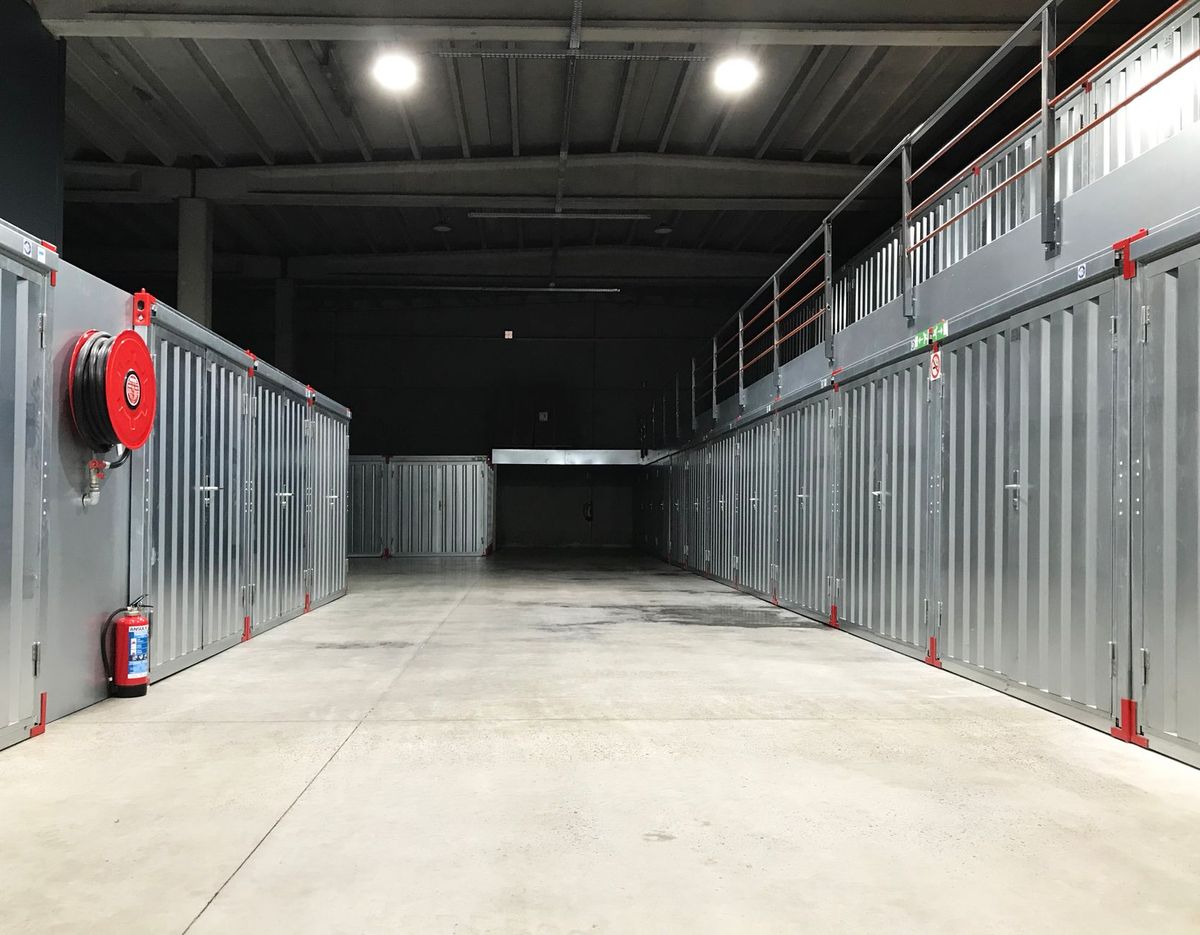
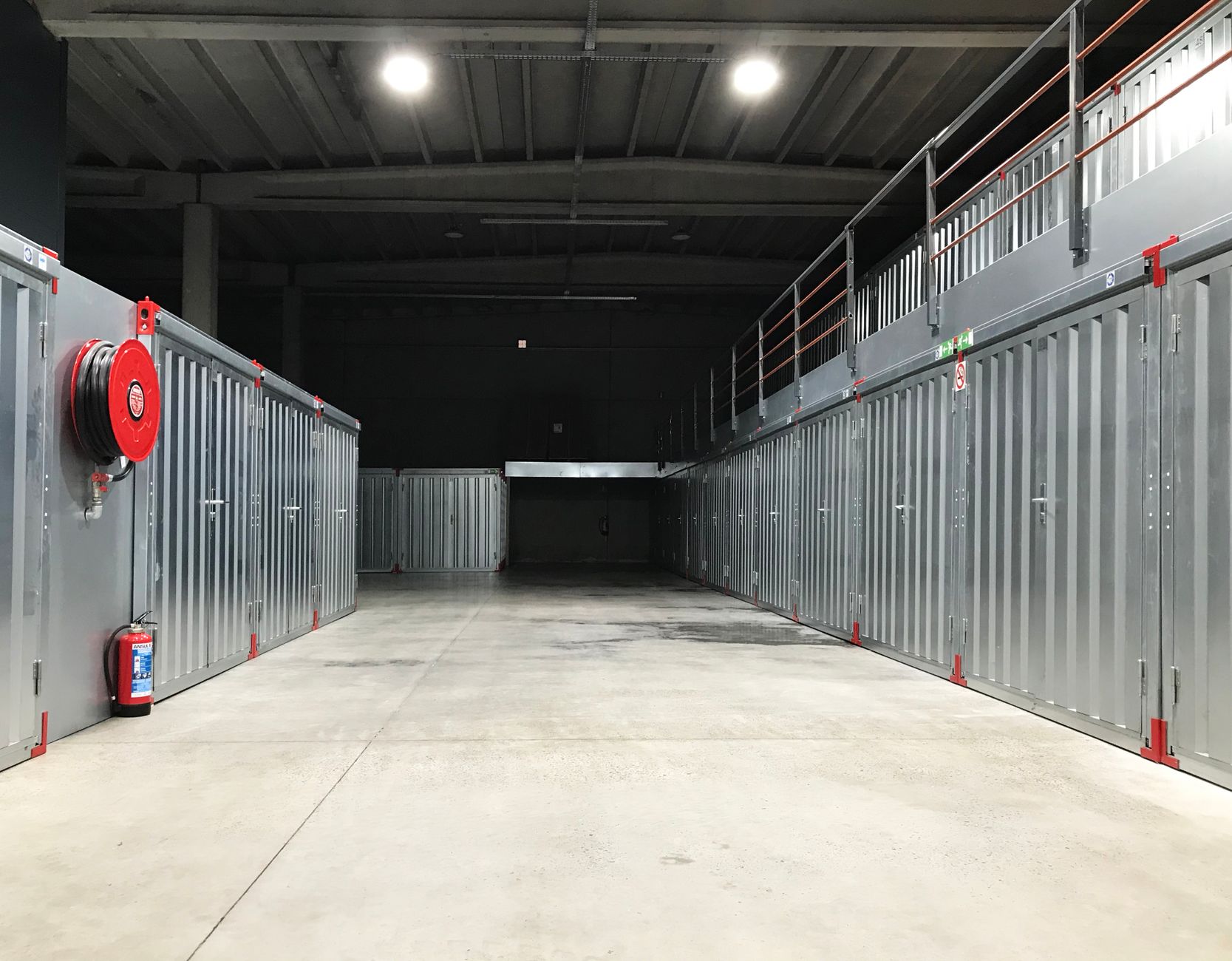
This is the cheapest storage you can legally build. Steel frame, metal skin, roll-up doors, a slab-on-grade, and drive aisles between rows. No conditioning, minimal electrical, no elevators. My shop delivers these in the $28 to $38 range on a clean pad, and the true value-market builders push the low end toward $25 with volume steel buying.
The economics are simple, which is why first-time storage developers start here. Fewer trades, faster schedule, and the highest rentable efficiency of any storage type. The catch is per-acre revenue: single-story spreads your rentable feet across a lot of dirt, so it only pencils where land is cheap.
Multi-Story Climate-Controlled: The $55-$75 Premium
Stack it three or four stories and add conditioning, and you are in a different building code chapter. Now you carry elevators, fire sprinklers throughout, interior corridors, a full building envelope with insulation, and HVAC sized to hold roughly 55°F to 80°F year-round. That climate system alone adds $8 to $18 per SF depending on whether you run split systems or a central plant.
I quote these at $55 to $75 per gross SF, and the top of that band is real in coastal metros. The upside is revenue density: climate-controlled units rent at a premium, and stacking three floors on the same pad triples your rentable feet per acre. You pay more per foot and per rentable foot, but the land leverage can make the return work where single-story never would.
The Climate-Controlled Middle: $42-$60 Single-Story
The sweet spot a lot of my clients land on is single-story climate-controlled. You add the insulated envelope and HVAC but skip the elevators, stair towers, and corridor losses that eat multi-story efficiency. That keeps you at 85% to 90% rentable while still commanding the climate-controlled rent premium. At $42 to $60 per SF, it is the highest-return tier in a lot of Sun Belt markets.
Component Breakdown: Where the Money Goes
Developers always ask me to itemize, so here is a representative single-story climate-controlled build at roughly $50 per gross SF. This is where you find the money when you value-engineer.
| Component | Cost per SF | Share of hard cost |
|---|---|---|
| Foundation and slab-on-grade | $7 - $10 | ~17% |
| PEMB steel shell and roof | $12 - $16 | ~28% |
| Insulated wall panels and envelope | $6 - $9 | ~15% |
| Roll-up doors and interior partitions | $4 - $6 | ~10% |
| HVAC / climate system | $8 - $18 | ~20% |
| Electrical, fire, security | $4 - $7 | ~10% |
The Slab Is Not the Place to Cheap Out
That foundation line runs $7 to $10 per SF, and I fight clients who want to thin the slab to save a dollar. A storage slab takes forklift and hand-truck loads plus point loads from stacked tenant goods. A 5-inch slab with proper control joints is standard; go thinner and you get cracking and joint spalling that shows up as a maintenance line for 30 years. If you want to sanity-check your concrete quantity before you bid, run it through the concrete calculator and compare against your sub's number.
HVAC Is the Swing Line
The climate system is the single most variable component, from $8 per SF for a simple split-system approach up to $18 for a zoned central plant with tighter humidity control. In humid markets, humidity control is not optional, because tenants will not pay a premium for a "climate-controlled" unit that sweats their photo albums into mildew. I price this line last and I price it honest, because it is where cheap bids hide their shortfalls.
For context on how storage stacks up against the broader industrial box, compare these to warehouse construction cost per square foot — storage and dry warehouse share the PEMB DNA but diverge hard on rentable efficiency and door count. And to see where steel and material inputs sit against the wider market, the 2026 construction cost index tracks the shell inputs that drive your biggest line item.
Soft Costs and the All-In Number
Everything above is hard cost. To get to a real project budget, my shop adds 18% to 28% for soft costs: architecture and engineering, permits and impact fees, the storage-specific site plan approval fight, financing costs, and a contingency I never let drop below 5%. On a single-story drive-up, that pushes an all-in of maybe $35 to $55 per SF. On a multi-story climate-controlled build, all-in lands at $70 to $95 per gross SF before land.
Land is its own conversation and swings from $3 per buildable SF in a rural market to $40-plus in an infill urban site. I keep it out of the per-SF construction number on purpose, because mixing land into hard cost is how developers fool themselves into thinking their contractor is expensive when the dirt is the problem. Model your full stack in the cost estimator with tier, site condition, and soft-cost load as separate inputs, and the number you hand your lender will hold up under scrutiny. For state-by-state ranges adjusted to local labor rates, see our self-storage construction cost guide.
Frequently Asked Questions
How much does it cost to build a self-storage facility per square foot in 2026?
Hard cost runs $25 to $45 per gross square foot for single-story drive-up, and $55 to $75 for multi-story climate-controlled. Add 18% to 28% for soft costs and you land at an all-in of roughly $35 to $95 per gross SF depending on type, before land. High-cost metros with prevailing wage push the top of every band up 20% to 35%.
Why is multi-story self storage so much more expensive per rentable foot?
Two reasons stack up. Multi-story carries elevators, stair towers, corridors, and full fire sprinkler coverage that single-story skips, and it only converts 65% to 78% of gross area into rentable units versus 90%-plus for drive-up. You pay more per gross foot and you rent fewer of those feet, so effective cost per rentable SF can run 40% to 80% higher.
Is climate-controlled storage worth the extra construction cost?
The climate envelope and HVAC add roughly $12 to $25 per SF, but climate-controlled units command meaningful rent premiums and hold occupancy better in downturns. In humid and hot markets the premium pays back on the pro forma. In mild-climate rural markets where land is cheap, single-story drive-up often returns more per dollar invested.
What percentage of self-storage cost is site work?
On a clean, flat infill pad, site work runs $5 to $8 per building SF, roughly 15% to 20% of hard cost. On sloped or wet sites needing retention, import fill, or extensive utility runs, it climbs to $15 to $20 per SF and can become the single largest line item. Site conditions kill more storage deals than vertical construction cost does.
How does self-storage compare to warehouse construction cost?
They share pre-engineered metal building construction, so the shells are cousins. Dry warehouse runs a similar $50 to $90 per SF range, but warehouse carries higher clear heights, dock equipment, and heavier slabs, while storage carries far more roll-up doors and interior partitions. Storage wins on rentable efficiency for single-story; warehouse wins on per-acre revenue at scale.
Your Action Item for This Week
Pull the last self-storage pro forma you touched, or the one you are chasing, and re-cut every construction number two ways: per gross square foot and per net rentable square foot. Apply the rentable ratio for your actual build type from the table above (90% single-story, 70% multi-story climate-controlled), then divide your hard cost by rentable feet, not gross. If the per-rentable number does not clear your lender's debt-service coverage with a 5% contingency baked in, you found the problem before the bank did. That single re-cut is the difference between a deal that funds and a deal that stalls in underwriting.