Last fall a developer I know called me asking what a "small car wash" should cost. He had a corner lot under contract, a Sonny's rep in his ear, and a banker waiting on a number.
I asked him one question. "Tunnel or self-serve?"
He didn't know. That right there told me he was about $400,000 short on whatever number was in his head.
I've estimated and built parts of nine car washes in the last seven years — three tunnels, four express exteriors, and two in-bay automatics on existing convenience-store sites. I've seen enough budgets get blown up by the same three or four mistakes that I want to put real numbers in front of anyone thinking about this asset class in 2026.
What a Car Wash Actually Costs in 2026
There are three models worth talking about. The cost spread between them is enormous, and they each serve completely different customers.
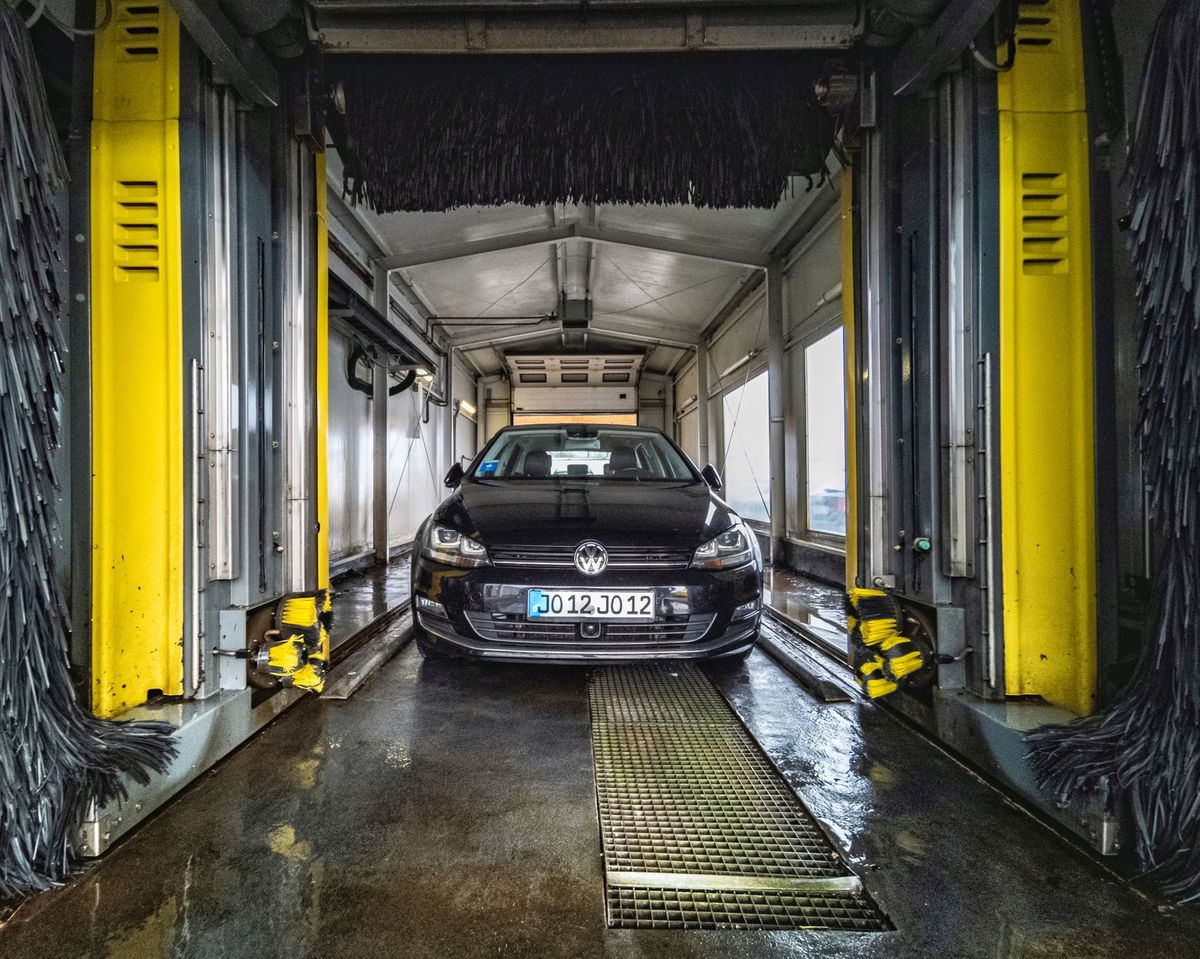
Tunnel (conveyorized) wash — $1.0M to $1.8M. A 100-foot tunnel on a mid-Atlantic infill site lands right around $1.2M all-in. Push it to 130 feet with a full canopy of 30 vacuum stalls and you're at $1.7M to $1.8M before soft costs. Tunnel length is the single biggest cost lever in the project — every additional 10 feet of conveyor adds $80K to $120K between structure, equipment, water lines, and chemical feed.
Express exterior — $500K to $800K. Shorter conveyor, no detail bays, smaller building shell. These run 60 to 80 feet of tunnel with a stripped-down vacuum row. Total build, not counting land, is $600K to $750K on a typical pad site. They've become the dominant new-build format because they generate volume without the labor headache.
Self-serve and in-bay automatic (IBA) — $300K to $600K. One to six bays under a single canopy. Equipment runs $80K to $150K for a single IBA versus $200K to $500K for a tunnel system. The construction is closer to a small CMU equipment building than a real commercial structure. The catch is the self-serve model is dying outside the Sun Belt — more on that below.
If you're trying to understand where car wash construction sits relative to other commercial work, my breakdown of commercial construction cost per square foot in 2026 is the right baseline — car wash buildings themselves are simple, but the equipment density is closer to a restaurant build-out than to retail.
Site Work and Permits — Where Budgets Quietly Blow Up
The dirty secret of car wash construction is that the site work and the permitting can equal the equipment cost, and almost nobody budgets for it correctly the first time out.
A typical car wash sits on a 0.75 to 1.5 acre corner lot. You're stacking 15 to 30 vacuum spaces, queue lanes, an entry/exit pattern that doesn't dump cars into rush-hour traffic, stormwater detention, and utility tie-ins for a building that uses 50 to 80 gallons per car. Add a teardown of whatever was on the lot before — usually an old gas station or tired strip retail — and you're looking at real money before you pour a footing.
Site work: $80K to $250K. Bare dirt with utilities at the curb is the low end. Environmental closure on old fuel tanks pushes you to the top fast. I had one express exterior where site work alone came in at $310K because of contaminated soils under a former service station — ate the developer's contingency in week three.
Permits and impact fees: $20K to $150K. A second-tier suburb might charge $25K total. A coastal California or Florida county with water-quality requirements can run $120K to $150K once you stack the building permit, plumbing permit, stormwater permit, water connection fee, sewer impact fee, and traffic study. Pull the impact fee schedule line-by-line before you sign a contract.
Permit timelines are the real killer. A new-construction car wash runs 6 to 14 months from submittal to issued permit in most jurisdictions. Existing site reuse cuts that roughly in half. With a developer chasing IRR and a banker watching carrying costs, that 6-month delta is worth real money. I tell every client to chase a reuse site before they look at raw dirt.
Want to sanity-check your number? Drop it into the Buildermuse cost estimator before you lock in the GMP — it's the gut-check I run on every concept-stage budget.
Equipment Costs by Vendor
The tunnel system is the most expensive single line item on a tunnel-wash build, and vendor choice matters more than people think.
Sonny's Enterprises. The dominant tunnel-equipment vendor in the US. A turnkey 100-foot Sonny's package — conveyor, arches, dryers, chemical delivery, water lines, controls — runs $280K to $420K. Their service network is the deepest, which matters when you're 18 months in and a bearing seizes at 7 AM on a Saturday.
MacNeil Wash Systems. Comparable pricing — $260K to $400K for a full 100-foot package. MacNeil has a reputation for cleaner-finishing arches and slightly better dryer performance.
Belanger / NS Wash Systems. Belanger dominates the in-bay automatic market. A new touchless IBA package runs $80K to $130K installed; a soft-touch friction IBA runs $100K to $160K. For a single-bay self-serve site, you're more likely buying Belanger or Washworld than Sonny's or MacNeil.
The line that gets undercounted is the vacuum island canopy plus the vacs and arches. Twenty vacuum stalls with a steel-frame canopy, lighting, and the vacuum manifold runs $35K to $60K. People see "vacuums are free" on the marketing material and assume the infrastructure is free too. It isn't.
Water Reclaim Systems Are No Longer Optional
This is the cost line that's blown up the most in the last five years, and the one I see new developers screwing up most consistently.
Water reclaim — recycling 50% to 80% of the wash water through filtration and reusing it on the pre-soak and undercarriage cycles — used to be a "nice to have" in dry markets. It's now effectively mandatory in:
- All of California, Arizona, Nevada, and most of New Mexico
- Most of Florida south of I-4, plus the Tampa Bay counties
- Coastal South Carolina, Georgia, and the Texas Hill Country
- A growing number of Colorado, Utah, and Oregon municipalities
The system itself is $30K to $80K installed depending on capacity. A 100-foot tunnel doing 50,000 cars a year needs roughly a 60-gallon-per-minute reclaim system — $55K to $70K from MacNeil, Sonny's, or a third party like New Wave or PurClean. Add the equipment room space for reclaim tanks and you're expanding your building footprint by 200 to 400 SF, another $40K to $80K in shell cost.
The mistake I watch developers make: they budget $30K for "water recycling" because that was the number five years ago, then the municipality requires a sub-10 NTU discharge spec. Now they're at $75K plus the equipment room expansion, $80K over budget before pouring concrete.
If your jurisdiction has water rates above $8 per thousand gallons, reclaim pays for itself in 24 to 36 months even when it isn't required. Run the math against your local material and utility cost trends before value-engineering it out.
Why Express Exterior Won the Volume Game
Walk any growth metro right now — Charlotte, Phoenix, Nashville, Tampa, Boise — and the car wash on every other corner is the express exterior. There's a reason.
Express exterior strips out everything that requires labor. No detail bay, no interior cleaning, no tire-shine attendant. The customer drives onto the conveyor, the tunnel washes the car, the customer drives off and uses a free vacuum. One attendant on the load lane, sometimes a second on membership signups, and that's the entire labor model.
The economics are brutal in the operator's favor. A well-located express pushing 80,000 to 120,000 cars a year at a $20/month unlimited membership generates $1.5M to $2.5M in annual revenue with 6 to 9 employees total. Capital cost is $600K to $800K for the build plus $300K to $600K for land. That IRR math is the entire reason private equity has poured north of $4 billion into the space since 2020.
The catch: express exterior only works if you have the lot. You need 0.9 to 1.4 acres for proper stacking and a vacuum island that can handle peak Saturday demand. Dense urban infill sites can't fit it, which is why IBAs and small tunnels still dominate city pad sites.
Common Estimating Mistakes
Things I watch first-time car wash developers blow money on, in rough order of frequency:
Underestimating the POS and membership platform. A Sonny's CarWashCRM or DRB Patheon package — license plate recognition, RFID tags, customer app, membership management — runs $25K to $80K. Almost nobody includes this in their first budget.
Forgetting the equipment room HVAC. Tunnel equipment rooms run hot. You need a 3 to 5 ton split system plus dehumidification. Add $12K to $25K.
Underbudgeting canopy electrical. Vacuum islands need 200A subpanels, LED lighting on a separate circuit, and pay-station rough-ins at every stall. That's $20K to $40K easy to skip on a quick pro forma.
Skipping the LP gas line for cold-weather operations. Any market that hits freezing needs heat trace on water lines and supplemental tunnel heating. $15K to $35K plus operating gas cost. Southern operators forget this when they expand north.
Ignoring stormwater retention. Most municipalities require on-site detention for a 25-year or 100-year event, and car washes are nearly all impervious surface. Underground detention chambers run $25K to $75K.
The fix is the same for all of them: build your budget line-by-line from a real equipment quote and a real civil set, not a per-square-foot rule of thumb. Car wash construction doesn't price like commercial buildings — the equipment is the project.
ROI Math: Membership Model vs Pay-Per-Wash
The economic case for a new car wash in 2026 lives or dies on the membership model. Get the math wrong and you'll misjudge how much you can spend on the build.
Pay-per-wash baseline. A standalone tunnel pushing 50,000 paid washes a year at an $11 average ticket generates $550K in top-line revenue. After labor, chemicals, utilities, and debt service on a $1.2M build, that's a fine but unremarkable business.
Unlimited membership flip. Convert 35% of those customers to a $25/month unlimited membership and the same site generates $750K to $900K — slightly higher cost basis since members wash more often, but the revenue is recurring and the cash collects on the first of the month before any cars show up.
The membership economics are why operators will spend $1.5M on a build that "only" generates $550K in pay-per-wash revenue. The asset isn't the building — it's the recurring revenue stream the building enables. A site doing 4,500 members at $25/month is a $1.35M annual revenue asset with the kind of cash-flow predictability that gets you a 7x to 10x revenue multiple at exit.
This is also why you have to overbuild the conveyor. A 100-foot tunnel doing 50 cars/hour at pay-per-wash needs to do 110 cars/hour at peak membership-Saturday throughput. Designing for pay-per-wash volumes and then retrofitting for membership is the most expensive mistake in this asset class — I've seen operators rip out and lengthen tunnels 18 months after opening.
The Buildermuse contractor directory breaks out builders by trade and state — several regional commercial GCs have built dedicated car wash divisions in the last three years.
The Bottom Line
A 100-foot tunnel in most secondary metros is a $1.1M to $1.3M build before land. An express exterior on a friendly pad site is $600K to $800K. A self-serve or IBA conversion of an existing convenience store is $300K to $500K and the right play in dense urban or cold-weather markets.
Where developers get hurt is treating it like a generic retail pad at $250/SF without itemizing the tunnel equipment, water reclaim, canopy electrical, and impact fees. Build the budget from the equipment quote up, not from a per-square-foot down. Sanity-check the number with the cost estimator tool and pad contingency at 12% to 15% on any teardown or environmental closure site.
Private equity is still deploying capital, the membership model is still proving out, and express exterior is still expanding into markets that have never seen it. Contractors who learn this niche now are going to have a steady book of $600K to $1.5M projects for the next five years minimum.
Frequently Asked Questions
How long does it take to build a car wash from permit to opening?
Once you have a building permit, construction runs 14 to 22 weeks for a tunnel wash, 10 to 16 weeks for an express exterior, and 8 to 12 weeks for an IBA. The wildcards are tunnel equipment lead time (10 to 18 weeks on Sonny's and MacNeil right now) and underground utility work. Permit timelines themselves run 6 to 14 months on new construction, much faster on reuse sites. Total timeline from land control to opening: 14 to 22 months ground-up, 8 to 14 months on a conversion.
What's the cheapest car wash to build that still pencils?
A single-bay touchless IBA on an existing convenience-store pad, using shared parking and existing utilities, runs $250K to $350K. Equipment is $80K to $130K, canopy and slab $40K, utility tie-ins $30K to $50K, permits $15K to $40K. The catch: single-bay IBAs only generate $80K to $150K in annual revenue, so they only pencil as an add-on amenity, not a standalone investment.
Why are express exterior car washes everywhere now?
Three reasons. The labor model is brutally simple — one or two attendants per shift versus eight to twelve at full-service. Unlimited memberships generate predictable recurring revenue that supports high acquisition multiples at exit. And per-car economics work even at low ticket prices because throughput is high and variable cost per wash is minimal. The combination has pulled in over $4 billion in PE capital since 2020.
Do I need water reclaim if my jurisdiction doesn't require it?
Yes, if water rates exceed roughly $8 per thousand gallons or sewer rates exceed $10 per thousand. A 50,000-car tunnel consumes 2.5 to 4 million gallons a year. Reclaiming 60% to 75% drops your water bill by $15K to $30K annually, paying back a $50K reclaim system in 2 to 3 years. It also gives you drought-restriction resilience even in cheap-water markets.
What's a realistic per-square-foot cost for a car wash building?
Per-SF math is misleading because equipment dominates the budget, but the building shell runs $120 to $250/SF for CMU-and-EIFS or pre-engineered metal. The full project on a per-SF basis ranges from $400/SF on a stripped IBA to $900/SF on a loaded tunnel with reclaim and premium POS. If someone quotes you "$300/SF" without breaking out equipment line items, walk away.
Is the self-serve car wash model still viable?
In the Sun Belt and dense urban infill markets, yes — particularly multi-bay self-serve combined with one or two IBAs. North of the Mason-Dixon line, it's dying. Cold-weather operations require heated bays, heat trace on every water line, and supplemental gas heating that crushes the economics. Customer preference has also shifted hard toward conveyor-based express exterior. If you're building new in 2026, it's a tunnel or express decision in 90% of markets.