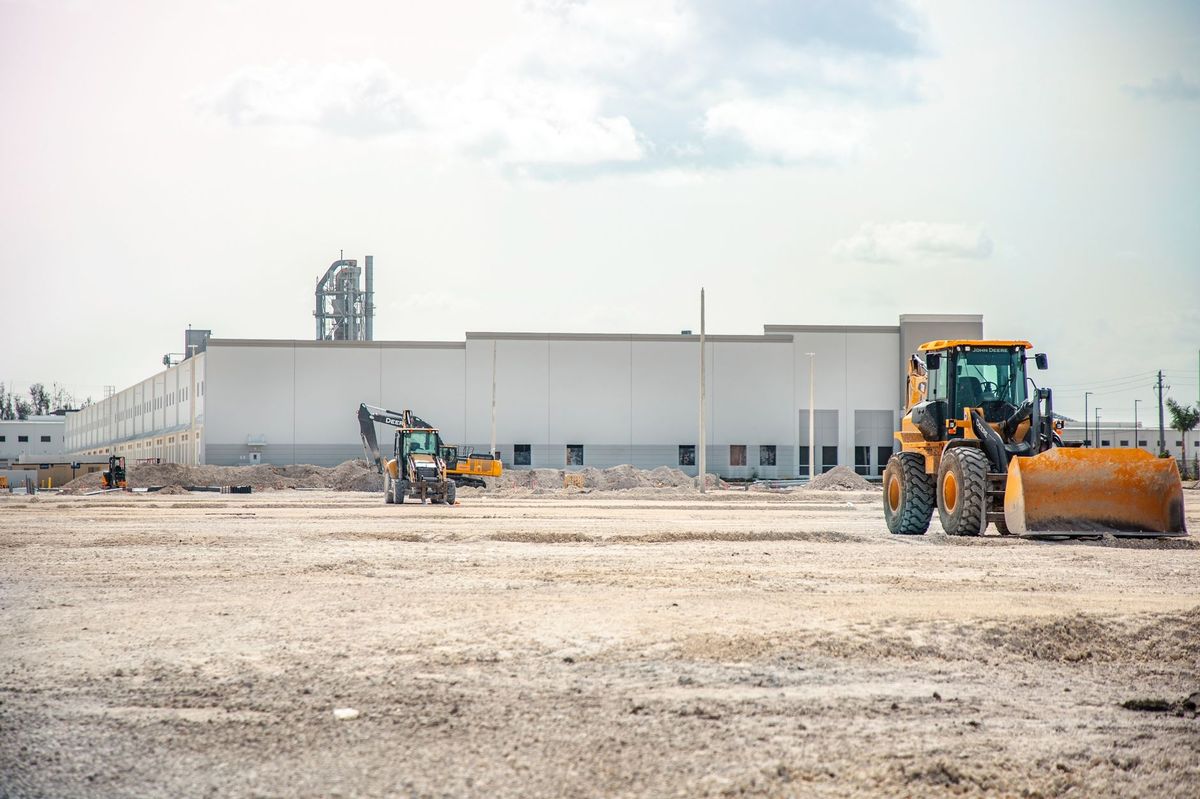
A tilt-up concrete distribution warehouse shell runs $85 per square foot nationally in 2026, with the real range sitting between $40 and $120 depending on clear height, geographic region, and whether you're spec-ing climate control or just a shell. I've bid 23 warehouse projects in the last three years and watched this number move from $72/SF in 2023 to $85 today. Material inflation and concrete labor tightening in key markets are real.
Here's the breakdown of warehouse construction cost, what moves the number, and how to distinguish between basic storage shells and sophisticated distribution centers.
Warehouse Types and Cost Ranges
Warehouse cost-per-square-foot varies dramatically based on functional type. A basic storage shed is a completely different project from a climate-controlled distribution center with automated racking.
Basic Storage Warehouse (Shell Only)
A basic storage shell — just roof, walls, and concrete floor for general storage — runs $40 to $60 per square foot. You're building a metal frame structure or concrete tilt-up, adding minimal mechanical (basic ventilation), no sophisticated electrical, no sophisticated fire suppression, and finish-quality flooring for forklifts and loading.
A 100,000 SF basic storage building at $50/SF costs $5 million. Material cost is roughly 55% (concrete, steel, roofing); labor is 25%; and general conditions plus GC overhead is 20%. This baseline aligns with commercial construction cost per square foot data at $165 to $200/SF for fully finished office, but warehouses prioritize open space over finishes.
Cross-Dock or Through-Warehouse
A cross-dock warehouse — designed for rapid product flow (goods arrive one dock, are immediately sorted, and depart another dock) — runs $70 to $100 per square foot. You need multiple dock doors positioned strategically, interior drive-through lanes for trailers, sophisticated electrical for lighting and sorting equipment, and possibly basic climate control for temperature-sensitive product.
A 150,000 SF cross-dock at $85/SF costs $12.75 million. The complexity is in layout design (dock positioning, trailer maneuvering room, interior aisle spacing) and electrical infrastructure for high bay lighting, conveyor systems, or sortation equipment.
Cold Storage or Temperature-Controlled
A cold storage warehouse with insulated walls and refrigeration systems runs $110 to $180 per square foot. The insulated structure (6 to 12 inches of polyurethane foam in the walls and roof) costs significantly more than uninsulated warehouse, and the refrigeration equipment, backup systems, and emergency protocols drive cost further up.
A 50,000 SF cold storage facility at $150/SF costs $7.5 million. About 35% of that is the refrigeration system and related mechanical equipment. The structure itself is expensive, but the specialized systems are the cost driver.
High-Bay Automated Warehouse
A high-bay automated warehouse (clear height of 40+ feet, with automated racking systems and conveyor/sortation technology) runs $120 to $180 per square foot. These are typically built to spec for sophisticated tenants (Amazon fulfillment centers, pharmaceutical distributors), with massive capital investment in building structure and integrated automation technology.
The cost is driven by clear height (40-foot clear height requires different structural systems than 24-foot), precision foundation requirements (automated racking requires tolerance control), and integrated building systems (backup power, sophisticated fire suppression, advanced HVAC for equipment heat load).
Cost Drivers: What Moves the Number Most
Five variables control the spread between $40/SF and $180/SF warehouse construction.
Clear height. A 24-foot clear height warehouse is fundamentally cheaper than a 40-foot clear height warehouse because you're using less material, less expensive structural systems, and less land footprint per square foot of storage. Clear height drives land use (taller building = less footprint = lower land cost), structural material requirements, and column spacing.
Taller warehouses use long-span steel trusses or exposed steel joists. 24-foot height uses simpler column-and-beam systems. A 32-foot clear height warehouse costs 15 to 20% more per square foot than a 24-foot equivalent. A 40-foot warehouse costs 30 to 50% more than 24-foot.
Dock equipment and door systems. Dock doors, levelers, shelters, and bumpers aren't cheap. A standard roll-up dock door runs $3,000 to $5,000. A powered dock leveler runs $2,500 to $4,000. A dock shelter (weather enclosure) runs $4,000 to $8,000. A 150,000 SF cross-dock warehouse with 40 dock positions needs 40 doors, 40 levelers, 20 dock shelters — that's $400,000 to $600,000 in dock equipment alone.
On a $12.75 million cross-dock project, dock equipment is 3 to 5% of total cost, but it's a discrete line item that can't be cut without losing functionality.
Fire suppression system. Warehouse fire suppression ranges from basic sprinkler to sophisticated systems. A standard wet sprinkler system costs $1.50 to $2.50 per square foot installed. An ESFR (Early Suppression Fast Response) system — designed for high-rack storage — costs $3.50 to $5.00 per square foot. Foam systems for flammable liquid storage cost $5.00 to $7.00 per square foot. Data centers and tech facilities often use advanced fire protection including clean-agent suppression, but warehouses typically spec standard or ESFR systems.
On a 100,000 SF warehouse:
- Basic wet sprinkler: $150,000 to $250,000
- ESFR for racking: $350,000 to $500,000
- Foam system: $500,000 to $700,000
For a standard distribution center with 30-foot racking, ESFR is typically spec'd — that's $1.50 to $2.50/SF of the total warehouse cost.
HVAC and climate control. A basic warehouse with natural ventilation (louvers, roof vents) adds minimal cost — maybe $0.50 to $1.00/SF. A climate-controlled warehouse with dedicated HVAC for temperature and humidity control costs $5.00 to $12.00/SF. The HVAC system includes rooftop units, ductwork (or destrat fans for open distribution centers), and controls.
A cross-dock might have basic climate control for office areas only, keeping the main warehouse at ambient temperature. A pharmaceutical distribution center must maintain 65 to 75 degrees and 35 to 55% RH throughout — that's a $5.00 to $8.00/SF HVAC investment.
Concrete foundation and site work. Warehouse foundations are thick and reinforced to handle racking loads, forklift traffic, and potential chemical spills. A basic warehouse slab runs 6 inches thick on compacted fill with standard reinforcement. A racked warehouse slab runs 8 to 10 inches thick with heavier reinforcement or post-tensioning to handle concentrated racking loads.
Concrete cost is roughly $4.50 to $6.00/SF of building footprint at current pricing (3,500 to 4,000 PSI mix, reinforcement, finishing). Site work (grading, drainage, paving, utilities) adds another $2.00 to $5.00/SF depending on site conditions and utilities proximity.
Tilt-Up vs. Steel Frame Warehouse
The two dominant structural systems for large warehouses are tilt-up concrete and steel frame with metal deck. The choice affects cost and timeline.
Tilt-up concrete: Cast walls horizontally on the site and tilt them up into place. Typical cost is $75 to $100/SF for a complete tilt-up building (shell + standard finishes). Advantages: faster timeline once site is ready (walls cast in parallel), lower material cost for concrete, excellent thermal mass for temperature moderation. Disadvantages: requires flat site with room for casting, weather-dependent during casting phase, difficult to modify if tenant needs change.
Steel frame: Erect structural steel columns and beams, add metal deck roof and walls. Typical cost is $80 to $120/SF. Advantages: adaptable to irregular sites, interior column-free layout possible, faster erection timeline, easier to modify for tenant-specific requirements. Disadvantages: higher material cost for steel (currently volatile pricing), requires more sophisticated connections and engineering.
For a standard rectangular distribution center on flat land, tilt-up is typically cheaper and faster. For irregular sites or when tenant flexibility matters, steel frame is often selected despite higher cost.
Regional Cost Variation
Warehouse construction costs vary significantly by region because labor costs, concrete pricing, and land value vary.
Sun Belt (TX, GA, NC, SC, FL): $70 to $95/SF. Highest construction volume nationally. Competitive labor markets, moderate concrete pricing, flat land. Texas and Georgia are the most cost-competitive warehouse markets.
Midwest (IL, IN, OH, MN): $75 to $100/SF. Strong logistics hubs (Chicago, Indianapolis) drive volume. Union labor in major metros increases costs slightly. Older industrial land is available at reasonable cost.
West Coast (CA, WA, OR): $100 to $140/SF. High labor costs, expensive concrete, seismic design requirements. California warehouse construction is among the most expensive in the nation.
Northeast (NY, NJ, CT, MA): $95 to $130/SF. High labor costs, congested sites with challenging logistics. Fewer large-format warehouse sites available drives up land value and construction cost.
Mountain West (CO, UT, AZ): $85 to $110/SF. Moderate costs with growing logistics activity. Denver and Salt Lake City markets tightening slightly due to distribution center demand.
The regional cost variation is 40 to 50% between cheapest (Sun Belt) and most expensive (coastal California). A $12 million project in Georgia might cost $15 to $16 million in California at the same specifications.
Tenant-Specific Customization
Most warehouses are built to spec (developer-built, tenant-to-be-determined) with generic configurations. When a tenant pre-leases, customization adds cost:
Specialized racking integration: $2,000 to $5,000 per racking row for structural bracing, reinforced floors, or power infrastructure for automated racking systems.
Specialized dock configuration: Custom dock positioning (internal docs, drive-through docs, or atypical spacing) adds $1,000 to $3,000 per dock position.
Tenant-specific electrical and IT: Distributed electrical panels, data cabling, high-density power for sortation equipment adds $3.00 to $8.00/SF depending on sophistication.
Specialized environmental controls: Advanced HVAC with humidity control, backup power systems, redundant mechanical equipment for mission-critical tenants (pharmaceutical, tech manufacturers) adds $5.00 to $15.00/SF.
Timeline: Permit to Completion
A 150,000 SF warehouse typically takes 14 to 18 months from project start to tenant occupancy:
- Site acquisition and design: 3 to 6 months
- Permitting and approvals: 2 to 4 months
- Site work and foundation: 2 to 3 months
- Structural (tilt-up or steel): 2 to 4 months
- Building envelope and MEP: 2 to 3 months
- Finishes, testing, and punch list: 1 to 2 months
Weather delays on concrete pours (tilt-up) or structural erection (steel) can add 4 to 8 weeks. Tenant coordination during construction adds unpredictability if customizations arise during construction.
Warehouse Market Context
The distribution center construction market in 2026 is normalizing after the 2020-2023 boom. According to ENR and commercial real estate data, the market absorbed massive warehouse capacity growth during e-commerce expansion. Vacancy rates remain low (6 to 8% nationally), but new construction is moderating from the frenzy of 2021-2022. Warehouse construction slowed 22% after a 3-year boom, which is reflected in tighter labor markets and higher costs per square foot in competitive regions.
The shift is toward higher-quality facilities. New warehouses spec 32+ foot clear height and sophisticated systems (ESFR fire suppression, advanced HVAC) to compete for quality tenants. Marginal older facilities (20-foot clear height, basic fire sprinklers) are being repurposed or devalued. The $85/SF benchmark reflects this shift toward better-quality construction.
Your Action Item for This Week
If you're bidding a warehouse project, confirm the clear height requirement first — it's the biggest cost driver. A 24-foot warehouse vs. a 32-foot warehouse is a 20% cost difference at the same footprint. Confirm dock position count and type (standard roll-up vs. drive-through vs. interior docks). Verify fire suppression requirement (basic sprinkler vs. ESFR) in your code jurisdiction. Then use the $85/SF benchmark for a basic distribution center, adjust by 15% per foot of clear height above 24 feet, add dock equipment at $10,000 to $15,000 per position, and add fire suppression cost at $2.00 to $3.00/SF. That methodology gives you a credible preliminary estimate.
Want project-specific numbers? Our free cost estimator and markup margin calculator do the math in a couple of minutes.
Frequently Asked Questions
What is the average cost per square foot for a warehouse?
A standard tilt-up distribution warehouse shell runs $85 per square foot nationally in 2026, with the range from $40 for basic storage to $180 for high-bay automated facilities. The cost is driven by clear height, dock configuration, fire suppression type, and geographic region.
What is the difference between warehouse construction and office building construction?
Warehouses prioritize clear open space with minimal interior columns, high clear heights (24 to 40+ feet), heavy-duty flooring and structural systems for racking/product storage, and sophisticated loading dock equipment. Office buildings prioritize column-free tenant spaces at standard 9-foot floor-to-floor heights, sophisticated HVAC and electrical for office occupancy, and finish-quality finishes. Warehouse cost-per-SF is typically 40 to 50% lower than office, but total project cost can be similar because warehouses are much larger (100,000+ SF vs. office buildings at 50,000 to 200,000 SF).
How much does a dock door cost?
A standard roll-up dock door runs $3,000 to $5,000. A powered dock leveler runs $2,500 to $4,000. A dock shelter runs $4,000 to $8,000. On a warehouse with multiple docks, dock equipment can represent $400,000 to $600,000 of total project cost.
What type of flooring is used in a warehouse?
Warehouse floors are typically 6-inch concrete slabs reinforced with wire mesh or fiber reinforcement, finished with epoxy or polyurea coating rated for forklift traffic. The coating system costs $2.00 to $4.00/SF applied. Some warehouses use polished concrete finish for aesthetic value and minimal dust; others use basic broom finish for cost savings.
How do I know what clear height my warehouse needs?
Clear height determines storage capacity (more height = more product capacity), structural cost, and the type of equipment that can be used. Standard multi-tier racking runs 30 to 35 feet. Automated racking requires 40+ feet. General storage can use 24-foot clear height. Confirm with the prospective tenant or your business plan what racking height is required, then design clear height to accommodate it with 2 to 3 feet clearance above racking top.
What is the difference between cross-dock and general storage warehouse?
A cross-dock warehouse is designed for rapid product flow — goods arrive one dock, are immediately sorted and staged, and depart another dock within hours. Cross-docks need interior drive-through lanes for trailers, strategic dock positioning, and conveyor or sortation systems. General storage warehouses store product for longer periods and typically use dense racking. Cross-dock construction is more expensive ($75 to $100/SF) than general storage due to complexity; general storage runs $65 to $85/SF.