American seaports are in the midst of the most aggressive modernization cycle in a generation, with $17.3 billion in active construction projects across 42 port facilities as of Q1 2026. The construction surge is driven by the convergence of post-pandemic supply chain restructuring, the shift to larger vessel classes requiring deeper channels and longer berths, federal IIJA port infrastructure funding, and growing competition from Gulf Coast and Southeast ports seeking to capture trade diverted from congested West Coast gateways.
The numbers tell a different story than the typical supply chain crisis narrative. The current port construction wave isn't a reactive response to the 2021-2022 congestion crisis — it's a structural realignment of American trade infrastructure that began before the pandemic and will continue through the early 2030s.
Active Construction by Region
Port construction spending is distributed across four coastal regions, with Gulf Coast and Southeast ports leading in both total spending and growth rate:
Gulf Coast: $5.8 billion. Port Houston leads with $1.9 billion in active construction including Project 11 channel deepening from 45 to 56.5 feet, new container terminal berths capable of serving 14,000+ TEU vessels, and wharf reconstruction projects replacing 1960s-era infrastructure. Port of Savannah follows at $1.4 billion including the Mason Mega Rail Terminal nearing completion, berth expansion adding 2,100 linear feet of new wharf, and 200 acres of new container yard construction. Port of Mobile has $850 million for a new container terminal and channel deepening to 50 feet. Port of New Orleans has $680 million for Napoleon Avenue Terminal expansion and cruise terminal construction. Other Gulf ports account for $980 million combined.
East Coast: $4.6 billion. The Port of New York/New Jersey leads at $2.1 billion for terminal automation upgrades, berth deepening to accommodate post-Panamax vessels, and intermodal improvements enabled by the completed Bayonne Bridge raise. Port of Virginia at $1.4 billion includes NIT South expansion and the nation's most ambitious automated terminal program. Port of Baltimore at $550 million includes Seagirt Terminal expansion and the critical Howard Street Tunnel clearance project that will allow double-stack rail service. Port of Charleston at $550 million includes Hugh K. Leatherman Terminal Phase 2 construction.
West Coast: $4.2 billion. Port of Long Beach leads at $1.6 billion for the Pier B On-Dock Rail Support Facility ($870 million alone), Middle Harbor Terminal completion, and Pier Wind offshore wind staging area construction. Port of Los Angeles at $1.3 billion for TraPac Terminal modernization, Everport Terminal expansion, and Outer Harbor electrification. Port of Oakland at $520 million for turning basin widening and the Seaport Logistics Center development. The Northwest Seaport Alliance (Seattle/Tacoma) at $780 million for Terminal 5 modernization and intermodal yard expansion.
Other regions account for $2.7 billion across Great Lakes ports, Pacific Northwest facilities, Hawaii, Alaska, and Puerto Rico.
Construction Categories and Technical Requirements
Port construction encompasses several specialized categories requiring distinct contractor capabilities:
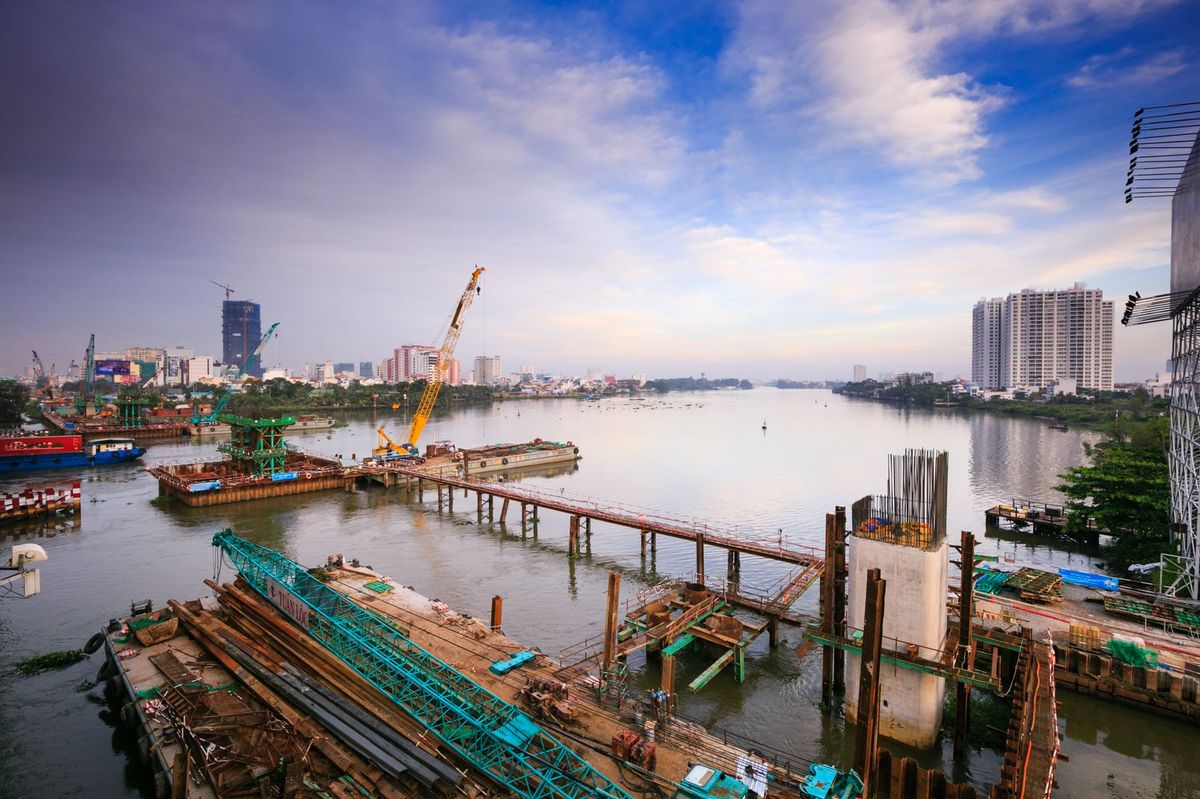
Channel Deepening and Navigation ($4.8 billion active). Deepening federal navigation channels to accommodate vessels drawing 50 feet or more requires dredging millions of cubic yards of sediment from channel bottoms. The work involves cutter suction dredges that excavate material through a rotating cutter head and pump slurry to disposal areas, trailing suction hopper dredges that self-load while underway and transport material to ocean disposal sites, and mechanical dredges using clamshell or environmental buckets for precision work near structures. Major channel projects include Port Houston's Project 11 at $1.6 billion for deepening 52 miles of the Houston Ship Channel, Savannah Harbor Expansion completing deepening to 47 feet at $973 million, Mobile Harbor at $450 million, and Jacksonville Harbor at $484 million.
The dredging contractor market is highly concentrated due to the Jones Act, which requires that dredging in US waters be performed by US-flag vessels. The top four dredging firms — Great Lakes Dredge & Dock, Weeks Marine, Manson Construction, and Cashman Dredging — handle the majority of federal and private dredging work. Equipment constraints, particularly for large cutter suction dredges, limit the industry's ability to rapidly scale capacity.
Container Terminal Construction ($5.2 billion active). Modern container terminals are among the most demanding construction environments in infrastructure. The wharf structure must support ship-to-shore gantry cranes weighing 2,000 to 2,500 tons with wheel loads exceeding 60 tons per corner. Container yards require reinforced concrete or heavy-duty asphalt pavement designed for stacking loads of 60+ tons per TEU ground slot in blocks 6 to 8 containers wide and 4 to 6 high. Automated terminals require precision-graded surfaces within tight tolerances for automated guided vehicles (AGVs) or automated straddle carriers.
Terminal construction involves marine pile driving — typically 24 to 48-inch steel pipe piles driven 80 to 150 feet into marine sediments — mass concrete placement for wharf decks and crane rails, heavy-duty paving for container yards often exceeding 500 acres, and complex electrical and controls systems for terminal operating systems, automated equipment, and ship-to-shore crane power supply.
Berth Reconstruction ($2.8 billion active). Upgrading 1960s and 1970s-era wharves to accommodate today's ultra-large container vessels is among the most complex port construction challenges. The work typically requires demolishing existing wharf structures while maintaining adjacent terminal operations, driving new piles to greater depths, constructing new wharf decks at wider dimensions, and installing modern fender systems, mooring hardware, and crane rail foundations. Phasing constraints — the need to maintain port operations during construction — frequently extend project timelines and increase costs by 15 to 25% compared to greenfield terminal construction.
Intermodal Rail Facilities ($2.3 billion active). Efficient port-to-rail connections are critical for inland distribution. On-dock rail (where trains load directly at the terminal) is the gold standard, but near-dock rail yards that connect to terminals via short drayage moves are more common due to space constraints at existing ports. Major rail projects include the Port of Long Beach Pier B On-Dock Rail at $870 million (the largest single port rail investment in US history), Savannah Mason Mega Rail at $220 million, and Virginia Central Rail Yard at $350 million.
Electrification and Environmental Systems ($1.2 billion active). Regulations in California, Washington, and other states require shore power connections (cold-ironing) for vessels at berth, zero-emission cargo handling equipment (electric RTG cranes, battery-electric yard tractors), and reduced criteria pollutant and greenhouse gas emissions from port operations. The electrical infrastructure required is substantial — a single large container vessel using shore power draws 7 to 12 MW, equivalent to the peak demand of a small town.
Workforce and Contractor Analysis
Port construction employs an estimated 35,000 to 45,000 construction workers nationally across all active projects. The specialized nature of marine construction creates workforce challenges. Marine pile drivers require experience in over-water barge operations, tidal management, and vessel traffic coordination — skills requiring years to develop. Concrete workers on marine structures must work in challenging conditions including saltwater exposure, tidal cycles, and confined spaces within cofferdam enclosures.
Key workforce categories in demand include marine pile drivers at approximately 5,000 positions, heavy equipment operators at 8,000, ironworkers and steel erectors at 4,000, electricians and controls technicians for terminal automation at 3,500, concrete workers at 6,000, and dredge operators at 2,500.
Federal Funding and Pipeline
The IIJA provided $2.25 billion for port infrastructure through PIDP grants and Army Corps construction accounts. PIDP grants awarded total approximately $1.8 billion across 150+ projects. Corps construction spending has increased from $800 million to $1.2 billion annually. The Corps' authorized navigation project backlog exceeds $10 billion.
Outlook
An additional $12 to $18 billion in planned port projects are in design and permitting, with construction expected between 2027 and 2030. These include Phase 2 expansions at Houston, Virginia, and Savannah, new offshore terminal concepts at Los Angeles, cruise terminal construction across Florida, and LNG export terminal construction on the Gulf Coast.
For construction firms with marine and heavy civil capabilities, port modernization represents a decade-long opportunity with diversified funding and growing demand driven by global trade growth, vessel size increases, and supply chain diversification strategies.
Port Construction Technology and Innovation
Port construction is adopting several technologies that increase productivity and quality:
Automated Survey and Monitoring using real-time kinematic (RTK) GPS, total stations, and drone-based photogrammetry provide continuous monitoring of pile driving accuracy, wharf alignment, and dredging progress. Machine-controlled dredging using GPS-guided cutter heads can achieve channel bottom tolerances within 6 inches of design grade, reducing over-dredging waste and material disposal costs.
Precast Concrete Elements for wharf construction reduce on-site construction time and improve quality. Precast deck panels, bulkhead sections, and fender panels are manufactured in controlled conditions and transported to the site for installation. The Port of Virginia's NIT South expansion uses extensive precast concrete to accelerate wharf construction while maintaining terminal operations on adjacent berths.
Self-Compacting Concrete (SCC) is increasingly used for marine concrete placement where conventional vibration is difficult — underwater tremie pours, congested reinforcing steel configurations, and form sections with limited access. SCC flows under its own weight to fill forms without mechanical vibration, reducing labor requirements and improving concrete quality in demanding marine environments.
Real-Time Environmental Monitoring is now required for most port construction projects. Turbidity monitoring during dredging, noise monitoring during pile driving, and air quality monitoring during paving and painting operations require continuous data collection and reporting. Non-compliance with environmental thresholds can trigger construction shutdowns — a risk that project managers must actively manage through equipment selection, work scheduling, and real-time monitoring response protocols.
The Logistics Challenge: Building While Operating
Perhaps the greatest challenge in port construction is maintaining port operations during construction. Container terminals cannot simply shut down for multi-year construction projects — the economic impact of diverting vessel traffic to competing ports would be catastrophic. This constraint means that port construction projects must be meticulously phased to maintain minimum berth availability, with construction occurring in isolated zones while adjacent terminal areas continue operating.
The operational constraint affects every aspect of construction planning: crane operations must be coordinated with vessel schedules, heavy construction traffic must share roads with container trucks and chassis, construction noise and vibration must be managed to avoid disrupting automated equipment calibration, and security protocols must be maintained throughout the construction zone. These constraints typically add 15 to 25% to construction costs compared to greenfield development, and extend project timelines by 25 to 40%.
Automation and Technology in Port Construction
The current wave of port construction is incorporating automation technology at unprecedented levels, fundamentally changing the construction scope and contractor requirements for terminal development.
Automated Container Terminals at the Port of Virginia (NIT), Port of Long Beach (LBCT), and Port of Los Angeles (TraPac) use automated stacking cranes (ASCs) that operate on precisely constructed rail gauge foundations, requiring construction tolerances of less than 1/4 inch over hundreds of feet — far tighter than conventional crane rail installations. The civil infrastructure for automated terminals includes precision-graded travel lanes for automated guided vehicles (AGVs) with surface tolerances of 3mm over 3 meters, embedded guidance systems (magnets, transponders, or painted markings) installed during paving, and extensive underground conduit and communications infrastructure connecting thousands of sensors, cameras, and control points across the terminal.
Semi-Automated Operations including remote-controlled ship-to-shore cranes and automated gate systems require construction of operations control centers, fiber optic communication networks throughout the terminal, and camera and sensor mounting infrastructure on cranes, light poles, and terminal structures.
The technology integration requirements of automated terminal construction are creating a new specialty within port construction — contractors must coordinate closely with automation system vendors (ZPMC, Kalmar, Konecranes, and others) to ensure that civil infrastructure meets the extremely tight tolerances required for reliable automated operation.
Resilience Construction
Port facilities face unique resilience challenges from sea level rise, increased storm intensity, and seismic risk (for West Coast ports). Current port construction projects are incorporating resilience features including elevated wharf decks (designed for 2 to 3 feet of projected sea level rise), seismic-resistant pile cap and beam connections (particularly at California ports subject to stringent seismic design requirements), hardened electrical infrastructure with flood-resistant switchgear and elevated substations, and emergency backup power generation capable of maintaining critical terminal operations during extended grid outages.
These resilience features add 5 to 15% to port construction costs but provide essential protection for infrastructure assets with 50-year or longer service lives that must remain operational through changing environmental conditions.
Related Reading
Frequently Asked Questions
How much federal funding goes to port construction spending us?
Federal and state data confirm that port construction spending us continues to be a major factor in 2026 construction planning. The latest available figure of $17.3 billion provides a useful baseline, though actual costs vary by region, project scope, and market conditions. Contractors should request updated quotes from suppliers and subcontractors before finalizing bids.
Which states benefit most from port construction spending us?
Market research on port construction spending us shows that geographic concentration matters significantly. With figures reaching $5.8 billion in key markets, the opportunities are substantial but location-dependent. States with strong population growth and infrastructure investment tend to see the highest activity levels.
What is the timeline for port construction spending us projects?
Year-over-year comparisons for port construction spending us show meaningful change. The figure of $1.9 billion from current data represents a shift that contractors need to account for in their planning and bidding strategies. Historical trend analysis suggests this trajectory may continue through the end of the year.