American electric utilities are spending $28 billion annually on grid construction and modernization — a figure that has doubled since 2019 and is projected to reach $40 billion per year by 2030. The surge is driven by the convergence of aging infrastructure exceeding design life, electrification of transportation and buildings increasing peak demand, extreme weather events exposing grid vulnerabilities, and the need to connect remote renewable energy generation with distant population centers.
The numbers tell a different story than the simplified clean energy transition framing. While renewable energy interconnection drives significant grid construction spending, the largest category — approximately 45% of the total — is replacing and hardening existing infrastructure that is simply wearing out after 50 to 70 years of continuous service.
Where the $28 Billion Goes
Electric grid construction spending breaks into four major categories:
Transmission Line Construction: $10.2 billion annually. High-voltage transmission lines (138kV to 765kV) carry bulk power from generation sources to load centers across long distances. The current transmission construction boom includes both replacement of aging lines built in the 1960s and 1970s and entirely new construction to connect renewable energy zones to the existing grid.
Major active and recently initiated transmission projects illustrate the scale. SunZia Transmission in New Mexico and Arizona represents $4.5 billion for 550 miles of HVDC transmission connecting 3,500 MW of wind generation. Grain Belt Express from Kansas to Indiana is $5.2 billion for 800 miles of HVDC connecting 7,000 MW of wind and solar. TransWest Express from Wyoming to the Desert Southwest is $3.3 billion for 732 miles of HVDC connecting 3,000 MW of wind. Champlain Hudson Power Express from Quebec to New York City is $5.7 billion for 339 miles of HVDC underground and underwater cable delivering 1,250 MW of Canadian hydroelectric power. These four projects alone represent $18.7 billion in construction spending requiring thousands of lineworkers and heavy equipment operators over multi-year build schedules.
Substation Construction and Upgrade: $7.8 billion annually. Substations transform voltage levels and route power flows across the grid. Construction demand includes new substations for growing load areas (data centers requiring 50 to 500+ MW are a major driver), upgrades to increase capacity at existing substations, replacement of aging transformers past their 40-year design life, and integration of battery energy storage and grid-forming inverters. A new 345kV/138kV transmission substation costs $40 to $80 million, while distribution substations (138kV to 12.5kV) cost $8 to $25 million. With approximately 80,000 substations in the US grid, ongoing replacement and upgrade creates massive baseline demand.
Distribution System Hardening: $6.4 billion annually. This category includes replacing wooden poles with steel or composite for storm resilience, undergrounding overhead lines in wildfire and hurricane zones, installing automated switches and reclosers for faster fault isolation, and upgrading transformers for increased EV charging and building electrification loads. California utilities alone spend $4.5 billion annually on wildfire mitigation construction, including 10,000+ miles of targeted undergrounding at $3 to $5 million per mile. Florida utilities spend over $2 billion annually on hurricane hardening.
Grid Interconnection Construction: $3.6 billion annually. Connecting new solar farms, wind farms, and battery storage to the grid requires generator step-up substations, collector systems, and interconnection transmission segments. The current interconnection queue backlog exceeds 2,600 GW of proposed generation and storage — representing years of future construction demand even if only a fraction of queued projects are ultimately built.
Transmission Construction: Methods and Costs
Transmission line construction follows a defined sequence of phases, each requiring specialized equipment and skills:
Route Clearing and Access Roads. New transmission corridors require clearing vegetation within the right-of-way (typically 100 to 200 feet wide for 345kV+ lines), constructing temporary access roads capable of supporting heavy cranes and equipment trucks, and establishing material staging areas. Clearing costs range from $20,000 to $80,000 per mile in forested terrain, while access roads add $50,000 to $200,000 per mile.
Foundation Construction. Transmission tower foundations vary by tower type and geotechnical conditions. Steel lattice towers use 4 reinforced concrete pier foundations per tower, each 4 to 8 feet in diameter and 15 to 40 feet deep. Tubular steel monopoles use a single drilled shaft, typically 6 to 12 feet in diameter and 30 to 60 feet deep. Foundation costs range from $50,000 to $250,000 per structure, with structures spaced at 800 to 1,500 feet (3.5 to 6.6 per mile).
Tower Erection. Steel lattice towers are assembled on-site from structural steel members using crawler cranes with 200 to 400-ton capacity. Monopoles are set as single or multi-section steel poles using specialized setting equipment. Tower costs range from $100,000 to $500,000 each for materials and erection.
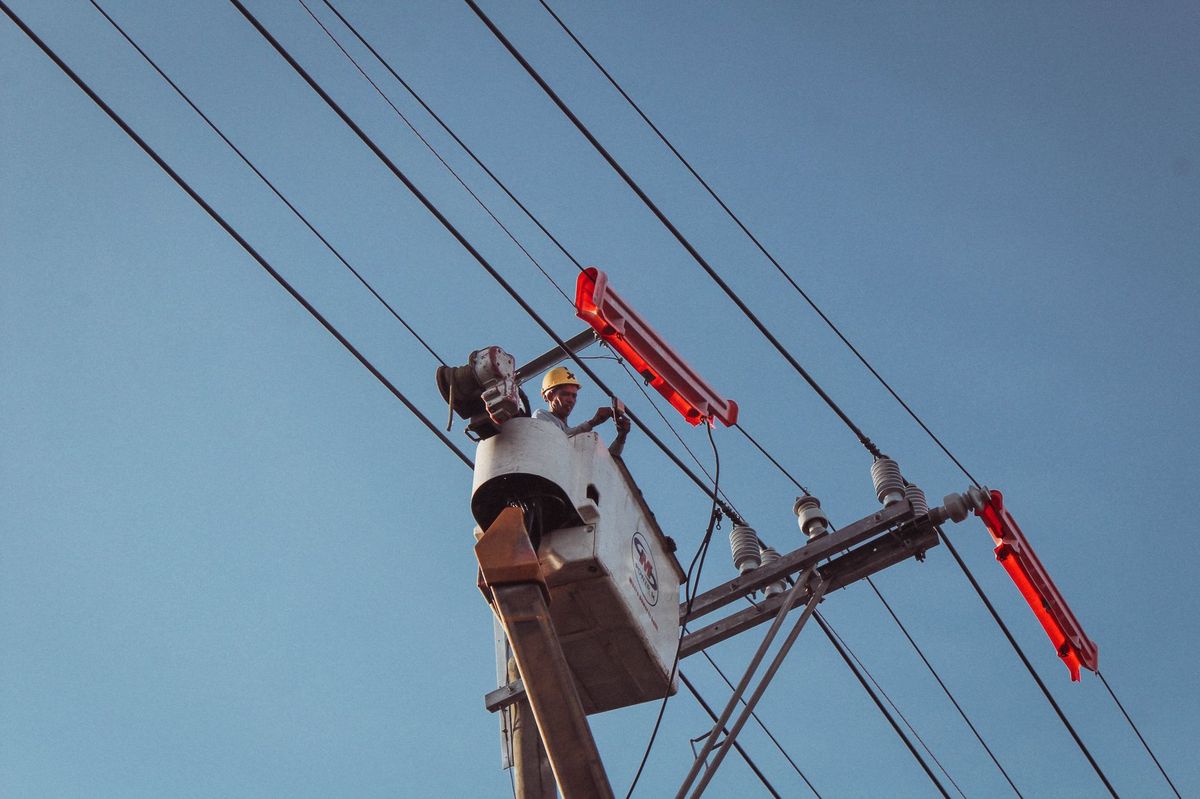
Conductor Stringing. The most skilled and labor-intensive phase involves pulling aluminum conductor (ACSR or ACCC) across tower spans using specialized puller-tensioner equipment. A typical 345kV double-circuit line requires 6 phase conductors plus 2 shield wires, each pulled in separate operations. Stringing productivity averages 2 to 5 spans per day depending on terrain and crossing complexity.
Total per-mile costs for new transmission vary by voltage and terrain: $2 to $4 million per mile for 138kV, $4 to $8 million for 345kV double-circuit, $6 to $12 million for 500kV or 765kV, and $15 to $30+ million per mile for underground HVDC cable installations.
The Lineworker Shortage
The grid construction boom is exacerbating an existing workforce crisis. The Department of Energy estimates 67,000 unfilled positions in the electric utility construction sector. The International Brotherhood of Electrical Workers (IBEW) and NECA have expanded apprenticeship programs, but the 4-year training timeline means current apprentices won't be fully qualified until 2030.
Meanwhile, approximately 25% of the current utility construction workforce is over age 55, accelerating retirements. Journeyman lineworker wages have reached $40 to $65 per hour base rate, with overtime pushing total compensation to $120,000 to $200,000+ annually on major transmission projects. Despite premium wages, recruitment remains challenging due to physical demands, remote locations, and extensive travel. The industry needs an estimated 50,000 additional lineworkers and substation electricians over the next decade.
Supply Chain Pressures
Grid construction faces supply challenges across critical materials. Large power transformers have lead times of 24 to 36 months due to limited domestic manufacturing capacity and global demand. The US relies heavily on imports from South Korea, Germany, and Mexico for these critical components. Transmission conductor lead times have extended to 12 to 18 months. Steel for towers and monopoles has stabilized but remains elevated versus pre-pandemic pricing. And specialty items including SF6-free switchgear, advanced sensors, and grid-forming inverters face emerging constraints.
Projections: $40 Billion by 2030
Grid construction spending will reach $40 billion annually by 2030, driven by continued electrification increasing peak load 15 to 25%, data center construction requiring dedicated transmission and substation infrastructure (a single large data center campus can require 200 to 500 MW of dedicated power delivery infrastructure costing $500 million to $1.5 billion), renewable energy requiring long-distance transmission build-out, and aging infrastructure reaching end of life across broad grid segments.
For construction firms, the grid market offers multi-decade demand visibility with strong margins driven by workforce scarcity. The firms investing in lineworker development, specialized equipment, and utility client relationships will capture the greatest share of this expanding and structurally undersupplied market.
Data Center Load Growth: The Grid's New Challenge
Perhaps the most dramatic driver of grid construction is data center power demand. Large-scale data centers require 50 to 500+ MW of dedicated power delivery infrastructure, equivalent to the electrical demand of a small to mid-size city. The explosion of artificial intelligence computing has accelerated data center construction, with an estimated 3,500 MW of new data center capacity under construction or in advanced planning in Northern Virginia alone.
The grid construction implications are enormous. A single 200 MW data center campus requires a dedicated transmission substation ($60 to $120 million), 5 to 15 miles of transmission line to connect to the bulk power grid ($30 to $120 million), distribution infrastructure within the data center campus ($20 to $40 million), and backup power generation (often 200+ MW of diesel or natural gas generators at $50 to $100 million). Total grid infrastructure cost per data center campus ranges from $150 million to $400 million — costs that are typically borne by the electric utility and recovered through rate charges to the data center operator and other ratepayers.
The geographic concentration of data center development in Northern Virginia (Loudoun County has more data center capacity than any county in the world), the Dallas-Fort Worth area, Phoenix, and Columbus, Ohio is creating localized grid construction booms that strain regional construction labor markets and equipment availability.
Grid-Scale Battery Storage Construction
Grid-scale battery energy storage systems (BESS) are the fastest-growing category of grid construction. Annual BESS installation capacity in the US reached 18 GW in 2025, up from 5 GW in 2022. BESS construction involves site preparation and grading, concrete pad construction for battery enclosures, electrical infrastructure including medium-voltage switchgear, transformers, and inverters, battery module installation and commissioning, fire suppression system installation, and grid interconnection construction.
A utility-scale BESS project (100 MW / 400 MWh) costs approximately $200 to $300 million for equipment and construction. The construction workforce for a large BESS installation includes 100 to 200 workers over a 12 to 18 month construction period, with electricians, concrete workers, and specialty battery technicians as the primary trades.
Wildfire Mitigation: California's $25 Billion Grid Reconstruction
California's investor-owned utilities — Pacific Gas & Electric (PG&E), Southern California Edison (SCE), and San Diego Gas & Electric (SDG&E) — are collectively spending approximately $4.5 billion per year on wildfire mitigation construction, with a cumulative 10-year investment expected to reach $25 billion by 2033.
The construction scope is massive. PG&E alone has committed to undergrounding 10,000 miles of overhead distribution lines in high-fire-risk areas at an average cost of $3.75 million per mile — a total investment of approximately $37.5 billion over 10 to 15 years. As of 2026, approximately 2,400 miles have been completed. The undergrounding process involves trenching or boring to install conduit at 36 to 48 inches depth, pulling new underground cable through the conduit, installing pad-mounted transformers and switching equipment to replace pole-mounted units, constructing underground junction structures (vaults, manholes, pull boxes), removing existing overhead lines and poles, and restoring the surface including pavement, sidewalk, and landscaping.
In addition to undergrounding, utilities are installing covered conductor (insulated overhead wire that prevents ignition from contact with vegetation) on lines that will not be undergrounded. Covered conductor installation costs $500,000 to $1.5 million per mile — significantly less than undergrounding but providing meaningful wildfire risk reduction. Over 5,000 miles of covered conductor have been installed across California since 2020.
Enhanced vegetation management is driving significant forestry and land-clearing construction work. Utilities are expanding vegetation clearance zones around power lines from the historical 4-foot minimum to 12 to 15 feet, requiring removal of millions of trees and extensive brush clearing in wildfire-risk areas. This work employs thousands of forestry workers and creates sustained demand for right-of-way maintenance contractors.
Interconnection Queue Reform and Construction Impact
The Federal Energy Regulatory Commission (FERC) issued Order 2023 in July 2023, reforming the generator interconnection process to address the massive backlog of over 2,600 GW of proposed generation and storage projects waiting for grid studies. The reformed process uses a first-ready, first-served cluster study approach that prioritizes projects with site control, signed interconnection agreements, and demonstrated financial commitment.
The construction impact of interconnection reform is significant. As the queue is cleared of speculative projects and viable projects advance to construction, the volume of interconnection-related grid construction — generator step-up substations, short transmission line segments, and system upgrades needed to accommodate new generation — will increase substantially. Estimates suggest that interconnection construction could add $5 to $8 billion per year to grid construction spending by 2028 as reformed queue projects move to construction.
Transmission Planning and Permitting Reform
The pace of grid construction is constrained not just by workforce and supply chain challenges but by the lengthy transmission planning and permitting process. New transmission lines require FERC approval for cost allocation across multiple utility service territories, state public utility commission approval for certificates of public convenience and necessity, environmental review under NEPA (for projects on federal land or requiring federal permits), and negotiation of right-of-way easements across private property.
The total timeline from initial project identification to construction completion averages 7 to 12 years for major transmission projects — a duration that adds billions in escalation costs and delays the grid modernization urgently needed for reliability and decarbonization goals.
FERC's 2023 transmission planning reforms (Order 2023 and the Long-Term Regional Planning NOPR) are designed to accelerate the planning process by requiring utilities to plan for future generation and load growth rather than waiting for specific generator interconnection requests. The Department of Energy's new authority to designate National Interest Electric Transmission Corridors on federal land and to serve as the lead agency for environmental review of designated transmission projects is expected to reduce permitting timelines by 2 to 4 years for qualifying projects.
For construction firms, planning and permitting reform is significant because it determines when projects move from planning to construction. Every project in the current pipeline that advances 1 to 2 years earlier due to reformed processes represents accelerated construction demand — beneficial for contractors positioned to capture the work but potentially straining workforce and equipment availability if multiple major projects advance simultaneously.
Frequently Asked Questions
How much federal funding goes to electric grid construction spending?
Industry analysts tracking electric grid construction spending report that 2026 has brought measurable shifts. With data showing $28 billion, the trend line suggests continued movement through the remainder of the year. Builders should factor this into both current bids and forward-looking project estimates.
Which states benefit most from electric grid construction spending?
Regional analysis of electric grid construction spending reveals uneven distribution across U.S. markets. The data point of $40 billion highlights the scale of activity, with Sun Belt and high-growth metro areas generally leading in volume. Contractors expanding into new territories should evaluate local demand indicators before committing resources.
What is the timeline for electric grid construction spending projects?
The trajectory for electric grid construction spending tells an important story when viewed against historical benchmarks. With the latest data showing 45%, the trend has clear implications for project feasibility, bidding accuracy, and resource allocation across the construction sector.