The Most Expensive Buildings in America
There are buildings, and then there are stadiums. The construction of professional and major college sports venues in the United States has reached $12.8 billion in active projects — facilities that are under construction or in final design with confirmed financing and groundbreaking dates. This figure includes NFL, MLB, NBA, NHL, MLS, and major college venues, along with the multi-sport entertainment districts that increasingly surround them.
The numbers are staggering at the individual project level. The average cost of a new NFL stadium has reached $2.2 billion. A new MLB ballpark costs $1 billion to $1.5 billion. NBA and NHL arenas run $1.5 billion to $2 billion. These are the most expensive single buildings constructed in the United States, and each one represents a construction project of extraordinary scale, complexity, and public visibility.
For the commercial construction industry, stadium projects are marquee assignments that test every capability of the firms that build them. The structural systems, building envelopes, MEP infrastructure, and finish quality required for modern sports venues place demands on contractors that exceed virtually any other building type. Let us examine the active project pipeline, the cost drivers, and the construction industry implications.
The Active Project Pipeline
The $12.8 billion in active stadium and arena projects includes the following major undertakings:
NFL stadiums: The Tennessee Titans' new stadium in Nashville ($2.1 billion, under construction with a 2027 opening target). The Buffalo Bills' new stadium in Orchard Park ($1.7 billion, under construction). The Chicago Bears' proposed Arlington Heights stadium ($4.7 billion including surrounding district, in advanced design). These projects alone represent over $8 billion in construction value, and additional NFL teams — including the Kansas City Chiefs and Jacksonville Jaguars — have announced stadium plans that are in earlier stages.
MLB ballparks: The Kansas City Royals' new downtown ballpark ($2 billion including infrastructure, in advanced design following voter approval). The Tampa Bay Rays' new stadium in the Tropicana Field redevelopment ($1.3 billion, in final design). These projects continue baseball's trend of replacing older multi-purpose stadiums with modern, baseball-only facilities that serve as anchors for mixed-use entertainment districts.
NBA/NHL arenas: The Milwaukee Bucks' arena district expansion and renovation ($500 million). Various arena renovation and modernization projects across the league totaling approximately $1.5 billion. The trend in basketball and hockey is increasingly toward extensive renovation of existing arenas rather than new construction, reflecting the 20 to 25-year useful life of arena technology and amenity systems even when the structural shell remains sound.
MLS stadiums: Multiple MLS expansion and relocation stadiums in various stages, including facilities in Las Vegas, San Diego, and other expansion markets. MLS stadiums are typically smaller (18,000 to 25,000 seats) and less expensive ($300 million to $600 million) than the other major professional sports venues but are increasing in ambition and cost as the league's revenue and visibility grow.
Major college facilities: Significant stadium renovation and new construction at Power Five conference programs, with notable projects at Clemson, South Carolina, and others totaling approximately $2 billion in active construction.
Cost Anatomy of a Modern Stadium
The cost structure of a modern sports stadium reflects the complexity of a building type that must simultaneously serve as a structural marvel, an entertainment venue, a broadcasting studio, a hospitality destination, and increasingly, an event platform for concerts, festivals, and other non-sports programming.
Structural system: 20% to 25% of total cost. Stadium structures are engineered to span enormous distances — the roof structure of a modern domed or retractable-roof stadium may span 800 to 1,000 feet without intermediate supports. The structural steel package for a major stadium typically weighs 25,000 to 45,000 tons and costs $200 million to $400 million. Foundation systems must support the concentrated loads of the seating bowl, the suspended roof structure, and the dynamic loads of 60,000 or more spectators. Structural engineering for a major stadium is among the most complex work in the profession, requiring expertise in long-span roof systems, precast concrete seating structures, and the dynamic analysis of structures subjected to crowd movement.
Roof system: 10% to 20% of total cost. Modern stadiums increasingly feature retractable or fixed roofs that allow year-round use and protect spectators and playing surfaces from weather. Retractable roof systems — the most complex and expensive option — cost $150 million to $350 million and involve massive moving structures (some weighing over 10,000 tons) with precision drive systems, track and bearing assemblies, and weatherproof enclosures. Fixed roof systems are less expensive ($80 million to $200 million) but still represent significant structural and architectural undertakings.
The building envelope below the roof — curtain wall, metal panel, and glazing systems that enclose the stadium — adds another $100 million to $250 million. The trend toward transparency (large glass facades that allow views into and out of the stadium) and architecturally expressive facades increases both cost and complexity.
Seating bowl and spectator areas: 15% to 20% of total cost. The seating structure — typically precast concrete risers on a steel or concrete frame — accounts for a significant share of the construction scope. A 60,000-seat stadium contains approximately 2,000 precast seating units, each weighing 10 to 20 tons, that must be manufactured, transported, and erected with precision. The premium seating — suites, club levels, and field-level hospitality areas — has become the primary revenue driver for stadium operators and accordingly commands the highest construction investment per square foot. Premium hospitality areas cost $500 to $1,200 per square foot to construct, reflecting the high-end finishes, sophisticated MEP systems, and specialized food service infrastructure these spaces require.
MEP systems: 15% to 20% of total cost. Stadium MEP systems are massive in scale: electrical systems serving 10,000 to 20,000 lighting fixtures and 100-plus megawatts of connected load, HVAC systems conditioning 3 million to 5 million cubic feet of enclosed volume, plumbing systems serving hundreds of restroom fixtures designed to minimize wait times during intermission, and fire protection systems that must address the unique challenges of high-occupancy assembly buildings with large open volumes.
The technology infrastructure alone represents $50 million to $150 million: video boards and distributed display systems, sound reinforcement serving every seat, WiFi networks supporting 60,000 or more simultaneous connections, broadcast infrastructure (camera positions, cabling, production facilities), and the underlying data network that connects it all.
Site and infrastructure: 10% to 15% of total cost. Stadium sites require extensive infrastructure: parking structures or surface lots for 15,000 to 30,000 vehicles, pedestrian circulation and plaza areas designed for crowd flow of 60,000 or more spectators, utility infrastructure capable of serving peak event loads, and transportation connections (transit stations, highway ramps, pedestrian bridges) that enable the movement of tens of thousands of people in a concentrated timeframe.
The Public Funding Debate
Stadium construction financing remains one of the most debated topics in public finance. The $12.8 billion in active projects involves varying combinations of public and private funding:
Public contribution patterns. Historical analysis shows that public funding (from state, county, and municipal sources including tax-increment financing, hotel taxes, sales taxes, and direct appropriations) has averaged 40% to 60% of total stadium project costs. However, the trend is toward reduced public participation, with recent projects showing public contributions of 25% to 40% and team owners assuming larger shares. The public contribution typically funds infrastructure, site preparation, and portions of the building that serve public functions, while private investment covers the revenue-generating premium seating and hospitality areas.
Economic impact claims. Stadium proponents cite economic impact studies projecting thousands of jobs, hundreds of millions in economic activity, and transformative neighborhood development. Academic research is more skeptical, with most independent studies concluding that stadiums generate modest net economic impact when accounting for the opportunity cost of public funds. However, the neighborhood development effects of stadium projects — particularly when combined with surrounding mixed-use development — can be significant and are increasingly the primary justification for public investment.
Construction Workforce and Timeline
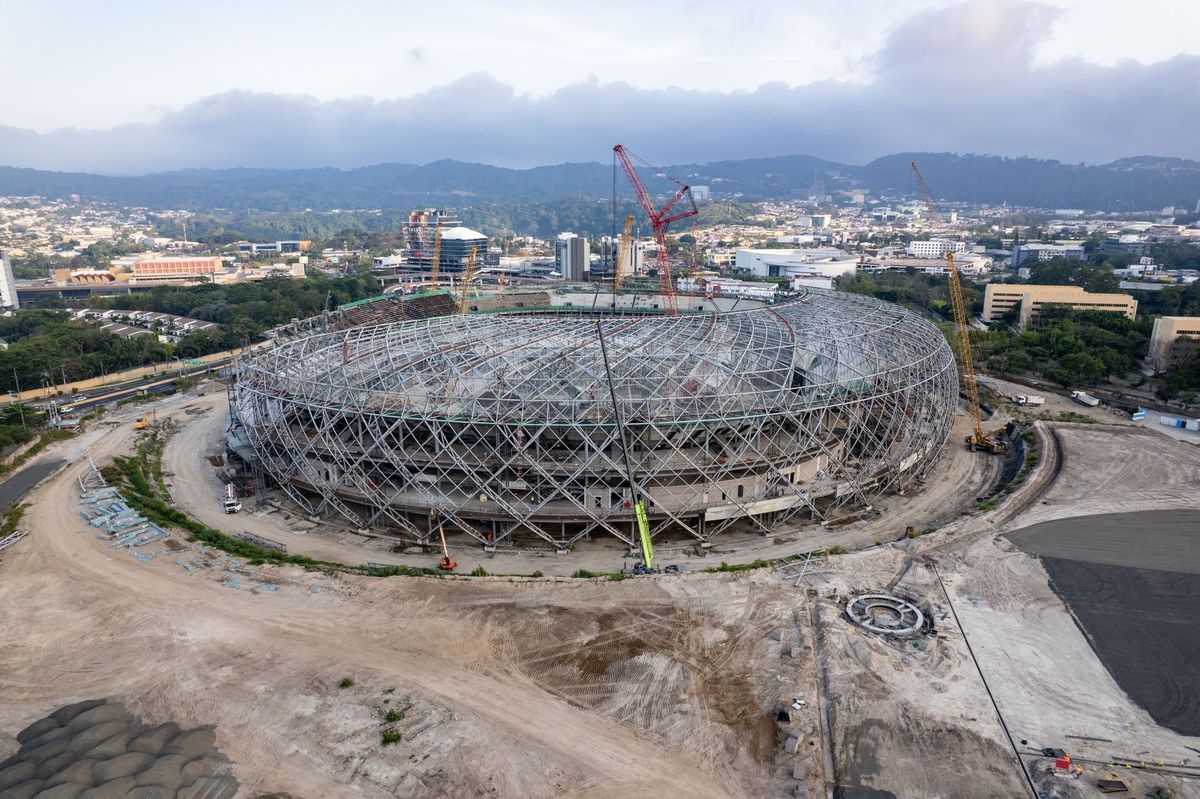
A major stadium project employs 3,000 to 6,000 construction workers at peak activity, with the construction phase spanning 30 to 42 months for a new facility. The workforce must include specialists in long-span steel erection, precast concrete installation, curtain wall and glazing systems, broadcast and AV installation, and large-scale MEP coordination.
The scheduling complexity is extraordinary. A modern stadium construction schedule contains 15,000 to 25,000 activities with thousands of interdependencies, and the project must meet an immovable deadline — the start of the sports season. There is no option to push opening day. Every schedule decision during the 30 to 42-month construction period must serve the goal of having the building ready for the first event.
The Entertainment District Model
The most significant evolution in stadium construction is the integration of the venue into a larger entertainment district — a mixed-use development that surrounds the stadium with restaurants, retail, hotels, residential buildings, and public spaces. This "district model" extends the economic activity generated by the stadium beyond event days and creates a year-round destination.
The district development adds $500 million to $2 billion to the total project investment beyond the stadium itself. The construction scope includes mid-rise and high-rise buildings, streetscape infrastructure, public plazas, parking structures, and the utility and transportation infrastructure to serve the district. For general contractors, the district model transforms a stadium project from a single large building into a multi-year, multi-building construction program with sustained revenue and employment.
Outlook
The stadium construction pipeline is expected to remain active through the end of the decade, supported by franchise relocations, expansion (MLS and potentially NBA/NHL), the replacement of aging facilities, and the renovation of existing venues that need technology and amenity upgrades to remain competitive.
For the construction industry, stadium projects represent the pinnacle of commercial construction complexity. The scale, the technical demands, the public visibility, and the immovable deadlines create an environment that tests every capability of the firms that undertake them. The $12.8 billion in active projects represents not just construction revenue but construction prestige — the projects that define careers, firms, and skylines.
The numbers are dramatic because the buildings are dramatic. And in an industry where most projects are measured in millions, the stadium segment operates in billions. That is a scale of opportunity — and responsibility — that demands the very best the construction industry has to offer.
The Sustainability Mandate
Modern stadium construction is increasingly subject to sustainability requirements — both regulatory mandates and voluntary commitments by team owners and municipalities. Recent stadium projects have achieved LEED Gold and Platinum certifications, incorporating features including on-site solar arrays generating 2 to 5 megawatts, rainwater harvesting systems that capture and reuse stormwater for irrigation and non-potable water uses, high-efficiency LED lighting with daylight harvesting controls that reduce lighting energy consumption by 40% to 60%, electric vehicle charging infrastructure serving 2% to 5% of total parking spaces, mass timber structural elements in portions of the building that reduce embodied carbon by 20% to 30% compared to all-steel construction, and waste diversion programs that achieve 75% to 90% diversion rates during construction.
The sustainability premium for stadium construction — the additional cost of incorporating these features versus a conventional approach — is approximately 5% to 8% of total project cost, or $100 million to $200 million on a $2 billion project. This premium is partially offset by reduced operating costs (energy-efficient stadiums save $2 million to $5 million annually in utility costs) and is increasingly non-negotiable — municipalities that provide public funding for stadium construction typically require sustainability commitments as conditions of their financial support.
For the construction industry, stadium sustainability requirements create demand for specialized expertise in renewable energy installation, water systems, advanced building envelopes, and sustainable material procurement. The contractors who develop these capabilities for stadium projects apply them across their full commercial portfolio, creating competitive advantages that extend far beyond the stadium sector.
The $12.8 billion in active stadium construction represents the apex of commercial construction achievement — projects where structural engineering, architectural ambition, technology integration, and sustainability come together at a scale unmatched by any other building type. For the firms that build them, stadiums are not just projects — they are statements of capability that define careers and firms for generations.
Frequently Asked Questions
How much does it cost to build a major professional sports stadium?
Construction costs vary significantly by sport and configuration. The average cost of a new NFL stadium has reached $2.2 billion. New MLB ballparks cost $1 billion to $1.5 billion. NBA and NHL arenas typically run $1.5 billion to $2 billion. These are the most expensive individual buildings constructed in the United States, and most projects are built over 3 to 5 year timelines that span multiple construction seasons.
How is stadium construction typically financed?
Modern stadium projects typically combine public and private funding. The public component — which has faced increasing scrutiny from taxpayers and local governments — covers infrastructure improvements, land acquisition, and sometimes direct facility contributions. The private component, funded by the team ownership and their private equity or real estate partners, covers the bulk of construction costs. Naming rights deals, premium seating revenue bonds, and NFL G-4 stadium loans also provide financing. The trend in recent years has been toward increasing private share as voters resist large direct public subsidies.
What makes stadium construction different from other commercial projects?
Stadiums require structural systems capable of supporting tens of thousands of occupants simultaneously, which creates loads that exceed virtually any other building type. The spectator sightline requirements, complex MEP infrastructure for food service and broadcast operations, premium suite construction, and the massive concourse and circulation systems all test contractor capabilities. Many stadium projects also include entertainment district development — hotels, retail, restaurants, and public plazas — that adds complexity beyond the main venue.