The Largest Industrial Construction Wave Since World War II
The scale of electric vehicle battery plant construction in the United States has no modern precedent. As of Q1 2026, $58 billion in EV battery manufacturing facilities have been announced across 28 states, with approximately $22 billion in active construction and the remainder in various stages of permitting, design, and pre-construction. When combined with the $42 billion in semiconductor fab construction, the battery plant pipeline confirms that the United States is experiencing the largest wave of industrial construction since the mobilization of World War II.
The numbers are extraordinary at the individual project level. A single battery gigafactory — a facility capable of producing 30 to 50 gigawatt-hours (GWh) of battery cells annually — costs $3 billion to $6 billion to construct. The largest announced projects exceed $7 billion. These facilities are measured in millions of square feet, employ 2,000 to 6,000 permanent workers, and consume hundreds of megawatts of electrical power.
For the commercial construction industry, battery plant construction represents a market segment that did not exist in meaningful scale five years ago and now commands $22 billion in active projects. Understanding the cost structure, construction requirements, and risk factors of this emerging building type is essential for contractors and developers evaluating opportunities in industrial construction.
The Project Pipeline
The $58 billion in announced US battery plant projects is distributed among three categories of manufacturers:
Joint ventures between automakers and battery cell manufacturers account for approximately 60% of the announced investment. These partnerships — Ford/SK Innovation, GM/LG Energy Solution (Ultium), Stellantis/Samsung SDI, Toyota/Panasonic, and BMW/Envision AESC — combine the automakers' capital and vehicle demand with the battery manufacturers' cell chemistry expertise and manufacturing know-how. The joint venture model reduces risk for both parties and has been the preferred structure for the largest projects.
Key active projects include Ultium Cells (GM/LG) facilities in Ohio ($2.3 billion, operational), Tennessee ($2.3 billion, operational), and Michigan ($2.6 billion, under construction). BlueOval SK (Ford/SK Innovation) plants in Tennessee ($5.6 billion, under construction) and Kentucky ($5.8 billion, two plants, under construction). Samsung SDI and Stellantis facilities in Kokomo, Indiana ($3.2 billion, under construction). And BMW/Envision AESC in South Carolina ($1.0 billion, under construction with expansion announced).
Asian battery manufacturers building US facilities account for approximately 25% of announced investment. LG Energy Solution, Samsung SDI, SK Innovation, Panasonic, and CATL are all building or have announced proprietary US manufacturing facilities independent of their automaker partnerships. These facilities are motivated by the Inflation Reduction Act's domestic content requirements for EV tax credits, which incentivize battery production in North America.
Panasonic's Kansas facility ($4 billion, under construction) and its Nevada expansion ($3.6 billion, under construction) are among the largest projects in this category. CATL's announced $5 billion facility in Michigan has attracted significant political attention due to the company's Chinese ownership.
Domestic startups and specialty manufacturers account for the remaining 15% of announced investment. Companies including QuantumScape, Solid Power, Form Energy, and others are developing advanced battery technologies (solid-state, iron-air, etc.) that require different manufacturing processes and facility designs. These projects are generally smaller ($500 million to $2 billion) and more speculative than the established manufacturers' facilities.
Construction Cost Structure
Battery plant construction costs are dominated by the building shell, the cleanroom manufacturing environment, and the utility infrastructure required to support the production process:
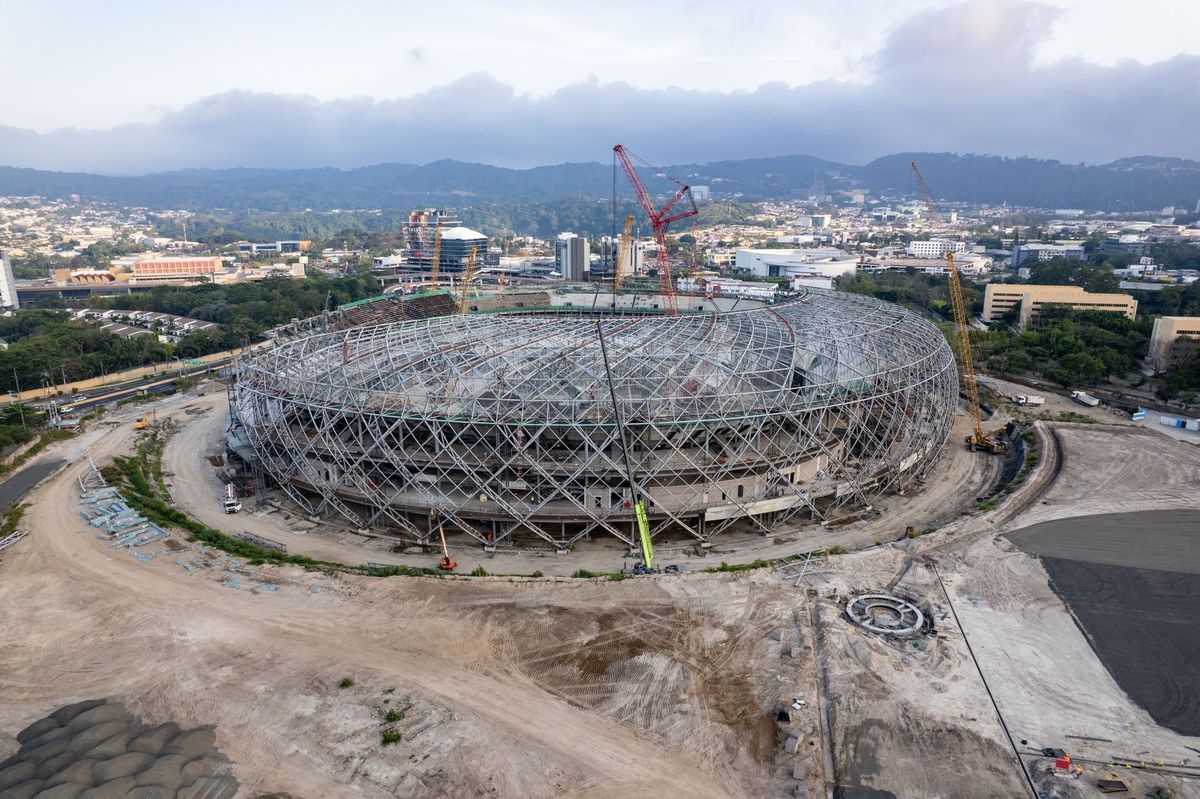
Building shell and site work: 25% to 30% of total project cost. Battery plants are massive single-story structures — typically 2 million to 4 million square feet of building area under a single roof. The building requires heavy structural capacity to support the weight of manufacturing equipment, with floor loads of 250 to 500 PSF in production areas. The slab — typically 8 to 12 inches of reinforced concrete with specific flatness requirements — is one of the largest single cost items, running $15 to $25 per square foot for millions of square feet.
The site work for a battery plant is extensive: grading and drainage for sites of 500 to 1,500 acres, road construction, utility corridors, stormwater management, and environmental mitigation. Site work costs typically represent $100 million to $300 million per project.
Dry room construction: 15% to 20% of total project cost. Battery cell manufacturing requires extremely low humidity environments — "dry rooms" maintained at less than 1% relative humidity (dew point of minus 40 degrees F or below). Dry room construction is analogous to cleanroom construction in semiconductor fabs, with insulated panel enclosures, specialized dehumidification systems, and airlocks to prevent moisture infiltration. The dry room environment costs $200 to $350 per square foot to construct — three to four times the cost of conventional manufacturing space.
Manufacturing equipment: 30% to 40% of total project cost. The production equipment for a battery gigafactory — coating lines, calendering machines, slitting equipment, stacking or winding machines, electrolyte filling systems, formation and aging equipment, and testing stations — represents the single largest cost component. Equipment costs of $1 billion to $2.5 billion per gigafactory are typical, with lead times of 12 to 24 months for major equipment items.
Utility infrastructure: 10% to 15% of total project cost. Battery plants have enormous utility requirements. A 35 GWh facility consumes 150 to 250 megawatts of electrical power — requiring dedicated substations and often necessitating upgrades to regional transmission infrastructure. Water consumption for cooling and process use can reach 2 million to 4 million gallons per day. Natural gas or steam is required for drying processes. The utility infrastructure — substations, transformers, water treatment, gas supply, and the connections to regional utility systems — typically costs $200 million to $500 million per project.
Workforce Requirements
Battery plant construction projects are among the most labor-intensive in commercial construction, rivaling semiconductor fabs in peak workforce requirements:
Peak construction workforce: 3,000 to 8,000 workers per project. The largest battery plant construction projects require peak workforces that exceed the available skilled labor in the local market, necessitating significant labor importation from other regions. At peak construction, the BlueOval City project in Tennessee employed over 6,000 construction workers — more than the total construction workforce of several adjacent counties combined.
Skill requirements. Battery plant construction requires the full spectrum of commercial construction trades, with particular demand for electricians (the electrical scope is massive), ironworkers (heavy structural steel erection), pipefitters (process piping for chemical handling and dehumidification systems), and specialty cleanroom/dry room construction workers. The dry room construction scope requires workers with training in panel installation, sealing, and the specific protocols for working in controlled environments.
Competition for labor. Battery plants compete for construction workers with semiconductor fabs, data centers, and other industrial mega-projects that are simultaneously under construction. In regions with multiple active mega-projects — central Arizona, central Tennessee, and the Ohio/Indiana corridor — the competition for skilled trades has driven wages up 20% to 30% above regional norms for conventional commercial construction.
The IRA Incentive Structure
The Inflation Reduction Act of 2022 created the financial incentive structure that catalyzed the battery plant construction boom. The key provisions include:
Section 45X Advanced Manufacturing Production Credit. This credit provides $35 per kilowatt-hour of battery cell production and $10 per kWh of battery module production. For a 35 GWh facility, the annual production credit is approximately $1.2 billion to $1.6 billion — a staggering incentive that fundamentally changes the manufacturing economics of domestic battery production. The credit is available through 2032, with phase-down beginning in 2030.
Section 30D Clean Vehicle Credit. The consumer-facing EV tax credit of up to $7,500 per vehicle requires increasing percentages of battery components to be manufactured or assembled in North America. This domestic content requirement creates the demand pull for US battery manufacturing capacity — without domestic production, vehicles cannot qualify for the full consumer credit.
These incentives have made US battery manufacturing economically competitive with Asian production despite higher labor costs and the significant capital investment required for new facility construction. The combination of production credits and consumer incentives has attracted approximately $5 of private investment for every $1 of federal incentive — a leverage ratio that has exceeded most projections.
Risk Factors
The battery plant construction boom carries meaningful risks:
Demand uncertainty. The construction pipeline is sized for US EV sales of 5 million to 7 million units annually by 2030. If EV adoption falls short of this trajectory — due to consumer preference shifts, charging infrastructure gaps, or policy changes — some of the announced capacity may not be needed, leading to project delays or cancellations. Several announced projects have already been scaled back or delayed, though active construction continues on most committed projects.
Policy risk. The IRA incentives that catalyzed the construction boom are subject to potential modification or repeal. While the bipartisan political support for domestic manufacturing provides some protection, changes to the incentive structure could affect the economics of projects that have not yet reached final investment decision. Projects already under construction are generally committed regardless of policy changes, but the pipeline of future announcements could be affected.
Technology evolution. Battery technology is evolving rapidly, with solid-state, sodium-ion, and other next-generation chemistries potentially displacing the lithium-ion technology that current factories are designed to produce. The risk of technological obsolescence is inherent in any manufacturing facility, but the $3 billion to $6 billion investment required for a battery gigafactory makes this risk particularly consequential.
Supply chain constraints. Battery manufacturing requires critical minerals — lithium, nickel, cobalt, manganese, and graphite — that have concentrated supply chains and volatile pricing. The availability and cost of these materials affect both the economics of battery production and the feasibility of the production volumes that the new factories are designed to achieve.
Implications for the Construction Industry
Battery plant construction has created a new specialty within commercial construction that demands specific capabilities: experience with massive single-story industrial structures, dry room and cleanroom construction expertise, heavy electrical and process piping capability, and the project management capacity to coordinate 5,000-plus workers on a single site.
The contractors who have positioned themselves in this space — primarily large national ENR-ranked firms — are seeing multi-year backlogs of battery plant work that provide revenue visibility uncommon in the construction industry. The $22 billion in active construction alone represents approximately 100,000 to 150,000 construction worker-years of employment — a substantial share of the national industrial construction workforce.
For subcontractors, the battery plant boom has created outsized demand for electrical, mechanical, and specialty construction services in specific geographic markets. Firms with capacity in Tennessee, Kentucky, Georgia, Michigan, and Ohio — where the majority of active projects are located — are experiencing unprecedented demand and corresponding pricing power.
The $58 billion pipeline is not a forecast or a projection — it is committed and announced capital from the world's largest automakers and battery manufacturers. The construction industry's task is to deliver these facilities on time, on budget, and at the quality levels required for advanced manufacturing. That is a challenge worthy of the scale of the investment — and the scale of the opportunity.
The Community Impact Dimension
Beyond the direct construction employment, EV battery plant projects are reshaping the communities where they are located. The permanent employment created by a single gigafactory — 2,000 to 6,000 jobs with average wages of $22 to $35 per hour — represents a transformative economic event for the small and mid-size communities where many of these facilities are being built.
The community impact extends to supporting infrastructure. Schools, healthcare facilities, retail, and housing must expand to accommodate the incoming workforce. The construction of this supporting infrastructure represents an additional multiplier on the direct battery plant investment — estimated at $300 million to $800 million per major facility in community infrastructure investment over a five-to-ten-year period.
Housing is perhaps the most pressing community need. The construction workforce during the building phase (3,000 to 8,000 workers for 24 to 36 months) and the permanent workforce (2,000 to 6,000 workers) create housing demand that far exceeds the existing supply in most host communities. Residential construction in battery plant communities has surged, with apartment developments, single-family subdivisions, and townhome communities all responding to the demand.
For the construction industry, the secondary effects of battery plant construction — the housing, schools, retail, healthcare, and infrastructure that must accompany the factory — represent a substantial additional pipeline of work. A contractor positioned in a battery plant community may see five to ten years of sustained construction demand across multiple building types, all driven by the single catalyst of the gigafactory investment.
The $58 billion in announced battery plant construction is the headline number, but the total construction impact — including direct plant construction, utility and infrastructure development, community supporting facilities, and induced residential and commercial construction — likely exceeds $100 billion over the decade. This is industrial construction at a scale that transforms not just the construction industry but the communities and regions where it occurs.
Frequently Asked Questions
How large is the US EV battery plant construction pipeline?
As of Q1 2026, $58 billion in EV battery manufacturing facilities have been announced across 28 states, with approximately $22 billion in active construction and the remainder in permitting, design, and pre-construction. A single battery gigafactory capable of producing 30 to 50 gigawatt-hours annually costs $3 billion to $6 billion to construct — the largest announced projects exceed $7 billion. These facilities are among the most capital-intensive industrial construction projects ever undertaken in the United States.
What construction challenges are unique to EV battery plant gigafactories?
Battery gigafactories require electrical infrastructure at a scale that challenges regional utility capacity — facilities may need 200 to 400 megawatts of dedicated power. The manufacturing process requires ultra-clean dry rooms with humidity control below 0.1% relative humidity, which demands specialized HVAC systems and airtight construction. Site preparation for facilities exceeding 5 million square feet requires extensive earthwork. And the timeline pressure is intense: automaker customers need cell production online by contractual dates, which means contractors face compression of schedules that normally would take 4 to 5 years into 2 to 3 years.
Which states are receiving the most EV battery plant investment?
Michigan, Tennessee, Georgia, Kentucky, and Ohio have captured the largest shares of announced investment, driven by proximity to existing auto manufacturing plants, strong state incentive packages under the Inflation Reduction Act framework, available industrial land, and workforce availability. The IRA's domestic production requirements created a structural incentive for US-based manufacturing, and states competed aggressively with tax credits, infrastructure commitments, and workforce training programs to attract these facilities, which each employ 2,000 to 6,000 permanent workers.