The average homeowner calling me for a roof quote this year is bracing for $15,000 and getting a number closer to $19,600 — that's a 2,800-square-foot roof at $7.00 per square foot, and it's the honest middle of the 2026 market. Here's the deal: roof replacement cost in 2026 runs $5.50 to $9.00 per square foot installed for architectural asphalt shingles, which covers roughly 85% of the residential jobs I see. Metal runs $9.50 to $16.00. Tile and slate start where metal ends and climb past $25.00. I've spent 25 years around framing crews and roofers, and I'm going to walk you through what actually drives that number so you can read a quote like a contractor instead of a mark.
What a Roof Actually Costs in 2026, Material by Material
Roofers price in "squares" — one square is 100 square feet of roof surface. A typical 2,000-square-foot ranch has about 2,400 to 2,800 square feet of roof once you account for pitch and overhangs, so 24 to 28 squares. When a roofer says "$450 a square," multiply by your square count and you've got the shingle line item.
Asphalt Shingles: Still 80% of the Market for a Reason
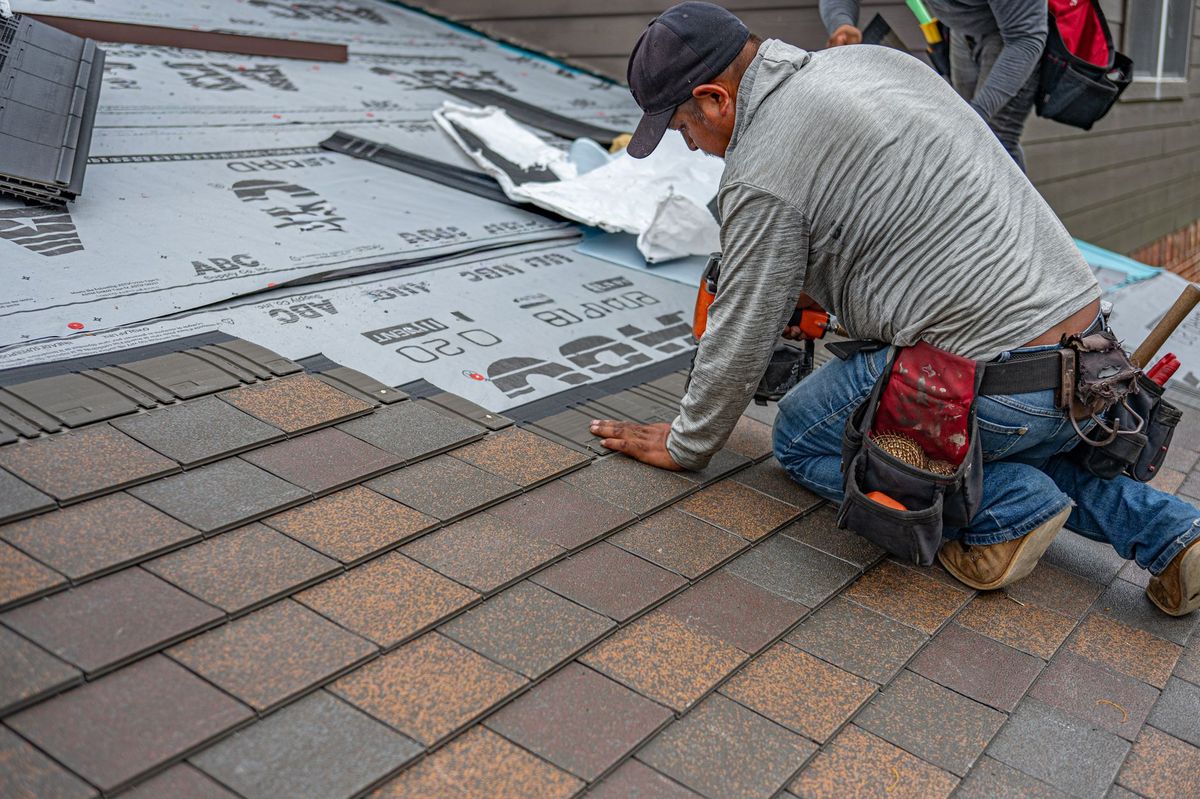
Three-tab shingles are nearly dead — maybe 5% of what goes on roofs now. Architectural (dimensional) shingles dominate at $550 to $900 per square installed, which is that $5.50-$9.00 per square foot figure. The shingles themselves are only $110 to $160 per square at the supply house; the rest is tear-off, underlayment, ice-and-water shield, drip edge, flashing, and labor. Labor alone is 55% to 60% of an asphalt job per industry cost data, and roofing labor rates climbed about 4.3% year over year according to BLS wage data for roofing contractors.
Premium "designer" asphalt — the thick stuff that mimics slate — runs $800 to $1,200 per square installed. It buys you a heavier wind rating (130 mph vs. 110 mph) and a better-looking roof, but the underlying lifespan is similar: 25 to 30 real-world years.
Metal: $9.50 to $16.00 Per Square Foot
Exposed-fastener metal panels (the ag-panel look) come in at $9.50 to $12.00 per square foot installed. Standing seam — concealed fasteners, the good stuff — runs $12.00 to $16.00. That's roughly double asphalt, but you're buying a 40-to-70-year roof instead of a 25-year roof. On a 26-square roof, the spread between mid-grade asphalt ($18,200) and standing seam ($33,800) is $15,600. If you're staying in the house 20+ years, metal usually pencils. If you're selling in five, it doesn't.
Tile, Slate, and Wood
Concrete tile installs at $10.00 to $18.00 per square foot; clay runs $12.00 to $25.00. Both need a roof structure rated for 900 to 1,100 pounds per square — many homes built for asphalt need $2,000 to $10,000 in structural reinforcement first. Natural slate is $18.00 to $30.00+ installed and lasts a century. Cedar shakes run $8.00 to $14.00 but are getting harder to insure in wildfire states; I've watched three clients get non-renewal notices over wood roofs since 2024.
The Cost Table: Squares, Sizes, and Real Totals
Here's what full replacements actually total in 2026 for a tear-off and re-roof with architectural asphalt at the national median of $7.00 per square foot:
| Roof Size (SF of roof) | Squares | Asphalt (arch.) | Standing Seam Metal | Concrete Tile |
|---|---|---|---|---|
| 1,500 | 15 | $8,250-$13,500 | $18,000-$24,000 | $15,000-$27,000 |
| 2,000 | 20 | $11,000-$18,000 | $24,000-$32,000 | $20,000-$36,000 |
| 2,500 | 25 | $13,750-$22,500 | $30,000-$40,000 | $25,000-$45,000 |
| 3,000 | 30 | $16,500-$27,000 | $36,000-$48,000 | $30,000-$54,000 |
| 3,500 | 35 | $19,250-$31,500 | $42,000-$56,000 | $35,000-$63,000 |
What Pushes You From $5.50 to $9.00
Same shingle, same town, and one house pays 60% more than another. Five things do it:
- Pitch. Anything over 8/12 is steep-slope work: staging, harnesses, slower production. Add 15% to 25%. A 12/12 Victorian can add 40%.
- Stories and access. Two-story homes add $0.50 to $1.00 per square foot. Tight lots where the dumpster and material boom can't get close add more.
- Complexity. Every valley, dormer, and skylight is flashing labor. A cut-up roof with 6 valleys and 3 dormers prices 20% above a simple gable.
- Decking condition. Plan on replacing 10% to 15% of sheathing on a 20-plus-year-old roof at $70 to $100 per sheet installed. With lumber prices where they are — see our breakdown of lumber at $487/MBF in 2026 — a full re-deck adds $2.20 to $3.00 per square foot.
- Code items. Ice-and-water shield is code-required at eaves in most northern states ($40-$60 per square affected), and drip edge is now required by IRC nearly everywhere.
Tear-Off vs. Overlay: The $1.10 Per Square Foot Trap
An overlay — nailing new shingles over the old layer — saves $1.00 to $1.25 per square foot in tear-off labor and dump fees. On a 26-square roof that's $2,600 to $3,250, and I understand why people ask for it. I tell them no about 95% of the time.
Why the Overlay Usually Loses
The math falls apart in three places. First, most shingle manufacturers cut their warranty on overlays, and some void wind coverage entirely. Second, the second layer traps heat and the shingles cook — expect 15% to 25% shorter life, so your 25-year shingle becomes a 19-year shingle. Third, when the roof does get replaced, you're paying for a double tear-off at $1.75 to $2.25 per square foot plus roughly double the disposal tonnage. A 26-square roof carries about 5,000 to 6,000 pounds of shingles per layer; dump fees in my area run $65 to $110 per ton.
The only overlay I'll sign off on: a single existing layer that's flat and dry, a low-complexity roof, and an owner who's selling inside five years. IRC code caps you at two total layers, period — if there are already two up there, tear-off isn't optional.
Regional Spreads: The Same Roof, $6,000 Apart
Roofing is a local-labor business, and the spread between markets is bigger than most people expect. Industry cost data puts the coastal-metro premium at 25% to 40% over the national median. Here's the 2026 picture for a 26-square architectural asphalt tear-off:
| Region | $/SF Installed | 26-Square Total | Notes |
|---|---|---|---|
| South / Southeast | $5.00-$7.00 | $13,000-$18,200 | Lowest labor; hurricane code adds nailing/underlayment cost coastal |
| Midwest | $5.50-$7.50 | $14,300-$19,500 | Hail-belt insurance work keeps crews busy; ice shield required |
| Mountain West | $6.00-$8.00 | $15,600-$20,800 | Snow-load and fire-rating requirements climbing |
| Texas | $5.25-$7.25 | $13,650-$18,850 | Big hail volume, aggressive competition |
| Northeast | $6.50-$9.50 | $16,900-$24,700 | Steep older roofs, high labor, short season |
| West Coast metro | $7.00-$10.50 | $18,200-$27,300 | Highest labor, permit costs $400-$1,500 |
Insurance matters here too. If your roof damage is storm-related, your out-of-pocket may just be the deductible — but note that insurers in hail states have been switching policies from replacement-cost to actual-cash-value on roofs over 10 years old. Read your policy before you assume.
Budgeting the Job Without Getting Burned
Get three bids, and make sure they're bidding the same scope: tear-off, sheathing allowance (get a per-sheet price for decking replacement in writing), underlayment type, ice-and-water coverage, flashing replacement vs. reuse, ridge vent, and disposal. The cheap bid that "reuses existing flashing" is where leaks come from — new step and chimney flashing is worth every dollar of the $500 to $1,500 it adds.
Run your numbers before the first roofer shows up. Our construction cost estimator will get you a sanity-check range for your square footage and region so you know whether a quote is in the strike zone or fishing. And if you're weighing a roof against other big-ticket work this year, compare it against what a home addition costs per square foot in 2026 — a roof is almost always the project that can't wait, because water damage compounds at a rate no other deferred repair matches. A $19,000 roof done on time beats a $19,000 roof plus $30,000 in rot, insulation, and drywall repair done two years late.
Timing has a price too. Roofers are slammed May through October. In most markets, a November-through-March install prices 5% to 10% lower, and asphalt installs fine down to about 40°F if the crew hand-seals in cold weather.
Frequently Asked Questions
How much does it cost to replace a roof on a 2,000-square-foot house in 2026?
Figure the roof surface first — a 2,000-square-foot house typically carries 2,300 to 2,800 square feet of actual roof depending on pitch and overhangs. At the 2026 range of $5.50 to $9.00 per square foot for architectural asphalt, that's $12,650 to $25,200 installed, with most straightforward jobs landing between $15,000 and $19,000. Steep pitch, two stories, or heavy decking replacement pushes you toward the top of the range.
What is a "square" in roofing and how do I estimate mine?
One square equals 100 square feet of roof surface. Quick field method: take your home's footprint (length times width), then multiply by a pitch factor — 1.06 for a shallow 4/12 roof, 1.2 for 6/12, 1.3 for 8/12, 1.42 for 10/12. A 30-by-50 footprint (1,500 SF) at 6/12 pitch is about 1,800 SF of roof, or 18 squares. Roofers measure it exactly with satellite tools, but this gets you within 10%.
Is it cheaper to overlay new shingles instead of tearing off?
Upfront, yes — an overlay saves $1.00 to $1.25 per square foot, or roughly $2,600 on an average roof. Long-term, it usually costs more: shingle life drops 15% to 25% from trapped heat, manufacturer warranties shrink or void, hidden decking rot goes unfound, and the eventual double tear-off runs $1.75 to $2.25 per square foot. Code allows a maximum of two layers. I recommend tear-off in nearly every case.
How much more does a metal roof cost than asphalt shingles?
Roughly 1.7x to 2.3x. In 2026, architectural asphalt installs at $5.50 to $9.00 per square foot while standing seam metal runs $12.00 to $16.00. On a 26-square roof that's about a $15,000 difference. Metal lasts 40 to 70 years versus 25 to 30 for asphalt, cuts cooling loads 10% to 15%, and often earns an insurance discount in hail states — so the premium pays back if you hold the house long enough.
Does homeowners insurance cover roof replacement?
Only for covered perils — wind, hail, falling trees — not for age or wear. If a storm did the damage, you pay your deductible and the insurer covers the rest, though many carriers now apply a separate wind/hail deductible of 1% to 2% of your dwelling coverage. Watch for actual-cash-value roof schedules on policies covering roofs older than 10 years; those depreciate the payout hard, sometimes 40% or more.
What time of year is cheapest to replace a roof?
Late fall through late winter in most markets. Demand drops after October, and crews bidding to stay busy will come in 5% to 10% under peak-season pricing. Asphalt installs fine in cold weather down to around 40°F with hand-sealing. Avoid the post-hailstorm rush in your area at all costs — that's when pricing peaks and out-of-town crews of uneven quality flood in.
Your Action Item for This Week
Go outside and count your squares. Measure your home's footprint, multiply by the pitch factor (1.2 for a typical 6/12 roof), and divide by 100. Then multiply that square count by $600 and by $850 — that's your realistic 2026 asphalt budget window. Write both numbers down. Then pull your homeowners policy and check two things: whether your roof is on replacement-cost or actual-cash-value coverage, and what your wind/hail deductible actually is. Fifteen minutes of homework, and you'll walk into every roofer conversation knowing more than 90% of homeowners do.