Roof Tear-Off Season: How to Run 3 Crews Without Losing Your Mind
Here's the thing about roofing season. It's a sprint. You've got roughly April through October to make your entire year. Seven months. That's it. And if you want to make real money — not just survive, but actually build a business — you need to run multiple crews simultaneously.
I went from running one roofing crew to three over a span of two years. The first year with three crews nearly killed me. I was driving between jobsites, putting out fires, answering my phone 90 times a day, and losing track of materials, crews, and schedules. I didn't sleep. I barely ate. And my profit margin was actually lower than when I ran one crew, because the chaos was eating my efficiency alive.
The second year, I figured it out. I built systems. I hired a field superintendent. I invested in technology that actually works. And I ran three crews smoothly, completed 147 tear-off-and-replace jobs, and posted the best margins of my career.
Let me show you the playbook.
The Three-Crew Structure That Works
Most guys who try to scale roofing crews just hire more people and throw them at jobs. That's a recipe for disaster. You need structure.
Here's how I organize three roofing crews:
Crew 1 — The A Team (Production Crew)
- 1 crew lead (your most experienced guy)
- 4 installers
- 2 laborers for tear-off and cleanup
- This crew handles your biggest, most complex jobs: multi-layer tear-offs, steep-pitch work, complicated flashing details, and high-value customers who will refer you to their network.
Crew 2 — The Workhorses
- 1 crew lead
- 3 installers
- 2 laborers
- This crew runs your bread-and-butter jobs: single-layer tear-offs on standard ranch and two-story homes. They're solid, reliable, and they crank through volume.
Crew 3 — The Development Crew
- 1 crew lead (a guy you're grooming to run a crew independently)
- 2 experienced installers
- 2 laborers (one of whom you're training to install)
- This crew handles simpler jobs: new construction shingle installs, single-layer tear-offs on smaller homes, and repairs. They're building skills and experience. In 12-18 months, this becomes your next A-Team.
Pro tip: Never put all your best guys on one crew. Spread your talent. Every crew needs at least one veteran installer who can handle problems independently. If your A-Team has all the talent and Crew 3 has all the rookies, Crew 3 will fail spectacularly and you'll spend all your time over there fixing problems.
Material Staging and Logistics
Running three crews means three jobsites consuming materials simultaneously. If one site runs out of shingles at 10 AM and you don't have a delivery coming until 2 PM, that crew is dead for four hours. At $50-65 per hour per person loaded rate, that's $1,400 in wasted labor for a 7-person crew. In one morning.
Material logistics is the single biggest operational challenge of multi-crew roofing. Here's how I solved it:
The 48-Hour Rule
Every job gets its materials delivered at least 48 hours before the crew starts. No exceptions. This gives you a buffer for delivery delays, wrong orders, and quantity discrepancies.
I place material orders a week before the scheduled start. My office manager confirms the order with the supplier three days out. The delivery is confirmed again the morning before.
Rooftop Loading
I pay for rooftop delivery from my supplier on every job over 20 squares. The $150-200 upcharge for a boom truck to put the shingles on the roof is the best money I spend. My crew walks up the ladder to start work, not carrying 80-pound bundles up a 28-foot extension ladder for two hours before they even start the tear-off.
On steep roofs (8/12 and above), I stage materials on scaffolded platforms at the eave line. The shingles go up one bundle at a time as the crew advances up the roof. This prevents the entire load from sliding off a steep pitch — I've seen that happen and it's terrifying.
The Satellite Staging Location
I rent a small storage yard — 2,000 square feet of gravel — near the center of my primary service area. I keep a rolling stock of the three most common shingle types (GAF Timberline HDZ in Charcoal, Weathered Wood, and Pewter Gray) and the standard accessory materials: ice and water shield, synthetic underlayment, drip edge, step flashing, pipe boots.
When a crew runs short, I can have a laborer in a pickup truck at the jobsite with additional materials in 30-45 minutes. Without the satellite yard, that same resupply run takes 2-3 hours round trip from the main supplier.
The yard costs me $800/month. It saves me an average of $4,000/month in lost crew productivity. No-brainer.
Pro tip: Track your material usage per square (100 SF of roof area) on every job. My average is 3.5 bundles of architectural shingles per square, 1 roll of synthetic underlayment per 4 squares, and 10 linear feet of drip edge per square. When you know your consumption rates precisely, your orders are accurate and your waste drops.
Scheduling for Three Crews
The scheduling mistake I see most often: booking three crews on three jobs that all start Monday and all finish Wednesday. Then nothing on the schedule for Thursday and Friday.
That's feast-or-famine scheduling, and it destroys your cash flow and your crews' morale. Nobody wants to work Monday through Wednesday and then sit home Thursday and Friday without pay.
My scheduling system uses a staggered start approach:
- Crew 1 starts Monday
- Crew 2 starts Tuesday
- Crew 3 starts Wednesday
Each crew gets 2-3 days per job (depending on size). By the time Crew 1 finishes their job on Wednesday, I'm already scheduling them for their next job on Thursday. Crew 2 finishes Wednesday or Thursday. Crew 3 finishes Thursday or Friday.
This staggering also smooths out my material deliveries (not all three arriving Monday morning), my dumpster schedules (not all three getting swapped on the same day), and my inspection requests.
The key is having enough work in the pipeline. At three crews running roughly 2 jobs per week each, I need 6 signed contracts per week during peak season. That means my sales pipeline needs to be generating 10-12 qualified leads per week to close 6.
With the material cost environment in 2026, pricing discipline matters more than ever. Don't chase volume at low margins. Three crews losing 2% on every job loses more money than one crew making 15%.
Pro tip: Use a simple scheduling board — even a whiteboard works — with three columns (one per crew) and rows for each week. Move jobs from "sold" to "scheduled" to "in progress" to "complete." This visual system is worth more than any fancy software when you're making real-time scheduling decisions.
Quality Control Across Three Sites
When you're running one crew, you're on site every day. You see every shingle laid, every piece of flashing bent, every ridge vent cut. Quality is easy to control because you're standing right there.
When you're running three crews, you can't be everywhere. And here's where most multi-crew operations fall apart — the quality drops on the sites where the boss isn't present, callbacks go up, and the reputation you built with one excellent crew gets destroyed by two unsupervised ones.
The Daily Inspection Rotation
I visit each jobsite once per day. First thing in the morning, I hit the site that's just starting tear-off — this is where the critical work happens (ice and water shield placement, underlayment lapping, drip edge installation). Mid-morning, I hit the site that's in mid-installation. Late afternoon, I hit the site that's wrapping up for final inspection.
Each visit is 30-45 minutes. I check three things:
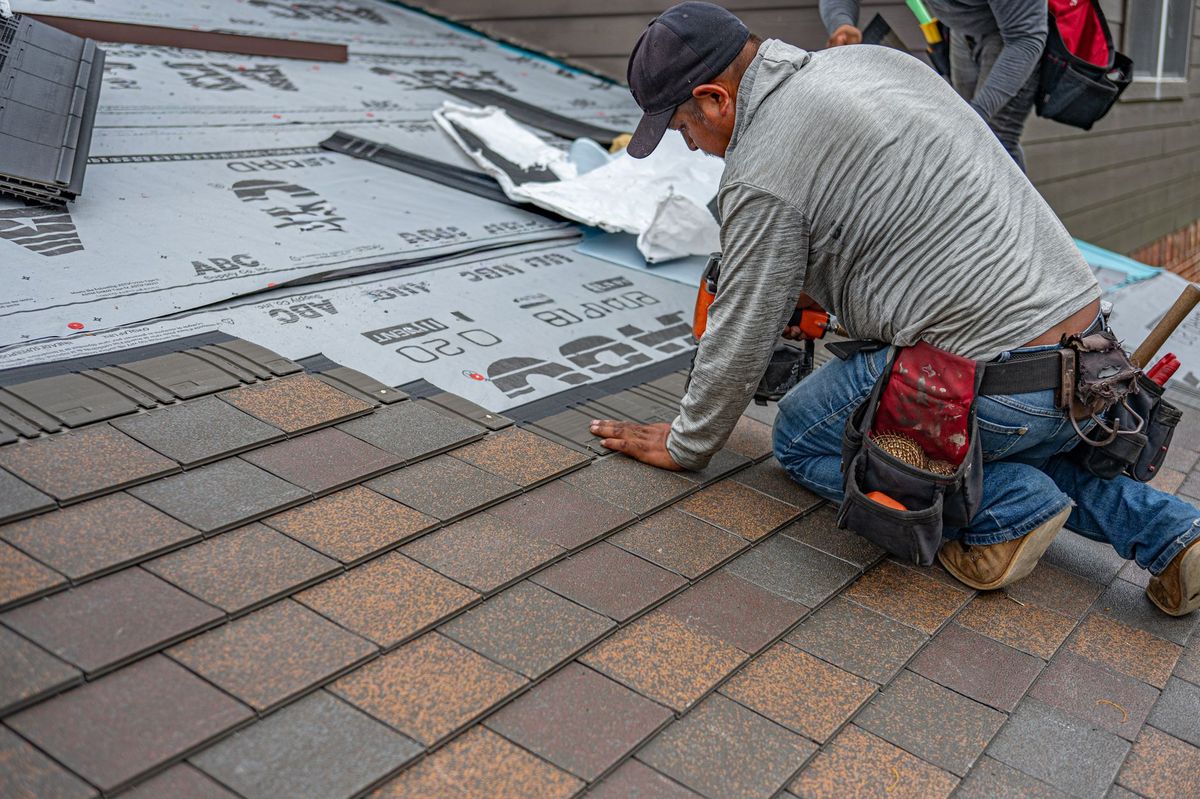
Underlayment installation. Is the ice and water shield extending 24 inches past the interior wall line (code minimum for ice dam protection)? Are the horizontal laps correct (4 inches minimum)? Is the synthetic felt running straight or does it look like a drunk guy rolling carpet?
Shingle alignment. I carry a tape measure and I check the exposure — that's the visible portion of each shingle. GAF Timberline HDZ calls for 5-5/8" exposure. If the exposure is off by more than 1/4", the courses drift and the roof looks wavy from the street. I've sent crews back to re-do entire slopes for exposure errors.
Flashing details. This is where 90% of roof leaks originate. Step flashing at wall intersections, counter-flashing at chimneys, pipe boot installations, valley construction. If the flashing isn't right, the shingles don't matter.
Photo Documentation
Every crew lead takes photos at four stages: pre-tear-off, underlayment complete, mid-installation, and final. These go into a shared Google Photos album organized by job address. I review them every evening.
This accomplishes three things: it gives me eyes on the job even when I'm not there, it creates a documentation record for warranty claims, and it makes the crew leads accountable for their work quality because they know the photos are being reviewed.
Pro tip: Require your crew leads to text you a photo of every completed flashing detail before they shingle over it. Once the shingles are down, you can't see the flashing. If it's wrong, you're not finding out until it leaks — and by then the repair is 10x the cost of doing it right the first time.
Managing Dumpsters and Waste
Three crews tearing off roofs generate massive amounts of waste. On a typical 30-square re-roof with one layer of removal, I generate 3-4 tons of debris. That's one 20-yard dumpster per job.
Running three crews means I need three dumpster swaps per week during peak season. I have a standing account with my waste hauler for scheduled swaps, but I also need flexibility for jobs that generate more waste than expected (multiple layers, heavy plywood replacement).
My waste management system:
Standard dumpster size: 20-yard roll-off for every job. This handles 90% of tear-offs up to 35 squares.
Delivery timing: Dumpster arrives the day before the crew starts. It's positioned exactly where I want it — close enough for efficient debris throwing but not blocking the driveway or damaging the lawn.
Crew discipline: All debris goes in the dumpster. Not on the ground. Not in the yard. Not "we'll clean it up later." Debris on the ground means nails in the yard, which means the homeowner's kid or dog gets hurt, which means a lawsuit.
Magnetic nail sweep: At the end of every tear-off day, two laborers run a rolling magnetic nail sweeper around the entire perimeter of the house, the driveway, and the sidewalk. This is non-negotiable.
The Field Superintendent: Your Most Important Hire
When I went from one crew to three, the single best decision I made was hiring a field superintendent. This is a person whose only job is to manage the daily operations of all three crews.
The field super handles:
- Morning crew deployment and daily assignment confirmation
- Material delivery coordination
- On-site problem solving (bad decking, hidden damage, customer issues)
- Quality inspections on the sites I can't visit that day
- Progress reporting — I get a text at lunch and at EOD with status on all three jobs
- Subcontractor coordination (gutter installers, chimney masons, skylight specialists)
My field super costs me $75,000/year in salary plus a company truck. That sounds like a lot. But without him, I'd need to be the one driving between three sites, which means I can't sell, I can't estimate, I can't manage the business. The field super frees me to do the work that generates revenue — sales and estimating — while he ensures the work gets done right.
If you can't afford a full-time field super, consider a part-time retired roofer who can make rounds 3-4 days a week. Even partial coverage is better than trying to be everywhere yourself.
Pro tip: Your field super needs to be someone the crews respect. Not someone they see as a spy or a babysitter. Promote from within if possible — your best crew lead who's ready for the next step. External hires take longer to build credibility with the crews.
Technology That Actually Helps
I'm not a technology guy. I'm a roofer. But I've found three tools that genuinely improve multi-crew operations:
EagleView / GAF QuickMeasure: Satellite roof measurement reports. $15-25 per report. I order these before every estimate and the measurements are within 1-2% of hand measurement. This eliminates the need to put a ladder up and walk every roof during the sales process, which means I can estimate twice as many jobs per day.
CompanyCam: Photo documentation app designed for contractors. Each project gets a timeline of photos tagged by location and date. Crew leads take photos throughout the day and I can review them from anywhere. $19/month per user.
Jobber or Housecall Pro: Scheduling and invoicing software. I use Jobber at $69/month. It handles scheduling, dispatching, invoicing, and customer communication. The automated "your crew is on the way" text to homeowners is worth the subscription cost alone — it reduces the "where are your guys?" calls by 80%.
Skip the fancy CRM systems and project management platforms designed for commercial construction. They're overkill for residential roofing operations and your crews won't use them.
Pro tip: Invest 30 minutes per week reviewing your job costing data in whatever software you use. Specifically look at labor hours per square and material cost per square on every completed job. These two numbers tell you exactly which crews are efficient and which need coaching.
The Bottom Line
Running three roofing crews is not three times as hard as running one. It's about ten times as hard — until you build the systems. Then it's actually easier than running one, because you have structure, redundancy, and the revenue to hire good people.
Get your crew structure right. Solve the material logistics problem. Stagger your scheduling. Inspect every site daily. Hire a field super when the numbers support it. And use technology selectively.
The roofing companies that will dominate the next decade aren't the ones with the most trucks. They're the ones with the best systems. Build yours now, while the workforce challenges are pushing your competitors out of the market.
Frequently Asked Questions
How many roofing jobs should a well-run crew complete per week?
A 7-person roofing crew should complete 2-3 standard re-roofs per week during peak season, depending on roof size and complexity. A standard single-layer tear-off and re-shingle on a 25-30 square roof (2,500-3,000 SF) should take 1.5-2 days with an experienced crew. Larger roofs (40+ squares), steep pitches, multiple layers, or complex flashing work may require 2.5-3 days. I track my crews on a "squares per man-day" metric — a good crew produces 5-6 squares per man-day. If a crew consistently falls below 4 squares per man-day, something is wrong with either crew composition or work habits.
What insurance coverage do I need for multiple roofing crews?
At minimum, you need general liability insurance ($1-2 million per occurrence is standard), workers' compensation insurance (mandatory in all states for roofing), commercial auto insurance for your vehicles, and inland marine insurance for your tools and equipment. For multi-crew operations, your workers' comp premium will be your largest insurance expense — roofing carries one of the highest classification codes. Budget 15-25% of payroll for workers' comp depending on your state and experience modification rate. Also carry an umbrella policy of at least $2 million above your general liability limits. One serious fall or property damage claim can exceed a $1 million GL policy.
How do I handle callbacks and warranty claims across three crews?
Assign warranty claims back to the crew that did the original installation. This creates accountability — if Crew 2 gets three leak callbacks in a month, there's a systemic quality issue with Crew 2 that needs to be addressed. Track callbacks per crew per month as a key performance metric. I give bonuses to crews that have zero callbacks in a quarter. For urgent leaks, dispatch the nearest available crew regardless of who did the original install — the homeowner doesn't care about your internal crew assignments, they care about the water coming through their ceiling. After the emergency repair, investigate and charge the callback to the responsible crew's quality record.
When should I add a fourth crew versus making three crews more efficient?
Don't add a fourth crew until your three existing crews are consistently hitting their productivity targets (5+ squares per man-day), your callback rate is below 2%, and your pipeline has sustained demand for 8+ jobs per week for at least three consecutive months. Premature scaling is the number one business killer in residential roofing. I'd rather run three profitable crews at full capacity than four crews at 75% utilization. Each additional crew adds management complexity, insurance cost, equipment investment, and cash flow requirements. Make sure your systems — scheduling, quality control, material logistics — are solid at three before you stretch to four.
READ NEXT: Construction Workforce Gap Hits 501,000