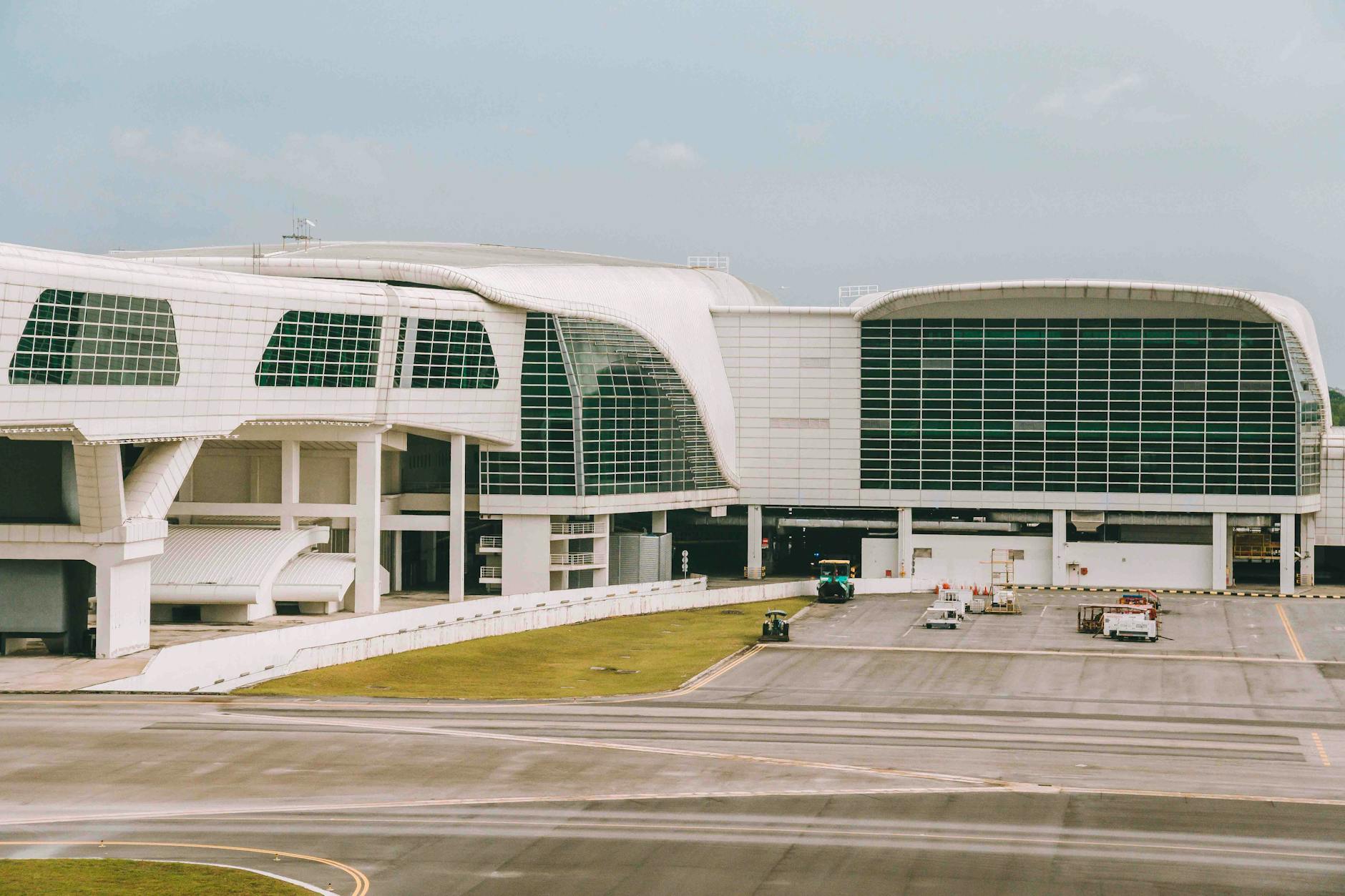
The building is closed in. The roof is on, the glass is hung, and the weather stopped being a schedule risk on the New Terminal One at JFK some time ago. It still is not open.
That gap is the whole story of this job right now, and it is the part of large-terminal construction that travel coverage skips. A weather-tight shell reads as "almost done" from the Van Wyck. Inside, the work that actually determines an opening date — tenant build-out, baggage system integration, boarding bridge commissioning, and the systems testing that has to pass before a single passenger walks through — was only getting started.
What is being built
New Terminal One is a 2.6 million square foot international terminal on a 134-acre site on the south side of JFK. At full build-out the Port Authority lists 23 gates, 22 of them widebody, more than 300,000 square feet of retail, dining and lounge space, and 13,000 rooftop solar panels that the agency describes as New York City's largest solar array. Phase A alone used 33,000 tons of structural steel, which the Port Authority compares to five Eiffel Towers.
The delivery is split. Phase A covers 14 widebody-capable gates plus a new arrivals hall and departures concourse, built on the cleared footprints of the former Terminals 2 and 3. Phase B adds nine more permanent gates and a permanent replacement for one temporary Phase A gate, and it gets built on the site of the current Terminal 1 — which has to be demolished first, after Phase A opens and takes over operations. Full completion is targeted for 2030.
Who is building it
The owner is not the Port Authority. It is JFK NTO LLC, a private consortium of Ferrovial as lead sponsor, Carlyle, JLC Infrastructure and Ullico, operating under a ground lease. Carlyle called the $9.5 billion commitment the largest private investment ever committed to a U.S. airport terminal.
AECOM Tishman holds the design-build general contract. Gensler is the design architect. Thornton Tomasetti is the structural engineer. Jennifer Aument runs the terminal company.
Why the financing structure changes the math on delay
Most large U.S. terminals are paid for with airport revenue bonds or passenger facility charges — public instruments, backed by an airport system, with a public agency absorbing schedule risk. New Terminal One is not that. It is privately financed, with roughly $5.9 billion in bonds outstanding and more than $6 billion in total borrowings, including more than $3.9 billion in green bonds issued across 2024 and 2025.
Debt service does not wait for a ribbon cutting. Every month the terminal is not collecting rent from airlines and concessionaires is a month of carrying cost against a fixed obligation. That is why a schedule slip that would be an inconvenience on a public job triggered a rating action here: Moody's kept the Baa3 rating — the bottom rung of investment grade — but moved the outlook to negative, citing the construction delay and lower-than-anticipated demand at opening.
For anyone bidding subcontract work on a privately financed terminal, that structure is worth understanding before you price it. Schedule pressure on a job like this is not abstract. It gets pushed down into sequencing, overtime, and how hard the CM leans on a late trade.
The opening date is genuinely disputed
There is no single answer here, and it would be dishonest to pick one.
The Port Authority's own project page and the airport's public channels have consistently framed Phase A as a 2026 opening — the original public target was June 2026. Bloomberg reported on May 15, 2026 that the opening had slipped to November 2026 at the earliest, and the Moody's outlook change followed the same delay. Trade coverage since then has treated November 2026 as a floor, not a committed date, and no revised date has been confirmed by the developer in the materials reviewed for this article.
So: the owner-side and airport-side messaging still points at 2026. The financial reporting points at late 2026 or later. Both are current. Treat any specific day you see quoted elsewhere with suspicion.
Why a closed-in building still takes a year
The critical path on a terminal at this stage is not structure. It is the stack of interdependent systems that have to be installed, integrated, tested and accepted in a specific order.
Baggage handling. An in-line baggage system is a mile-scale conveyor and screening machine threaded through the basement and mezzanine of a live building. It cannot be commissioned until the electrical and controls behind it are energized and stable, and it has to run against real volume before anyone will certify it. Testing was underway as the interior work progressed.
Passenger boarding bridges. Each bridge is a separate mechanical, electrical and controls package that has to be set, powered, and proven against aircraft on the apron. That means airside access, aircraft time, and coordination with an airport that never stops moving.
Tenant build-out. More than 300,000 square feet of concessions is not one contract. It is dozens of restaurant, duty-free and lounge fit-outs, each with its own designer, its own contractor, and its own inspection sequence, all competing for the same freight elevators, the same hoisting windows and the same inspectors. Terminal concessions almost always run behind base-building work because they cannot start until the space is turned over.
None of that shows from outside the fence. All of it moves an opening date.
The workforce and the airside problem
The Port Authority puts the terminal at more than 10,000 total jobs, including more than 6,000 union construction positions during the development phase, built under a project labor agreement. The consortium set a 30 percent MWBE participation goal and reported contracting with 101 MWBE firms and paying more than $64.7 million for professional services before construction even started — over $46 million to 71 MBE firms and more than $18.5 million to 30 WBE firms. The terminal company also reports more than $1.72 million invested in education, business development, workforce training and environmental stewardship programs. It holds MWBE and local information sessions the second Tuesday of every month for firms trying to get on the job.
Staffing a job of that size is one problem. Staffing it inside an operating international airport is a different one. The site sits within the airport's secured area, which shapes how crews get to work, where material can be laid down, and how deliveries are staged. Terminal 1 kept running through the demolition of Terminals 2 and 3 and through the construction of the building that replaces them. When Phase A opens, that condition inverts: passengers move into half the complex while the other half stays a hard-hat site, and Phase B construction begins on the ground the old Terminal 1 currently occupies.
That phase overlap — live passengers on one side of a temporary partition, demolition and steel on the other — is the hardest part of the remaining eight years of this project, and it has barely started.
Why it matters to contractors
Two things. First, the materials bill on a job this size is a live index of what heavy commercial work costs right now; the 33,000 tons of Phase A structural steel alone tracks against the movement you can see in structural steel pricing. Second, the terminal is not close to finished. Phase B is a nine-gate terminal in its own right, plus the demolition of an operating terminal, and it will generate subcontract and supplier packages into the 2030s.
Aviation work of this scale also resets wage expectations across a regional market. When 6,000 union construction workers are committed to one site under a PLA, everything else competing for the same trades in Queens and Nassau feels it — a dynamic worth watching in construction wage data. And JFK is not drawing on that bench alone: US airport capital spending hit a record $28 billion in fiscal 2025, with programs at LAX and O'Hare bidding for the same specialty aviation trades at the same time.
What happens next
Watch for three things: a firm, developer-confirmed Phase A opening date, which has not been issued; the start of Terminal 1 demolition, which is the gate that unlocks Phase B; and whether Moody's resolves the negative outlook once the terminal is generating revenue. Until Phase A opens, none of the rest of the schedule can move.
If you want to chase work on the back half of this program, the federal and public solicitation feed on Buildermuse's bid board is the place to watch for related aviation packages as they hit the street.