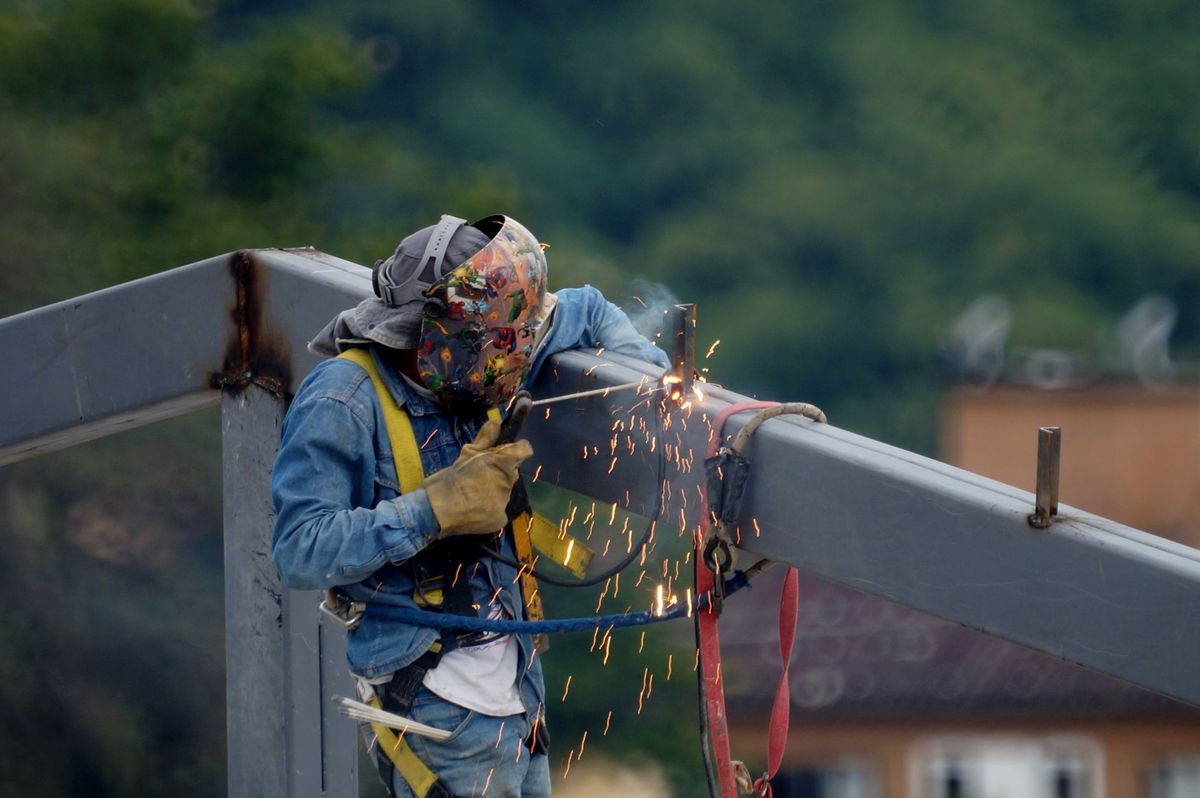
The Bureau of Labor Statistics Occupational Employment and Wage Statistics release covering Standard Occupational Classification 51-4121 — welders, cutters, solderers, and brazers — reports a national median wage of $23.62 per hour ($49,130 annually) for the most recent reporting year. That number understates what construction welders actually earn. Welder wages in construction 2026 run substantially higher than the cross-industry median because the construction sector competes against manufacturing for the same skilled workforce while imposing harsher conditions, more travel, and tighter project schedules.
Pulling NAICS 23 (construction) cross-tabulations from the same release shifts the picture sharply. Construction-employed welders show a median of $32.85/hour, 75th percentile $41.20, 90th percentile $54.80. The construction premium over the all-industry median runs 39% — one of the largest sector premiums BLS reports for any skilled-trade occupation. The numbers below are what employers are paying in 2026 to staff pipeline, refinery turnaround, structural steel, and industrial maintenance work.
What the BLS Numbers Actually Say
BLS OES data for SOC 51-4121 (all industries) reports a national median of $23.62/hour ($49,130/year), mean of $25.04/hour, 75th percentile $30.10, and 90th percentile $39.40. The dataset covers approximately 438,000 welders. Roughly 18% of those — about 78,800 — are employed in NAICS 23 construction sub-industries.
The construction-specific cross-tab from the same release: NAICS 23 median $32.85/hour ($68,330/year), mean $35.40, 75th percentile $41.20, 90th percentile $54.80. The $9.23 spread between the all-industry median and the construction median is roughly twice the inflation-adjusted construction wage growth of the last five years. Construction welders are not earning more because the industry decided to be generous — they are earning more because the alternative is not having welders show up on the jobsite.
For broader context on how welder pay compares with other trade rates, see the construction wages by trade analysis.
The Specialty Premium: 6G, Nuclear, and Pipeline
Base wage data tells half the story. The other half is certification. The American Welding Society and the American Society of Mechanical Engineers maintain procedure and performance qualification standards that define what a welder is allowed to weld on what kind of project. Each qualification carries a market price.
6G pipe welding (ASME Section IX, all-position pipe in fixed 45-degree orientation): The benchmark certification for industrial pipe work. 6G-certified TIG/stick combo welders on refinery turnarounds, petrochemical maintenance, and process piping projects commonly earn $42 to $58 per hour straight time, plus overtime at 1.5x and frequent perdiem of $100 to $175 per day. Total compensation on a 60-hour week during a turnaround commonly exceeds $4,200 weekly before perdiem, $4,900 to $5,300 weekly after.
Nuclear-certified welders (10 CFR 50 Appendix B quality program, ASME Section III): Welders working on safety-related components in commercial nuclear plants must hold qualification under a quality program that satisfies federal regulation. Hourly rates routinely exceed $60 per hour and outage-window rates can push past $85 per hour for shutdowns where every day of schedule has measurable revenue impact. The certification carries renewal requirements every six months on each procedure the welder is qualified to, and continuous-period requirements that disqualify a welder whose work has been interrupted for more than six months without requalification.
Combo welders (stick, TIG, MIG, flux-cored, all positions): A welder qualified across multiple processes commands a premium even without a specialty certification. AGC of America's most recent construction wage survey found that combo welders earned an average $3.40/hour more than single-process welders in the same metro area.
API 1104 pipeline welders: Cross-country pipeline work falls under American Petroleum Institute Standard 1104. UA Local 798 (United Association Pipeliners) scale for the 2026 contract year runs at $54.20 per hour base with package value (pension, health, annuity, training) bringing total compensation above $92 per hour. Pipeline welders also receive per-mile travel pay, perdiem, and rig pay (additional compensation for welders who own and operate their own welding rig trucks, commonly $35 to $50 per hour above scale).
Underwater welders: A separate occupational category (BLS classifies them under commercial divers, SOC 49-9092) with median wages above $60,000 plus dive premiums that push experienced offshore underwater welders well into six-figure annual earnings. Less than 1,000 commercial underwater welders work in the U.S. construction sector.
Why Construction Welders Outearn Manufacturing Welders
The 39% NAICS 23 premium over the all-industry median is structural, not accidental. Four factors compound:
Jobsite hardship. Construction welders work outdoors year-round in conditions manufacturing welders never see — interstate bridge in February, Texas refinery in July, 14,000-foot wind tower foundation in Colorado. That hazard tolerance gets priced into the wage.
Travel and perdiem. Industrial maintenance and pipeline work is mobile by design. A 6G welder may work seven states in a year. Employers compete for that mobility with perdiem of $100 to $175 per day for non-local assignments, typically pegged to GSA city rates. Perdiem at $125/day across a 200-day mobile work year adds $25,000 outside the W-2 wage line.
Schedule pressure. Turnaround work runs on fixed schedules with seven-figure daily downtime penalties. Welders run 60 to 84 hour weeks for the turnaround duration. Manufacturing welders rarely face that schedule.
Certification half-life. Construction welders maintain qualifications across multiple procedures, each with six-month continuous-employment requirements before requalification triggers. Wages compensate for that maintenance burden.
Safety note: Hexavalent chromium exposure is the welder safety issue with the longest regulatory tail. OSHA 29 CFR 1926.1126 sets the construction permissible exposure limit at 5 micrograms per cubic meter of air, with an action level of 2.5 micrograms. Stainless steel welding, hardfacing operations, and any welding on chromate-coated surfaces generate hex-chrome fumes that exceed the PEL within minutes without local exhaust ventilation. The OSHA construction standard requires written exposure control plans, periodic air monitoring, medical surveillance for any welder exposed above the action level for 30 or more days per year, and respiratory protection where engineering controls are not feasible. Manganese, zinc, lead, and cadmium exposures carry separate standards. Welder compensation should not be evaluated without recognizing what the regulatory framework requires the employer to provide.
State-by-State Wage Variation
BLS OES state data for SOC 51-4121 shows a wide spread driven by oil and gas, petrochemical, and shipbuilding concentrations.
Highest-paying states (all-industry medians): Alaska $33.40 (North Slope oil and gas), Hawaii $29.80, Wyoming $29.20 (pipeline and trona mining), North Dakota $28.40 (Bakken), Washington $27.80 (Boeing aerospace demand spilling into structural).
Texas: Employs more welders than any other state (more than 53,000) with an all-industry median of $26.40 but construction-employed welders at $34.80 median. The Permian Basin, Houston Ship Channel, and Gulf Coast refinery turnaround work pull construction welder pay well above the state average.
Lower-paying states: Mississippi ($20.80), Arkansas ($21.40), Alabama ($21.60) — lower industrial maintenance and weaker union density.
For deeper state-level wage analysis, the Buildermuse state dashboards cover wage levels and contractor concentration across all 51 jurisdictions.
Union Scale and the Pipefitters/Boilermakers/Ironworkers Cross-Trade Picture
A significant share of construction welding falls under collective bargaining agreements held by trades other than a dedicated "welders union." The three primary craft unions covering welders in construction:
United Association (UA) — Local 798 and pipeline locals. The pipeline welder local, headquartered in Tulsa, holds national agreements for cross-country pipeline work. 2026 base wage of $54.20/hour plus a package value of roughly $38/hour. Local 798 maintains its own welding qualification testing center and accepts welders who pass the Local 798 weld test regardless of geographic origin.
International Brotherhood of Boilermakers. The Boilermakers cover pressure vessel, boiler, and heat exchanger work. National Transient Lodge welders working under the Boilermaker Construction National Agreement earn base wages typically between $42 and $52 per hour depending on the regional zone, with package value adding another $25 to $35.
International Association of Bridge, Structural, Ornamental, and Reinforcing Iron Workers. Structural welders working under Iron Workers agreements typically earn the Iron Worker base rate (commonly $36 to $48/hour depending on local) plus a welder differential of $1.50 to $4.00/hour.
Union welders also benefit from defined-benefit pension contributions and joint apprenticeship training that non-union welders fund themselves. The non-union construction welder typically pays $4,000 to $9,000 out of pocket to obtain and maintain a 6G qualification, while the union welder receives that training through joint apprenticeship trust funds at no individual cost.
The Apprenticeship Pipeline Problem
The structural problem for the welding trade is that the supply pipeline has not kept pace with retirement. The American Welding Society's most recent workforce projection estimates a national shortage of approximately 400,000 welders by 2026 across all industries, with construction and pipeline work absorbing a disproportionate share of unfilled demand.
The supply numbers from BLS:
- Annual replacement need (all welder occupations): approximately 47,600 openings per year
- Annual completion of welder training programs (community college, technical school, registered apprenticeship combined): approximately 32,000
The gap of 15,600 welders per year compounds. Registered apprenticeship data from the U.S. Department of Labor's RAPIDS system shows roughly 8,400 active welder apprentices in 2025, against a total welder workforce of 438,000. The replacement ratio is structurally inadequate.
The labor accounting math behind staffing a welding workforce is best worked through with a labor burden calculator that captures base wage, payroll taxes, workers comp, benefit loading, and perdiem on a fully loaded hourly basis.
Safety note: Welder apprentices face higher injury rates than journey-level welders. CPWR data analyzing BLS Survey of Occupational Injuries and Illnesses shows that first-year apprentice welders have eye, hand, and burn injury rates approximately 2.4 times the rate for welders with five or more years of experience. The injury mix shifts from acute (burns, arc-eye, falls) toward chronic (musculoskeletal, respiratory) as workers age in the trade. Both require structured prevention.
Robotic Welding and Its Limited Construction Impact
Robotic welding has reshaped automotive manufacturing and pipe-spool fab shops. Construction welding has largely not been affected. Setup time exceeds weld time on field welds with variable joint configurations, jobsite power and access defeat robotic fixture requirements, and ASME Section IX qualification of automated processes adds cost most field projects cannot amortize.
The exception is large-diameter cross-country pipeline, where automated orbital rigs (Serimax, CRC-Evans, Lincoln Electric) have captured a growing share of mainline welds. Even there, tie-in welds, repair welds, and station piping remain manual operations. The net impact of automation on construction welder demand through 2026 is approximately zero.
Frequently Asked Questions
What is the average hourly wage for a construction welder in 2026?
Construction welders (NAICS 23) earn a median hourly wage of $32.85 based on BLS Occupational Employment and Wage Statistics data for SOC 51-4121. The mean is $35.40, the 75th percentile is $41.20, and the 90th percentile is $54.80. Construction-employed welders earn approximately 39% more than the all-industry median for welders, cutters, solderers, and brazers because of jobsite hardship, travel and perdiem, schedule pressure, and certification maintenance requirements.
How much do 6G pipe welders earn?
6G-certified TIG/stick combo welders working on refinery turnarounds, petrochemical maintenance, and process piping projects commonly earn $42 to $58 per hour straight time, plus overtime at 1.5x and perdiem of $100 to $175 per day. Total weekly compensation on a 60-hour turnaround week routinely exceeds $4,200 before perdiem and $4,900 to $5,300 after. UA Local 798 pipeline welders working under the 2026 contract earn $54.20/hour base plus package value above $38/hour, with additional pay for rig welders who own their own welding rig trucks.
Which states pay welders the most?
BLS state-level data places Alaska ($33.40), Hawaii ($29.80), Wyoming ($29.20), North Dakota ($28.40), and Washington ($27.80) at the top of state-median welder wages across all industries. Texas employs the most welders nationally (more than 53,000) and shows a construction-specific welder median of $34.80/hour driven by Permian Basin, Houston Ship Channel petrochemical, and Gulf Coast refinery work.
Are welders in shortage?
Yes, structurally. The American Welding Society estimates a national shortage of approximately 400,000 welders by 2026 across all industries. BLS replacement demand of roughly 47,600 welders per year exceeds annual training program completions of approximately 32,000, producing a recurring gap of about 15,600 welders per year. Registered apprenticeship enrollment of approximately 8,400 active welder apprentices is structurally insufficient for the 438,000-welder workforce.
Do construction welders get benefits beyond hourly pay?
Construction welders working under union collective bargaining agreements (UA, Boilermakers, Iron Workers) receive defined-benefit pension contributions, health and welfare contributions, annuity contributions, and apprenticeship training fund contributions totaling $25 to $40 per hour in package value above base wage. Non-union construction welders typically receive employer-sponsored health insurance, 401(k) match, and perdiem for non-local assignments. Total compensation including benefits and perdiem for a 6G-certified construction welder regularly exceeds $110,000 annually based on a 50-week work year at 50 hours per week.