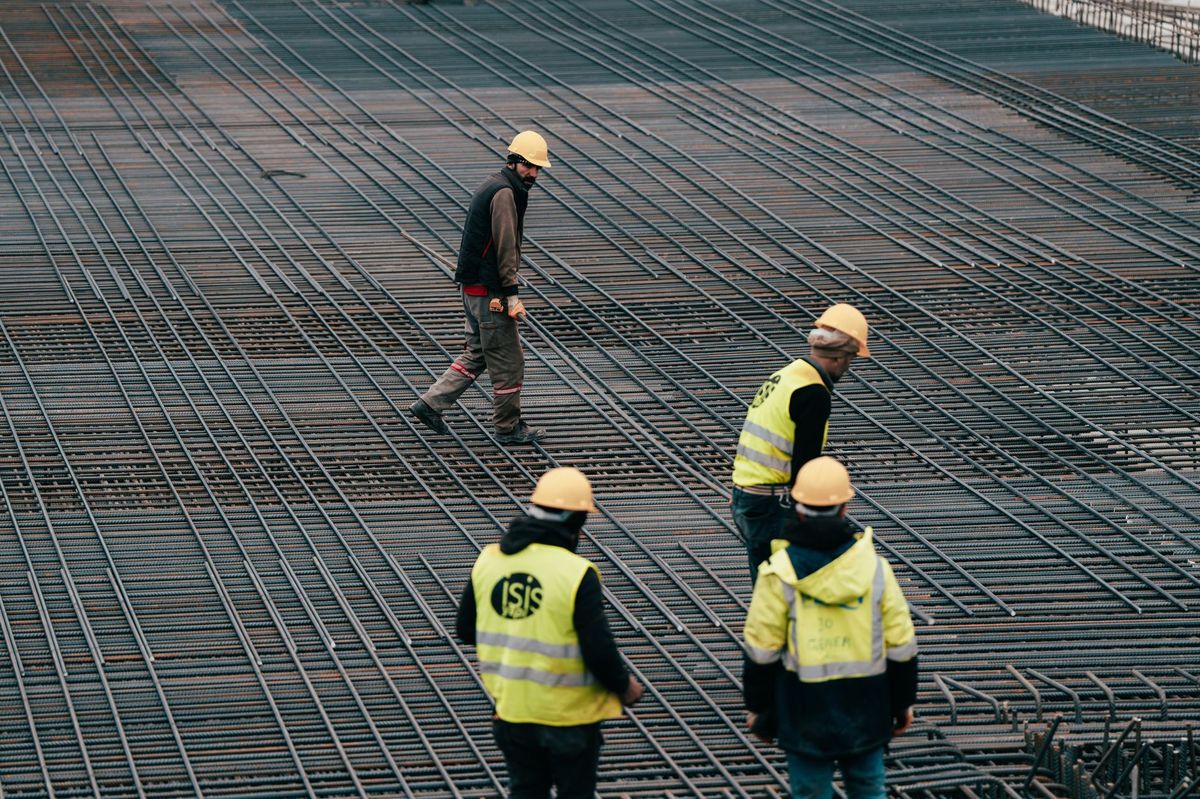
The Bureau of Labor Statistics Current Employment Statistics survey for February 2026 shows that average hourly earnings for all construction employees reached $38.42 — up 4.3% from $36.84 one year ago. That marks the fourth consecutive year that construction wage growth has outpaced the Consumer Price Index, which rose 2.9% over the same period.
For an industry that spent decades losing workers to competing sectors because the pay did not match the physical demands, this sustained wage growth represents a fundamental correction. The data is clear — the market is doing what the market does when demand exceeds supply, and construction workers are finally benefiting.
The National Picture: $38.42 and Climbing
BLS CES data reveals that the $38.42 average hourly wage for construction workers in February 2026 includes all occupations within the industry — from laborers to superintendents, from first-year apprentices to 30-year journeymen. The annual growth rate of 4.3% compares favorably to:
- All private-sector workers: $34.62/hr, up 3.6%
- Manufacturing workers: $33.88/hr, up 3.1%
- Retail trade workers: $21.74/hr, up 3.4%
- Transportation and warehousing: $30.12/hr, up 3.8%
Construction workers now earn $3.80 per hour more than the average private-sector employee. A decade ago, that premium was only $1.40/hr. The gap has widened because construction wages have grown at a compound annual rate of 4.1% since 2020, while the all-private-sector average has grown at 3.5%.
BLS data also shows that total construction employment reached 8.14 million in February 2026, a gain of 196,000 jobs year-over-year. Despite the well-documented labor shortage, the industry continues to add workers — they are just not adding them fast enough to fill the 501,000-position gap.
Safety note: Higher wages attract workers, but they also create pressure to maximize output per worker. OSHA 29 CFR 1926.20(a) states that construction employers must initiate and maintain programs to provide safe and healthful working conditions. Productivity pressure cannot override safety obligations. I have investigated incidents where workers were pushed to skip tie-off procedures because the crew was behind schedule. No schedule is worth a life.
Regional Wage Breakdown: Where the Money Is
Construction wages vary dramatically by geography. BLS Occupational Employment and Wage Statistics data for 2025 (the most recent regional release) shows stark differences:
Highest-paying metros:
- New York-Newark-Jersey City: $52.10/hr average — driven by prevailing wage requirements and high union density
- San Francisco-Oakland-Berkeley: $50.80/hr — elevated by tech campus and data center construction
- Boston-Cambridge-Newton: $49.40/hr — fueled by biotech lab and institutional building
- Chicago-Naperville-Elgin: $47.60/hr — strong union presence and robust infrastructure pipeline
- Seattle-Tacoma-Bellevue: $46.90/hr — driven by continued tech sector building and housing starts
Moderate-paying metros:
- Denver-Aurora-Lakewood: $38.20/hr
- Phoenix-Mesa-Chandler: $35.40/hr
- Atlanta-Sandy Springs-Alpharetta: $34.80/hr
- Houston-The Woodlands-Sugar Land: $34.10/hr
- Dallas-Fort Worth-Arlington: $33.90/hr
Lower-paying metros:
- San Antonio-New Braunfels: $29.80/hr
- Memphis: $29.20/hr
- Birmingham-Hoover: $28.60/hr
- Jackson, MS: $27.40/hr
The $24.70 spread between New York and Jackson represents a significant cost-of-living differential, but it does not fully explain the gap. BLS cost-adjusted wage data (using Regional Price Parities) shows that construction workers in New York still earn approximately 18% more in real purchasing power than those in Mississippi, even after adjusting for local costs.
Union density explains much of the regional variation. In metro areas where union construction membership exceeds 30%, average wages are $8.40/hr higher than in metros with union density below 10%, according to BLS union membership data.
Trade-Specific Wages: What Each Craft Earns
BLS OES data breaks construction wages by specific occupation, revealing a wide range of earnings across trades:
Highest-paying construction trades (median hourly, 2025):
- Elevator installers and repairers: $52.80/hr — the perennial leader, with demand driven by building codes and an aging vertical transportation fleet
- Boilermakers: $46.20/hr — specialized skills and hazardous conditions command a premium
- Electrical power-line installers: $44.60/hr — utility-scale work pays well above building trades
- Electricians: $42.10/hr — strong demand from data center and EV charging infrastructure
- Plumbers, pipefitters, and steamfitters: $38.80/hr
- Structural ironworkers: $38.20/hr
Mid-range trades:
- Operating engineers: $35.20/hr
- HVAC mechanics and installers: $34.60/hr
- Brickmasons and blockmasons: $32.40/hr
- Carpenters: $29.90/hr
Entry-level trades:
- Drywall installers: $28.20/hr
- Roofers: $27.80/hr
- Painters: $26.40/hr
- Construction laborers: $25.40/hr — but this is up 5.8% year-over-year, the fastest growth rate of any trade
The $27.40 spread between elevator installers and laborers reflects the premium that specialization, licensing, and hazard exposure command. Electricians have seen their median wage grow 18.2% over five years, the largest absolute gain among major trades, driven by data center construction, EV infrastructure, and renewable energy installation demand.
Safety note: Higher-paid trades often involve higher-risk work. Elevator installers, ironworkers, and power-line workers face some of the highest fatality rates in the industry. OSHA 29 CFR 1926.251 (rigging equipment), 1926.550 (cranes), and 1926.960 (power transmission) set specific standards for these high-hazard operations. The wage premium exists for a reason — respect it by ensuring every dollar of that premium is backed by adequate safety investment.
Benefits Packages: The Hidden Compensation
Hourly wages tell only part of the story. BLS Employer Costs for Employee Compensation data shows that the total compensation package for construction workers averages $56.18 per hour when benefits are included — 46% above the base hourly wage.
The benefits breakdown for construction workers:
- Health insurance: $7.42/hr (employer cost) — construction's share is higher than the private-sector average of $6.84/hr because physical work demands robust medical coverage
- Retirement and savings: $3.64/hr — includes defined benefit pensions (union) and 401(k) contributions (non-union)
- Paid leave: $3.18/hr — vacation, holidays, and sick time
- Legally required benefits: $3.52/hr — Social Security, Medicare, workers' compensation, and unemployment insurance
Workers' compensation costs alone average $2.14 per hour for construction employers, more than double the all-industry average of $0.98/hr. This reflects the higher injury rates and severity typical of construction work. States with high workers' comp rates — including California ($3.42/hr), New York ($3.18/hr), and Alaska ($2.94/hr) — add significant cost above the base wage.
For union construction workers, the total package is even larger. The Building Trades Department of the AFL-CIO reports that the average union construction worker receives total compensation of $63.40 per hour, including negotiated fringe benefits that fund apprenticeship training, annuity plans, and supplemental unemployment benefits.
Construction vs. Other Industries: The Competitiveness Question
The key question for workforce recruitment is whether construction compensation competes with alternatives available to the same worker pool. BLS data allows a direct comparison.
A construction laborer earning $25.40/hr with a total compensation package of approximately $37/hr is competing against:
- Amazon warehouse associate: $21/hr base plus benefits — lower pay but air-conditioned, predictable schedule
- UPS delivery driver (union): $42/hr at top scale — higher pay, benefits, and no exposure to weather
- Manufacturing production worker: $26/hr average — similar pay, more stable employment, climate-controlled
- CDL truck driver: $31/hr average — higher base pay, independence, high demand
For skilled trades workers, the comparison is more favorable. An electrician earning $42/hr with a $62/hr total package competes against:
- Industrial electrician (manufacturing): $38/hr — less pay but steadier schedule and benefits
- Controls technician: $44/hr — similar pay, growing demand, less physically demanding
- Utility lineworker: $45/hr — higher pay but extreme conditions and travel requirements
The data is clear — construction wages have become genuinely competitive for skilled trades workers. The remaining recruitment challenge is less about money and more about working conditions, career visibility, and cultural perception. Young workers are not choosing between construction at $42/hr and office work at $42/hr. They are choosing between a career they have heard of and one they have not.
Overtime and Premium Pay
BLS data shows that construction workers average 42.3 hours per week, compared to 34.3 hours for all private-sector employees. That additional 8 hours of overtime at 1.5x rates significantly boosts actual take-home pay.
A journeyman electrician working 42.3 hours per week earns roughly:
- 40 hours at $42.10: $1,684
- 2.3 hours at $63.15 (1.5x): $145
- Weekly total: $1,829
- Annualized (50 weeks): $91,450
AGC survey data shows that 38% of construction workers regularly work 50+ hours per week during peak season, with some specialty trades averaging 55-60 hours. At those levels, a journeyman electrician's annualized earnings can exceed $110,000.
However, the income comes with a cost. Extended overtime reduces productivity — ENR data shows that after the eighth consecutive week of 50+ hours, worker productivity drops by 15-20%. And as I have noted, NIOSH data links extended work hours to higher injury rates. The premium pay is earned, not given.
The Four-Year Trend: Why This Matters
The significance of four consecutive years of above-inflation wage growth cannot be overstated. BLS CPI-adjusted construction wage data shows:
- 2023: 5.1% nominal wage growth vs. 3.4% CPI = 1.7% real wage gain
- 2024: 4.8% nominal vs. 2.9% CPI = 1.9% real wage gain
- 2025: 4.5% nominal vs. 3.1% CPI = 1.4% real wage gain
- 2026 (annualized): 4.3% nominal vs. 2.9% CPI = 1.4% real wage gain
Cumulatively, construction workers have experienced a real wage increase of approximately 6.5% over four years. That means their paychecks buy 6.5% more goods and services than they did at the start of 2023. For an industry where real wages were essentially flat from 2010 to 2020, this is a meaningful structural shift.
The driver is straightforward: the material cost pressures that squeeze contractor margins have not stopped contractors from raising wages, because the alternative — not having workers — is more expensive than paying more for them.
Prevailing Wages and Davis-Bacon Impact
The Davis-Bacon Act requires that workers on federally funded construction projects be paid the locally prevailing wage, as determined by the Department of Labor. The DOL's 2024 update to Davis-Bacon regulations — the first major revision in 40 years — expanded coverage and updated the survey methodology used to determine prevailing rates.
DOL data shows that Davis-Bacon prevailing wage determinations now cover approximately $217 billion in annual federal and federally assisted construction. The average Davis-Bacon rate exceeds the BLS average by $6.80/hr for the same trade in the same metro area, because prevailing wage surveys weight union rates more heavily in areas with significant collective bargaining activity.
The IIJA infrastructure pipeline has significantly expanded the volume of Davis-Bacon-covered work. AGC estimates that 72% of IIJA-funded construction projects are subject to Davis-Bacon requirements. For contractors who had previously worked primarily in the private sector, this means adapting payroll practices, certified payroll reporting, and wage compliance documentation.
Safety note: Davis-Bacon compliance intersects with safety in an important way. Projects that pay prevailing wages attract more experienced workers, and experienced workers have lower injury rates. CPWR data shows that Davis-Bacon projects have a lost-time injury rate of 2.1 per 100 workers, compared to 3.4 for comparable non-prevailing-wage projects. Paying workers fairly is not just ethical — it is a safety strategy.
The updated Davis-Bacon rules also strengthened anti-retaliation provisions. Workers who report wage violations on federal projects are protected, and contractors who retaliate face debarment. In fiscal year 2025, the DOL Wage and Hour Division recovered $28.6 million in back wages owed to construction workers on Davis-Bacon projects.
To turn these wages into a real crew budget, run them through our free labor burden calculator — base pay is only about 70% of what a worker actually costs.
Frequently Asked Questions
What is the average construction wage in the US in 2026?
BLS Current Employment Statistics data for February 2026 shows that the average hourly earnings for all construction employees reached $38.42, up 4.3% from $36.84 one year ago. When total compensation including benefits is factored in, the average rises to $56.18 per hour. Wages vary significantly by region, trade, and union status.
Which construction trade pays the most?
BLS Occupational Employment and Wage Statistics data shows that elevator installers and repairers earn the highest median wage at $52.80/hr, followed by boilermakers ($46.20/hr) and electrical power-line installers ($44.60/hr). Among the more common trades, electricians lead at $42.10/hr median. All figures represent 2025 annual data.
Are construction wages keeping up with inflation?
Yes. Construction wages have outpaced inflation for four consecutive years. In 2026, nominal wage growth of 4.3% exceeds the CPI increase of 2.9%, producing a real wage gain of 1.4%. Cumulatively, construction workers have experienced approximately 6.5% in real wage gains since 2023, marking a significant improvement from the 2010-2020 period when real wages were essentially flat.
Take Action Now
If you are a construction worker, know your market value. Pull up BLS OES data for your trade and metro area — it is free and public at bls.gov. If your current wage falls below the 25th percentile for your experience level and region, bring the data to your employer. The shortage gives you leverage you have not had in decades. Use it responsibly, but use it. You have earned it.