Restaurant Build-Outs: The Most Underrated Specialty in Commercial
Listen. Everybody wants to build warehouses. Everybody wants to build data centers. Everybody wants to chase the big-ticket commercial projects that make the headlines.
Meanwhile, restaurant build-outs are sitting right there — steady, profitable, repeat work that most commercial contractors ignore because the projects are "too small."
Here's the thing. I've built out 34 restaurants in the last six years. Fast casual. Full service. Quick service. Ghost kitchens. Breweries. Coffee shops. And I'm going to tell you something that the guys chasing $50 million warehouse contracts don't want to hear: my restaurant build-out division has better margins, more predictable cash flow, and more repeat business than any other segment of my company.
The average restaurant build-out in my market is $350,000-750,000 in construction cost. That's a sweet spot. Big enough to be worth your time. Small enough that the big GCs don't bother competing for them. And there are hundreds of them every year in any metro area.
Let me break down why this specialty is a goldmine — and what you need to know to do it right.
The Market Nobody's Talking About
The National Restaurant Association tracks restaurant openings, closings, and renovations. In 2025, there were approximately 54,000 new restaurant openings nationally. Not all of those involved construction — some were operators moving into existing restaurant spaces. But a significant percentage required substantial build-out work.
Add to that the renovation cycle. A restaurant's interior takes a beating. Heavy foot traffic, commercial kitchen heat and moisture, grease, cleaning chemicals. Most restaurants renovate or refresh every 7-10 years. That's a constant cycle of renovation work in addition to new construction.
The data center boom is pulling commercial labor into massive single-project commitments. Warehouse construction is similar — long-duration, high-manpower projects. Restaurant build-outs are the opposite: 6-12 week projects with smaller crews. That makes them ideal for mid-size contractors who don't have 50 people to commit to a single job.
Why Restaurant Build-Outs Are Different
A restaurant is not an office. It's not a retail store. It's a food manufacturing facility embedded inside a customer-facing hospitality space. That dual nature creates construction challenges that don't exist in other commercial work.
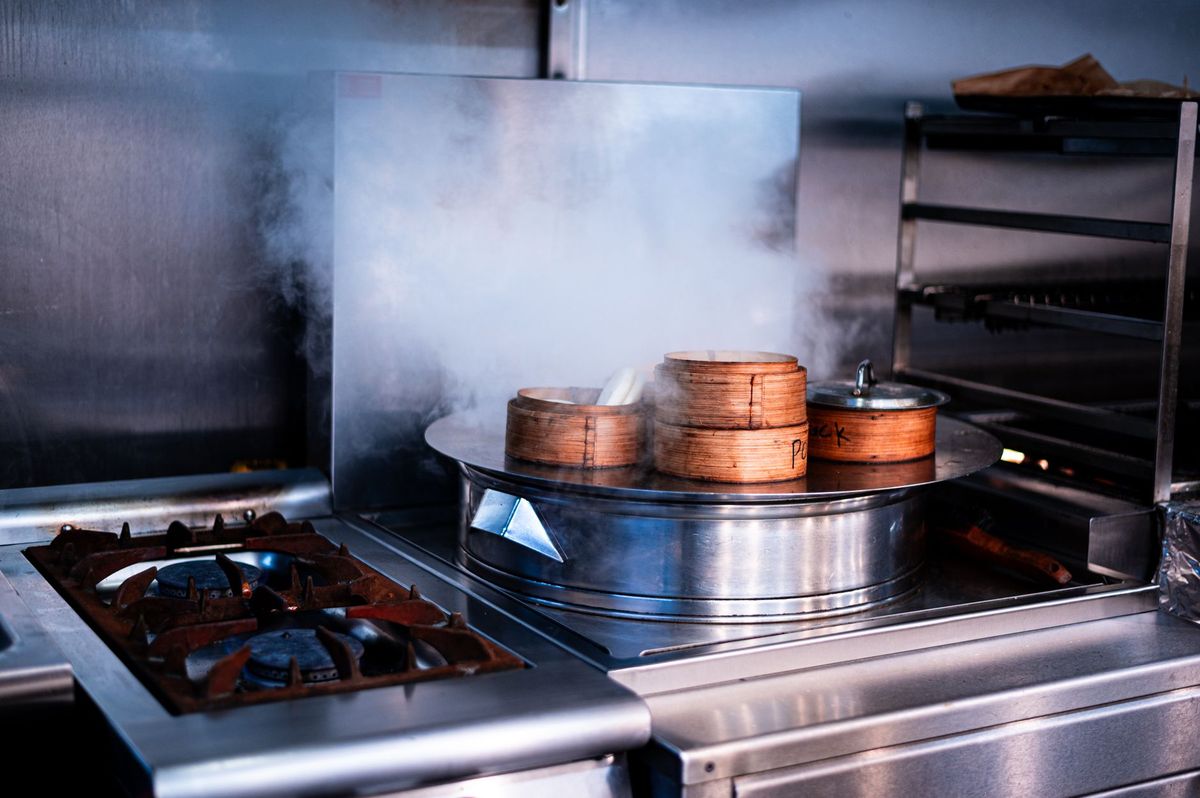
The Kitchen Is an Industrial Installation
A commercial kitchen is the most complex space per square foot in all of construction. In a 1,200 SF kitchen footprint, you're installing:
Electrical: 200-400 amp service for cooking equipment, walk-in refrigeration, HVAC, and lighting. Multiple dedicated circuits for individual pieces of equipment. Often 3-phase power. The electrical panel in a restaurant kitchen looks like something out of a submarine.
Plumbing: Hot and cold water to every sink, dishwasher, and ice machine. Floor drains — lots of them. A grease interceptor (grease trap) that's sized to the kitchen's output. Gas piping for cooking equipment. A dedicated hand-wash sink at every food prep station (health department requirement).
HVAC: A commercial kitchen hood system is a massive installation. The hood itself, exhaust ductwork, make-up air system, and fire suppression (Ansul or similar wet chemical system). A Type I hood over a cooking line can move 2,000-4,000 CFM of air. That air has to be replaced — you can't exhaust 3,000 CFM without bringing 3,000 CFM back in. The make-up air unit is often the single most expensive mechanical component in the build-out.
Fire suppression: Beyond the hood suppression, the kitchen needs a fire sprinkler system that's often upgraded from the base building's system. High-piled storage in dry goods areas may require different sprinkler heads than the dining room.
Floor system: Commercial kitchen floors take incredible abuse. I install quarry tile over a mortar bed with a membrane system in every kitchen I build. The floor must be pitched to drains (typically 1/8" per foot minimum), which means the mortar bed varies in thickness across the kitchen. Getting this right is critical — standing water in a kitchen is a health code violation and a slip hazard.
Pro tip: Build a relationship with a commercial kitchen equipment dealer in your market. They'll spec the equipment, provide utility requirement sheets (BTU loads, electrical specs, water requirements), and often handle the equipment delivery and installation. Your job is the infrastructure — the floor, the walls, the mechanical rough-ins, and the hood installation. Let the equipment dealer handle the equipment. This division of responsibility prevents finger-pointing when a piece of equipment doesn't fit or doesn't work.
The Dining Room Is a Design Statement
While the kitchen is industrial, the dining room is pure design. Restaurateurs and their architects obsess over every detail — the lighting, the materials, the acoustics, the flow. A restaurant's success is tied to its atmosphere, and the construction team is responsible for bringing that atmosphere to life.
This means your finish carpentry needs to be excellent. Your tile work needs to be excellent. Your paint needs to be excellent. The tolerance for imperfection in a restaurant dining room is zero, because customers are sitting 3 feet from your work, under carefully designed lighting that highlights every flaw.
I've had restaurateurs reject paint finishes that were technically perfect because the sheen "didn't feel right" under their selected lighting. I've re-installed banquette seating three times because the upholstery guy's foam density created a seat height that was 1/2-inch too low for the table height the designer specified.
This level of detail orientation is either going to drive you crazy or you're going to love it. I love it. The precision required keeps the hack contractors out of this market, which keeps the margins healthy for those of us who can deliver.
Health Department and Code Requirements
Restaurant construction involves the most inspection-heavy permitting process in commercial construction. Your typical restaurant build-out requires:
- Building permit (standard)
- Mechanical permit (hood system, HVAC)
- Plumbing permit (grease interceptor, fixtures)
- Electrical permit
- Fire alarm and suppression permit
- Health department plan review and inspection
- Liquor authority review (if applicable — bar layout, storage)
- ADA compliance review (public accommodation requirements)
The health department review is the wild card. Every health department has different requirements, and they can be surprisingly specific. Sink placement. Wall finish materials (FRP or tile in all food prep areas). Ceiling type (non-porous, washable). Hand-wash sink location relative to food prep stations. Pest control measures.
I've had a health department inspector fail a final inspection because a mop sink didn't have a backflow prevention device. A $25 part. But failing that inspection delayed the restaurant's opening by 10 days while we got the part, installed it, and scheduled a re-inspection. That's $30,000+ in lost revenue for the operator. All for a $25 part that should have been in the plans.
Pro tip: Before you start demo or construction on any restaurant build-out, schedule a pre-construction meeting with the health department. Walk through the plans with the inspector who will be doing the final sign-off. Get their comments in writing. Address every item before you start construction. This one meeting can prevent weeks of delays at the end of the project.
Pricing Restaurant Build-Outs
Restaurant build-outs price differently than standard commercial construction. The cost per square foot is dramatically higher because of the kitchen density and the finish quality.
Here's what I'm seeing in 2026:
- Fast casual (Chipotle-style): $175-250 per SF, total project cost $350,000-600,000 for a 1,800-2,500 SF space
- Full-service restaurant: $250-400 per SF, total project cost $500,000-1,200,000 for a 2,500-4,000 SF space
- Quick-service (drive-through): $200-300 per SF, total project cost $600,000-1,000,000 for a ground-up building
- Ghost kitchen: $150-200 per SF, total project cost $150,000-300,000 for a 1,000-1,500 SF space
- Brewery/taproom: $200-350 per SF, total project cost $600,000-1,400,000 for a 3,000-5,000 SF space
The kitchen typically represents 40-50% of the total build-out cost despite being only 25-35% of the total square footage. The hood system alone can be $40,000-80,000 depending on length and complexity.
My markup on restaurant build-outs is 18-22% over direct costs. This is higher than my typical commercial markup of 12-15% because the coordination intensity, inspection density, and finish quality requirements justify it. And restaurant operators are used to paying for quality — they understand that a well-built restaurant pays for itself in fewer maintenance issues and faster openings.
Pro tip: Always include a design contingency in your restaurant proposals — I use 8-10% of hard costs. Restaurateurs change their minds. The chef decides he needs a different cooktop. The designer swaps the bar tile. The owner sees a competitor's restaurant and wants that lighting fixture instead. Design changes are inevitable in restaurant work. Budget for them upfront and you won't be fighting over change orders every week.
Building Your Restaurant Build-Out Business
If I've convinced you that restaurant build-outs are worth pursuing, here's how to get started.
Build Your Subcontractor Network
You need specialized subs who understand restaurant construction:
Commercial kitchen hood installer. This is a licensed specialty. The hood fabrication, installation, ductwork, and fire suppression system require specific certifications. Find one good hood company and build a long-term relationship.
Commercial plumber. Not a residential plumber. You need someone who understands grease interceptor sizing, backflow prevention, and health department requirements. They need to be comfortable with complex gas piping for commercial cooking equipment.
Commercial electrician. 200+ amp services, 3-phase power, dedicated circuits for every piece of kitchen equipment. The electrician needs to read an equipment schedule and know that a Rational combi oven needs a 208V 60A circuit, not a standard 20A outlet.
Tile installer. Quarry tile in kitchens, decorative tile in dining areas and bathrooms. This is specialized work — kitchen floor tile over a mortar bed with proper slope to drains is an art form.
Millwork/casework company. Custom bars, hostess stands, banquettes, wainscoting, coffered ceilings. Restaurant millwork is visible and it needs to be perfect.
Market to the Right People
Restaurant operators find contractors through three channels:
Kitchen equipment dealers. They're the first people a restaurateur calls. If you have a relationship with the dealer, they'll recommend you.
Architects who specialize in restaurants. Every market has 3-5 architecture firms that do most of the restaurant design work. Get on their bid lists.
Referrals from other restaurateurs. This is the best channel. Do great work for one restaurant owner and they'll refer you to every other restaurant owner they know. The restaurant community is tight-knit.
Start with Renovations
Don't start with ground-up restaurant construction. Start with renovations and refreshes. An $80,000-150,000 renovation project — new flooring, new bar top, equipment upgrades, paint refresh — is lower risk and lets you learn the restaurant workflow without the complexity of a full build-out.
Once you've done 3-4 renovations successfully, you'll have the subcontractor relationships, the code knowledge, and the client relationships to take on full build-outs confidently.
The Cash Flow Advantage
Restaurant build-outs have one massive financial advantage over large commercial projects: the payment cycle is fast.
On a 10-week restaurant build-out, I submit monthly pay applications. That's two or three draws over the life of the project. Retainage is typically 5% (compared to 10% on larger commercial work). And because the project is short, my retainage release comes 30-60 days after completion instead of sitting tied up for 6-12 months on a big project.
My average days to payment on restaurant work is 23 days from invoice. On large commercial work? 45-60 days. That difference in cash flow is enormous for a mid-size contractor's operating capital.
With margins getting squeezed by material costs, fast cash flow and healthy margins are more important than ever. Restaurant build-outs deliver both.
The Bottom Line
Restaurant build-outs are the most underrated specialty in commercial construction. The market is huge. The barriers to entry keep out the unqualified. The margins are strong. The cash flow is fast. And the repeat business is built into the industry's renovation cycle.
Stop chasing warehouse contracts against 15 other GCs. Start building restaurants for operators who need quality, speed, and expertise. The work is there. The money is there. The question is whether you're willing to invest the time to learn the specialty.
I was. And it's the best business decision I've made in 28 years of construction.
Before you commit to a budget, run your own numbers with our free construction cost estimator and check quantities with the markup margin calculator.
Frequently Asked Questions
How long does a typical restaurant build-out take from permit to opening?
Plan on 12-20 weeks total for a full build-out in an existing shell space. That breaks down to 3-6 weeks for permitting (health department review can be the bottleneck), 8-12 weeks for construction, and 1-2 weeks for final inspections and punch list. Ground-up restaurant construction adds 4-8 weeks for the shell building. The most common schedule-killer is the hood system — fabrication takes 4-6 weeks from submittal approval. Order the hood the day the permit is issued, not after framing is complete. Equipment delivery is the second-biggest schedule risk — commercial kitchen equipment lead times can be 8-12 weeks for specialty items.
What's the biggest risk in restaurant build-out pricing?
Existing conditions in second-generation restaurant spaces (a space that was previously a restaurant). The prior tenant may have left behind outdated electrical, undersized plumbing, a damaged grease interceptor, or a hood system that doesn't meet current code. You won't discover all of these issues until demo is complete. My rule: budget 10-15% contingency on second-generation spaces and 5-8% on new shell spaces. Also, equipment changes mid-construction are extremely common — the chef decides he needs a bigger reach-in cooler, which changes the electrical circuit, which changes the panel layout. Price the spec but budget for changes.
Do I need special licensing to build restaurants?
You need a standard commercial general contractor's license in your state, plus the same licenses required for any commercial project (building, mechanical, electrical, plumbing). There's no specific "restaurant construction" license. However, several of your subcontractors need specialized certifications: the hood installer needs a fire suppression contractor's license, the gas piping installer needs a gas fitter's license, and the fire alarm installer needs an alarm contractor's license. Make sure every sub on your restaurant project carries the appropriate specialty licenses — health department and fire marshal inspections will verify these, and using unlicensed specialty contractors can shut your project down.
How do I handle change orders when the restaurateur keeps changing the design?
This is the number one source of conflict in restaurant build-outs. My approach: include a clear change order process in the contract that specifies a written change request, a pricing response within 48 hours, written approval before work proceeds, and a schedule impact assessment. I also include an allowance for "design development changes" — typically $20,000-40,000 depending on project size — that covers the inevitable minor changes without triggering formal change orders for every $500 modification. When a change exceeds the allowance, it becomes a formal change order. This two-tier system keeps the project moving without sacrificing cost control. Communicate early and often — surprises create conflict, transparency creates trust.
READ NEXT: Material Costs Squeeze Margins in 2026