A mobile crane is one of the few things on a commercial job that a contractor almost always rents by the hour and almost never owns. The rental invoice is also one of the easiest to misread, because the hourly number on the quote is rarely what you pay. Minimums, travel time, permits, riggers, fuel surcharges and counterweight hauling all sit underneath it.
This article prices the mobile crane line from documents you can check: published rate sheets from four named crane companies, two public agency equipment rate schedules, Bureau of Labor Statistics wage data for crane operators, and the OSHA standard that governs who can sit in the seat. Every dollar figure below names its source and the date we read it. Where a figure could not be found in a published source, we say so rather than print a "typical range." Tower cranes are a different product with different economics, covered separately in how a tower crane climbs.
Bare Rental vs. Operated and Maintained
Mobile cranes are rented two ways, and the two prices are not comparable.
An operated and maintained rental (the industry also says "operated" or "crane service") delivers the crane with a certified operator, usually priced per hour portal to portal, with a minimum number of billable hours per call. The crane company owns the maintenance, insurance on the machine, and the operator's wages and certification. This is how most commercial contractors buy crane time for steel erection days, rooftop unit sets, precast panels and equipment picks.
A bare rental delivers the machine alone, priced by the month (sometimes week), and the contractor supplies the operator, fuel and daily care. Bare rental makes sense when the crane will sit on one site for months, as on a long steel package, a precast parking structure or a plant job, and the contractor already employs Operating Engineers.
Two public rate books illustrate the gap between what the crane costs to own and run and what a crane company charges with an operator:
- The FEMA 2025 Schedule of Equipment Rates, which applies to disasters declared on or after July 1, 2025 (FEMA page updated April 8, 2026, read October 30, 2026), lists a 60-ton Grove GMK3055 all-terrain crane at $285.76 an hour and a 34.9-ton Grove GMK2035E at $226.10 an hour. FEMA states those rates include depreciation, overhead, all maintenance, field repairs, fuel, lubricants, tires and other costs incidental to operation, and that labor costs of the operator are not included.
- The Caltrans Labor Surcharge and Equipment Rental Rates book effective September 1, 2026 through March 31, 2027 (read October 30, 2026) says plainly that "the operator cost is not included in the equipment rate" and that its calculated rate "is likely to be lower than the rate charged by a rental yard," which "may include additional overhead and profit as well as a premium for short-term rentals."
Keep that distinction in mind when you read any rate below. Agency schedules are ownership-and-operating costs used to reimburse contractors for force-account work. Crane company sheets are market prices that include the operator and the company's margin.
What Operated Mobile Cranes Cost by Capacity Class
Capacity class is the main price driver on every rate sheet we found. The following figures come from published sheets, each with its date.
North Texas Crane Service (Lewisville, Texas), 2025 rate sheet
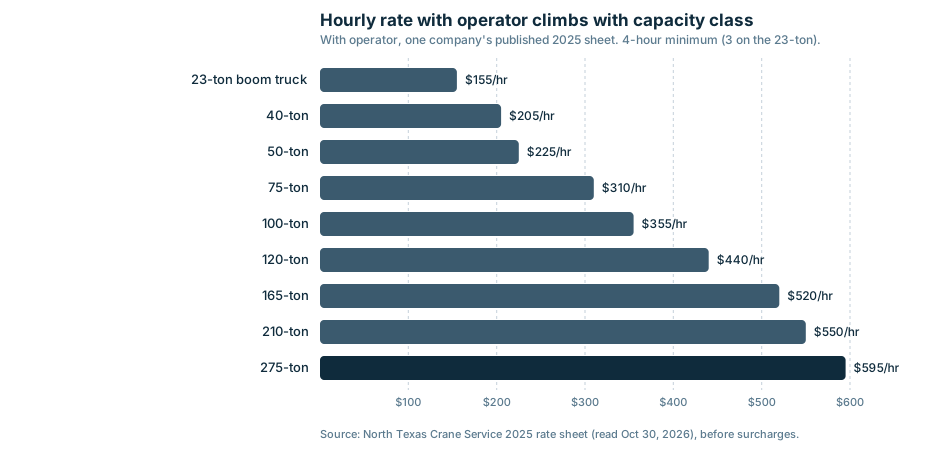
North Texas Crane Service publishes a 2025 crane rental rate sheet as a PDF on its website (read October 30, 2026). Hydraulic mobile cranes with operator:
| Capacity | Boom and jib | Rate per hour | Minimum | Road permit |
|---|---|---|---|---|
| 23-ton boom truck | 70 ft boom, 23 ft jib | $155 | 3 hr | $52.45 |
| 30-ton boom truck | 102 ft boom, 25 to 43 ft jib | $175 | 4 hr | $65 |
| 40-ton | 95 ft boom, 26 to 45 ft jib | $205 | 4 hr | $65 |
| 50-ton | 110 ft boom, 33 to 56 ft jib | $225 | 4 hr | $65 |
| 60-ton | 110 ft boom, 33 to 56 ft jib | $250 | 4 hr | $125 |
| 75-ton | 115 ft boom, 25 to 59 ft jib | $310 | 4 hr | $125 |
| 100-ton | 164 ft boom, 32 to 57 ft jib | $355 | 4 hr | $125 |
| 120-ton | 167 ft boom, 36 to 59 ft jib | $440 | 4 hr | $140 |
| 165-ton | 197 ft boom, 36 to 105 ft jib | $520 | 4 hr | $175 |
| 210-ton | 197 ft boom, 43 to 125 ft jib | $550 | 4 hr | $250 |
| 275-ton | 223 ft boom, 67 to 117 ft jib | $595 | 4 hr | $275 |
The same sheet adds a 7 percent fuel surcharge to all invoices, bills time portal to portal with travel charged both ways, applies overtime over 8 hours per shift and before 7:00 a.m. or after 5:00 p.m. Monday through Friday and all day Saturday and Sunday at $50 per hour per man, and adds $85 per hour on Sundays and holidays.
Limehouse & Sons (Ladson, South Carolina), current web rate list
Limehouse & Sons publishes its crane rates on its website (undated page, read October 30, 2026). The list covers all three carrier types:
- 12-ton boom truck, $145 per hour ($175 overtime), 4-hour minimum
- 22-ton Grove all-terrain, $185 ($215 overtime), 4-hour minimum, plus a rough-terrain hauling charge both ways
- 40-ton Grove rough-terrain, $200 ($230 overtime), 4-hour minimum, plus hauling both ways
- 70-ton Link-Belt, $240 ($270 overtime), 4-hour minimum
- 100-ton Link-Belt truck crane, $310 ($360 overtime), 6-hour minimum
- 175-ton Grove all-terrain, $440 ($490 overtime), 8-hour minimum
- 210-ton Grove truck crane, $470 ($520 overtime), 8-hour minimum
- 350-ton Grove all-terrain, $575 ($625 overtime), 10-hour minimum
Overtime on that list starts after 3:30 p.m. on weekdays and covers all day on weekends. The company adds an 8 percent fuel surcharge on all cranes and trucks, a $20 permit charge on cranes of 70 tons and up, a set-up and break-down fee on the 90-ton and larger cranes (amount quoted on request), a $35 daily modular rigging charge, and a 2 percent fee for credit card payment. At least 24 hours' notice is required to cancel.
Dependable Crane (Sacramento, California), pricing page
Dependable Crane's pricing page (undated, read October 30, 2026) lists a 22-ton at $265 per hour with a 1-hour minimum, a 40-ton at $285 with a 2-hour minimum, a 75-ton at $350 with a 4-hour minimum, and a 115-ton at $450 with an 8-hour minimum. A counterweight trailer adds $1,200.
Streamline Crane Service (Wellington, Colorado), price sheet as of January 1, 2025
Streamline Crane, which serves Colorado and Wyoming, lists a 45-ton National NTC45-127 truck crane with a 127-foot boom at $220 per hour, portal to portal, with a 1-hour on-site minimum plus travel time (read October 30, 2026). Work outside Monday through Friday, 6:00 a.m. to 4:30 p.m., carries a $35 per hour premium with a 4-hour minimum. Rough-terrain cranes from 30 to 130 tons and conventional cranes from 100 to 600 tons are priced on request.
What the sheets have in common
Read together, the four sheets show the structure of the market better than any single number. A 40-ton class crane with operator was $200 in South Carolina, $205 in North Texas and $285 in Sacramento on the sheets we read. A 75-ton was $310 in Texas and $350 in Sacramento. Minimums are 4 hours for mid-size hydraulic cranes on three of the four sheets, and they climb to 6, 8 and 10 hours as capacity rises, because a 200-ton-plus crane arrives with counterweight on separate trucks and takes real time to set up. The one sheet with 1- and 2-hour minimums (Dependable) carries a higher hourly rate.
None of the four published a rate for a crawler crane; the two that mention them price on request. Crawlers are usually quoted as a project, not an hourly call-out, because they arrive in pieces on multiple loads and are assembled on site with an assist crane.
Bare Rental: Monthly Rates and Agency Schedules
Bare monthly pricing is harder to find in public. North Texas Crane Service is the exception: its 2025 sheet publishes bare monthly rates for hydraulic cranes of $5,000 for a 30-ton, $5,500 for a 35-ton, $7,250 for a 40-ton, $7,500 for a 50-ton, $10,500 for a 60-ton, $12,000 for a 75-ton and $13,500 for an 80-ton, with cranes over 90 tons and under 25 tons quoted on availability. Delivery and pickup are extra and depend on size and distance. The same sheet notes that rough-terrain cranes are available bare or with an operator.
Divide those by a 176-hour month (22 days at 8 hours) and the bare 40-ton works out to about $41 an hour of machine time before fuel, operator and transport, against $205 an hour operated from the same company. That is the gap a long-duration job is buying when it goes bare, and it is also the gap you give back if the crane sits.
For a view of ownership-and-operating cost by crane type, the Caltrans book effective September 1, 2026 (read October 30, 2026) lists hourly rates by make and model, without operator:
| Caltrans class | Example model | Hourly rate |
|---|---|---|
| Hydraulic cranes, self-propelled (rough-terrain) | Grove RT-58 | $81.75 |
| Hydraulic cranes, self-propelled | Grove RT-500D | $130.07 |
| Hydraulic cranes, self-propelled | Grove RT-865 | $178.68 |
| Hydraulic cranes, self-propelled | Grove RT-9100 | $298.24 |
| Hydraulic cranes, truck mounted with carrier | Link-Belt HTC 1040 | $197.49 |
| Hydraulic cranes, truck mounted with carrier | P&H Alpha 100-ton | $324.14 |
| Hydraulic cranes, truck mounted with carrier | Link-Belt HTC 11100 | $360.24 |
| Shovels and cranes, crawler (lattice boom) | Manitowoc 3900B (100-ton) | $231.09 |
| Shovels and cranes, crawler | Manitowoc 4100W Vicon series 2 | $403.24 |
| Shovels and cranes, crawler | Manitowoc 4600 Vicon series 3 | $686.18 |
Caltrans applies a 15 percent markup for overhead on top of these for force-account work and pays idle time on an excusable delay at a reduced delay factor (0.12 for self-propelled hydraulic cranes, 0.18 for crawlers, limited to 8 hours a day). The book's labor surcharge table also singles out "Mobil Crane & Hoist Service" at 12 percent of wages for regular time and 11 percent for overtime, above the 10 percent general rate, because of workers' compensation cost.
The FEMA 2025 schedule covers the small end that the crane companies above do not: a 19,000-pound truck-mounted crane (Manitex 1970C on a Peterbilt 537) at $48.09 an hour, a 46,000-pound Manitex 2281T at $53.07, a 60,000-pound Manitex 30100C at $83.67, a 15-ton Broderson RT-300-2C rough-terrain at $293.14, and a 125-ton American HC-125 lattice crawler at $338.94, all without operator.
Use agency rates to understand what a crane company's cost base looks like, to price a bare rental you will operate yourself, or to build a force-account claim. Do not use them to estimate an operated call-out.
The Add-Ons That Decide the Invoice
The hourly rate is the headline. These are the lines below it on the sheets we read.
Minimums and travel
Every published sheet bills portal to portal. North Texas Crane states that travel time is charged both ways on top of the minimum. Streamline bills a 1-hour on-site minimum plus travel. If a 4-hour minimum crane spends 45 minutes each way on the road, the smallest invoice you can write is 5.5 hours at the crane rate. For a 75-ton at $310, that is $1,705 before surcharges, for a pick that may take 40 minutes.
Fuel surcharges and overtime
Two of the four sheets add a fuel surcharge on the whole invoice: 7 percent at North Texas Crane, 8 percent at Limehouse & Sons. Overtime windows differ by company. Limehouse starts overtime at 3:30 p.m.; North Texas at 5:00 p.m. or after 8 hours; Streamline at 4:30 p.m. A steel erection day that runs to 6:00 p.m. costs different amounts in different cities for that reason alone, and a Sunday pick at North Texas adds $85 an hour on top of overtime.
Riggers, signal persons and oilers
Rigger and signal person rates appear on two of the sheets: $95 per hour with a 4-hour minimum at North Texas Crane, and $88 per hour (rigger) or $92 (rigger foreman) with 4-hour minimums at Limehouse & Sons, with overtime at $132 and $138. Under OSHA 1926.1419 a signal person is required whenever the point of operation is not in the operator's full view, which on a commercial roof or a tight infill lot is most of the time. If you plan to supply your own signal person and riggers, they must meet the qualification rules in Subpart CC; see the breakdown in our crane lift plan guide.
An oiler, the second person who rides with and services a large crane, did not appear as a priced line on any of the four sheets. On large hydraulic and crawler cranes in union markets the oiler is typically part of the quoted crew; ask whether the quote is one-person or two-person before you compare it against another company's.
Permits, counterweight and transport
Road permits are a per-move line, and they grow with the crane. North Texas Crane charges $52.45 for a 23-ton boom truck permit and $275 for a 275-ton, and notes that oversize and overweight loads require additional permits priced on request. Limehouse charges $20 for cranes 70 tons and up. Counterweight travels separately once the crane is big enough: Dependable's $1,200 counterweight trailer and North Texas Crane's $160 per hour truck-tractor and trailer with driver (4-hour minimum) and $225 per hour haul truck and lowboy (4-hour minimum) are what that line looks like. Limehouse's set-up and break-down fee on its 90-ton and larger cranes is the same cost by another name.
Rigging hardware and standby
North Texas Crane prices a spreader bar at $150 a day and a man basket at $150 a day, and standby at $95 an hour per man. Limehouse charges $35 a day for modular rigging. Standby is the line that gets contractors in trouble: a crane waiting on a late truck or an unready anchor bolt pattern bills the same as a crane lifting.
Who Runs It: Operator Pay and Certification
For a bare rental, the operator is your cost. The Bureau of Labor Statistics' May 2025 Occupational Employment and Wage Statistics (retrieved from the BLS public data API on October 30, 2026) put national employment for crane and tower operators (SOC 53-7021) at 42,890, with a median wage of $32.73 an hour or $68,080 a year, a mean of $34.68 an hour ($72,130 a year), a 10th percentile of $20.50 an hour ($42,640) and a 90th percentile of $49.79 an hour ($103,570). Those are wages only, before fringes, payroll taxes and workers' compensation, and in most commercial markets the operator comes through an Operating Engineers local whose agreement sets the loaded rate. Our report on the crane operator shortage looks at what that labor market is doing to availability.
Whoever employs the operator, OSHA 29 CFR 1926.1427 (read on osha.gov October 30, 2026) sets the floor. The operator must be certified by a testing organization accredited by a nationally recognized accrediting agency, licensed by a state or local program that meets the standard's criteria, or certified under an audited employer program; military qualifications count only for the issuing employer. Certification is issued by equipment type, or type and capacity, and is valid for 5 years. Separately, under paragraph (f) the employer must evaluate each operator through a demonstration of skill on the equipment in question and document that evaluation. Most of the section took effect December 10, 2018; the evaluation and documentation requirements took effect February 7, 2019. When a contractor takes a bare crane, both the card and the evaluation record belong to the contractor.
Critical Lifts, Engineering and Multi-Crane Picks
Subpart CC does not define a "critical lift." That term comes from company safety programs and project specifications, which typically flag picks near the top of the load chart, picks over occupied space, or picks of hard-to-replace equipment, and require a written plan. What the standard does require is planning for two specific cases. Under 1926.1432 (read on osha.gov October 30, 2026), any lift where more than one crane supports the load must be planned by a qualified person, with engineering expertise provided where that person decides it is needed, and directed by a lift director who reviews the plan in a meeting with everyone involved. Under 1926.1431, hoisting personnel is limited to 50 percent of rated capacity, with a proof test and trial lift.
For the contractor, the cost of a critical lift is mostly time and paper rather than a rate-sheet line: a stamped lift plan from the crane company's engineer or your own, a ground-bearing check against the outrigger loads, a utility call if anything can come within 20 feet of a power line under 1926.1408, and a crane sized with margin, which usually means stepping up a capacity class. Every step up on the North Texas Crane sheet costs between $20 and $85 an hour plus a larger permit, which is cheap next to a failed pick. Multi-crane tandem lifts double the crane line and add the lift director's time.
Building the Crane Line in an Estimate
Price it the way the invoice will arrive:
- Pick the capacity class from the heaviest load at the longest radius, with the hook block and rigging included, then confirm it against the load chart. Capacity class sets the hourly rate, the minimum hours and the permit.
- Count call-outs, not hours. Each mobilization triggers the minimum and the travel both ways. Four 2-hour picks on four days cost more than one 8-hour day.
- Decide operated or bare. If the crane will be on site for several weeks with steady work and you have an Operating Engineer, get a bare monthly quote and add operator wages and fringes, fuel, delivery and pickup. Otherwise buy it operated.
- Add the listed extras: fuel surcharge, riggers at a 4-hour minimum, counterweight transport, permits, rigging hardware and the overtime premium for any day that will run past the sheet's regular shift.
- Carry standby. A half day of standby at the crane rate is a realistic contingency on any job that depends on deliveries.
- Get two written quotes on the same scope and compare them line by line. As the sheets above show, the difference between companies is often in the minimums, the overtime window and the surcharges rather than the hourly rate.
The equipment rental business as a whole is covered in our piece on the equipment rental market and rent-versus-buy math, which has the American Rental Association's 2026 forecast.
Frequently Asked Questions
How much does it cost to rent a mobile crane per hour with an operator?
On the published sheets we read on October 30, 2026, operated hydraulic mobile cranes ran from $145 an hour for a 12-ton boom truck (Limehouse & Sons, South Carolina) and $155 for a 23-ton boom truck (North Texas Crane Service, 2025 sheet) to $575 for a 350-ton all-terrain (Limehouse) and $595 for a 275-ton (North Texas). A 40-ton class crane was $200 to $285 across three companies, and a 75-ton was $310 to $350 across two. Rates vary by region and company, so get a written quote.
How much is a mobile crane per day?
Published sheets price by the hour, not the day. An 8-hour day on a 75-ton at $310 an hour (North Texas Crane, 2025) is $2,480 plus a 7 percent fuel surcharge, travel time both ways, the road permit and any riggers. The same company's 275-ton is $4,760 for 8 hours before extras.
What is the 4-hour minimum on a crane rental?
Most operated crane rate sheets bill at least 4 hours per call-out for mid-size hydraulic cranes, even for a 30-minute pick, and the clock usually runs portal to portal. Larger cranes carry longer minimums: Limehouse & Sons lists 6 hours at 100 tons, 8 hours at 175 to 210 tons and 10 hours at 350 tons; Dependable Crane lists 8 hours on its 115-ton.
What does a bare crane rental cost per month?
North Texas Crane Service's 2025 sheet is the one published bare price list we found: $5,000 a month for a 30-ton hydraulic crane, $7,250 for a 40-ton, $10,500 for a 60-ton and $13,500 for an 80-ton, plus delivery and pickup. Bare rental excludes the operator, fuel and daily maintenance.
Does a mobile crane operator need to be certified?
Yes. Under OSHA 29 CFR 1926.1427, operators of cranes covered by Subpart CC must be certified by an accredited testing organization, licensed by a qualifying state or local program, or certified under an audited employer program, with certification by crane type or type and capacity, valid for 5 years. The employer must also evaluate and document each operator on the equipment they run.
What do crane operators earn?
BLS May 2025 OEWS data put the national median for crane and tower operators at $32.73 an hour ($68,080 a year), with a 90th percentile of $49.79 an hour ($103,570). Union agreements set the loaded rate in most commercial markets.
What is a critical lift and does it cost more?
OSHA Subpart CC does not define the term; company programs and project specs do. OSHA does require a qualified-person plan and a lift director for multi-crane lifts (1926.1432) and strict limits on hoisting personnel (1926.1431). A critical lift adds engineering time, a written plan and often a larger crane, rather than a separate line on the rate sheet.
Your Action Item for This Week
Pull the last three crane invoices your company paid and line each one up against the quote. Mark every line that was not on the quote: travel hours, fuel surcharge, overtime, standby, permits, rigging hardware, riggers. Then write those lines into your crane request-for-quote template so the next quote comes back with all of them priced. That one change makes two crane companies' numbers comparable and takes the surprise out of the invoice.