Parking garage construction cost hit $25,000 per space nationally in 2026, with the real range spanning $15,000 per space for surface lots in rural markets to $60,000+ per space for underground parking in dense urban cores. I've built parking structures across every format — surface, above-grade concrete structures, and underground garages — and the $25K benchmark represents a mid-rise concrete structure (5-7 levels) in a moderate-cost metropolitan area.
Here's the breakdown of parking construction cost by type, what drives the per-space number, and how to think about parking when you're estimating a mixed-use development or parking-dependent project.
Parking Types and Per-Space Costs
Parking construction cost varies dramatically based on structure type and site conditions.
Surface Parking Lots
Surface parking costs $1,500 to $3,500 per space including site preparation, asphalt paving, striping, lighting, and storm drainage. A 100-space surface lot costs $150,000 to $350,000. The per-space cost is lowest because you're building minimal structure — mostly site work and pavement.
Surface lots are land-intensive. A standard 9-foot-by-18-foot parking space requires roughly 180 square feet of lot area including drive aisles and maneuvering space. A 100-space lot consumes approximately 18,000 square feet (roughly 0.4 acres). In urban markets where land value runs $10-$50+ per square foot, surface parking becomes economically impractical because the land value alone constrains the business model.
Surface lots work in suburban and rural markets where land is inexpensive and building height isn't economically justified.
Multi-Level Structured Parking (Above Grade)
Above-grade concrete structures run $15,000 to $35,000 per space depending on number of levels and site constraints. A 5-level concrete structure costs $18,000-$28,000 per space; a 10-level structure costs $22,000-$35,000 per space as heights increase and structural requirements stiffen.
A 500-space structured garage (5 levels × 100 spaces per level) costs $9 million to $14 million. The per-space economics work in urban and dense suburban markets where land value justifies vertical structure. A 500-space garage on a 15,000-square-foot site (100 SF per space including structural bays) costs less land value than a surface lot requiring 90,000 square feet.
Concrete structure design. Most modern parking structures use post-tensioned concrete flat plates (2-3 story spans between columns, creating open floors with minimal obstructions). The structural system costs $4,000-$7,000 per space. Columns are typically spaced 30-40 feet on center to allow compact car parking in a 9×18-foot grid.
Ramps and circulation. Vehicle circulation (ramps, aisles, striping) adds $1,500-$2,500 per space. Ramps are typically 6-8% slope (one foot of vertical rise per 12-15 feet of ramp run), consuming significant square footage. Two-way ramps are 16 feet wide; one-way are 12-14 feet.
Mechanical and electrical. Lighting (critical for safety and customer confidence) costs $800-$1,500 per space. Mechanical ventilation for enclosed garages costs $1,000-$2,000 per space for both equipment and ductwork. Electrical systems (lighting control, security, EV charging infrastructure) add $500-$1,200 per space.
Finishes and safety systems. Concrete floor protection (epoxy coating or sealant), restriping, signage, and paint add $200-$600 per space. Fire-rated walls or sprinkler systems (required in some jurisdictions for enclosed garages) add $300-$800 per space.
Underground Parking
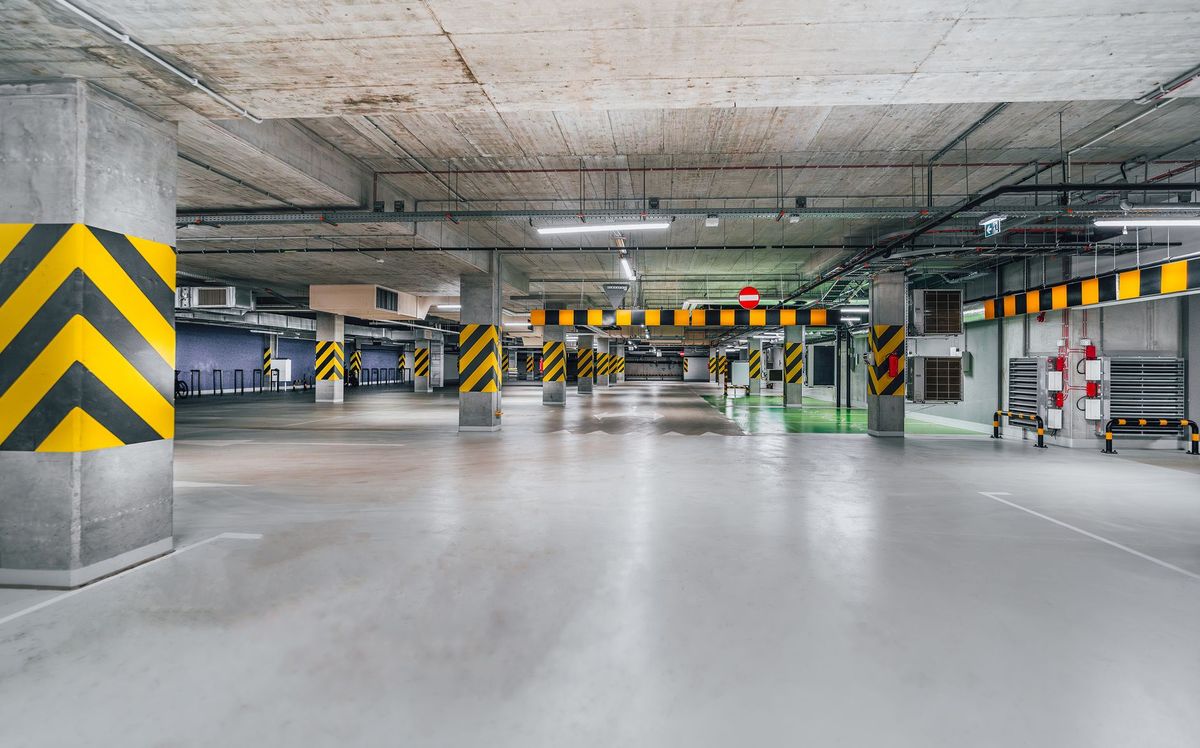
Underground parking is the highest-cost parking format, running $35,000 to $70,000+ per space. Underground structures require excavation, shoring, dewatering, and waterproofing — all expensive. A single-level underground garage typically costs $35,000-$50,000 per space; a two-level underground structure averages $45,000-$65,000 per space as material and labor complexity compound.
Excavation and shoring. Removing earth and temporary support systems can cost $4,000-$12,000 per space depending on soil type, water table depth, and adjacent structures. Urban sites with high water tables and limited adjacent clearance are the most expensive — shoring and dewatering can double excavation cost.
Structural systems. Underground garages typically use cast-in-place concrete (vs. post-tensioned decks in above-grade structures) because the structure must resist earth and water pressure. Thicker walls and more extensive reinforcement are required. Structural cost runs $6,000-$12,000 per space.
Waterproofing. Underground structures must prevent water infiltration — a critical cost. Waterproofing systems (membrane, cavity drains, or sump systems) cost $2,000-$4,500 per space.
Mechanical and utilities. Enclosed underground structures need heavy-duty ventilation to remove vehicle exhaust. Ventilation alone costs $2,000-$4,000 per space. Electrical, lighting, and fire suppression add another $1,500-$3,000.
Underground parking makes economic sense only in dense urban markets where land value and zoning require parking below grade. Downtown Manhattan, Boston, or San Francisco parking regularly exceeds $50,000 per space.
Parking Garage Cost Breakdown by Component
A detailed cost analysis for a 500-space, 5-level above-grade concrete structure illustrates typical budget allocation:
| Component | Cost Per Space | Percentage of Total |
|---|---|---|
| Site work and demolition | $600-1,200 | 3-5% |
| Structural frame (concrete) | $4,000-7,000 | 16-28% |
| Ramps and circulation drives | $1,500-2,500 | 6-10% |
| Mechanical (ventilation equipment) | $1,000-2,000 | 4-8% |
| Electrical and lighting | $1,200-1,800 | 5-7% |
| Fire suppression/safety systems | $400-800 | 2-3% |
| Concrete protection/sealing | $400-800 | 2-3% |
| Finishes, striping, signage | $300-600 | 1-2% |
| General conditions and contingency | $3,000-5,000 | 12-20% |
Total per space: $12,400-$22,300 for a 5-level structure in a moderate-cost market.
What Drives Parking Cost Per Space
Five factors control whether a parking project lands at $18,000/space or $40,000/space.
Structure type and height. A 3-level structure costs less per space than a 7-level structure because you spread general conditions, permitting, and management cost across fewer spaces. A 3-level garage on the same site footprint as a 7-level garage costs roughly $3,000-$5,000 less per space, but you need more land. Compare parking cost against the broader commercial construction cost benchmarks to contextualize the investment. Site economics dictate height.
Ramp configuration. Straight ramps (one entry point, vehicles wind up/down) cost less than spiral ramps or helical ramps. Straight ramps consume roughly 15-20% of structure square footage; helical ramps consume 20-30%. On a tight urban site, you might be forced into a helical ramp, adding $1,500-$2,500 per space.
Ventilation requirements. Open structures (parking not enclosed on three sides) need minimal ventilation — fresh air naturally flows through. Enclosed structures in urban locations need mechanical ventilation to remove exhaust. Ventilation adds $1,500-$3,000 per space and represents an ongoing operational cost (fan energy).
Seismic and climate requirements. Parking structures in seismic zones (California, Pacific Northwest) require sophisticated structural design — more reinforcement, base isolators on high-rise structures. Seismic design adds 15-25% to structural cost. Structures in freeze-thaw climates (Northeast, Midwest) require thicker concrete and air-entrained mixes to prevent spalling — adds 8-12% to concrete cost.
Site conditions. A brownfield site with soil remediation, utility relocation, or contamination assessment adds $500-$3,000 per space. A high water table in an urban location requiring dewatering during construction adds $1,000-$2,000 per space. A site with adjacent historic structures requiring shoring adds another $1,000-$2,500 per space.
Regional Cost Variation
Parking construction costs vary 40-60% between regions.
High-cost urban markets (40-60% above national average): San Francisco, New York, Boston, Washington DC, Los Angeles. Labor cost premium (union tradespeople at $90-$130/hour) is the dominant factor. Material and equipment costs are also elevated. A parking structure costing $25,000/space nationally might cost $35,000-$40,000/space in these markets.
Moderate-cost markets (at national benchmark): Denver, Austin, Nashville, Portland, Charlotte. Adequate labor supply, reasonable material costs, competitive market. These markets see active parking construction on mixed-use projects.
Low-cost markets (20-35% below national): Phoenix, Albuquerque, Boise, inland California, rural Texas. Lower labor costs, abundant land making surface parking more competitive, simpler regulatory environment. Structured parking costs $16,000-$20,000 per space.
Mixed-Use Integration Costs
Parking integrated into mixed-use buildings (retail below, parking above) carries additional cost: fire-rated separation between uses, individual ventilation systems, separate utility metering, and architectural finishes that match the residential or office component. Integration adds 10-20% to standalone garage cost.
A 300-space parking structure as a standalone facility costs $6-$9 million. The same structure integrated beneath a mixed-use building costs $7-$10.8 million due to integration complexity.
Timeline and Construction Process
Parking structure timeline is typically shorter than comparable buildings because of repetitive work and straightforward sequencing:
- Permitting: 4 to 8 weeks
- Excavation and site prep: 4 to 8 weeks (longer if underground or poor soil conditions)
- Structural concrete: 6 to 12 months (depending on level count and ramp complexity)
- MEP rough-in: 4 to 8 weeks (running parallel with structure in later levels)
- Finishes and striping: 3 to 6 weeks
Total time from start to opening: 8 to 14 months for a 5-level above-grade structure.
Your Action Item for This Week
If you're pricing a mixed-use development with parking, confirm three variables: total space count, structure type (above grade vs. underground), and site constraints (water table, adjacent structures, seismic zone). Use $25,000/space as your baseline for a mid-rise concrete structure in a moderate market. Adjust down 20% for surface lots or outdoor uncovered parking decks. Adjust up 40-60% for underground. Add 20-30% if you're in a high-cost coastal market or seismic zone. Use the concrete cost calculator to estimate your parking slab and structure material requirements. Then talk to your concrete crew about the ramp configuration and level count — the per-space cost scales linearly with level count up to a point, then flattens as you spread fixed costs.
Frequently Asked Questions
What is the cost per space for a parking garage?
Average parking garage construction cost is $25,000 per space nationally in 2026. The range spans $1,500-$3,500 for surface lots, $15,000-$35,000 for above-grade structures, and $35,000-$70,000+ for underground parking. Cost depends on structure type, building height, site conditions, and market labor cost.
How many parking spaces fit in an acre?
A surface lot fits approximately 120-150 parking spaces per acre (accounting for drive aisles and circulation). A 5-level parking structure on one acre of land provides 600-750 spaces, illustrating the land-use efficiency of vertical parking in dense markets.
What is the least expensive way to provide parking?
Surface parking is least expensive at $1,500-$3,500 per space. Above-grade structures cost $15,000-$35,000 per space depending on height and market. Underground parking is most expensive at $35,000-$70,000+ per space. Economic choice depends on land value — if land cost is low, surface parking wins. If land is expensive, vertical structures pencil out better.
Why does underground parking cost so much more than above-grade?
Underground parking requires excavation, temporary shoring systems, dewatering, waterproofing, and enclosed ventilation — all expensive. Above-grade structures use simpler concrete systems with natural ventilation. Underground structures also have longer schedules due to excavation and shoring, increasing general conditions cost.
How much does concrete cost for parking structures?
Concrete material and placement costs $150-$300 per cubic yard installed (including forming, reinforcement, and finishing). A 5-level structure contains roughly 150-200 cubic yards of concrete per 100 parking spaces, representing $22,500-$60,000 of concrete cost per 100 spaces, or $225-$600 per space for concrete material alone.
What is the cost difference between a parking garage and a parking lot?
A surface parking lot costs $1,500-$3,500 per space. An above-grade 5-level structure costs $18,000-$28,000 per space — roughly 5-8 times higher. The tradeoff is land: a lot uses 0.65-0.75 acres per 100 spaces; a structure uses 0.1-0.15 acres per 100 spaces. In urban markets where land costs $20-$100+ per square foot, the structure economics pencil out.