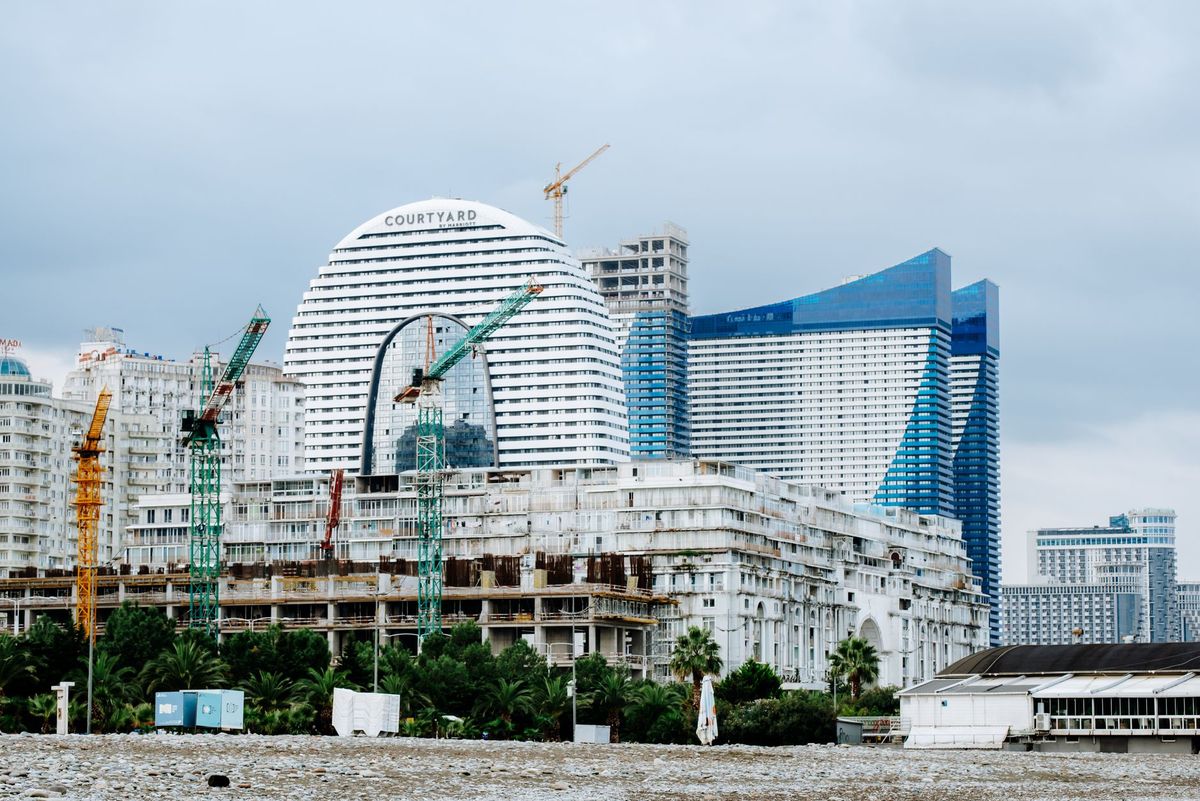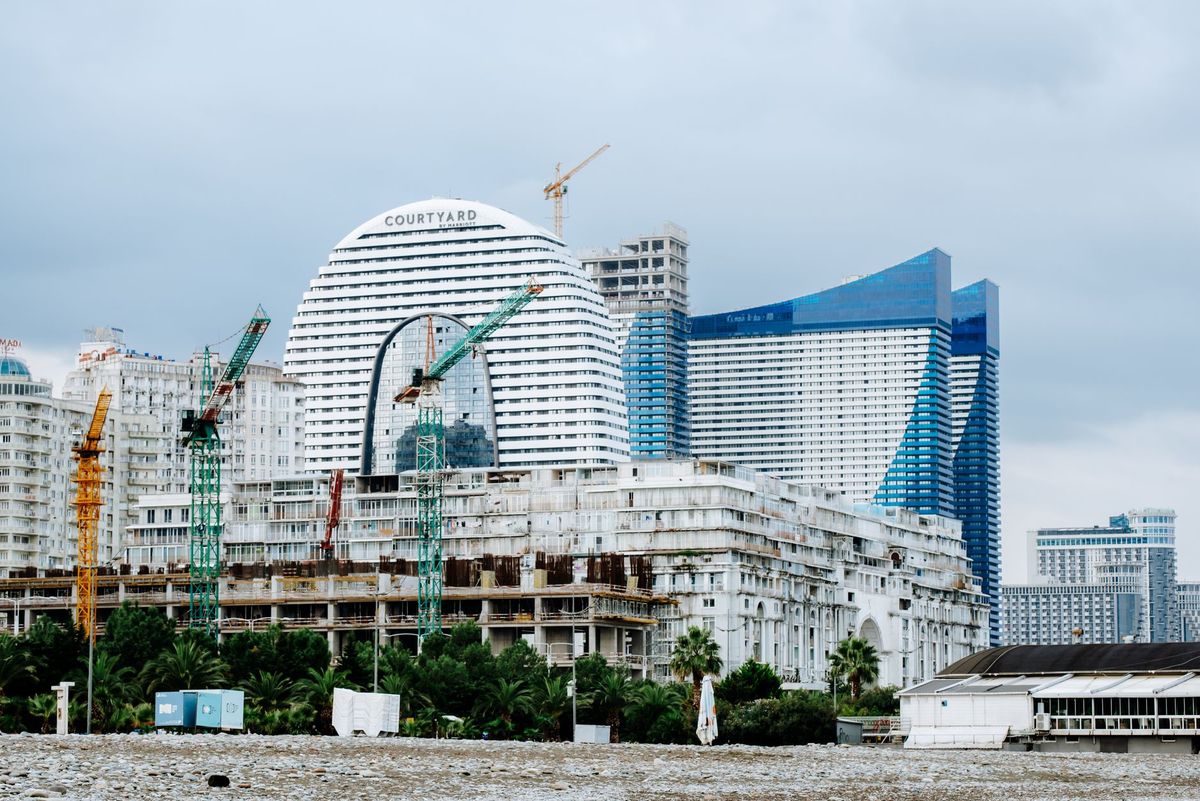
The Gulf states are carrying a construction pipeline valued at well over $1.3 trillion in awarded and planned projects — a figure that regional trackers such as MEED Projects have reported climbing through the mid-2020s — and Saudi Arabia alone accounts for more than half of it. To put that in perspective, that single-region pipeline exceeds two full years of total US nonresidential building construction spending. The scale is not a rounding difference from Western markets; it is a different order of magnitude, built on oil revenue redeployed into diversification programs on timelines and budgets that have no modern Western equivalent.
I cover these programs at the policy-and-systems level because they are, fundamentally, government-directed capital plans — Saudi Arabia's Vision 2030, the UAE's diversification agenda, Qatar's post-World-Cup pivot — executed through sovereign wealth vehicles rather than private developers. What follows is an honest look at the scale, the workforce, and what international and US contractors actually need to understand before chasing this work. Currencies are shown with US-dollar conversions; the Saudi riyal and UAE dirham are both pegged to the dollar (SAR 3.75 = $1; AED 3.67 = $1), which removes the exchange-rate risk that dominates most cross-border analysis.
The Scale of Gulf Giga-Projects
"Giga-project" is a Saudi coinage, and it is literal: these are developments budgeted in the tens of billions of dollars each, an order of magnitude above the "mega-project" threshold of roughly $1 billion used elsewhere. The Public Investment Fund (PIF), Saudi Arabia's roughly $900-billion sovereign wealth fund, is the primary engine, directing capital into a portfolio of giga-projects under the Vision 2030 diversification program launched in 2016.
| Program / project | Sponsor | Reported scale | Status signal |
|---|---|---|---|
| NEOM (incl. The Line, Oxagon) | Saudi PIF | Budgets reported at $500B+ over its life | Phased, scope rebased in 2024-2025 |
| Vision 2030 giga-project portfolio | Saudi PIF | Portion of Saudi's $1T+ pipeline | Multiple active awards |
| UAE diversification (Abu Dhabi, Dubai) | Government / sovereign vehicles | Tens of $B annually | Steady, tourism + logistics-led |
| Qatar post-2022 program | Government | ~$200B+ legacy build-out | Maturing, selective new starts |
Two honest caveats belong on that table. First, headline budgets and delivery timelines have been revised: Saudi Arabia publicly rebased parts of the NEOM program through 2024-2025, deferring some scope and stretching timelines as oil-price reality met ambition, and reporting from Bloomberg and the Financial Times has documented these adjustments. Second, "planned" is not "under construction" — a large share of that $1.3 trillion pipeline is in design or procurement, not on site. The real, fundable, near-term work is a subset, and reading the pipeline as if it were all shovel-ready is the classic mistake international firms make. For the underlying material-cost context that drives these budgets, our construction cost index report tracks the steel, copper, and cement inputs a Gulf giga-project consumes in enormous volume.
The Workforce Behind the Numbers
The Gulf construction model runs on migrant labor at a scale unmatched anywhere. Foreign nationals — predominantly from South Asia — make up the large majority of the private-sector construction workforce across the GCC, and individual giga-projects have reported on-site headcounts in the tens of thousands. A single major Saudi program can employ 30,000-50,000+ workers at peak. This labor model is also the source of the region's sharpest scrutiny: the kafala sponsorship system, worker welfare standards, and heat-safety rules have drawn sustained attention from the International Labour Organization and human-rights organizations, and Qatar's World Cup build-out brought that scrutiny to a global audience. Reform has been uneven — Qatar and Saudi Arabia have both announced kafala changes — but any international contractor entering this market inherits the reputational and compliance exposure that comes with it.
Cost Per Square Foot: Cheaper Structure, Premium Finish
Gulf construction costs are bifurcated. Standard commercial and residential build costs run below Western equivalents — a mid-grade office in Riyadh or Dubai can be built for roughly $150-220/SF thanks to inexpensive labor and local cement — but the signature giga-project architecture inverts that entirely. Iconic towers, undersea and desert engineering, and record-setting spans push costs into a bracket where the "cost per square foot" framing stops being useful, because you are pricing engineering firsts, not repeatable product. Turner & Townsend's regional surveys generally place Gulf standard-build costs below London and New York, with the premium concentrated in the marquee, precedent-setting work.
What International Contractors Should Know
The opportunity is enormous and real, but the failure rate among Western firms that misread the market is high. Four things separate the firms that profit from the ones that write off receivables.
Payment Terms and Getting Paid
The single most cited risk from international contractors in the Gulf is payment timing. Historically, extended payment cycles and disputed variations have stretched contractor cash cycles well beyond Western norms, and firms have carried large receivables against government and quasi-government clients. The pattern improved after reforms and after the oil-price recovery, but the lesson stands: price working-capital cost into the bid, secure advance-payment and milestone structures, and never assume Western 30-60 day terms. A job that looks profitable on margin can be a cash sink if you are financing 180+ days of receivables. Stress-test that in the markup and margin calculator with realistic payment assumptions, not optimistic ones.
Localization Requirements
Saudi Arabia's Vision 2030 attaches local-content and Saudization requirements to major awards — mandated percentages of local hiring, local sourcing, and in-kingdom value that shape how foreign firms must structure their presence. The UAE has parallel Emiratization goals. A foreign contractor typically cannot simply fly in a crew; the winning structure is usually a joint venture or local subsidiary that meets in-country value targets. The 2021 requirement that companies establish regional headquarters in Saudi Arabia to win government contracts was an explicit signal: the Gulf wants durable local presence, not fly-in-fly-out delivery.
Scale Requires Balance-Sheet Depth
Giga-project packages are large enough that only firms with deep balance sheets and bonding capacity can carry them, which is why the prime contractor rosters are dominated by the largest global and regional players. The same tier of contractors that builds hyperscale data centers and major US infrastructure operates here — the firms profiled in our top 20 data center construction contractors overlap heavily with the primes on Gulf work, because the capital and management depth required is comparable. Smaller international firms enter through specialty subcontract packages — facades, MEP, marine works, specialist geotechnical — rather than as primes.
Margins Versus Western Markets
Gulf giga-project margins can exceed Western norms on well-structured work — high-single to low-double-digit gross is achievable on specialty and technically demanding packages — but the risk-adjusted picture is what matters. Currency risk is near zero because of the dollar pegs, which is a genuine advantage over European or Canadian work. But that benefit is offset by payment-timing risk, scope-change exposure on first-of-kind engineering, and program rebasing that can defer or cancel packages mid-stream. Compare the risk-adjusted return honestly against a domestic alternative before committing management bandwidth — the same discipline I apply to the transatlantic comparison in our US vs UK vs Germany construction cost analysis. Model both scenarios in the cost estimator before you chase a Gulf award.
Frequently Asked Questions
How big is the Middle East construction market in 2026?
The Gulf states carry an awarded-and-planned pipeline reported at well over $1.3 trillion, with Saudi Arabia accounting for more than half through its Vision 2030 giga-project portfolio funded by the Public Investment Fund. That single-region figure exceeds two years of total US nonresidential building spending — though a large share is still in design or procurement rather than under construction.
What is a giga-project?
A giga-project is a Saudi term for a development budgeted in the tens of billions of dollars each — an order of magnitude above the roughly $1 billion "mega-project" threshold used elsewhere. NEOM, with reported life-of-program budgets exceeding $500 billion, is the flagship example. The Public Investment Fund sponsors most Saudi giga-projects under Vision 2030.
Should US contractors bid on Gulf megaprojects?
Only with the right structure. The opportunity is large and the dollar pegs remove currency risk, but success usually requires a joint venture or local subsidiary meeting local-content and Saudization or Emiratization targets, deep balance-sheet and bonding capacity for prime packages, and working capital priced for extended payment cycles. Smaller firms typically enter through specialty subcontract packages rather than as primes.
How many workers do Gulf giga-projects employ?
Individual major programs have reported peak on-site headcounts in the tens of thousands — a single Saudi giga-project can employ 30,000-50,000 or more. Foreign migrant labor, predominantly from South Asia, makes up the large majority of the GCC construction workforce, which is also the source of ongoing labor-rights and heat-safety scrutiny from the International Labour Organization and others.
What is the biggest risk in Middle East construction contracts?
Payment timing. Extended payment cycles and disputed variations have historically stretched contractor cash cycles well beyond Western norms, leaving firms financing large receivables against government and quasi-government clients. Price working-capital cost into every bid, secure advance-payment and milestone structures, and never assume Western 30-60 day terms.
Have the giga-project budgets been cut?
Some have been rebased. Saudi Arabia publicly deferred and rescoped parts of the NEOM program through 2024-2025 as oil-price reality met ambition, and financial press reporting has documented stretched timelines. Treat headline pipeline figures as planned rather than committed — the fundable near-term work is a subset of the trillion-dollar totals.
Your Action Item for This Week
If the Gulf is on your radar, do one piece of unglamorous homework before anything else: separate the pipeline into "under construction," "awarded," and "planned," because those are three different risk profiles and most reporting blends them into one headline number. Then, for any package you would actually pursue, model it with realistic Gulf assumptions — dollar-pegged currency (a genuine advantage), extended payment terms, and a local-content structure — in the cost estimator, and pressure-test the margin against 120-to-180-day receivables in the markup and margin calculator. If the job still clears your risk-adjusted hurdle after that, it is worth the trip. If it only works on optimistic payment terms, it was never real.