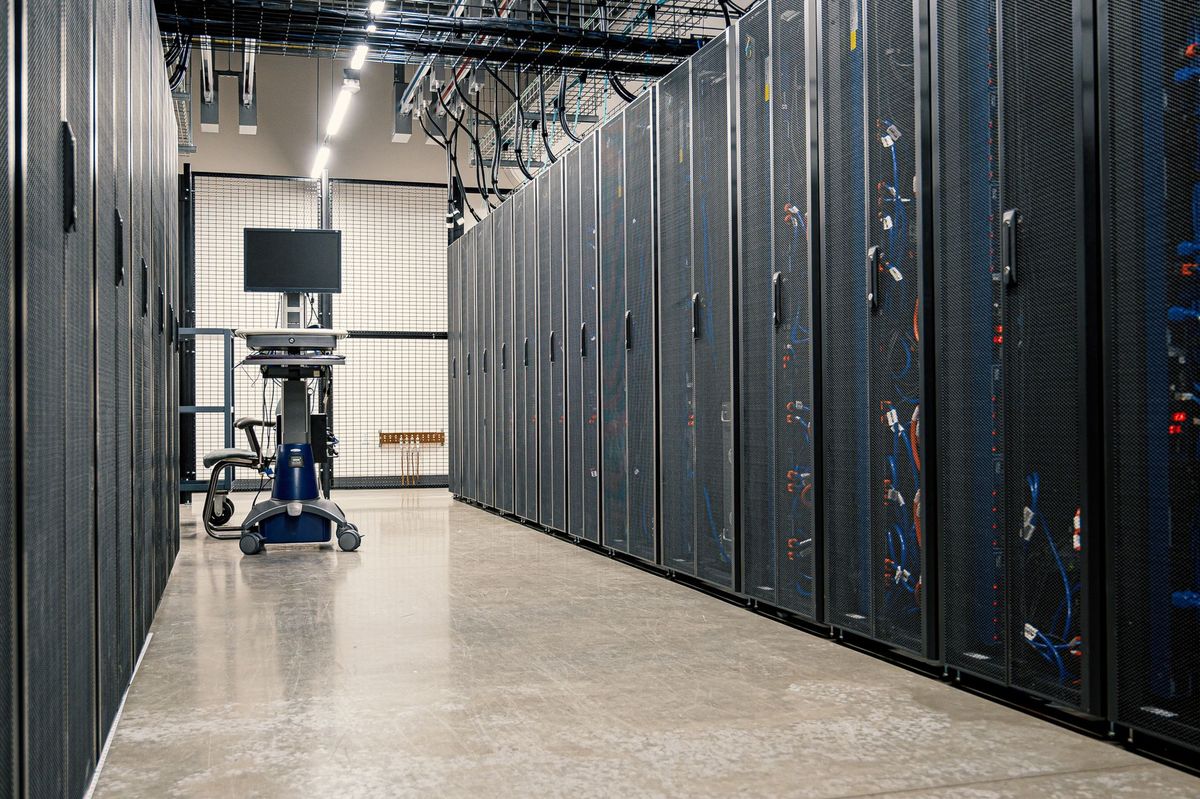
Metro Atlanta now has more data center capacity under construction than any other market in North America. CBRE's H1 2026 North American Data Center Trends report, released August 27, 2026, counted 2,882 MW under construction in Atlanta, ahead of Northern Virginia at 2,420 MW. It was the first time Atlanta has led the country on that measure. Six months earlier, CBRE's H2 2025 report (March 4, 2026) had Atlanta at 2,076 MW under construction, so the pipeline grew by roughly 800 MW in half a year.
This article covers why the work is landing in Georgia, what the state and utility rules look like, where the risks are, and what it means for contractors. Every figure below is tied to a named source and date. Earlier versions of this page carried a county-by-county megawatt table, land prices, power rates, labor rates and materials prices that we could not trace to any published source; those have been removed.
How big the Atlanta market is
The CBRE numbers tell the story:
| Measure | H2 2025 (CBRE, Mar 4 2026) | H1 2026 (CBRE, Aug 27 2026) |
|---|---|---|
| Inventory | 1,459.2 MW | 1,803.2 MW |
| Under construction | 2,076 MW | 2,882 MW |
| Vacancy / availability | 2% vacancy | 29.5 MW available |
In the H2 2025 release CBRE said Atlanta had become the second-largest data center market in the U.S. behind Northern Virginia, with 456 MW of net absorption that half-year and more than 3 GW of long-term power commitments. Across all eight primary markets CBRE tracks, 7,481 MW was under construction in H1 2026, more than 80% of it preleased, with vacancy at 1.4%.
Put those together and Atlanta's under-construction pipeline is now larger than its entire operating inventory. For contractors, that means the next two to three years of work is already in the ground or in procurement, and most of it has a tenant signed.
For the national picture, see our 2026 data center construction forecast.
Why Georgia became a data center magnet
Georgia Power's large-load pipeline
Power availability is the first thing a data center developer looks for, and Georgia Power has been planning for very large new loads. Under its 2023 IRP Update and 2025 IRP stipulations, the utility files quarterly large-load reports with the Georgia Public Service Commission. The Q1 2026 Large Load Economic Development Report, filed May 15, 2026 in Docket No. 56002, said that as of March 31, 2026:
- Customer commitments (contracts for electric service plus requests for service) totaled 12,400 MW across 31 large-load customers, up 500 MW from the prior quarter.
- Twenty-one of those 31 projects had broken ground, including ten already online, representing about 8,500 MW of the committed load.
- The total economic development pipeline through the mid-2030s had grown from about 69,100 MW to 76,200 MW, of which 73,100 MW was large-load projects.
- The near-term pipeline for winter 2028/2029 was 23,600 MW of large load.
When Georgia Power filed its 2023 IRP Update in October 2023, customer commitments were 3,600 MW and the pipeline was about 17,000 MW, according to the same report. The pipeline number includes speculative requests and should not be read as load that will definitely show up; the committed figure is the more useful one for contractors.
To serve that load, the PSC on December 19, 2025 approved 9,885 MW of new generation capacity for Georgia Power, about two-thirds of it natural gas-fired and the rest battery storage and storage paired with renewables, according to a January 5, 2026 summary by Ashurst Perkins Coie. The stipulation also requires Georgia Power to allocate significant costs to large-load customers in its next rate case, with incremental large-load revenue expected to put downward pressure of at least $8.50 a month on a typical 1,000 kWh residential bill in 2029 through 2031. For the bigger picture on utility load, see data center power demands are rewriting the grid.
The sales and use tax exemption
Georgia exempts qualifying high-technology data center equipment from state sales and use tax under O.C.G.A. § 48-8-3(68.1), administered by the Georgia Department of Revenue under Rule 560-12-2-.117. The minimum investment and job thresholds depend on county population. Under HB 1291 (2022), which applies to projects certified on or after May 9, 2022:
| County population | New quality jobs | Aggregate expenditures (any 7-year period) |
|---|---|---|
| Over 50,000 | 25 | $250 million |
| 30,001 to 50,000 | 10 | $75 million |
| 30,000 or fewer | 5 | $25 million |
HB 1291 also extended the window for qualifying expenditures from December 31, 2028 to December 31, 2031, and Alston & Bird's February 19, 2026 advisory confirms the exemption as drafted expires December 31, 2031. Expenditures counted toward the threshold include spending on design and construction of the data center as well as the equipment, which is why the threshold matters to contractors: your contract value is part of how the owner qualifies.
The exemption has been under political pressure. In 2024 the legislature passed a bill to suspend it, and Governor Kemp vetoed it. In the 2026 session several bills targeted it again: SB 408 would have ended the exemption January 1, 2027; SB 410 would have repealed it outright; SB 436 would have paused new exemption certificates from July 1, 2026 to June 30, 2027; and HB 559 would have sunset it at the end of 2026. Bloomberg Government reported on April 3, 2026 that the session ended without the House including the data center exemption in its repeal package, which killed the SB 410 effort, and SB 408 is listed as dead as of April 2, 2026. A state audit published in December 2025 estimated Georgia would have collected $474 million in sales tax in 2025 without the exemptions, per the same Bloomberg report. Expect this fight to return in the 2027 session. We compare Georgia with other states in every state offering data center tax incentives.
Fiber, land and proximity
Atlanta sits on major long-haul fiber routes and has a deep supply of industrial land in its outer counties compared with Northern Virginia, which is close to fully built out. CBRE's March 2026 release cited energy policy, regulatory support and PSC approvals as reasons for Atlanta's growth. We have not found a reliable published comparison of land prices between the two markets, so we do not quote one here.
Where the friction is: local moratoriums
Growth has brought pushback from local governments. Examples from local reporting:
- Coweta County approved a 180-day moratorium on new data center applications in May 2025 while it rewrote its ordinance (Newnan Times-Herald and Yahoo News coverage, May 12, 2025).
- DeKalb County commissioners voted 5-2 on June 9, 2026 to extend their data center moratorium by 100 days to September 30, 2026, according to Atlanta News First. The same report noted Rockdale County extended its own ban and the City of Roswell approved a moratorium.
The practical effect for contractors: a project that looks locked can stall at a county commission or zoning hearing. Track the planning agendas in the counties where you want work, not just the GC's schedule. Read the specific ordinance language to see whether projects already in review are exempt.
What it costs and what holds it up
There is no published Atlanta-specific cost per megawatt that we could verify. The best national benchmark is Cushman & Wakefield's 2026 Data Center Development Cost Guide, which, as reported by CRE Daily on August 27, 2026, put all-in greenfield development cost at $8.9 million to $23.3 million per MW in the U.S. and Canada, excluding chips and GPUs. Costs were up an average of 21% per MW since the guide's prior edition in late 2024. The guide named Silicon Valley, Chicago, New York, Northern New Jersey, Toronto and Los Angeles as the most expensive markets and Texas markets among the cheapest, and it pointed to Atlanta's record absorption as a sign demand is spreading beyond the high-cost hubs. For square-foot figures, see our data center construction costs per square foot breakdown.
The same guide reported lead times of 68 to 113 weeks for pad-mounted transformers, 60 to 100 weeks for generators and 38 to 63 weeks for medium-voltage switchgear, with switchgear prices up 60% and transformer prices up 29% between December 2021 and early 2026. On a data center job, the concrete and steel schedule is predictable. The electrical gear schedule is not. Whoever buys the long-lead equipment, and when, matters more to your schedule than almost anything else in the contract.
The labor market
Electricians and pipefitters are the trades every data center GC is trying to secure. The federal wage data for the Atlanta-Sandy Springs-Roswell metro area, from the BLS Occupational Employment and Wage Statistics for May 2025, shows these median hourly wages:
| Occupation | Atlanta metro median (May 2025) | U.S. median (May 2025) |
|---|---|---|
| Electricians | $28.20 | $30.38 |
| Plumbers, pipefitters and steamfitters | $28.07 | n/a here |
| Construction laborers | $20.20 | $22.66 |
Statewide, the Georgia median for electricians was $28.04. These are medians across all employers, including residential and service work. Data center projects, union jobs and overtime-heavy schedules typically pay above median, but we have not found a published Atlanta data center pay scale to cite, so we are not quoting one. Use your local union agreement or your own payroll as the benchmark when you bid.
The larger point is that metro Atlanta wages start lower than the national median for electricians, while the volume of work under construction is the largest in the country. That combination tends to push wages and travel incentives up during peak manpower, so build escalation into multi-year bids.
Most hyperscale volume goes through a short list of general contractors, ranked in our data center construction contractors list.
Risks that could slow it down
- Power delivery. Georgia Power's committed load has grown fast, and the PSC approved new generation in December 2025, but generation and transmission projects take years. A finished building waits if its substation is late.
- Policy. The sales tax exemption survived 2026 but has been challenged in two of the last three sessions.
- Local opposition. Moratoriums in Coweta, DeKalb, Rockdale and Roswell show how quickly county politics can change the pipeline.
- Speculative load. Georgia Power's 76,200 MW pipeline is far larger than its 12,400 MW of commitments. Not all of the pipeline will be built.
- Water. Cooling design decisions are increasingly shaped by local water concerns, which can change mechanical scope during design.
Texas has followed a similar arc with different constraints; see Texas becomes the #2 data center market.
What to do this quarter
Pull the planning and zoning agendas for the metro counties where you want work and list every data center project at rezoning or site plan stage. Read the latest Georgia Power quarterly large-load report on the PSC docket; the committed-customer count and the share that has broken ground are a good leading indicator. Then talk to the GCs running Atlanta mission-critical work about their electrician and pipefitter needs over the next 12 months. With 2,882 MW under construction, crew availability is what they are short on.
Frequently Asked Questions
How much data center capacity is under construction in Atlanta?
CBRE's H1 2026 report, released August 27, 2026, counted 2,882 MW under construction in Atlanta, the most of any North American primary market, against an operating inventory of 1,803.2 MW. That was up from 2,076 MW under construction in CBRE's H2 2025 report.
Does Georgia still offer a sales tax exemption for data centers?
Yes. The high-technology data center equipment exemption under O.C.G.A. § 48-8-3(68.1) remains in effect and, as drafted, expires December 31, 2031. Bills in the 2026 session to repeal or shorten it (SB 408, SB 410, SB 436, HB 559) did not pass, according to Bloomberg Government reporting on April 3, 2026. In counties over 50,000 people, a project needs 25 new quality jobs and $250 million in qualifying expenditures over a seven-year period.
How much new load is Georgia Power planning for?
In its Q1 2026 large-load report filed May 15, 2026, Georgia Power reported 12,400 MW of committed large-load customers across 31 projects, with 21 of them under construction or online. Its broader economic development pipeline was 76,200 MW through the mid-2030s, which includes projects that may never be built.
What does an electrician earn in Atlanta?
The BLS May 2025 median for electricians in the Atlanta-Sandy Springs-Roswell metro area was $28.20 an hour, versus $30.38 nationally. Data center and union work often pays more than the median, so check local agreements before bidding labor.
Could the Georgia data center boom stall?
It could slow. The main risks are power and transmission timing, renewed efforts to cut the sales tax exemption, county moratoriums such as DeKalb's extension through September 30, 2026, and the gap between Georgia Power's committed load and its much larger speculative pipeline.
What is the biggest scheduling risk on these jobs?
Long-lead electrical equipment. Cushman & Wakefield's 2026 cost guide reported 68 to 113 weeks for pad-mounted transformers, 60 to 100 weeks for generators and 38 to 63 weeks for medium-voltage switchgear. Confirm who is buying that gear and when before you sign.