The Economics of Shared Office Have Matured
Co-working space construction has evolved from a venture-backed experiment to a mature commercial real estate product type with established design standards, predictable costs, and measurable returns. The average buildout cost for a co-working space in the United States now stands at $125 per square foot — a figure that has stabilized after years of escalation during the WeWork-driven expansion era and subsequent recalibration.
That $125 per square foot average encompasses a wide range — from $80 per square foot for basic suburban co-working to $200 or more per square foot for premium urban locations with extensive amenity programs. Understanding where costs fall along this spectrum, and what design elements drive them, is essential for landlords, operators, and the general contractors who build these spaces.
The Co-Working Market in 2026
Before examining the construction details, the market context is important. The co-working sector has undergone significant structural change since 2019, and the current market differs materially from the pre-pandemic landscape:
Total co-working inventory: Approximately 125 million square feet across 6,800 locations in the US. This represents about 2% of total office inventory — up from 0.8% in 2019 but below the 3% to 4% projections that were common during the pre-pandemic expansion.
Operator landscape: The sector has consolidated significantly. WeWork's bankruptcy and restructuring removed approximately 15 million square feet of capacity. IWG (Regus/Spaces) remains the largest global operator. Newer operators including Industrious (now backed by CBRE), Convene, and numerous regional and local operators have captured market share with more conservative financial models and stronger landlord partnerships.
Demand drivers: The hybrid work trend has been a net positive for co-working. Companies that have reduced their traditional office footprint still need meeting space, project space, and flexible capacity for teams that gather periodically. Individual remote workers and small businesses need professional work environments without long-term lease commitments. These demand drivers support continued growth of 8% to 12% annually in co-working square footage.
Business model evolution: The dominant model has shifted from master lease (where the operator leases space from the landlord and subleases to members) to management agreement (where the landlord retains ownership and the operator manages the space for a fee). The management model reduces operator risk, aligns landlord and operator interests, and creates a more stable foundation for the investment in buildout costs.
Buildout Cost Breakdown
The $125 per square foot average for co-working buildout includes the full scope of converting raw or second-generation office space into a functioning co-working environment. Here is the component-level breakdown:
Demolition and base building preparation: $8 to $15/SF. Most co-working buildouts begin with selective demolition of existing tenant improvements — removing partitions, ceilings, and flooring to expose the base building structure. The extent of demolition depends on whether the space is raw shell (minimal demolition) or second-generation (significant removal of existing improvements). Environmental considerations — asbestos-containing materials, lead paint — can add $3 to $8 per square foot in older buildings.
Partitions and architectural elements: $20 to $35/SF. The spatial configuration of a co-working space requires a mix of partition types: full-height walls for private offices and phone rooms (providing sound privacy), glass-fronted walls for visibility and natural light (the signature co-working aesthetic), and low partitions or furniture-based delineation for open work areas. The glass partition systems that define the co-working look — typically floor-to-ceiling frameless or minimally framed glass — cost $60 to $100 per linear foot installed, making them a significant cost driver.
Mechanical, electrical, and plumbing: $25 to $45/SF. Co-working spaces have higher MEP density than conventional office because they pack more people into less space and include amenities (kitchens, coffee bars, phone rooms) that require additional plumbing, ventilation, and electrical service. Key MEP cost drivers include supplemental cooling for high-density areas (hot desking at 100 SF per person versus the typical office standard of 200 SF per person), dedicated ventilation for phone rooms and conference rooms, electrical capacity for abundant power and data throughout the space, and plumbing for kitchen and coffee bar areas that would not exist in a conventional office tenant improvement.
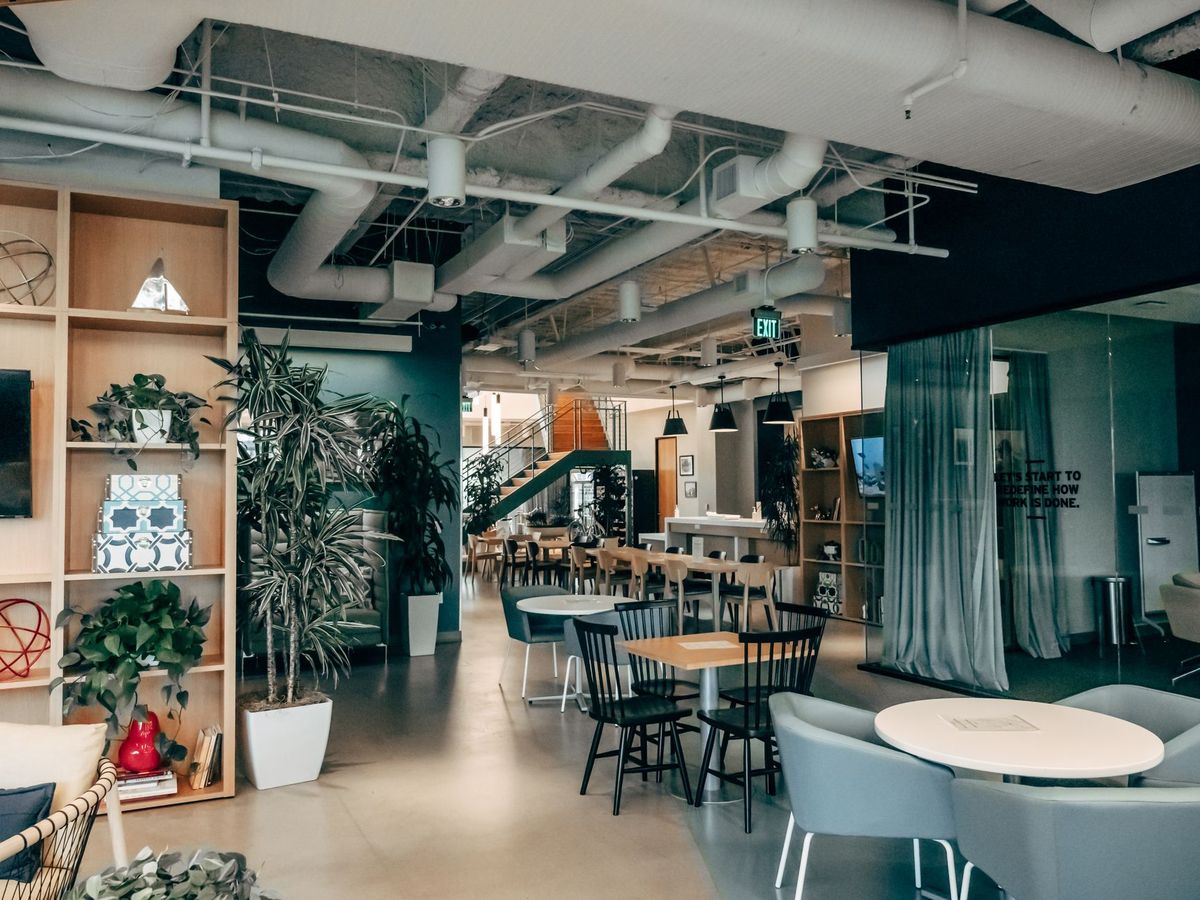
Finishes: $25 to $45/SF. The finish level is the primary differentiator between basic and premium co-working buildouts. The core elements include flooring (polished concrete at $3 to $5 per square foot for budget builds, luxury vinyl tile at $5 to $8, hardwood at $10 to $15 for premium areas), ceiling treatment (exposed structure with pendant lighting at $8 to $12 per square foot, versus dropped ceiling at $5 to $8), wall finishes (paint at $1 to $2, wallcovering at $3 to $8, specialty finishes at $10 and above), and lighting (a critical design element in co-working, with fixture costs of $8 to $15 per square foot for the layered lighting approach that defines quality co-working environments).
Furniture, fixtures, and equipment: $20 to $40/SF. Co-working furniture is a significant investment: sit-stand desks ($400 to $800 each), ergonomic task chairs ($300 to $600 each), lounge seating ($500 to $2,000 per piece), conference tables and chairs, phone room furnishings, and kitchen/cafe equipment. The furniture package for a 20,000-square-foot co-working space typically costs $400,000 to $800,000. Quality matters here because the furniture endures heavy use from multiple users and must maintain its appearance and function for 7 to 10 years to amortize the investment.
Technology infrastructure: $10 to $20/SF. Co-working spaces require robust technology: enterprise-grade WiFi with redundant access points (one AP per 800 to 1,200 square feet), conference room AV systems ($5,000 to $15,000 per room), access control and member management systems, digital signage, and the underlying structured cabling and network infrastructure. The technology investment has increased approximately 40% since 2019, driven by higher bandwidth requirements, video conferencing infrastructure, and the integration of space management platforms.
Design and project management: $5 to $12/SF. Professional design is essential for co-working spaces because the design directly affects member experience, operational efficiency, and brand perception. Co-working design has become a specialized discipline, with firms that focus exclusively on flexible workspace commanding design fees of $8 to $15 per square foot. Project management adds another $3 to $5 per square foot for a buildout that typically takes 12 to 20 weeks from demolition to opening.
Design Trends Shaping 2026 Buildouts
The design of co-working spaces continues to evolve, driven by changing work patterns, member expectations, and operational learnings:
Private office ratio is increasing. The original co-working model emphasized open desking with limited private offices. Current designs are reversing this ratio — new co-working spaces now allocate 50% to 65% of usable area to private offices (from two-person to twenty-person suites), up from 30% to 40% five years ago. This shift reflects member demand for privacy, acoustic separation, and dedicated space, as well as the higher revenue per square foot that private offices generate compared to hot desks.
Acoustic design has become paramount. The number-one complaint in co-working spaces is noise. Operators and designers are responding with enhanced acoustic treatments: sound-masking systems ($2 to $4 per square foot), acoustic ceiling panels (replacing the hard exposed ceilings that amplify sound), upholstered wall panels in common areas, and acoustic glazing for glass-fronted offices ($120 to $180 per linear foot versus $60 to $100 for standard glass).
Hospitality-influenced amenity spaces. The common areas in premium co-working spaces now rival boutique hotels in design quality. Coffee bars with commercial espresso machines, curated libraries, meditation rooms, outdoor terraces, and event spaces with full AV and catering capability are standard features in Class A co-working. These amenity spaces typically represent 20% to 30% of total area and account for a disproportionate share of buildout costs due to their finish level and MEP requirements.
Biophilic design integration. Living walls, interior plantscaping, natural materials, and maximized daylighting have moved from trend to standard practice in co-working design. The biophilic design elements add $3 to $8 per square foot in construction cost but are associated with member satisfaction and retention improvements that justify the investment.
Flexibility in buildout. Recognizing that the co-working market evolves rapidly, operators are increasingly requesting buildouts that can be reconfigured without major construction. Demountable partition systems, modular furniture, and infrastructure designed for flexibility (abundant power and data access points, flexible lighting zones, moveable acoustic panels) add cost upfront but provide operational agility over the ten-year lease horizon.
Return on Buildout Investment
The financial model for co-working relies on generating enough revenue per square foot to cover the buildout amortization, operating costs, and a return to the landlord:
Revenue per square foot: Well-operated co-working spaces in strong markets generate $50 to $85 per square foot annually in membership revenue, compared to $30 to $50 per square foot for conventional office leases. The revenue premium reflects the higher density, the value-added services, and the flexibility premium that members pay.
Buildout amortization: At $125 per square foot and a 10-year useful life, the annual buildout amortization is $12.50 per square foot. This is comparable to the tenant improvement allowance that landlords provide for conventional office tenants (typically $50 to $100 per square foot, amortized over 7 to 10-year lease terms at $7 to $14 per square foot annually).
Breakeven: A co-working space with a $125 per square foot buildout, operating costs of $25 to $35 per square foot (including labor, technology, and overhead), and buildout amortization of $12.50 per square foot needs to generate $50 to $60 per square foot in revenue to break even. This is achievable at 75% to 85% occupancy in most urban and suburban markets, which is consistent with the stabilized performance of well-operated co-working spaces.
Outlook
The co-working construction market is projected to grow 10% to 15% annually through 2028, driven by the continued expansion of hybrid work, the conversion of traditional office space to flexible use, and the growth of co-working in suburban markets where it has historically been underrepresented.
For general contractors, co-working buildouts represent a steady pipeline of mid-size tenant improvement projects ($1 million to $5 million typically) with specialized design requirements and compressed schedules. The contractors who excel in this niche combine speed of execution (operators want to open quickly to start generating revenue), attention to design quality (the finish level directly affects the operator's ability to attract and retain members), and the MEP expertise to deliver high-density, high-performance environments within existing building constraints.
The $125 per square foot benchmark is not a ceiling — it is a center point around which the market continues to innovate. The co-working spaces being built today are more functional, more attractive, and more durable than their predecessors, reflecting lessons learned from a decade of rapid growth and occasional failure. The numbers tell a story of a maturing sector that has found its economic model and is building — literally — for the long term.
The Suburban Co-Working Expansion
One of the most significant developments in the co-working market is the expansion into suburban locations, which represent a growing share of new buildouts. Suburban co-working locations now account for approximately 30% of new buildouts, up from 15% five years ago.
The suburban co-working model differs from urban locations in several important ways that affect construction scope and cost. Suburban locations typically occupy ground-floor or second-floor spaces in mixed-use or office buildings with lower base rents than urban locations. Floor plates tend to be larger (10,000 to 20,000 square feet versus 5,000 to 12,000 in urban locations), allowing for more open workspace and larger private office suites. Parking is essential — suburban co-working members drive — and the availability of adjacent parking is a key site selection criterion.
Buildout costs for suburban co-working tend to be 15% to 25% lower than urban locations, averaging $95 to $110 per square foot versus $125 to $160 for urban premium spaces. The savings come from lower base building costs, simpler MEP requirements (suburban buildings typically have more accessible ceiling plenums and more flexible structural grids), and finish levels that emphasize comfort and functionality over the design-forward aesthetics of urban co-working.
The suburban co-working member profile differs from urban locations: more small business owners and remote employees (versus freelancers and startups in urban locations), higher demand for private offices (suburban members are less likely to use hot desks), and stronger demand for meeting rooms and event spaces (suburban members use co-working spaces for client meetings that urban members more often conduct at restaurants or coffee shops).
For contractors, the suburban co-working expansion creates a pipeline of mid-size tenant improvement projects in locations that are typically easier to access, have fewer construction logistics constraints, and offer more predictable schedules than urban projects. The standardization of suburban co-working — operators are increasingly applying proven design templates across multiple locations — creates opportunities for contractors who can deliver consistent quality at competitive prices across multiple projects.
Want project-specific numbers? Our free cost estimator and markup margin calculator do the math in a couple of minutes.
Frequently Asked Questions
How much does co-working space construction cost per square foot?
The 2026 national average for co-working space buildouts is $125 per square foot. The range is wide: basic suburban co-working with standard finishes and minimal amenities runs $80 per square foot, while premium urban locations with extensive lounge areas, private office pods, high-end AV systems, and full café operations can reach $200 or more per square foot. The biggest cost driver is the ratio of private offices to open workspace — private offices require more demising walls, acoustic treatment, and data infrastructure per square foot than open-plan areas.
What construction elements drive co-working buildout costs the highest?
Acoustic performance is the single largest driver of premium costs. Co-working operators have learned that noise bleed between open workspace and private offices, phone booths, and conference rooms is the top tenant complaint. Achieving adequate acoustic separation in open-plan environments requires decoupled ceiling systems, acoustic batt in all partition walls, specialized door hardware, and sometimes structural decoupling — none of which are cheap. High-density data and power infrastructure, premium café buildout, and branded entry and lounge areas are the other significant cost centers.
How does co-working buildout cost compare to conventional office fit-out?
A conventional corporate office fit-out typically runs $80 to $150 per square foot depending on quality. Co-working spaces at $125 per square foot average are comparable, but the cost distribution is different. Co-working spaces spend more on common area design and amenity spaces (which have to attract and retain tenants who are paying by the month, not locked into long leases), and less on individual tenant spaces. The economics require co-working operators to earn premium revenue per square foot to justify the capital investment, which is why location and demand density matter more for co-working than for conventional office.