The Fastest Rise and Fall in Commercial Construction History
No sector in commercial construction has experienced a more dramatic boom-and-bust cycle than cannabis facility construction. From 2019 through 2022, cannabis cultivation and processing facility construction surged as state after state legalized recreational use, creating a gold-rush mentality among operators and investors. Construction spending on cannabis facilities peaked at an estimated $3.8 billion in 2022, making it one of the fastest-growing specialty construction segments in the country.
The numbers tell a starkly different story in 2026. Cannabis facility construction has collapsed 62% from its peak, with estimated 2025 spending of $1.4 billion. The decline is ongoing, and most industry analysts project further contraction in 2026 and 2027. The cause is straightforward and unforgiving: the industry built far more production capacity than the legal market can absorb, and the resulting oversupply has crushed wholesale cannabis prices, operator profitability, and the economic justification for new facility construction.
For the construction industry, the cannabis facility collapse is both a cautionary tale and a practical challenge for contractors who invested in this specialty. Let us examine the data and the lessons.
The Anatomy of Oversupply
The cannabis oversupply problem is the predictable result of a market structure that encouraged maximum production capacity with limited mechanisms for demand calibration:
Licensing proliferation. State regulatory agencies, eager to demonstrate the success of legalization and responding to political pressure for equitable access, issued cultivation licenses at a pace that far exceeded market demand. Oregon issued over 2,000 cultivation licenses for a market that could support perhaps 600. Oklahoma, which had among the most permissive licensing frameworks, issued over 10,000 licenses for a population of 4 million. Michigan, California, Colorado, and Massachusetts experienced similar dynamics, though at varying scales.
Wholesale price collapse. The consequence of excess cultivation capacity is predictable: wholesale cannabis prices have declined 65% to 80% from peak levels in most mature legal markets. In Oregon, wholesale cannabis flower prices fell from $1,800 per pound in 2018 to under $300 per pound by 2025. Colorado saw declines from $1,400 to $400 per pound over the same period. At these price levels, many cannabis cultivation facilities cannot cover their operating costs, let alone generate returns on the capital invested in construction.
Operator financial distress. The major publicly traded cannabis companies — Curaleaf, Trulieve, Green Thumb, Columbia Care — have reported significant write-downs of facility assets, and many have closed or idled cultivation facilities that were built during the expansion phase. Smaller operators have fared worse, with an estimated 30% of licensed cannabis cultivators ceasing operations since 2023. The financial distress has eliminated demand for new facility construction and created an inventory of existing facilities available at distressed prices.
What Cannabis Facilities Cost to Build
For context, the construction cost profile of cannabis facilities is worth examining, as it illustrates why the sector attracted contractor interest during the boom:
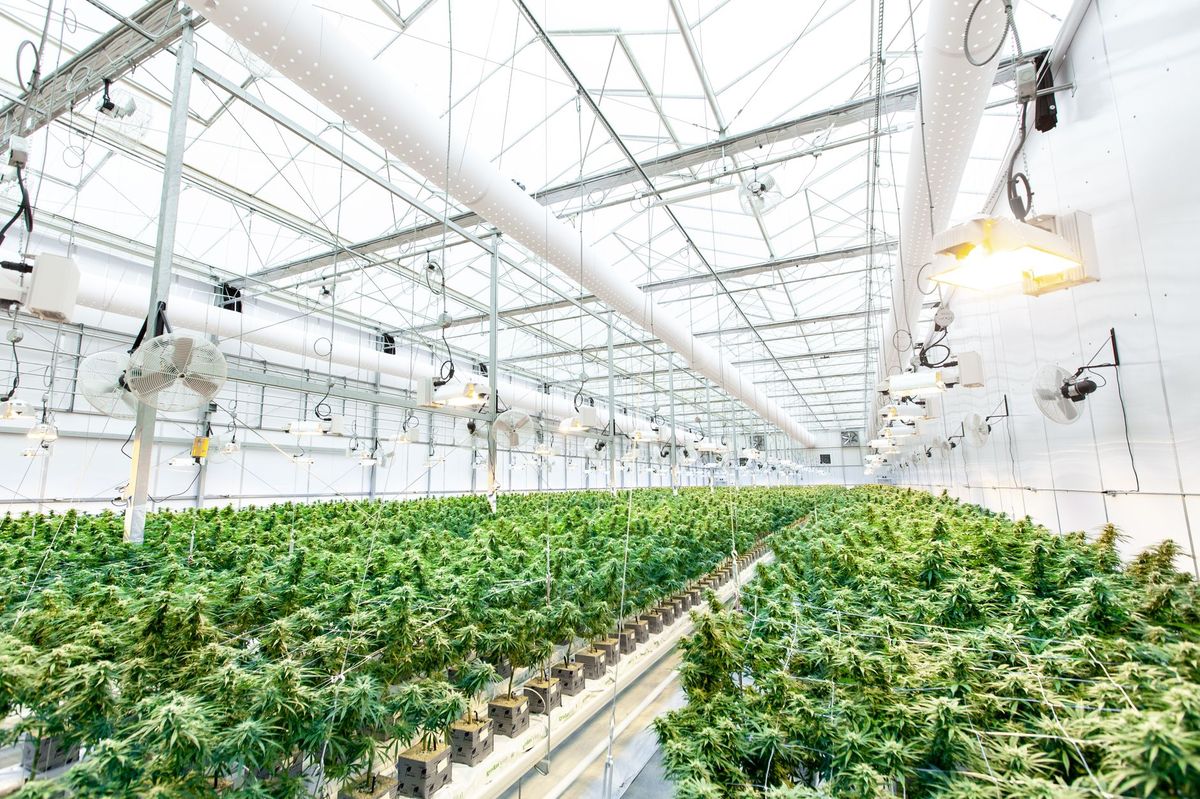
Indoor cultivation facility: $250 to $450/SF. Cannabis indoor cultivation requires a controlled environment with precise temperature (72 to 82 degrees F depending on growth stage), humidity (40% to 60%), lighting (high-intensity LED grow lights consuming 25 to 50 watts per square foot), and air handling (complete air exchange every 1 to 3 minutes with HEPA filtration and carbon filtration for odor control). The MEP systems for indoor cannabis cultivation are among the most intensive in commercial construction — comparable to laboratory or cleanroom environments.
A typical indoor cultivation facility of 30,000 to 50,000 square feet costs $8 million to $22 million to construct, including the building shell, growing rooms, mother and clone rooms, drying and curing areas, processing space, vault storage, security systems, and the extensive MEP infrastructure. The electrical service alone is substantial — a 40,000-square-foot indoor facility requires 2,000 to 4,000 amps of electrical service, rivaling industrial manufacturing facilities many times its size.
Greenhouse cultivation: $100 to $200/SF. Greenhouse operations use supplemental lighting and environmental controls to extend growing seasons and improve consistency, at roughly half the construction cost of fully indoor facilities. The trade-off is less precise environmental control and potential vulnerability to pest and weather issues.
Processing and extraction facilities: $200 to $400/SF. Cannabis processing facilities — where raw flower is converted to concentrates, edibles, topicals, and other products — require specialized equipment (CO2 extraction systems, hydrocarbon extraction systems, commercial kitchens for edibles), explosion-proof construction in extraction areas, and extensive ventilation and safety systems. Processing facility construction costs overlap with indoor cultivation costs but with different emphasis on equipment and safety infrastructure.
Dispensary/retail: $150 to $250/SF. Cannabis retail stores require secure product storage (vault rooms with specific security specifications), point-of-sale areas with regulatory compliance features (age verification, seed-to-sale tracking integration), and design finishes that increasingly rival upscale retail environments. Dispensary construction costs have remained relatively stable because retail operations — the customer-facing end of the cannabis supply chain — are less affected by wholesale price declines.
The 62% Decline: Where the Cuts Fell
The 62% decline in cannabis facility construction is not distributed evenly across project types:
New indoor cultivation construction has essentially ceased. The massive indoor grow facilities that defined the cannabis construction boom — 50,000 to 100,000-square-foot buildings packed with LED lighting and environmental control systems — are no longer being built. The combination of wholesale price collapse, excess existing capacity, and the availability of distressed facilities at below-construction-cost prices has eliminated the economic rationale for new indoor cultivation construction. An estimated 85% decline in new indoor cultivation facility construction accounts for the majority of the sector's overall decline.
Greenhouse construction has also declined sharply. New greenhouse construction has fallen approximately 60%, with the same oversupply dynamics affecting greenhouse operators. Some greenhouse operators have been more resilient than indoor operators because of their lower cost of production, but the wholesale price declines have eroded margins for all cultivation methods.
Processing facility construction has declined moderately. New processing facilities are down approximately 40% from peak levels, with the decline less severe than cultivation because the concentrate and edible categories have continued to grow market share even as overall cannabis sales growth has slowed. Operators are still investing in processing capacity to shift their product mix toward higher-margin processed products, though at a slower pace than during the boom.
Dispensary construction remains relatively active. Retail cannabis construction has declined only about 20% from peak levels, supported by continued new market openings (New York, New Jersey, Connecticut, and others have begun or expanded retail operations since 2023), the buildout of remaining licenses in existing markets, and the renovation and upgrade of early-generation dispensaries that need modernization.
Geographic Patterns
The cannabis construction decline is most severe in the markets that overbuilt most aggressively:
Oregon, Oklahoma, and Colorado — the three most oversupplied markets — have experienced construction declines of 75% to 90%. These markets have essentially no new cultivation facility construction and minimal processing or retail construction. The existing facility inventory includes significant vacancies and distressed properties.
California has declined approximately 65%, with the nation's largest legal market still struggling with a combination of oversupply, competition from the persistent illicit market (which is estimated to be larger than the legal market), and a regulatory and tax burden that makes legal operations increasingly difficult.
Michigan and Massachusetts have declined 50% to 60%, with both markets transitioning from the rapid expansion phase to a mature market with excess capacity.
Newer markets — New York, New Jersey, Connecticut, Ohio, Minnesota — represent the remaining areas of construction activity, as license holders build the retail and cultivation infrastructure needed to launch operations. However, even in these newer markets, operators are building more conservatively than their predecessors in earlier-legalizing states, having observed the consequences of overbuilding.
Lessons for the Construction Industry
The cannabis facility construction collapse offers lessons that extend beyond the cannabis sector:
Regulatory-driven demand is not the same as market-driven demand. The cannabis construction boom was driven by the regulatory creation of a new legal market, which generated enormous initial demand for facilities. But regulatory demand — the need to build licensed facilities to participate in a new market — is a one-time event, not a sustained demand driver. Once the initial build-out is complete, construction demand falls to replacement and renovation levels that are a fraction of the initial surge.
Specialty construction niches can evaporate rapidly. Contractors who invested heavily in cannabis facility construction expertise — hiring specialized personnel, purchasing specific equipment, and building their marketing around the sector — found themselves with excess capacity when the market contracted. The specialization that was a competitive advantage during the boom became a vulnerability during the decline.
Client credit risk in emerging industries is elevated. Cannabis operators during the boom years often had limited financial track records, uncertain revenue projections, and aggressive growth plans funded by speculative capital. Some contractors who built facilities during the boom have been left with unpaid invoices from operators who subsequently closed or entered financial distress. Enhanced credit due diligence — particularly in emerging industries with unproven economic models — is a lesson reinforced by the cannabis experience.
Asset specificity creates illiquidity. Cannabis cultivation facilities are difficult to repurpose for other uses because of their unique construction characteristics — the extensive electrical infrastructure, the specialized HVAC systems, the security features, and in some cases, the odor from years of cultivation that has permeated the building materials. Facilities that cost $15 million to build are selling at auction for $2 million to $4 million because the buyer pool is limited to other cannabis operators, and most operators are not expanding.
What Comes Next
The cannabis facility construction market will stabilize at a level well below the boom-era peak. The likely steady-state construction volume is $1 billion to $1.5 billion annually — supporting the renovation and upgrade of existing facilities, the buildout of new-market licenses, and selective new construction in markets where demand growth justifies expansion.
Federal legalization or rescheduling — if it occurs — could create a temporary construction surge as interstate commerce opens and operators reconfigure their supply chains. However, the oversupply lesson is likely to moderate the response, and the existing facility inventory provides substantial capacity that could serve an expanded legal market without proportional new construction.
For the construction industry, the cannabis sector story is a reminder that not all construction booms are created equal. The sectors that provide the most durable demand — healthcare, infrastructure, residential housing — are driven by fundamental human needs that persist through economic cycles. The sectors that provide the most explosive but least durable demand — cannabis, cryptocurrency mining, specific technology verticals — are driven by market creation events that generate intense but temporary construction activity.
The numbers have spoken with painful clarity: the cannabis facility construction boom was real, the opportunities it created were genuine, and the correction it produced was severe. For contractors and developers, the lesson is eternal and universal — the numbers that seem too good to be true usually are. The data always tells a story, and the smart money listens to the story the data tells.
Opportunities in the Downturn
Despite the severe contraction, opportunities remain for construction firms with cannabis facility experience:
Facility optimization and renovation. Operators who survive the shakeout are investing in efficiency improvements — LED lighting upgrades, HVAC optimization, automation of cultivation processes, and processing line improvements — that reduce operating costs and improve product quality. These renovation projects typically range from $500,000 to $3 million and represent a steady pipeline for contractors with cannabis facility experience.
New market buildouts. States that have recently legalized adult-use cannabis — including New York (retail rollout continuing into 2026), Ohio, and Minnesota — still require new facility construction for licensed operators. While operators in these newer markets are building more conservatively than their predecessors, the construction scope remains substantial: each new cultivation facility requires $5 million to $15 million in construction investment, and each dispensary requires $500,000 to $1.5 million.
Facility decommissioning and conversion. The closure of cannabis cultivation facilities creates demand for decommissioning services — removing growing equipment, remediating odor, restoring the building to a condition suitable for alternative use — followed by the renovation of the space for its next occupant. This work is specialized (cannabis facilities may have chemical contamination and biological waste that require professional remediation) and represents a growing niche as facility closures continue.
Compliance-driven construction. As state regulators tighten quality and safety requirements, existing facilities must be upgraded to meet new standards. Track-and-trace system upgrades, security enhancements, fire protection improvements, and waste management system installations all generate construction work for firms familiar with the regulatory framework.
The cannabis construction market will not return to its 2022 peak. But a stabilized market of $1 billion to $1.5 billion in annual construction spending — composed of new market buildouts, facility renovations, and compliance upgrades — represents a viable, if smaller, niche for contractors who have the specialized knowledge and relationships to serve it. The numbers have recalibrated, and the firms that recalibrate with them will find sustainable opportunity in the post-boom landscape.
Frequently Asked Questions
Why did cannabis facility construction collapse so dramatically?
Cannabis facility construction peaked at an estimated $3.8 billion in 2022 and has since collapsed 62% to approximately $1.4 billion in 2025. The cause is oversupply: states issued cultivation licenses far in excess of what legal market demand could support. Oregon, Oklahoma, Michigan, California, and Colorado all saw licensing proliferation that created more production capacity than consumer demand could absorb. Wholesale cannabis prices crashed, operator profitability evaporated, and the economic case for new facility construction disappeared.
What happens to contractors who specialized in cannabis facility construction?
Contractors who built cannabis facilities developed real expertise in controlled-environment agriculture, specialized HVAC and humidity control, security systems, and electrical infrastructure for high-intensity lighting. These skills transfer to adjacent sectors: pharmaceutical manufacturing cleanrooms, food-grade processing facilities, indoor vertical farming, and specialized laboratory construction all require overlapping technical capabilities. The transition requires business development effort but the underlying construction expertise has legitimate market value outside cannabis.
Are there any cannabis construction markets that are still active?
Federal legalization remains the wildcard that could restart the market by enabling access to banking and capital markets, allowing interstate commerce that would consolidate the fragmented state-by-state structure, and removing the tax burden of IRS Section 280E. Several states that legalized more recently — including Maryland, Missouri, and Ohio — have tighter licensing frameworks and are less oversupplied than mature markets. But broad recovery in cannabis construction spending is unlikely until the structural oversupply issue resolves, which typically requires two to four years of reduced cultivation investment.