The Most Valuable Real Estate in the Suburbs Is Already Paved
The demolition of big-box retail stores reached an all-time high in 2025, with an estimated 340 former Sears, Kmart, JCPenney, Macy's, and other large-format retail buildings demolished to make way for new development. That's up from 280 demolitions in 2024 and roughly 200 in 2023. More remarkably, the redevelopment plans for these sites increasingly call for residential construction — converting vast suburban parking lots into housing that addresses the affordability crisis while creating walkable communities on land that's already served by roads, utilities, and transit.
The numbers tell a story of structural transformation in the suburban landscape. The total inventory of enclosed shopping mall space in the US has declined from 1.1 billion square feet in 2015 to approximately 870 million square feet in 2026 — a 21% reduction that reflects the permanent restructuring of retail away from department-store-anchored malls. And the roughly 230 million square feet of demolished mall space has been replaced, in large part, by mixed-use developments that integrate the residential density these communities desperately need.
For the construction industry, this transformation represents a substantial and growing pipeline of demolition, remediation, and new construction work. Let us examine the data, the economics, and the emerging development models.
Why Big-Box Demolition Is Accelerating
The acceleration of big-box demolitions reflects the convergence of several forces that have been building for a decade:
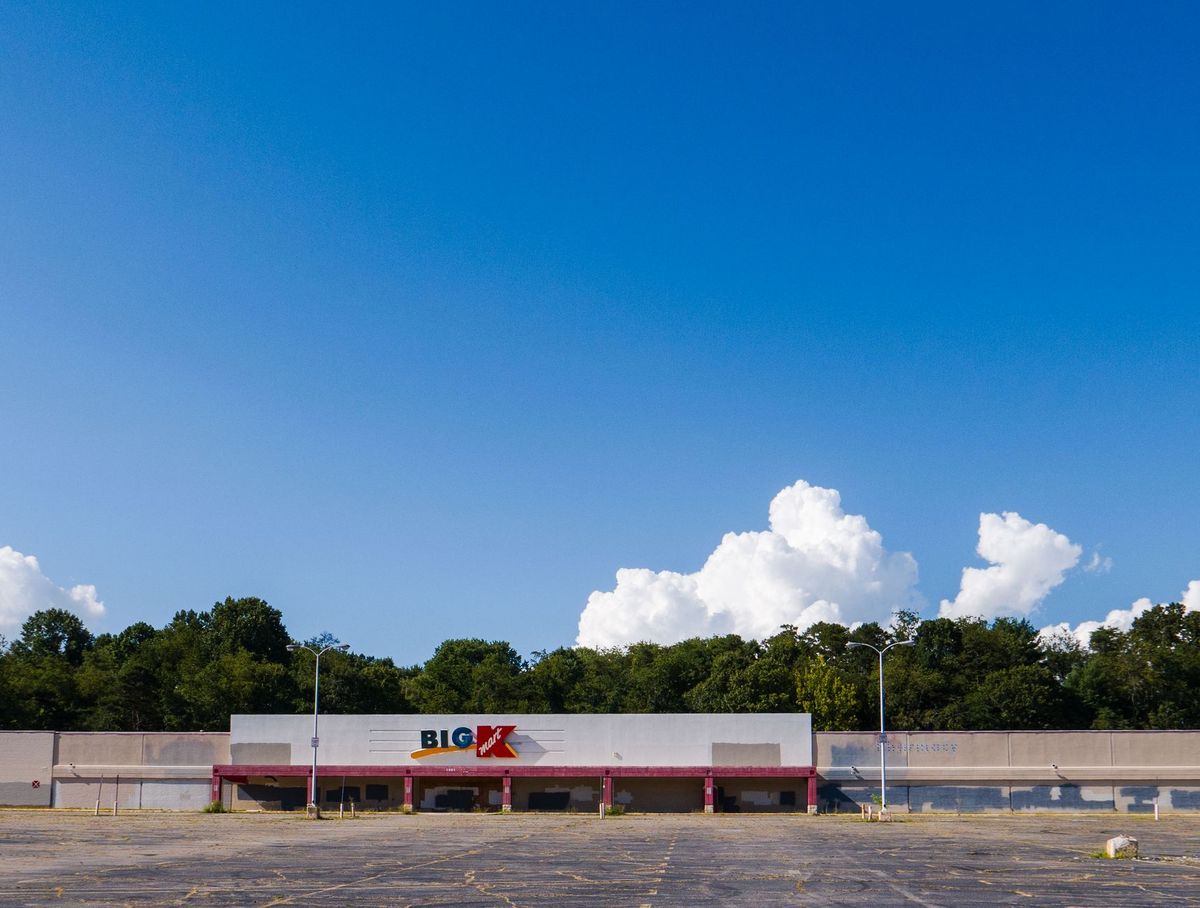
Department store bankruptcies and closures. The cascade of department store failures — Sears (2018), JCPenney (2020), Bed Bath & Beyond (2023), and the ongoing contraction of Macy's, Nordstrom, and Kohl's — has created an unprecedented inventory of vacant large-format retail buildings. An estimated 1,200 former department store locations remain vacant or underutilized across the US, each occupying 80,000 to 200,000 square feet of building area on sites of 10 to 40 acres.
Functional obsolescence of the buildings. Most big-box retail buildings were constructed as single-use structures with design characteristics that make adaptive reuse challenging: low ceiling heights (12 to 16 feet clear versus the 20 to 32 feet needed for modern warehouse or commercial use), limited fenestration (retail buildings have minimal natural light), and floor plates that are too large for most commercial uses. While some have been successfully converted to other retail, entertainment, or institutional uses, the majority are more economically demolished and replaced than renovated.
Land value exceeds building value. In many suburban markets, the land beneath a defunct big-box store is worth more than the building sitting on it — especially when the land is zoned or can be rezoned for residential use. A 20-acre former mall site in a suburban location with utilities, road access, and proximity to employment centers can be worth $10 million to $40 million for residential development, versus $2 million to $8 million as a vacant retail property. This value differential creates a powerful economic incentive for demolition and redevelopment.
Zoning reform enables residential conversion. Municipal governments are increasingly rezoning former retail sites for residential and mixed-use development, recognizing that repurposing underperforming retail land for housing addresses multiple community needs simultaneously. These zoning changes often come with density bonuses, reduced parking requirements, and expedited permitting that improve the development economics.
The Demolition Scope and Cost
Demolishing a big-box retail building is a substantial construction project in its own right:
Structural demolition costs: $5 to $12 per square foot of building area, depending on the construction type and local disposal costs. A 150,000-square-foot former department store costs $750,000 to $1.8 million to demolish. Steel-frame buildings are generally less expensive to demolish than concrete structures because the steel has salvage value ($100 to $200 per ton) that offsets demolition costs.
Parking lot removal: $3 to $6 per square foot for asphalt removal and disposal. A typical big-box site has 4 to 8 acres of paved parking (175,000 to 350,000 square feet), costing $500,000 to $2.1 million to remove. The underlying base material may be reusable for new site work, reducing disposal costs.
Environmental remediation: $500,000 to $3 million depending on site conditions. Common environmental issues on former retail sites include underground storage tanks (from former auto centers), asbestos-containing materials in building construction (particularly in buildings built before 1980), contaminated soils from dry cleaning operations (former mall tenants), and stormwater management systems that require upgrading for new use.
Total demolition and site clearance cost: $2 million to $6 million for a typical big-box site. This cost is borne by the redevelopment project and is typically justified by the land value created for new development.
What's Replacing the Big Boxes
The redevelopment patterns emerging from big-box demolition sites fall into three primary models:
Model 1: Residential-dominant mixed-use (55% of redevelopments). The most common approach replaces the big-box store with a residential development of 200 to 600 units — typically a mix of apartments, townhomes, and sometimes for-sale condominiums — with 20,000 to 50,000 square feet of ground-floor retail. The retail component is intentionally modest, reflecting the reality that the site's original retail function is no longer viable at its former scale.
The economics of this model are compelling. A 20-acre former mall site that generated $1 million to $2 million in annual rent as a struggling retail center can generate $8 million to $15 million in annual revenue as a 400-unit residential community with neighborhood retail. The site already has road access, utility connections, and (usually) zoning precedent for commercial use, reducing the entitlement risk and infrastructure cost.
Construction costs for residential-dominant redevelopments on former big-box sites range from $200 to $350 per square foot for the residential component, consistent with conventional apartment construction. The site work benefits from existing utility infrastructure but requires new stormwater management systems to accommodate the change in impervious surface coverage and building density.
Model 2: Town center or lifestyle center (30% of redevelopments). Some former big-box sites are being redeveloped as mixed-use town centers that combine residential, retail, restaurant, entertainment, and civic uses in a walkable format. These projects are typically larger and more complex than residential-dominant developments, encompassing 20 to 50 acres and representing $100 million to $500 million in total development value.
Town center redevelopments create entirely new community nodes in suburban areas that previously lacked walkable destinations. The most successful examples — like the redevelopment of former Sears locations in multiple markets — combine residential density with curated retail, dining, and community spaces that serve as gathering places for the surrounding neighborhoods.
The construction scope for town center redevelopments includes streetscape infrastructure (sidewalks, lighting, landscaping, public plazas), structured parking (often below-grade or wrapped within buildings to minimize visual impact), and the coordination of multiple building types with different structural systems, use requirements, and delivery schedules.
Model 3: Institutional or community use (15% of redevelopments). A smaller but important share of former big-box sites is being redeveloped for institutional uses — schools, community colleges, healthcare facilities, government offices, and community centers. These conversions, which sometimes retain the existing building structure, serve community needs that are often undermet in suburban areas where the original zoning prioritized retail and commercial uses.
The Housing Impact
The conversion of big-box sites to residential use has a measurable impact on local housing supply. A single 20-acre big-box redevelopment that produces 400 housing units represents a significant addition to the housing stock of a suburban community, often more than the total housing production from all other sources in the municipality combined.
The cumulative impact is substantial. If each of the 340 big-box demolitions in 2025 results in an average of 300 housing units (a conservative estimate given the typical site sizes), the total housing production from big-box conversion is approximately 102,000 units — representing roughly 7% of total US housing starts and a meaningful contribution to addressing the national housing shortage.
The housing produced on former big-box sites also tends to be well-located — near employment, retail, transit, and public services — because the original retail developments were sited for accessibility. This locational advantage makes big-box conversion housing particularly valuable from a community planning perspective, as it adds density and affordability in precisely the locations where housing is most needed and most beneficial.
Challenges and Complexities
Big-box redevelopment is not without challenges, and the construction industry should be aware of the common difficulties:
Community opposition. Despite the obvious benefits of replacing a vacant eyesore with new development, residential redevelopment of commercial sites often faces community opposition. Concerns about density, traffic, school capacity, and neighborhood character can delay or complicate the entitlement process. Effective community engagement — early, transparent, and responsive to legitimate concerns — is essential for successful redevelopment.
Environmental remediation. As noted above, former retail sites frequently have environmental conditions that require remediation before residential construction can proceed. The cost and timeline for remediation can be significant, particularly for sites with contaminated soils or groundwater. Phase I and Phase II environmental assessments are essential components of due diligence, and the remediation scope should be fully defined before acquisition or development commitments are made.
Infrastructure capacity. While former big-box sites have existing utility connections, the capacity of those connections may not be adequate for the increased density of residential use. Water and sewer capacity, in particular, may require upgrades that can cost $1 million to $5 million and require coordination with municipal utilities. Stormwater management systems designed for a retail parking lot (which sheds water rapidly from impervious surfaces) must be redesigned for a residential development with different drainage patterns.
Phasing complexity. Large-site redevelopments are typically phased over multiple years, with each phase designed to be economically self-sustaining. The phasing plan must account for construction logistics (maintaining site access and livability for early-phase residents during later-phase construction), marketing considerations (each phase must generate sufficient sales or leasing to fund subsequent phases), and infrastructure sequencing (utilities and roads must be built ahead of the buildings they serve).
Market Outlook
The pipeline of big-box sites available for redevelopment will continue to expand through the end of the decade. The ongoing contraction of department stores, the evolution of big-box retail toward smaller formats, and the aging of the 1990s and 2000s retail building stock all contribute to a growing inventory of sites that are candidates for demolition and redevelopment.
The construction opportunity is significant and growing. A conservative estimate suggests that big-box redevelopment will generate $15 billion to $25 billion in annual construction spending by 2028, encompassing demolition, site work, residential construction, retail construction, and infrastructure improvements.
For general contractors, big-box redevelopment projects combine the complexity of demolition, the technical requirements of environmental remediation, and the scale of multi-phase residential and mixed-use construction. These projects reward firms that can manage the full development lifecycle — from demolition to certificate of occupancy — and navigate the community engagement and entitlement processes that are essential for project success.
The parking lots are becoming housing. The numbers say it is the highest and best use of some of the most accessible land in suburban America. And for an industry searching for construction opportunities in a market of mixed signals, the demolition of the old and the construction of the new represents one of the clearest and most durable trends in commercial real estate.
The Economic Development Angle
Big-box redevelopment is increasingly supported by economic development agencies and municipal governments that recognize the opportunity to transform underperforming commercial properties into vibrant community assets. The economic development tools available for big-box redevelopment include the following:
Tax increment financing districts that capture the incremental property tax revenue generated by the redevelopment and redirect it to infrastructure and public amenity costs. Brownfield and environmental remediation grants that offset the cost of addressing environmental conditions on former retail sites. Community development block grants that support affordable housing components within mixed-use redevelopments. Opportunity Zone designations that attract capital gains investment to qualified census tracts where big-box sites are located. And state and local tax abatements that reduce the property tax burden during the initial years of the redevelopment.
The cumulative effect of these incentives can be substantial — reducing the effective development cost by 15% to 30% on qualifying projects and improving returns to levels that attract private capital. For construction firms, understanding these incentive programs and their requirements is a competitive advantage in pursuing big-box redevelopment projects.
The demolition contractors, environmental remediation firms, and general contractors who serve the big-box redevelopment market are building the next generation of suburban communities on the foundations — literally — of the previous generation's shopping destinations. The parking lots that once served America's consumer culture are becoming the neighborhoods that serve America's housing needs. The numbers confirm this is not a trend but a transformation, and the construction industry is the engine that makes it possible.
At 340 demolitions and growing, the big-box redevelopment pipeline represents one of the most reliable and expandable construction opportunities in the commercial market. The sites are available, the demand for housing is insatiable, and the policy environment is supportive. The builders who position themselves at the intersection of demolition, remediation, and residential construction will find work for a decade or more.
Frequently Asked Questions
How many big-box retail buildings are being demolished in 2025–2026?
Big-box retail demolitions reached an estimated 340 in 2025, up from 280 in 2024 and roughly 200 in 2023. The sites are predominantly former Sears, Kmart, JCPenney, and Macy's locations — department stores that anchored enclosed shopping malls now facing permanent closure. US enclosed mall space has declined from 1.1 billion square feet in 2015 to approximately 870 million square feet in 2026, a 21% reduction, with the demolished space increasingly replaced by mixed-use developments that include residential units.
What types of construction work does big-box redevelopment generate?
The demolition itself is the first phase — larger stores require mechanical demolition and in many cases environmental remediation for asbestos, underground storage tanks, or contaminated soils from decades of dry-cleaning and automotive tenants. The redevelopment that follows typically includes residential construction (apartment buildings, townhomes, or condos), supporting retail in smaller-format buildings, structured parking, and public space. Projects with residential components in the 300 to 1,200 unit range have become the dominant model because housing demand is strong enough to justify the full demolition and site remediation cost.
Are there incentives for contractors pursuing big-box redevelopment projects?
Yes. Municipal governments and economic development agencies actively support big-box redevelopment with TIF (tax increment financing) districts, fee waivers, infrastructure grants, and density bonuses that allow more residential units than base zoning would permit. These incentive packages can reduce effective development costs by 15% to 30% on qualifying projects — improving returns enough to attract private capital to sites that would otherwise be uneconomic to develop. For construction firms, understanding these programs and their timelines is a competitive advantage in pursuing and pricing these projects.