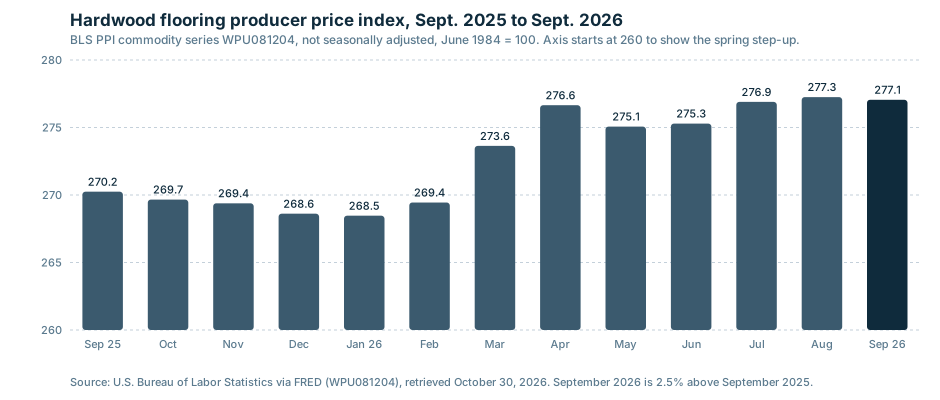
Hardwood flooring prices in 2026 moved less than most of what else goes into a house. The Bureau of Labor Statistics producer price index for hardwood flooring (FRED series WPU081204, retrieved October 30, 2026) stood at 277.054 in September 2026, up 2.5% from 270.243 in September 2025. Over the same twelve months the softwood lumber index (WPU0811) rose 14.2%. So the mill-gate price of the boards is up a few percent, not a lot. What moves a flooring bid in 2026 is species, solid versus engineered, prefinished versus site-finished, who is installing it, and how much of the material came through a port.
This article pulls together the published per-square-foot numbers, says where each one came from and how old it is, and then works through what a contractor should actually put in a quote. There is no government survey of installed flooring prices, so the dollar figures below come from dated consumer cost guides. Treat them as a sanity check on a bid, not as a bid.
What the Price Indexes Say Happened This Year
The BLS producer price indexes track what mills and manufacturers charge, not what you pay at the distributor. They are index points, not dollars. But they are the only monthly, public, nationally consistent read on flooring prices, and they show the shape of the year.
| BLS PPI series (FRED ID) | Sept. 2025 | Sept. 2026 | Change |
|---|---|---|---|
| Hardwood flooring (WPU081204) | 270.243 | 277.054 | +2.5% |
| Oak and maple hardwood flooring (WPU08120401) | 274.003 | 280.924 | +2.5% |
| Hardwood flooring other than oak and maple (WPU08120402) | 148.437 | 152.034 | +2.4% |
| Hardwood lumber (WPU0812) | 281.338 | 285.075 | +1.3% |
| Softwood lumber (WPU0811) | 252.782 | 288.562 | +14.2% |
All five series retrieved from FRED on October 30, 2026. The first four are indexed to June 1984 = 100 except the "other than oak and maple" series, which is indexed to December 2011 = 100, so compare the percentages, not the levels.
The hardwood flooring index was flat from September 2025 through February 2026, sitting between 268.5 and 270.2. It stepped up in March (273.637) and April (276.649), then held in a narrow band between 275.1 and 277.3 through September. From December 2025 to September 2026 the index rose 3.1%. In other words, the price move for the year happened in one spring step, and flooring bought in the second half of 2026 cost roughly what it did in May.
The hardwood lumber index, which is the raw stock the flooring mills buy, told a slightly different story. It climbed steadily from 281.338 in September 2025 to a peak of 289.117 in July 2026, then eased to 286.365 in August and 285.075 in September. Lumber cost pressure on flooring mills stopped building in late summer. Our lumber prices guide covers the softwood side, which matters for the subfloor and sleepers under a hardwood floor more than for the floor itself.
Material Cost per Square Foot by Species
Three consumer cost guides publish species-level prices. They define their numbers differently, so the table carries all three with their dates. Fixr's hardwood floor installation guide (updated January 31, 2025) gives materials-only prices. This Old House's hardwood flooring cost guide (updated June 5, 2026) gives installed prices including labor and materials, and says its cost data comes from RSMeans construction estimates, national material and labor costs, and quotes gathered in consumer focus groups. Today's Homeowner's hardwood flooring cost guide (updated March 14, 2025) gives a per-square-foot species price that it presents separately from labor.
| Species | Fixr, materials only (Jan. 2025) | Today's Homeowner (Mar. 2025) | This Old House, installed (June 2026) |
|---|---|---|---|
| Red oak | $3 to $5.75 | $2 to $7 | $2 to $6 |
| White oak | $3.75 to $7 | $5 to $8 | $4 to $7 |
| Hickory | $4.15 to $7.15 | $4 to $8 | $3 to $7 |
| Maple | $6.25 to $10 | $3 to $6 | $3 to $10 |
| Walnut | $8.25 to $10.50 | $10 to $12 (Brazilian walnut) | $5 to $10 (Brazilian walnut) |
| Pine | $1.25 to $2.10 | not listed | $2 to $4 |
Two notes on that table. Today's Homeowner and This Old House list Brazilian walnut, a tropical species, not American black walnut; Fixr's walnut line does not say which. And the guides disagree on maple by a wide margin, which is a reminder that these are editorial ranges, not surveys.
What the guides agree on: red oak is the floor of the market, white oak carries a premium of roughly a dollar to three dollars a square foot over red oak in every guide, and walnut sits at the top of the domestic species. Fixr's guide also lists Janka hardness ratings, which is why hickory (1,820) prices above oak despite being a plentiful domestic species: it is harder to mill and harder to nail. White oak comes in at 1,360 and red oak at 1,290 on the same list.
The species choice is being pushed by demand as much as supply. The National Wood Flooring Association's 2026 Industry Outlook, published in Hardwood Floors Magazine on October 1, 2025, reported that white oak "continues to be a dominant domestic selection for 63 percent of members," and that consumers are asking for longer and wider boards, engineered factory-finished flooring, and natural and light color tones. Wide white oak is the expensive end of the domestic market and the part of the market everyone wants, which keeps its price firm.
Thickness and width move the material price within a species. Fixr lists 5/16-inch flooring at $2 to $5 per square foot materials only, 3/4-inch at $3 to $6, and 7/8-inch at $3 to $7, and by width lists 3-inch boards at $3 to $6, 5-inch at $4 to $7 and 7-inch at $8 to $10. Today's Homeowner's thickness table runs higher: 5/16-inch at $3 to $6, 3/4-inch at $5 to $10, and 7/8-inch at $10 to $15. Fixr puts unfinished planks at $2 to $6 per square foot and says prefinished flooring starts at $3 per square foot for standard types and $10 for exotics.
Solid Versus Engineered
Engineered flooring is a real wood wear layer on a plywood or composite core. It is more stable over slabs and radiant heat, and it is where the imported share of the market is concentrated, which matters for the tariff section below.
Installed, the guides put the two closer together than most homeowners expect:
| Type | Fixr, installed (Jan. 2025) | This Old House, installed (June 2026) | Today's Homeowner, materials + labor (Mar. 2025) |
|---|---|---|---|
| Solid hardwood | $9 to $23 | $5 to $28 | $3 to $20 materials, $3 to $7 labor |
| Engineered hardwood | $8 to $14 | $6 to $23 | $3 to $15 materials, $3 to $10 labor |
| Parquet / true parquet | $11 to $15 (parquet install type) | $13 to $40 (true parquet) | $3 to $15 materials, $12 to $23 labor |
Fixr breaks solid hardwood out by grade: low-grade $9 to $13 per square foot installed, mid-grade $11 to $18, high-grade $15 to $25. It prices floating floors at $7 to $12 installed and, by installation type with labor included, click-and-lock at $10 to $14, plank at $15 to $20, and herringbone at $16 to $22. This Old House lists its overall installed range at $6 to $18 per square foot, with a 2,000-square-foot house at $12,000 to $36,000.
The practical difference is in the second and third decade. A 3/4-inch solid floor can be sanded and refinished repeatedly; This Old House prices a professional sand and refinish at $3 to $8 per square foot. An engineered floor can be refinished only as many times as its wear layer allows, and a thin veneer may not survive one full sanding. On a quote, write the wear-layer thickness of any engineered product into the spec so the customer is comparing the same thing across bids.
Tariffs and Imported Engineered Flooring
The tariff story for flooring in 2026 is easy to get wrong, because the wood tariff everyone heard about mostly does not apply to flooring.
Proclamation 10976 of September 29, 2025, published in the Federal Register on October 6, 2025 (90 FR 48127), imposed Section 232 duties on imports of timber, lumber and their derivative products effective October 14, 2025: a 10% ad valorem duty on softwood timber and lumber, 25% on certain upholstered wooden products, and 25% on kitchen cabinets and vanities. The proclamation capped the rate on wood products from the United Kingdom at 10% and on products from the European Union and Japan at 15% when added to the normal column 1 duty. It scheduled increases to 30% on upholstered products and 50% on cabinets and vanities for January 1, 2026. A proclamation issued December 31, 2025, delayed those two increases until January 1, 2027, according to Sandler, Travis and Rosenberg's trade report of January 6, 2026.
Hardwood flooring is not on that list. The NWFA's own magazine said so plainly in a December 7, 2025 government affairs column: "Hardwood products are not specifically included in the main finding." The same column noted that the decision's annexes moved some flooring tariff codes that had previously been excluded from tariffs into the country-specific reciprocal tariffs announced in April 2025. Floor Covering News reported on October 21, 2025 that most imported laminate, engineered flooring and hardwood plywood had been exempt from Section 232 but that "reciprocal tariffs" of up to 20% took effect on those categories October 14, depending on the exporting country.
What that meant on the ground, from the same Floor Covering News report: Stanton, which sources hardwood and laminate from Southeast Asia, saw tariffs of 18% to 20% on the region on top of an existing 8% duty, and said it would pass a portion of the increase to customers. True Touch Floors said its China-made MonoTech engineered line would see an 8% increase while its traditional hardwood imports would not change price at that time. R&J Flooring Supply, the U.S. distributor for Vietnam-made Denali hardwood, said it had built up U.S. inventory and did not plan to raise prices in the near future.
The NWFA's 2026 Industry Outlook survey, taken in summer 2025, put numbers on the industry response: about 45% of members said tariff and trade concerns had caused them to raise prices to offset tariff-related costs, 37% had switched to domestic suppliers, and 70% reported no supply disruptions for any product in 2025. Just over half said they were worried about tariffs and trade policy going into 2026. On sales, 39% expected growth in 2026 and 46% expected sales to stay the same.
Two open items matter for anyone pricing an import-heavy job. Proclamation 10976 directed the Commerce Secretary to provide the President an update on hardwood timber and lumber imports by October 1, 2026, so the President could decide whether an additional duty on hardwood timber or lumber, "as well as any additional duties on derivatives of such products," is warranted. It also, in clause 16, told Commerce to establish a process for adding wood products to the tariff's scope. As of October 30, 2026, we found no published proclamation adding hardwood or engineered flooring to the Section 232 list. Check the current Harmonized Tariff Schedule and your distributor's surcharge language before you lock a price on imported engineered product, and put a tariff-adjustment clause in the contract if the material is coming from overseas.
Labor Rates per Square Foot
Labor is where regional variation shows up most, and the published figures are older than the material figures. Fixr (January 31, 2025) puts typical hardwood installation labor at $3 to $6 per square foot, "although some costs could go much higher for difficult installations," and says carpenters charging by the hour run $60 to $80 per hour for hardwood installation. Today's Homeowner (March 14, 2025) lists labor at $3 to $7 per square foot for solid hardwood, $3 to $10 for engineered, and $12 to $23 for parquet. This Old House (June 5, 2026) notes that unfinished boards cost less to buy but carry higher labor because the sanding and finishing happen on site.
The wage data underneath those billing rates comes from the BLS Occupational Employment and Wage Statistics program for May 2025, retrieved through the BLS public API on October 30, 2026. Floor sanders and finishers (occupation 47-2043) earned a mean hourly wage of $25.22 and a median of $24.25, with the 90th percentile at $33.82, and the program counted 3,720 of them nationally. Carpenters (47-2031), which is where many wood floor installers are classified, had a mean hourly wage of $31.55 and a median of $29.12. Those are wages paid to employees, not what a contractor bills; payroll burden, equipment, truck, insurance and profit sit on top. A $60 to $80 hourly billing rate against a $25 to $32 wage is an ordinary markup for a two-person trade crew, which is why Fixr's hourly figure and its per-square-foot figure line up.
Removal and prep are separate lines. Fixr prices removing an existing hardwood floor at $250 to $900 for a large living space of 250 to 300 square feet, or $1 to $3 per square foot, and tile removal at $1.50 to $3.25 per square foot. This Old House puts joist repair, where a subfloor turns out to be the problem, at $2,000 to $5,000 before any flooring work can start. None of those are included in the per-square-foot installation figures above.
Waste Factors and What to Put in the Quote
Both Fixr and Today's Homeowner tell readers to add 10% to the measured area for waste. Fixr adds that herringbone jobs "normally require extra material," and This Old House notes that rift-sawn boards, which have the straightest grain, "create the most waste." Neither guide gives a separate percentage for diagonal or pattern layouts, so if you run one, set the overage from your own cut history rather than from a published number.
Worked through on published ranges, a 1,000-square-foot straight-lay white oak floor looks like this. Add 10% waste and order 1,100 square feet. At Fixr's white oak materials range of $3.75 to $7, that is $4,125 to $7,700 in material. At Fixr's labor range of $3 to $6 per square foot on the 1,000 installed feet, labor is $3,000 to $6,000. That puts the floor at $7,125 to $13,700 before removal, subfloor prep, transitions, stair nosing, finish coats on a site-finished job, and any tariff surcharge on imported product. That is our arithmetic on two published ranges, not a published price, and it is wide because the ranges are wide. The point of the exercise is to see which lines a customer's bids are missing.
A quote that can be compared against another quote spells out:
- Species, grade, width and thickness, and whether the product is solid or engineered with the wear-layer thickness stated.
- Prefinished or site-finished, and if site-finished, the finish system and number of coats.
- Square footage measured, the waste percentage applied, and the quantity ordered.
- Removal of the existing floor and haul-off, priced separately.
- Subfloor repair and flattening as an allowance or a unit price, since nobody knows what is under the old floor until it comes up.
- Moisture testing and acclimation time, stated in days, because a floor installed before it reaches the house's moisture content will gap or cup.
- Transitions, reducers, stair nosing and shoe molding, by the piece.
- Country of origin for engineered product and a tariff-adjustment clause if it is imported.
Run the takeoff through the flooring calculator and, if you are buying rough stock for a custom mill run, the board foot calculator; the board feet guide explains the conversion. On a whole-house renovation, flooring is often priced inside a bigger number; our kitchen remodel cost guide shows where it fits in that budget.
Frequently Asked Questions
How much have hardwood flooring prices risen in 2026?
The BLS producer price index for hardwood flooring (FRED series WPU081204) was 277.054 in September 2026, 2.5% above September 2025 and 3.1% above December 2025. The increase came in one step in March and April 2026 and the index has been flat since. That is a mill-level index, not a retail price.
What does hardwood flooring cost per square foot installed?
This Old House (updated June 5, 2026) puts installed hardwood at $6 to $18 per square foot including labor and materials. Fixr (updated January 31, 2025) puts solid hardwood at $9 to $23 installed and engineered at $8 to $14. Today's Homeowner (updated March 14, 2025) puts it at $12 to $18 installed with a range of $6 to $24. The spread comes from species, grade, finishing and labor rates in your market.
Which hardwood species is cheapest?
Red oak, in every guide we checked. Fixr lists red oak at $3 to $5.75 per square foot materials only, against white oak at $3.75 to $7, hickory at $4.15 to $7.15, maple at $6.25 to $10 and walnut at $8.25 to $10.50. Pine is cheaper still at $1.25 to $2.10 but is a softwood and dents easily.
Is engineered hardwood cheaper than solid?
Usually, but not by as much as the material price suggests. Fixr's installed ranges are $8 to $14 for engineered and $9 to $23 for solid. Engineered is more stable over concrete and radiant heat, and the imported share of it is exposed to tariffs. Solid 3/4-inch flooring can be refinished more times, which This Old House prices at $3 to $8 per square foot per refinish.
Are there tariffs on hardwood flooring in 2026?
Hardwood flooring is not on the Section 232 wood tariff list from Proclamation 10976 (September 29, 2025), which covers softwood lumber at 10% and upholstered furniture, kitchen cabinets and vanities at 25%. Imported flooring is instead subject to the country-specific reciprocal tariffs; Floor Covering News reported rates of up to 20% depending on the exporting country as of October 14, 2025. Commerce was due to report to the President on hardwood imports by October 1, 2026, and we found no action adding flooring as of October 30, 2026.
How much waste should I add when ordering hardwood flooring?
Fixr and Today's Homeowner both say to add 10% to the measured square footage for straight-lay installations. Herringbone and other pattern layouts and rift-sawn material use more; neither guide publishes a separate percentage for those, so price them from your own cut history.
What do flooring installers earn?
BLS Occupational Employment and Wage Statistics for May 2025 put the mean hourly wage for floor sanders and finishers at $25.22 and the median at $24.25, and for carpenters at $31.55 mean and $29.12 median. Fixr's $60 to $80 hourly billing rate for hardwood installation sits on top of those wages after burden, overhead and profit.