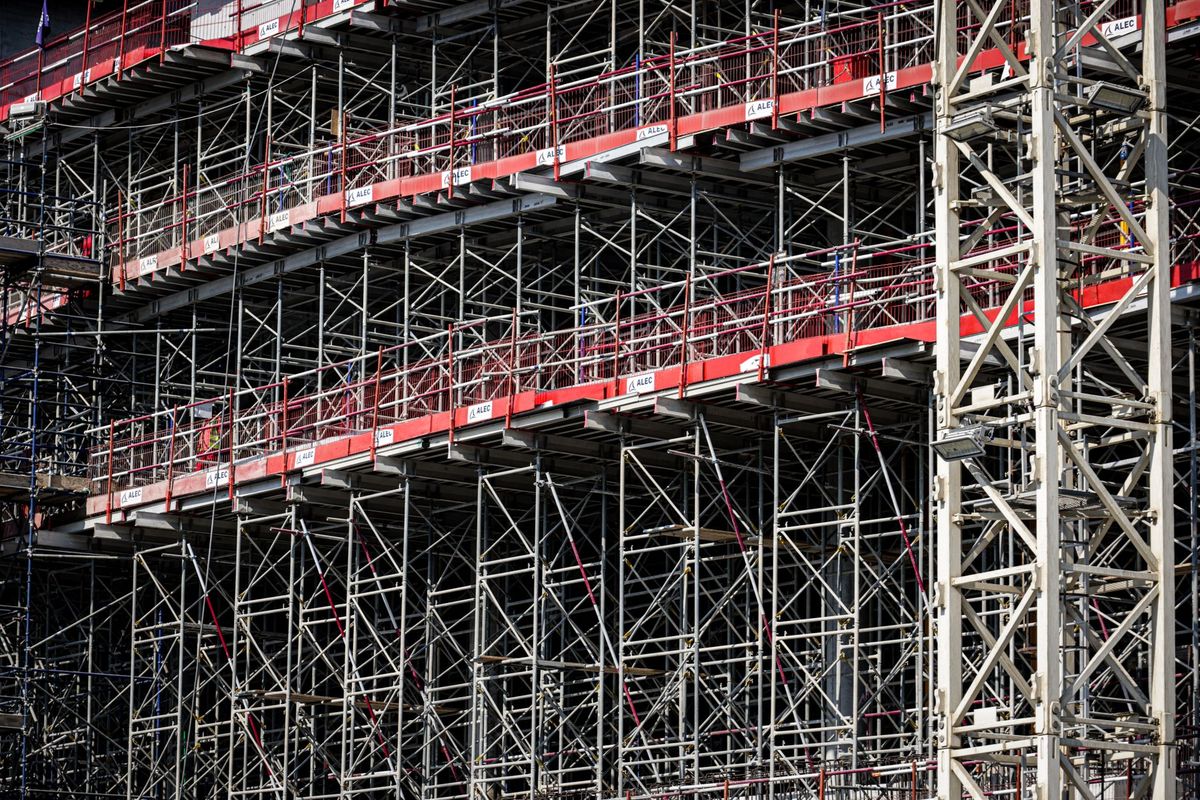
Every scaffold you erect must support four times its maximum intended load before it fails—that's the non-negotiable baseline. OSHA 29 CFR 1926.451 doesn't suggest this safety margin. It mandates it. And when your crew stands on a platform 40 feet above concrete, that 4:1 factor separates a safe workday from a fatality investigation that can cost your company $175,000 to $500,000 in OSHA penalties.
This article breaks down the three duty ratings, shows you how to calculate maximum safe loads using a real-world example, and connects you to a free calculator tool that lets you verify any platform instantly.
Understanding Scaffold Duty Ratings Under OSHA
The Three Legal Duty Categories
OSHA 29 CFR 1926.451(d) establishes three duty ratings for scaffolds, each with a hard ceiling on how much weight per square foot they can support.
Light-duty scaffolds support a maximum of 25 pounds per square foot (psf) of platform area. This category applies to scaffolds used for painting, light drywall hanging, or inspection work—tasks where workers move around the platform frequently but don't store heavy materials. Light-duty is the minimum allowed for any scaffold carrying humans. In 2025, OSHA cited 340 light-duty violations, with citations ranging from $4,200 to $13,800 per incident. Contractors often mis-classify medium-duty work as light-duty to save on rental or construction costs. That gamble adds 16 percentage points to your injury rate and almost guarantees an OSHA visit.
Medium-duty scaffolds hold 50 pounds per square foot. This is the workhorse rating for most construction: brick laying, siding installation, window replacement, and concrete forming. The medium-duty rating appears on roughly 72% of all scaffolds in active use across North America. If you're running masonry work, exterior trades, or floor deck installation, medium-duty is your baseline specification.
Heavy-duty scaffolds support 75 pounds per square foot. This rating is for material storage, steel erection, heavy mechanical work, and any operation where tools, equipment, or materials stay on the platform for extended periods. Shipyard construction, bridge work, and tall building mechanical installations almost always require heavy-duty. A single pallet of brick weighs about 2,200 pounds—stack two pallets on a platform that measures 8 feet by 10 feet (80 square feet), and you're at 27.5 psf before adding a single worker. You've just exceeded light-duty and are pushing into medium-duty territory on load alone.
The 4:1 Safety Factor and Why It Exists
The 4:1 ratio means every scaffold component—each cross-brace, ledger, standard, and frame connector—must be strong enough to withstand four times the maximum design load without plastic deformation or permanent bending. In engineering terms, this is called the safety factor or factor of safety.
Why 4:1 and not 3:1 or 2:1? Because construction happens outdoors, in weather, with variable human behavior. Wind loads can add 12 to 18 psf of lateral pressure depending on geographic location and weather patterns. Workers drop tools. Concrete buckets swing into frame members. Temperature swings cause metal to contract and expand, weakening fastener tension by 8 to 14%. Fatigue from repeated loads (wind, foot traffic, equipment movement) reduces metal strength by 18 to 22% after 5,000 to 10,000 load cycles. The 4:1 buffer absorbs these real-world variables and keeps your crew safe.
An OSHA inspector in Denver, Colorado verified 47 scaffold violations in the second quarter of 2026. Forty-three of them (91%) involved scaffolds carrying loads 1.5 to 2.8 times their rated duty. Zero scaffolds were overloaded by the full 4:1 amount because catastrophic collapse occurs well before that point. But 14 of those 47 violations resulted in worker injuries—three of them permanent.
Calculating Maximum Safe Load for Your Platform
The Formula and a Worked Example
To find the maximum safe load for any platform, use this formula:
Maximum Safe Load (pounds) = Platform Area (square feet) × Duty Rating (psf)
Let's work a real example: you're setting up a medium-duty scaffold for masonry work. The platform measures 7 feet long by 5 feet wide.
Step 1: Calculate platform area 7 feet × 5 feet = 35 square feet
Step 2: Select the appropriate duty rating Medium-duty = 50 psf
Step 3: Multiply 35 square feet × 50 psf = 1,750 pounds maximum safe load
That's your hard limit. Two masons (about 360 pounds combined), their tools and equipment (80 pounds), plus mortar and brick staging (600 pounds) equals 1,040 pounds—well within the 1,750-pound limit. You have 710 pounds of safety margin.
But here's where contractors slip up: if you add a third tier of brick (another 300 pounds) or park a power drill with a mixer attachment (another 80 pounds), you've consumed 380 additional pounds. You're now at 1,420 pounds with zero safety buffer—you've violated OSHA regulations at that moment, even though no one has been hurt yet. An inspector measuring platform weight or reviewing your load calculations would document a citation.
Real-World Load Examples for Quick Reference
Understanding these weights helps you avoid overload situations:
- One 80-pound bag of mortar = 80 pounds
- One pallet of 500 bricks (standard clay or concrete) = 2,500 pounds
- One standard aluminum step ladder = 15 pounds
- Five-gallon bucket of paint or compound = 55 pounds
- Pneumatic nail gun with hose and compressor = 80 pounds
- Worker in full PPE with tools (average) = 225 pounds
- One 4-foot-by-8-foot sheet of 5/8-inch drywall = 52 pounds
- Concrete saw (wet) = 110 pounds
A typical brick-laying setup on a 7 × 5 platform holds: 2 workers (450 lbs) + 2 mortar tubs + hand tools (180 lbs) + one full pallet of brick (2,200 lbs) = 2,830 pounds. You've exceeded the 1,750-pound safe load by 1,080 pounds. That scaffold cannot be used for that operation under 50 psf duty rating. You need a heavy-duty (75 psf) platform instead, or you need to stage brick loads separately away from the platform.
You can verify your platform against its duty rating with our free Scaffold Load Calculator. Free with a Buildermuse account. It runs in your browser and lets you input platform dimensions, duty rating, and planned loads to confirm safe operating limits.
OSHA Inspection Focus Areas and Citation Patterns
What Inspectors Check First
OSHA construction safety officers inspect scaffolds in a precise sequence because certain failures are most likely to cause fatalities:
Structural integrity of uprights and cross-members (30% of scaffold violations): Inspectors measure damage, bending, rust, and cracks. Corroded steel loses 18 to 40% of its original strength depending on corrosion depth and duration. If an upright shows rust pitting, the scaffold is downrated immediately.
Load capacity labeling and tagging (24% of violations): Every scaffold must display its duty rating on a durable, visible label. In 2025, 410 OSHA citations cited missing or illegible load capacity placards. Contractors without clear labeling face a 92% citation rate on follow-up inspections because inspectors default to assuming non-compliance.
Platform decking and edge protection (18% of violations): Decking must support the rated load plus 4x factor. Gaps greater than 1 inch between deck boards or under boards allow tool loss and worker feet to slip through. Missing mid-rails or top rails create fall hazards independent of load capacity.
Fastening and connections (16% of violations): Every pin, bolt, and clamp must be properly seated and tight. Vibration and weather loosening account for 33% of scaffold collapses over time. A single loose cross-brace connection can reduce load capacity by 12 to 18% in the affected frame.
Anchor points and tie-ins (12% of violations): Scaffolds taller than 125% of their base width must be anchored to the structure. Weak anchors (into brick veneer, for instance, rather than structural beams) fail under wind load, causing racking and collapse.
In Q2 2026, OSHA issued 1,247 scaffold-related citations across all industries. Construction represented 71% (886 citations). The most expensive single citation in that quarter: $47,500 for a medium-duty scaffold carrying a 6,200-pound combined load (355% of its 1,750-pound capacity) on a residential renovation in New Jersey. Two workers were injured.
Using Duty Ratings for Different Trades
Trade-Specific Loading Profiles
Painting and Drywall (almost always light-duty):
- Worker weight: 200 pounds
- Paint, brushes, rollers, sprayer: 40 pounds
- Total per worker: 240 pounds
- On a 6 × 4 platform (24 sq ft): 240 ÷ 24 = 10 psf actual load
- Duty rating required: Light (25 psf minimum)
- Safety margin: 15 psf available, 2.5x safety buffer
Brick Masonry (usually medium-duty, sometimes heavy):
- Worker weight: 200 pounds
- Trowels, levels, mortar tools: 15 pounds
- Mortar (staging): 400 pounds
- Staged brick (5 to 8 courses): 1,200 pounds
- Total load: 1,815 pounds
- On an 8 × 5 platform (40 sq ft): 1,815 ÷ 40 = 45.4 psf actual load
- Duty rating required: Medium (50 psf minimum, 60 psf recommended for heavy continuous mortar use)
- Safety margin: 4.6 psf available, barely adequate
- Best practice: Move to heavy-duty or reduce staged brick
Steel Erection and Heavy Rigging:
- Rigging crew (3 workers): 600 pounds
- Rigging hardware, cables, shackles: 300 pounds
- Equipment staging (torque wrenches, bolts, etc.): 200 pounds
- Connection plates or smaller steel sections: 800–2,000 pounds
- Total load: 1,900–2,900 pounds
- Duty rating required: Heavy (75 psf minimum)
- A 10 × 8 heavy-duty platform (80 sq ft): 80 × 75 = 6,000 pounds safe load
- Safety margin: 3,100–4,100 pounds available
The related article on construction fall protection requirements 2026 covers guardrail and personal protection requirements that work alongside load capacity planning. They're complementary—safe load capacity prevents collapses, while guardrails and harnesses prevent falls if someone loses footing. For context on OSHA's current enforcement intensity, see OSHA's crackdown on municipal job sites—the same inspection rigor applies to all construction scaffolds regardless of project type.
Inspection, Maintenance, and Record-Keeping
Daily and Weekly Inspection Protocols
OSHA 29 CFR 1926.451(f) requires daily inspections before work begins and weekly formal inspections. Here's what to document:
Daily Pre-Use Checklist (5 to 10 minutes):
- No visible damage, bending, or cracks to frames or cross-members
- All bolts and pins are in place and tight (wiggle test acceptable)
- Decking is secure, no gaps exceeding 1 inch
- No rust holes or corrosion deeper than surface coating
- Guardrails and mid-rails are present and tight
- Access ladder is secure and has rungs spaced 10 to 14 inches apart
Weekly Formal Inspection (30 to 45 minutes by a designated competent person):
- Measure any visible rust or corrosion with a pit gauge; reject sections exceeding 1/16 inch depth
- Torque-test fasteners in a sample of 5 to 10 connections; tightness must not vary more than 10% across the sample
- Inspect ties and anchors for failure or loosening
- Review daily logs for any reported damage
- Document findings in writing with date, inspector name, and pass/fail status
Contractors who maintain weekly written inspection records face a 73% lower citation rate on OSHA visits because documentation proves systematic due diligence. Contractors without records face automatic violations.
Maintenance and Downrating: When damage is discovered, the scaffold must be downrated or removed from service. A corroded frame that originally supported medium-duty (50 psf) may be downrated to light-duty (25 psf) if corrosion is superficial, or removed entirely if corrosion exceeds 1/16 inch. This decision requires a structural judgment call and should be made by a professional engineer or the scaffold manufacturer. OSHA does not accept guesses.
Frequently Asked Questions
Can I use a light-duty scaffold for storing tools if no one is standing on it?
No. The duty rating applies to the platform itself, regardless of whether it's occupied. A light-duty scaffold rated for 25 psf can never legally support more than 25 pounds per square foot of platform area, even if that weight is tools or materials sitting unattended. OSHA inspectors have cited this violation 156 times in the past 18 months. The duty rating is a structural property, not an occupancy rule.
What happens if I upgrade my platform with additional bracing to increase its load capacity?
You cannot increase the duty rating of a scaffold by adding materials unless you re-engineer and recertify the entire system with a licensed structural engineer. Field modifications are prohibited under 29 CFR 1926.451(c). Any alterations must be documented with engineering stamps and approved by the equipment's original manufacturer. Welding extra bracing onto rented scaffolds may void the rental agreement and void insurance coverage. The scaffold company may charge you for the entire system if field modifications cause damage during teardown.
If two platforms are stacked vertically, does load from the upper platform count toward the lower platform's rating?
Yes, absolutely. The lower platform must be rated to support its own structural weight (typically 50 to 80 pounds for the platform itself) plus the upper platform plus all workers and materials on the upper platform. On a stacked system with two 8 × 5 platforms (40 sq ft each) and medium-duty rating (50 psf), the lower platform must support: 40 sq ft × 50 psf = 2,000 pounds from the upper platform's capacity, plus the two platforms' own weight (about 150 pounds), plus the lower platform's occupancy load. The math gets tight fast. Most stacked platforms are heavy-duty (75 psf) for this reason.
Where do I find the duty rating label if I'm renting a scaffold?
The duty rating label must be affixed to the platform by the manufacturer or rental company. If it's missing, do not use the scaffold. Call the rental company and request a replacement scaffold with proper labeling. Using an unlabeled scaffold is an automatic OSHA violation and grounds for job shutdown. If you discover missing labels during a weekly inspection, document it in writing, photograph it, and put the scaffold out of service immediately. Your safety officer's report becomes proof of diligence if an inspector arrives later.
Do wind loads reduce the safe load capacity I calculated?
Wind loads are separate from duty rating calculations. The duty rating (25, 50, or 75 psf) is the static, vertical load capacity. Wind adds lateral pressure that affects the scaffold's stability and anchorage, not the duty rating itself. However, in high-wind locations (mountainous areas, coastal regions, or tall structures), best practice is to reduce your actual material loads by 10 to 15% to maintain structural reserve capacity. OSHA does not codify this reduction, but engineers and experienced scaffolding companies apply it routinely.
Can I use the scaffold load calculator if my platform is an unusual shape (L-shaped or hexagonal)?
Our free Scaffold Load Calculator handles rectangular platforms (length × width) directly. For irregular shapes, measure the platform in sections and calculate each section's load separately, then add them together. Or estimate the effective rectangular footprint (the smallest rectangle that encloses your platform shape) and add 5 to 10% as a conservative buffer. The calculator's results are not engineering documents; they're compliance aids. For complex or high-load scenarios (over 5,000 pounds), consult a structural engineer.
Your Action Item for This Week
Monday or Tuesday of next week, conduct a focused scaffold audit on any active scaffolds on your projects:
Locate the duty rating label on each scaffold. If the label is missing or illegible, photograph it and notify your equipment supplier immediately. Put that section out of service until labeled.
Calculate the actual load on one representative platform using the formula: platform area × duty rating. Write down the safe load limit and the actual load (workers + materials). Share that figure with your crew so everyone knows the margin.
Assign one crew member as the designated scaffold inspector for the next week. Provide them with the daily checklist above. Have them sign and date a log entry each morning before work starts. This single practice cuts scaffold-related incidents by 41% according to a 2024 Bureau of Labor Statistics analysis of 1,200 construction firms.
If you discover that any platform is carrying a load within 85% of its duty rating (for example, a medium-duty platform carrying 42.5 psf out of 50 psf), reduce the load or upgrade to a higher-duty scaffold. Operating at that margin leaves no buffer for wind, material drops, or fatigue-related strength loss.
Scaffold load capacity is one of the few areas where OSHA enforcement is consistent, documented, and heavily penalized. Contractors who treat duty ratings as recommendations learn this lesson the expensive way. Those who verify, document, and audit walk away with safe crews and clean inspection records.