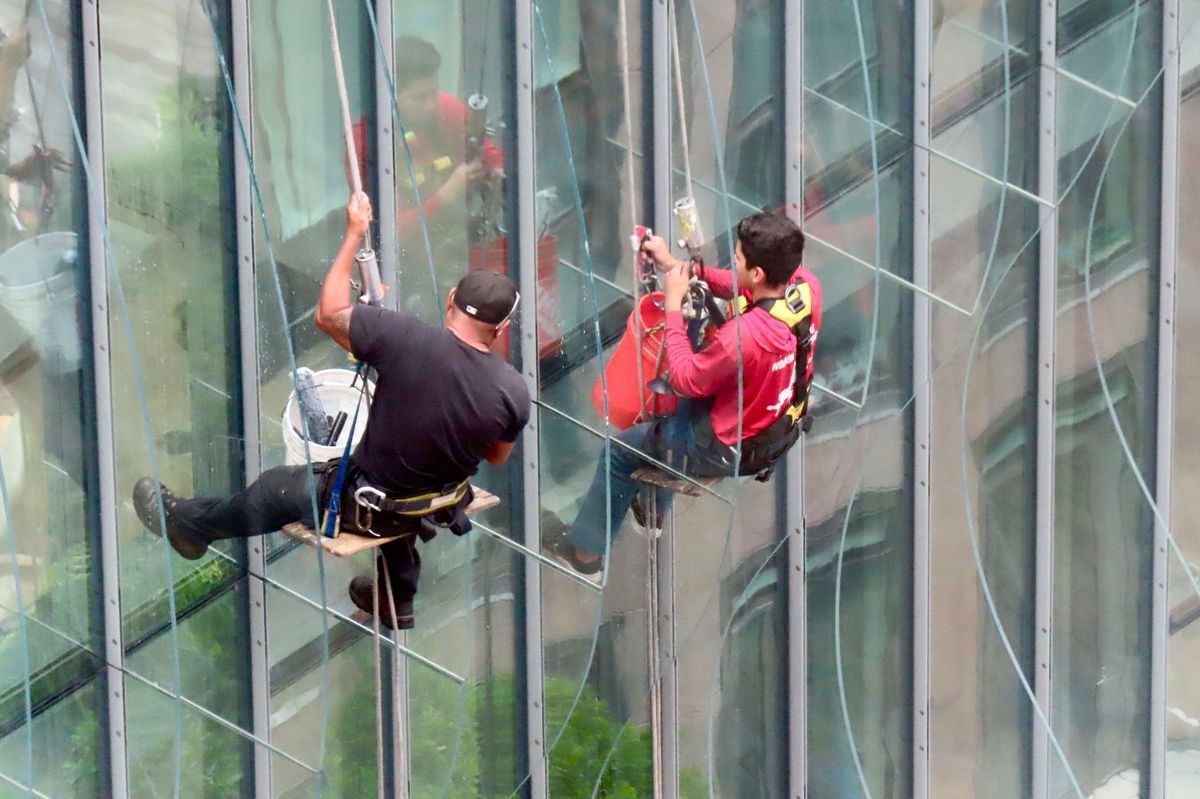
Photo by Anamul Rezwan
Fall protection is still the standard federal OSHA cites more than any other. In the final fiscal year 2025 numbers (October 1, 2024 through September 30, 2025), 29 CFR 1926.501 drew 6,992 violations, as reported by the National Safety Council's Safety+Health magazine on April 29, 2026. Fall protection training (1926.503) was on the same list with 2,216 violations, and scaffolding (1926.451) and construction ladders (1926.1053) were close behind. OSHA's preliminary list for fiscal 2026, covering October 1, 2025 to August 31, 2026 and updated on osha.gov on October 5, 2026, again puts 1926.501 in the No. 1 spot, with scaffolding fourth, ladders fifth and fall protection training eighth.
None of that is new, which is the point. The rules in Subpart M of 29 CFR Part 1926 have not changed in years. What gets contractors cited is not a surprise regulation but the gap between what the standard says and what actually happens on the deck. This article walks through the requirements as written in the current eCFR text (Title 29, current as of October 2026), what the numbers in the standard actually are, and where crews tend to fall short.
For the full citation rankings and how other standards stacked up, see our breakdown of OSHA's top 10 construction citations for 2026.
The 6-Foot Rule and Where It Applies
The core trigger is in 29 CFR 1926.501(b)(1): "Each employee on a walking/working surface (horizontal and vertical surface) with an unprotected side or edge which is 6 feet (1.8 m) or more above a lower level shall be protected from falling by the use of guardrail systems, safety net systems, or personal fall arrest systems."
Two things trip people up.
First, the measurement is to the lower level the worker could fall to, not the height of the building. OSHA's definition of "lower levels" in 1926.500 is broad: ground, floors, platforms, ramps, excavations, pits, tanks, material, water, equipment and structures all count. A worker on a mezzanine 7 feet above a slab is covered even if the building is one story.
Second, the 6-foot trigger is not limited to roof edges. Section 1926.501(b) repeats it for a long list of situations:
- Leading edges under construction, (b)(2)
- Hoist areas, (b)(3)
- Holes, including skylights, more than 6 feet above lower levels, (b)(4)
- Faces of formwork and reinforcing steel, (b)(5)
- Ramps, runways and walkways, (b)(6)
- Edges of excavations 6 feet or deeper that are not readily seen, and wells, pits and shafts, (b)(7)
- Work 6 feet or more above dangerous equipment, (b)(8). Below 6 feet, guardrails or equipment guards are still required to keep a worker from falling into the equipment.
- Overhand bricklaying, (b)(9)
- Low-slope and steep roofs, (b)(10) and (b)(11)
- Precast concrete erection, (b)(12)
- Residential construction, (b)(13)
- Wall openings where the outside bottom edge is 6 feet or more above lower levels and the inside bottom edge is less than 39 inches above the walking surface, (b)(14)
- A catch-all for any other walking/working surface 6 feet or more above lower levels, (b)(15)
Residential work gets no separate height. Section 1926.501(b)(13) says each employee in residential construction 6 feet or more above lower levels "shall be protected by guardrail systems, safety net system, or personal fall arrest system," unless the employer can show those systems are infeasible or create a greater hazard, in which case a written fall protection plan under 1926.502(k) is required. The regulation also states plainly that there is "a presumption that it is feasible" to use at least one conventional system. The burden is on the employer.
Height Triggers Outside Subpart M
Some work is governed by other subparts with different numbers. These are the ones that come up most on mixed sites, quoted from the current eCFR.
Scaffolds. Under 1926.451(g)(1), "each employee on a scaffold more than 10 feet (3.1 m) above a lower level shall be protected from falling to that lower level." Separately, 1926.451(b)(3) says the front edge of a platform shall not be more than 14 inches from the face of the work unless guardrails or personal fall arrest are used (3 inches for outrigger scaffolds, 18 inches for plastering and lathing). Scaffold capacity and planking rules are covered in our article on scaffold load capacity and OSHA duty ratings.
Steel erection. Subpart R uses a 15-foot trigger. Section 1926.760(a)(1) requires protection for steel erection employees on a surface with an unprotected side or edge "more than 15 feet (4.6 m) above a lower level." Connectors must be protected from fall hazards of more than two stories or 30 feet, whichever is less, and between 15 and 30 feet must be provided with a personal fall arrest, positioning or restraint system and wear the equipment needed to tie off, per 1926.760(b). Controlled decking zones are limited to 90 feet wide by 90 feet deep and no more than 3,000 square feet of unsecured decking, per 1926.760(c).
Aerial lifts. Section 1926.453(b)(2)(v) says "a body belt shall be worn and a lanyard attached to the boom or basket when working from an aerial lift." The note to that paragraph points out that since January 1, 1998, body belts are not acceptable in a personal fall arrest system; a body belt is allowed only in a tethering or restraint system. Paragraph (b)(2)(iii) separately bans "belting off to an adjacent pole, structure, or equipment while working from an aerial lift."
Fixed ladders. Under 1926.1053(a)(19), where the total length of climb equals or exceeds 24 feet, fixed ladders must have a ladder safety device, a self-retracting lifeline with rest platforms at intervals of no more than 150 feet, or a cage or well with ladder sections no longer than 50 feet each.
Guardrail Systems: The Numbers in 1926.502(b)
Guardrails are the simplest protection to audit, which is why inspectors measure them.
- Top edge height: 42 inches plus or minus 3 inches above the walking/working level, per 1926.502(b)(1).
- Midrails, when used: installed "midway between the top edge of the guardrail system and the walking/working level," per (b)(2)(i). Screens and mesh must run from the top rail to the walking level; intermediate members such as balusters can be no more than 19 inches apart.
- Top rail strength: withstand at least 200 pounds applied within 2 inches of the top edge in any outward or downward direction, per (b)(3).
- Midrail and screen strength: at least 150 pounds in any downward or outward direction, per (b)(5).
- Rails must be at least one-quarter inch nominal diameter or thickness, and wire rope used for top rails must be flagged with high-visibility material at no more than 6-foot intervals, per (b)(9).
Field-built 2x4 rail is legal, and Appendix B to Subpart M gives lumber sizes that OSHA deems to meet the strength criteria. When a field-built system departs from those sizes or spacings, someone needs to be able to show it still meets the 200-pound and 150-pound loads.
Personal Fall Arrest Systems: 1926.502(d)
A personal fall arrest system is the anchorage, connectors and body harness together, and the standard sets performance numbers for each piece.
- Anchorages must be "capable of supporting at least 5,000 pounds (22.2 kN) per employee attached," or be designed, installed and used as part of a complete system that maintains a safety factor of at least two, under the supervision of a qualified person, per (d)(15).
- Lanyards and vertical lifelines need a minimum breaking strength of 5,000 pounds, per (d)(9).
- Horizontal lifelines must be designed, installed and used under the supervision of a qualified person with a safety factor of at least two, per (d)(8).
- Self-retracting lifelines and lanyards that limit free fall to 2 feet or less must sustain a 3,000-pound tensile load, per (d)(12).
- When stopping a fall, the system must limit arresting force to 1,800 pounds with a body harness, keep free fall to no more than 6 feet with no contact with a lower level, and limit deceleration distance to 3.5 feet, per (d)(16).
The anchor is where many setups fail an inspection. A connector screwed into sheathing is not automatically a 5,000-pound anchorage. Use anchors with a documented rating from the manufacturer, install them per the instructions, and keep the documentation on site.
Two inspection rules are worth knowing word for word. Section 1926.502(d)(21) says personal fall arrest systems "shall be inspected prior to each use for wear, damage and other deterioration, and defective components shall be removed from service." And (d)(19) says systems and components "subjected to impact loading shall be immediately removed from service and shall not be used again for employee protection until inspected and determined by a competent person to be undamaged and suitable for reuse." A shock-absorbing lanyard with a deployed pack belongs in the trash, not back in the gang box.
Paragraph (d)(20) is the one many site safety plans skip: "The employer shall provide for prompt rescue of employees in the event of a fall or shall assure that employees are able to rescue themselves." A harness that catches a worker and leaves him hanging with no rescue plan does not meet the standard.
Our fall protection calculator helps work out clearance below the anchor before a crew ties off.
Safety Nets and Hole Covers
Safety nets are less common on light commercial and residential work but are spelled out in 1926.502(c). Nets must be installed "as close as practicable under the walking/working surface on which employees are working, but in no case more than 30 feet (9.1 m) below such level." Under (c)(4)(i), nets must be drop-tested at the jobsite after initial installation and before use, whenever relocated, after major repair, and at 6-month intervals if left in place. The test is a 400-pound bag of sand 30 inches (plus or minus 2) in diameter.
Hole covers, under 1926.502(i), are a chronic citation source because they are so easy to get wrong:
- Covers in roadways and vehicle aisles must support at least twice the maximum axle load of the largest vehicle expected to cross.
- All other covers must support at least twice the weight of employees, equipment and materials that may be on them at one time.
- All covers must be secured to prevent displacement by wind, equipment or employees.
- All covers must be color coded or marked "HOLE" or "COVER."
An unmarked, unsecured scrap of plywood over a floor opening misses three of those four.
Written Fall Protection Plans Under 1926.502(k)
A fall protection plan is not a general alternative to guardrails and harnesses. Section 1926.502(k) says the option "is available only to employees engaged in leading edge work, precast concrete erection work, or residential construction work" who can show conventional protection is infeasible or creates a greater hazard. When it applies, the plan must:
- Be prepared by a qualified person and developed specifically for the site, and kept up to date. Changes must be approved by a qualified person.
- Be kept at the job site with all approved changes.
- Be implemented under the supervision of a competent person.
- Document why conventional systems are infeasible or more hazardous.
- Discuss other measures to reduce the hazard, including whether scaffolds, ladders or vehicle-mounted platforms can be used.
- Identify each location where conventional protection cannot be used. Those locations become controlled access zones.
- Use a safety monitoring system where no other alternative measure has been implemented.
- Name or otherwise identify each employee designated to work in controlled access zones.
- Be reviewed after any fall or serious incident, including a near miss.
A generic company template that does not name locations and workers does not meet (k).
Training Requirements: 1926.503
Fall protection training was the eighth most-cited standard on OSHA's preliminary fiscal 2026 list, and the citations are usually about paperwork as much as content.
Section 1926.503(a) requires a training program "for each employee who might be exposed to fall hazards," delivered by a competent person, covering the nature of fall hazards in the work area; correct procedures for erecting, maintaining, disassembling and inspecting the systems in use; the use and operation of guardrails, personal fall arrest, safety nets, warning lines, safety monitoring systems and controlled access zones; the role of each employee in a safety monitoring system and in fall protection plans; limits on mechanical equipment during low-slope roofing; handling and storage of materials and erection of overhead protection; and the standards in Subpart M.
Under 1926.503(b), the employer verifies the training with a written certification record containing the employee's name or other identity, the date or dates of training, and the signature of the trainer or the employer. Only the latest certification has to be kept.
There is no fixed annual retraining requirement in 1926.503. Instead, (c) requires retraining when the employer has reason to believe a worker lacks the needed understanding or skill, including when workplace changes or new fall protection equipment make previous training obsolete, or when a worker's knowledge or use of the equipment shows they have not retained it. Toolbox talks can count toward this if they are documented with the elements above.
Penalties in 2026
OSHA's penalties page lists the maximum amounts that may be assessed after January 15, 2026: $16,550 per serious or other-than-serious violation, $16,550 per day beyond the abatement date for failure to abate, and $165,514 per willful or repeated violation. State Plan states must adopt maximums at least as effective as federal OSHA's.
Each unprotected exposure can be cited separately, so a crew with several workers on an unguarded edge can produce more than one line item. OSHA can also adjust penalties based on employer size, good faith and history under its Field Operations Manual; the specific reductions depend on the case.
OSHA also runs a National Emphasis Program on falls, CPL 03-00-025, dated May 1, 2023 on OSHA's list of national emphasis programs. It directs inspectors to open inspections when they see work at height without fall protection, which is one reason roofing and framing crews get inspected without a complaint or accident.
What Inspectors Keep Finding
Based on what the standard requires and where the most-cited paragraphs sit, these are the field conditions that line up with citations:
- Roofers working steep or low-slope roofs during setup before any system is in place, contrary to 1926.501(b)(10) and (b)(11).
- Leading-edge decking and sheathing with no guardrail, net or arrest system and no site-specific (k) plan.
- Floor and roof holes covered with loose, unmarked material.
- Harnesses tied to anchors with no documented rating.
- Scaffold platforms over 10 feet with missing rails, and gaps to the work face over 14 inches.
- Training records missing the date, the trainee's identity or the trainer's signature.
None of these require new equipment so much as a competent person who walks the deck before work starts.
Frequently Asked Questions
What height requires fall protection in construction?
Six feet above a lower level for most construction work under 29 CFR 1926.501(b). Scaffolds use a "more than 10 feet" trigger under 1926.451(g)(1), and steel erection uses "more than 15 feet" under 1926.760(a)(1), with connectors protected above two stories or 30 feet.
Does the 6-foot rule apply to residential construction?
Yes. Section 1926.501(b)(13) requires guardrails, safety nets or personal fall arrest for residential construction work 6 feet or more above lower levels. An employer that can show those are infeasible or create a greater hazard must use a written, site-specific fall protection plan under 1926.502(k). The regulation presumes conventional protection is feasible.
Can a worker sign a waiver refusing fall protection?
No. The duty in 1926.501 is the employer's. If a worker refuses to use required protection, the employer must keep that worker out of the exposure. A signed refusal does not shield the employer from a citation.
What is the difference between fall arrest and fall restraint?
A personal fall arrest system stops a fall that has started, and 1926.502(d) sets the 5,000-pound anchorage, 1,800-pound arresting force and 6-foot free fall limits. A restraint system keeps the worker from reaching the edge at all. Fall restraint is listed as an accepted method in the steel erection rule at 1926.760, and the note to the aerial lift rule at 1926.453(b)(2)(v) says a body belt is acceptable in a tethering or restraint system, though not in a personal fall arrest system.
How often do harnesses need to be inspected or replaced?
OSHA requires inspection before each use under 1926.502(d)(21) and removal from service of any component that has taken a fall until a competent person determines it is undamaged, under (d)(19). Subpart M does not set a fixed replacement age; follow the manufacturer's service-life instructions and retire anything with damaged webbing, stitching or hardware.
What are the maximum OSHA penalties for fall protection violations in 2026?
After January 15, 2026, OSHA's maximums are $16,550 per serious violation and $165,514 per willful or repeated violation, with failure to abate at $16,550 per day, according to OSHA's penalties page.