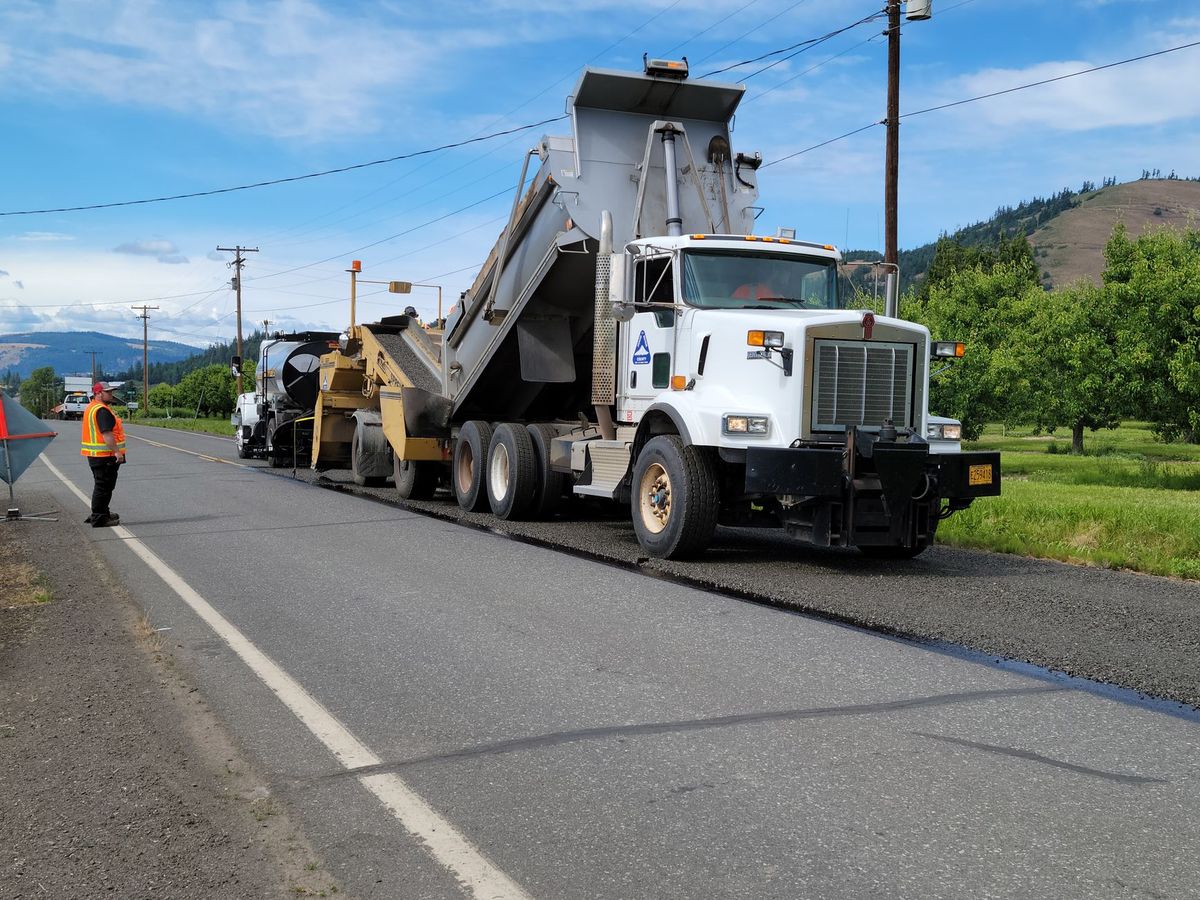
A 5% error in an asphalt tonnage estimate on a routine 40,000-square-foot commercial parking lot is 18 tons of hot mix — roughly $2,000-$2,300 at 2026 prices, or one fully loaded truck you either paid for and didn't need or didn't order and had to wait on while the paver sat idle at $400-$600 per hour of crew time. Asphalt tonnage math is not complicated, but it is unforgiving, because hot-mix asphalt is manufactured to order, delivered at 275-325°F, and unusable within hours. This guide covers the standard formula, worked examples at real project scales, the compaction and waste adjustments that separate accurate estimates from short loads, and where hot-mix pricing sits in 2026.
If you want the answer without the arithmetic, our free asphalt tonnage calculator runs this entire computation — dimensions, density, compaction, and waste — in about ten seconds. The rest of this article explains what the calculator is doing and why each input matters.
The Asphalt Tonnage Formula: L × W × D × 145 ÷ 2,000
The industry-standard calculation converts the volume of your paved area into weight using the unit density of compacted hot-mix asphalt:
Tons = Length (ft) × Width (ft) × Depth (ft) × 145 lbs/CF ÷ 2,000
Four notes on the inputs, because each one is a common failure point:
- Depth must be in feet, not inches. A 3-inch lift is 0.25 feet. Forgetting this conversion — entering 3 instead of 0.25 — produces an estimate 12 times too high, an error that has genuinely appeared in submitted bids.
- 145 lbs per cubic foot is the standard density for compacted hot-mix asphalt. Actual mix designs range from roughly 140 to 148 lbs/CF depending on aggregate specific gravity and binder content; your plant's mix design sheet states the exact value, typically expressed as maximum theoretical density (Gmm). For estimating, 145 is the accepted default across NAPA guidance and most state DOT tabulations.
- The formula yields compacted, in-place tonnage — which is what you pay the plant for, since delivered tonnage compacts into place. The compaction factor section below explains the distinction that trips people up.
- A useful cross-check: one ton of hot mix covers approximately 13.8 square feet at 12 inches thick — or, in the form estimators actually use, about 110 lbs per square yard per inch of depth (the "SY-inch" rule that appears in most state DOT specifications, e.g., 112 lbs/SY-inch in several Southeastern DOT standard specs).
Quick reference: tons per 1,000 square feet
At 145 lbs/CF, every 1,000 SF of pavement requires:
- 1.5-inch lift: 9.1 tons
- 2-inch lift: 12.1 tons
- 3-inch lift: 18.1 tons
- 4-inch lift: 24.2 tons
- 6-inch lift (full-depth, two lifts): 36.3 tons
Memorize the 2-inch number — 12 tons per 1,000 SF — and you can sanity-check any bid tabulation in your head.
Worked Examples at Three Project Scales
Formulas are abstract; loads of asphalt are not. Here are three complete calculations, including the waste allowance covered in the next section.
Example 1: Residential driveway, 60 ft × 12 ft, 3 inches
- Volume: 60 × 12 × 0.25 = 180 CF
- Weight: 180 × 145 = 26,100 lbs
- Tons: 26,100 ÷ 2,000 = 13.05 tons
- With 8% waste (small job, hand work at edges): 13.05 × 1.08 = 14.1 tons ordered
At 2026 pricing of $90-$130/ton, that is $1,270-$1,835 in material — before trucking minimums, which matter at this scale because plants commonly impose 3-5 ton minimums or small-load surcharges of $150-$400.
Example 2: Commercial parking lot, 200 ft × 180 ft, 2-inch surface over 3-inch binder
- Area: 200 × 180 = 36,000 SF
- Binder lift: 36,000 × 0.25 × 145 ÷ 2,000 = 652.5 tons
- Surface lift: 36,000 × 0.167 × 145 ÷ 2,000 = 435.8 tons
- Subtotal: 1,088.3 tons; with 5% waste: 1,142.7 tons ordered
At $105/ton blended, material alone is roughly $120,000. Note the two lifts are calculated separately because binder and surface mixes are different products at different prices — binder courses with larger aggregate typically run $5-$12/ton cheaper than fine-graded surface mixes.
Example 3: Municipal street overlay, 0.5 mile × 24 ft, 1.5-inch mill-and-fill
- Area: 2,640 × 24 = 63,360 SF (7,040 SY)
- By the SY-inch rule: 7,040 SY × 1.5 in × 110 lbs = 1,161,600 lbs = 580.8 tons
- By the CF formula: 63,360 × 0.125 × 145 ÷ 2,000 = 574.2 tons — the two methods agree within 1.2%, which is the expected tolerance between the 110 lbs/SY-inch approximation and the 145 lbs/CF density
- With 4% waste (long uniform pulls, minimal handwork): 604 tons ordered
For any of these, entering the dimensions into the asphalt calculator reproduces the math and lets you flex depth and waste assumptions instantly — useful when a client asks what dropping from 3 inches to 2.5 inches saves (answer: 16.7% of tonnage, always).
Compaction Factor and Waste: The Two Adjustments That Prevent Short Loads
The base formula gets you within 5% on paper. These two adjustments close the gap between paper and the plant ticket.
Compaction: loose asphalt is about 20-25% thicker than finished pavement
Hot mix leaves the paver screed in a loose condition and is compacted by rolling to its specified density — typically 92-96% of maximum theoretical density under state DOT specs, verified by nuclear gauge or cores. The operational rule: loose lift thickness ≈ 1.20-1.25 × compacted thickness. To finish at 2 inches compacted, the paver spreads roughly 2.5 inches loose.
Here is the critical point for tonnage: if you calculated from the specified compacted depth using 145 lbs/CF, compaction is already accounted for — that density describes finished pavement. You do not multiply your tonnage by 1.25; that error inflates orders by a quarter. The 1.25 factor matters for field operations (screed settings, yield checks during paving), not for the purchase quantity. Where estimators legitimately add tonnage is when the base is irregular: paving over a milled or unprimed surface with ±0.5 inch of variation consumes real material filling the low spots, commonly 3-8% of theoretical tonnage on overlay work. FHWA and state DOT overlay guidance treats this as "yield loss," and experienced crews track yield hourly — comparing tons placed against square yards covered — to catch it before the last truck.
Waste: 4-10% depending on job geometry
Waste covers handwork around structures, transitions, irregular edges, truck-bed and paver cleanout, and material that cools below workable temperature (roughly 185-220°F minimum for compaction, per mix type). Standard allowances:
- Large, uniform areas (highway pulls, big lots): 3-5%
- Typical commercial work with islands, curbs, and structures: 5-7%
- Small or complex jobs (driveways, patching, courtyards with many edges): 8-10%
Under-ordering is the more expensive mistake. A short load means a second delivery at minimum-load pricing, a cold joint where the fresh mat meets material that sat too long, and an idle crew — a 20-ton shortfall on a lot job can cost $2,500-$4,000 all-in against the $2,200 the extra tonnage would have cost in the original order.
Hot-Mix Asphalt Pricing in 2026: $90-$130 Per Ton
Hot-mix asphalt is selling for $90-$130 per ton at the plant across most U.S. markets in mid-2026, with metro-area surface mixes at the top of the range and high-volume base mixes at the bottom. Three structural facts explain the number and its direction:
| Cost Component | Share of HMA Cost | 2026 Condition |
|---|---|---|
| Liquid asphalt binder (PG grades) | 25-35% | $600-$750/ton binder; tracks crude oil with a lag, flat-to-up in 2026 |
| Aggregate | 30-40% | Up 5-8% year over year; quarry capacity tight in Sun Belt metros |
| Plant energy (burner fuel, electricity) | 10-15% | Natural gas moderated from 2022-23 peaks but above pre-2020 baseline |
| Trucking and delivery | Separate line | $110-$160/hour per truck; often 10-20% of installed cost |
Delivered and installed, commercial paving in 2026 typically prices at $3.50-$7.00 per square foot for a standard 4-5 inch full-depth section, and $1.75-$3.25/SF for a 1.5-2 inch overlay — figures consistent with the tonnage math above once labor, equipment, and mobilization are loaded in. Our detailed breakdown of asphalt paving cost per square foot covers the installed-price side, including regional spreads and the mobilization minimums that dominate small-job pricing.
Two market notes worth building into 2026-27 bids. First, most state DOTs and many private contracts include asphalt price-adjustment clauses indexed to a monthly binder price; on multi-month projects, confirm whether your contract carries one, because an unhedged 15% binder move on a 10,000-ton job is a six-figure exposure. Second, public-sector paving demand remains elevated as IIJA-funded resurfacing programs continue through the law's authorization window — the volume backdrop we track in our IIJA infrastructure funding status tracker — which has kept plant schedules full and spot pricing firm in most regions. Recycled content is the partial offset: mixes with 20-30% RAP (reclaimed asphalt pavement), now permitted in surface courses by the majority of state DOTs, typically price $4-$9/ton below virgin mixes at equivalent performance grades.
From Tonnage to Purchase Order: A Five-Step Checklist
Tonnage math feeds a procurement decision. The estimators who never get burned follow the same sequence:
- Calculate compacted tonnage per lift using L × W × D × 145 ÷ 2,000, keeping binder and surface courses separate. Verify with the asphalt calculator.
- Confirm the density with your plant's mix design. If the job specifies a mix with Gmm implying 148 lbs/CF, a 1,000-ton estimate at 145 is 20 tons light.
- Apply waste by geometry: 3-5% uniform, 5-7% typical commercial, 8-10% complex. Add 3-8% yield allowance on overlays with irregular existing surfaces.
- Check truck logistics against tonnage. At 20-22 tons per truck and a 30-45 minute round trip, a 1,100-ton day needs 50+ loads; match trucking to paver speed so mix arrives above compaction temperature.
- Lock pricing and the adjustment clause. Get plant quotes valid through your paving window, confirm small-load surcharges, and identify whether binder escalation is your risk or the owner's.
Frequently Asked Questions
How do I calculate asphalt tonnage from square feet?
Multiply square feet by depth in feet, then by 145 lbs per cubic foot, and divide by 2,000. Example: 10,000 SF at 3 inches (0.25 ft) = 10,000 × 0.25 × 145 ÷ 2,000 = 181.3 tons compacted. Add 4-10% waste depending on job complexity. Our free asphalt calculator at /tools/asphalt-calculator/ automates the full computation.
How many tons of asphalt are in a truckload?
A standard tandem dump truck carries 13-16 tons of hot mix; tri-axles and quad-axles carry 18-22 tons; live-bottom trailers carry 22-25 tons. At 2026 trucking rates of $110-$160 per hour, haul distance from the plant is a meaningful cost line — jobs beyond 25-30 miles from a plant pay a visible premium.
How much area does one ton of asphalt cover?
At 2 inches compacted, one ton covers approximately 82.8 square feet; at 3 inches, about 55.2 SF; at 4 inches, about 41.4 SF. The general relation: coverage (SF) = 2,000 ÷ (145 × depth in feet).
Do I multiply tonnage by a compaction factor?
No — not if you calculated from the specified compacted thickness at 145 lbs/CF, which already describes finished, rolled pavement. The 1.20-1.25 loose-to-compacted ratio governs screed settings during paving, not purchase quantity. Do add a 3-8% yield allowance when overlaying irregular or milled surfaces, since low spots absorb extra material.
What does hot-mix asphalt cost per ton in 2026?
$90-$130 per ton at the plant in most U.S. markets, with binder courses at the low end and polymer-modified or fine surface mixes at the high end. Delivery adds $110-$160 per truck-hour, and small loads under 3-5 tons commonly carry surcharges of $150-$400. Mixes with 20-30% RAP run $4-$9/ton below virgin equivalents.
What depth of asphalt do I need?
Typical sections: residential driveways 2-3 inches over 4-6 inches of compacted aggregate base; commercial parking lots 3 inches (car areas) to 4-6 inches (truck lanes and dumpster pads); municipal streets 4-7 inches full depth per the agency's standard details. Depth is a structural design decision — under-building truck areas by an inch saves 12 tons per 1,000 SF today and buys alligator cracking within 3-5 years.
Your Action Item for This Week
Take one paving project you have in estimating right now and run the tonnage twice: once with the standard formula at 145 lbs/CF, and once with the actual density from your plant's mix design sheet, with waste set to match the job's edge complexity. If the two numbers differ by more than 3%, your default density assumption is costing or risking money on every bid — update your template. Then bookmark the asphalt calculator and make it the first stop on every takeoff before a single truck is scheduled.