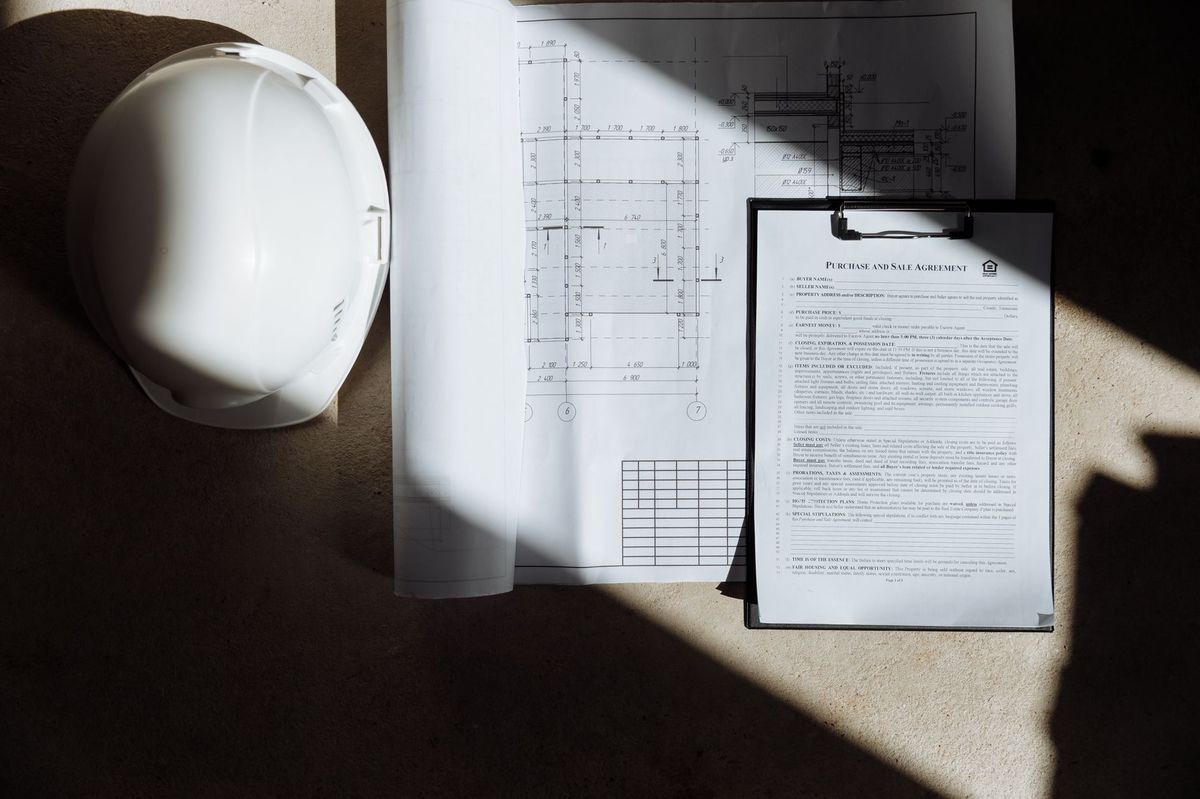
The first federal solicitation I ever opened was 347 pages, and I read all of it. That was roughly 14 hours of my life, and I lost the bid anyway — to an incumbent who, I later learned from the award data on USAspending, had held that installation's paving work for nine straight years. The 347 pages contained maybe four that would have told me to walk away, and I could have found them in 20 minutes.
That expensive lesson turned into a system. My shop now screens 8 to 12 federal solicitations a week, spends about 20 minutes on each, and full-estimates maybe one in ten. Our hit rate on the ones we actually bid went from 1-for-11 in year one to roughly 1-for-4 now — not because our numbers got sharper, but because we stopped estimating jobs we were never going to win. When a full takeoff and proposal costs $3,000 to $15,000 in estimating labor, the go/no-go decision is the highest-margin 20 minutes in the company.
Here's the exact reading order, what each section actually tells you, and the red flags that end the meeting early. Learning how to read a federal construction solicitation isn't about reading more — it's about knowing which 15 pages out of 300 decide everything.
The Anatomy: What You're Actually Holding
Federal construction solicitations come in two main flavors, and the cover page tells you which within five seconds.
Sealed Bid (IFB) vs. Negotiated (RFP)
If it's an Invitation for Bids (IFB) under FAR Part 14, it's sealed bidding: lowest responsive, responsible bidder wins, period. No negotiations, no technical proposal beauty contest — your number either wins or it doesn't. If it's a Request for Proposals (RFP) under FAR Part 15, the government can evaluate technical approach, past performance, and price together, and can negotiate. IFBs reward tight estimating; RFPs reward proposal writing plus estimating, and a good RFP response can eat 100+ hours where an IFB bid might take 30.
Most construction solicitations arrive on Standard Form 1442 (Solicitation, Offer, and Award — Construction), and the document follows the Uniform Contract Format. You don't read it front to back. You read it in this order:
- The SF1442 cover page — NAICS code, set-aside status, response deadline, magnitude. Two minutes, and it kills 40% of solicitations by itself.
- Section 00 22 / L-equivalent (Instructions to Offerors) — what you must submit and how you'll be judged.
- Section 00 12 / M-equivalent (Evaluation) — LPTA or best value. Changes your whole bid strategy.
- The Statement of Work and drawings index — scope reality check, not a full takeoff.
- The wage determination and bonding clauses — your labor cost floor and your surety conversation.
Everything else — the 200 pages of FAR clauses incorporated by reference, the safety plan boilerplate, the submittal register — matters at execution, not at go/no-go.
Where These Documents Live
Every federal solicitation over $25,000 posts to SAM.gov's Contract Opportunities. If you haven't registered yet, that's a separate 2-to-6-week project — I wrote the full walkthrough in my SAM.gov registration guide for contractors — and you can't submit an offer without an active registration under FAR 4.1102. For the screening itself, I do my first pass on Buildermuse's free live bid board, which tracks about 1,900 open federal construction solicitations and lets me filter to my state — Texas, in my case — before I ever open a 300-page PDF.
Minute 0 to 5: The Three Kill Switches
The first five minutes answer one question: am I legally and practically allowed to win this? Three data points, all on or near the cover page.
Kill Switch #1: NAICS Code and Size Standard
Every solicitation carries exactly one NAICS code, and that code carries an SBA size standard. Building construction codes (236220) and heavy civil (237310) sit at $45 million in average annual receipts; specialty trade codes (238xxx) sit at $19 million. If the job is set aside for small business and your five-year average receipts are over the standard, you're done — close the PDF. If you're under it, you just confirmed you can compete in a pool that excludes the $500 million ENR-list primes. That's the good kind of kill switch.
Check the code itself for sanity, too. A roofing job solicited under 236220 instead of 238160 changes who your competition is — that's a $45M pool instead of a $19M pool, and it's also grounds for a size-standard question during the Q&A window if it smells wrong.
Kill Switch #2: Set-Aside Status
The set-aside field tells you who's allowed to bid:
- Total Small Business — any firm under the size standard. Biggest pool, typically 5 to 15 bidders on construction.
- 8(a) — SBA's program for disadvantaged firms; sole-source possible up to $4.5 million for construction. If you're not certified, you're out.
- SDVOSB (service-disabled veteran-owned) — the VA in particular is required by its Vets First rule to prioritize these; government-wide the statutory goal is now 5% of contract dollars.
- WOSB/EDWOSB — women-owned, limited to designated NAICS codes.
- HUBZone — firms in historically underutilized business zones; carries a 10% price evaluation preference in full-and-open competitions.
- Unrestricted / full and open — everyone, including the giants. As a small firm, I bid these only when the job is under about $2 million, because below that the big primes' overhead structures usually can't chase it profitably.
One certification you hold that matches the set-aside can cut the bidder pool from 12 to 4. That alone can double your win probability before you sharpen a pencil.
Kill Switch #3: The Magnitude Range
FAR 36.204 prohibits the government from telling you the exact budget, but it requires them to state a construction magnitude range: "between $1,000,000 and $5,000,000," "between $5,000,000 and $10,000,000," and so on up to "more than $500 million." This is your bonding reality check. If the magnitude is $5M to $10M and your surety has you programmed at $3M single / $8M aggregate, you're not bidding this job — you're calling your bond agent about where your program needs to be next year.
The magnitude also frames competition. In my experience, the $1M–$5M band is the sweet spot for small federal contractors: big enough to matter, small enough that the mega-primes ignore it. Under $1M draws crowds of 15+ bidders and razor margins; I've seen sub-$500K jobs go 22 deep with a winning number 18% under the government estimate.
Minute 5 to 15: The Money Pages
Passed all three kill switches? Now you read the pages that set your cost floor and your risk ceiling.
The Wage Determination: Your Labor Floor in Writing
Every federal construction contract over $2,000 carries Davis-Bacon prevailing wage requirements, and the applicable wage determination is attached to the solicitation (or incorporated by reference from SAM.gov). Do not skim this. Find your key trades and read the actual numbers: base hourly rate plus fringe. A WD showing electricians at $38.42 base + $19.85 fringe means your fully burdened electrician cost starts near $58 before payroll taxes, insurance, and overhead — and if your private-work rate structure is $34 all-in, your entire labor estimate just moved 40%+.
Two things to check beyond the rates. First, the WD's construction type (Building, Highway, Heavy, or Residential) — the wrong schedule attached to the wrong work type is a legitimate RFI. Second, certified payroll: WH-347 reports weekly, every week, every sub. That's 2 to 4 admin hours weekly you must price into overhead. Shops that ignore this discover it as a 1.5% margin leak around month three.
Bonds: The Miller Act Math
The Miller Act (implemented at FAR 28.102) sets the thresholds: on federal construction over $150,000, you'll need a performance bond and a payment bond, each typically at 100% of contract price. The solicitation will also demand a bid guarantee — usually 20% of the bid price capped at $3 million — that accompanies your offer. Show up without the bid bond and you're non-responsive; nobody reads your number.
Bond premiums on a first federal job typically run 1% to 3% of contract value depending on your financials — that's $30,000 to $90,000 on a $3 million job, and it goes in your bid as a direct cost. If you've never bonded at this level, the surety conversation takes weeks, not days; my primer on how bid, performance, and payment bonds actually work covers what underwriters want to see. The go/no-go question here is simple: can my surety commit to this magnitude before the bid date? If the answer is "probably," the answer is no.
Evaluation Method: LPTA vs. Best Value
Flip to the evaluation section. LPTA (Lowest Price Technically Acceptable) means every technically acceptable offer is ranked by price alone — your proposal just has to clear the bar, and then it's a knife fight on number. Best value tradeoff means the government can pay more for better past performance or technical approach — and the weighting language matters enormously. "Technical factors, when combined, are significantly more important than price" is an invitation for a strong-résumé contractor to win at 8% above the low bid. I've won a best-value job at $212,000 over the low offeror because our past performance file was three relevant projects deep and theirs was empty.
Match the method to your strengths. New to federal work with no CPARS ratings? LPTA and sealed IFBs are your lane — past performance can't sink you if it isn't scored. Ten years of clean CPARS? Best value is where your margin lives.
Deadlines, Site Visits, and the RFI Window
Three dates, calendared immediately: the site visit (often the only one, sometimes mandatory — miss a mandatory site visit and you're done), the question cutoff (RFIs typically close 10 to 14 days before bid), and the offer due date. The spacing between them tells you whether the agency is serious about competition. Thirty-plus days from posting to due date with a site visit in week one: healthy. Which brings me to red flags.
Minute 15 to 20: Red Flags and the Checklist
The last five minutes are pattern recognition — the tells that say this job already has a winner and you're being invited to donate estimating hours as the competition prop.
Incumbent-Shaped Specs and Other Tells
- The 5-day turnaround. A $2M project posted with 7 or fewer days to respond is either an emergency or a formality — and either way, someone with pre-existing knowledge of that site has a decisive edge. I don't bid anything over $500K with less than 21 days unless I already know the facility.
- Suspiciously specific requirements. "Offeror must have completed three projects of this type at this installation within five years" is a spec shaped like a specific company. Check USAspending for who's been awarded work at that location under that NAICS — if one firm has a nine-year streak, you've found the shape.
- Brand-name specs without "or equal." FAR 11.104 requires brand-name-or-equal language in most cases; a spec locked to one proprietary system with no equal provision is worth an RFI, and if the answer is a stonewall, it's worth a walk.
- Amendment storms. Four amendments in ten days means the design isn't done. Undone designs become change-order wars, and change-order wars on federal jobs are fought through the FAR Part 43/33 machinery with your cash flow as the hostage. GAO bid protest statistics run roughly 2,000 protests a year with an effectiveness rate near 50% — that's the system telling you flawed solicitations are common. Protesting is a tool, but a business plan it is not.
The 20-Minute Go/No-Go Checklist
Here's the actual card, in order. Any hard "no" stops the clock:
- NAICS + size standard — am I small enough (or is it unrestricted)? (1 min)
- Set-aside — do I hold the required certification? (1 min)
- Magnitude range (FAR 36.204) — inside my bonding program with room to spare? (1 min)
- Geography — within an hour of my crews, or does it price like a road show? (1 min)
- Scope scan — is 70%+ of the dollar value work we self-perform or reliably sub? (4 min)
- Wage determination — spot-check my three biggest trades against my burden rates. (3 min)
- Evaluation method — LPTA/IFB (bid on price strength) or best value (bid on record strength)? (2 min)
- Calendar — site visit reachable, 21+ days to bid, RFI window open? (2 min)
- Incumbent check — USAspending award history for this location and NAICS. (3 min)
- Gut math — magnitude midpoint × my realistic margin: is the prize worth $5K-$15K of estimating cost at my honest win probability? (2 min)
Score 10-for-10 and you estimate. Score 8 with two soft spots and you dig deeper on just those two. Any hard failure on items 1 through 3 and the file closes in under five minutes — which is the whole point. Last quarter my shop screened 41 solicitations, fully estimated 5, and won 2 worth a combined $3.1 million. The 36 we didn't chase were the profitable decisions; at an average $6,000 per full federal estimate, the screen saved roughly $216,000 in estimating labor we'd have spent at maybe a 5% blended win rate.
Frequently Asked Questions
What's the difference between an IFB and an RFP in federal construction? An IFB (Invitation for Bids) under FAR Part 14 is sealed bidding — lowest responsive, responsible bid wins, no negotiations, no technical scoring beyond responsibility. An RFP (Request for Proposals) under FAR Part 15 lets the government weigh technical approach and past performance against price and negotiate with offerors. IFBs cost 30 to 50 hours to bid; a serious RFP response can run 100+. New federal contractors with thin past-performance files generally do better starting on IFBs and LPTA jobs, where a clean low number wins regardless of résumé.
What does the magnitude range on a solicitation actually tell me? Under FAR 36.204, agencies must disclose a price band — "between $1,000,000 and $5,000,000," for example — instead of the exact government estimate. Use it three ways: confirm the job fits your bonding capacity, gauge the likely competitor pool (under $1M draws crowds; $1M–$5M is the small-contractor sweet spot), and sanity-check scope — if the drawings look like $8 million of work against a $1M–$5M magnitude, either you're misreading the scope or the government is, and both are RFI material.
Do I really need a bid bond just to submit an offer? On federal construction expected to exceed $150,000, yes — FAR 28.101 requires a bid guarantee, typically 20% of your bid price capped at $3 million, and an offer without one is rejected as non-responsive no matter how good the number is. The bid bond itself usually costs little or nothing from your surety, but it requires having a surety relationship in place, which takes weeks to establish the first time. Performance and payment bonds (each around 100% of contract price under the Miller Act) follow at award, with premiums typically 1% to 3% of contract value.
How do I find out who the incumbent is before I bid? USAspending.gov, free, five minutes. Search awards by the NAICS code on the solicitation, filter to the agency and place of performance, and look at the last five fiscal years. If one contractor holds a string of similar awards at that installation, you've found your incumbent — then decide whether the solicitation reads neutral or reads like it was written around their qualifications. An incumbent isn't an automatic no-bid; an incumbent plus a 7-day response window plus experience requirements only they can meet is.
What's a wage determination and why does it matter so much? It's the Davis-Bacon schedule of minimum hourly wages and fringe benefits, by trade, that you must pay on any federal construction contract over $2,000 — attached to or referenced in every solicitation. It matters because it sets your labor cost floor: if the determination pegs carpenters at $52 fully loaded and you estimated off your $36 private-market rate, you're either going to lose money or lose the bid. It also obligates weekly certified payroll (form WH-347) for you and every subcontractor, which is real administrative overhead — price it, don't discover it.
How many solicitations should I screen before expecting to win one? My real numbers: screen 8 to 12 a week, estimate about 1 in 10 of those, win about 1 in 4 estimated. That's roughly 40 screens per win once your system is tuned — and worse in year one, when you're still learning which agencies and job sizes fit your shop. The screening discipline is what makes the math survivable: 20 minutes per screen costs almost nothing, while every undisciplined full estimate burns $3,000 to $15,000. Volume of screens, scarcity of bids.
Your Action Item for This Week
Pull three live solicitations in your NAICS code off the bid board — your state's page gets you there fastest — and run each one through the 10-item checklist above with a 20-minute timer running. Don't bid anything. Just score them 1 through 10 and write one sentence per job on why it's a go or a no-go. Then take the single best-scoring job and spend 15 more minutes on USAspending.gov finding the last three awards at that location. By Friday you'll know two things you don't know today: how fast you can actually screen, and whether your local federal market has room for a new bidder or an incumbent with a moat. Both answers are worth more than any estimate you'd have started instead.