Gym and fitness center construction cost hit $180 per square foot nationally in 2026 for a 15,000-20,000 square foot facility in a moderate-cost market. The range spans $120-$150/SF for a basic tenant improvement conversion of existing retail space to $220-$280/SF for a full-amenity facility with pools, studios, locker rooms, and spa areas in a high-cost urban market. I've built four fitness centers in the last three years, and I've watched this cost climb 16-18% since 2020, driven by higher electrical loads for equipment, more sophisticated HVAC requirements, and increased locker room/wet area construction.
Here's the breakdown of fitness center construction cost by format, what drives the per-square-foot number, and how to estimate gym projects.
Gym Formats and Cost Per Square Foot
Fitness center construction cost varies dramatically based on amenity scope and space configuration.
Basic Fitness Tenant Improvement
A basic gym tenant improvement in existing retail space runs $120 to $160 per square foot. You're converting an empty retail shell (landlord pays for base building: structure, roof, HVAC, electrical service) into a gym. Tenant improvement includes interior walls, flooring, lighting, equipment infrastructure, and minimal wet areas (typically just changing rooms, not showers).
A 10,000-SF tenant improvement at $140/SF costs $1.4 million total. The cost includes:
- Interior walls and framing: $15,000-$25,000
- Flooring (rubber gym flooring, vinyl): $40,000-$60,000
- Lighting and ceiling: $20,000-$35,000
- Electrical (dedicated circuits for equipment): $30,000-$50,000
- Plumbing and sinks: $15,000-$25,000
- Changing rooms and lockers: $20,000-$40,000
- Paint and finishes: $10,000-$15,000
- Fitness equipment and installation: $500,000-$750,000
- General conditions and contingency: $100,000-$150,000
Tenant improvement works best when the landlord provides a quality base building with adequate electrical service (200+ amp minimum) and modern HVAC. Poor base buildings require substantial base-building remediation, increasing cost.
Mid-Market Ground-Up Gym (No Wet Areas)
A ground-up 15,000-20,000 SF fitness facility with no pool or spa runs $160 to $200 per square foot. The building includes cardio area, weight training area, group fitness studios, basic locker rooms (changing but no showers), and minimal support space. Total project cost ranges from $2.4 to $4 million.
The cost breakdown for a 18,000-SF mid-market gym at $180/SF ($3.24 million total):
- Site work and utilities: $180,000-$280,000 (5-8%)
- Building shell (structure, roof, envelope): $630,000-$900,000 (18-27%)
- HVAC (higher loads for wet bulb management): $270,000-$450,000 (8-14%)
- Electrical (high-load circuits for equipment): $180,000-$270,000 (5-8%)
- Plumbing (lockers, showers, drinking fountains): $90,000-$150,000 (3-5%)
- Flooring and rubber gym surface: $90,000-$150,000 (3-5%)
- Framing and interior walls: $90,000-$135,000 (3-4%)
- Locker room fixtures and amenities: $120,000-$180,000 (4-6%)
- Lighting and ceiling: $90,000-$135,000 (3-4%)
- Fitness equipment and installation: $900,000-$1,350,000 (27-42%)
- Permits, testing, contingency: $180,000-$270,000 (5-8%)
Total: $2.8 to $3.8 million ($155 to $210 per square foot).
Full-Amenity Facility (Pool, Spa, Multiple Studios)
A 30,000+ SF full-amenity fitness facility with pools, indoor sports court, multiple group fitness studios, spa, and extensive locker rooms runs $220 to $320 per square foot. Total project costs typically exceed $6.6 million. These facilities attract high-end memberships and premium positioning.
The cost premium comes from:
- Pools require specialized structure (waterproofing, deck, circulation systems): $400,000-$700,000 for a 25-yard lap pool plus warm-water therapy pool.
- Indoor sports court requires higher ceiling heights (24-28 feet), specialized flooring, and netting systems: $150,000-$250,000.
- Spa and sauna areas add $100,000-$200,000 for equipment and plumbing.
- Multiple group fitness studios require acoustic treatment and sprung flooring: $80,000-$150,000.
- Locker room expansion with private lockers, saunas, steam, and towel service infrastructure: $200,000-$350,000.
Construction Cost Breakdown by Component
A detailed cost analysis for an 18,000-SF mid-market gym illustrates typical budget allocation:
| Component | Cost Per SF | Percentage of Total |
|---|---|---|
| Site work and parking | $10-$15 | 5-8% |
| Structural (foundation, frame, roof) | $35-$50 | 18-27% |
| HVAC (humidity control, ventilation) | $15-$25 | 8-14% |
| Electrical and lighting | $10-$15 | 5-8% |
| Plumbing and wet areas | $5-$8 | 3-5% |
| Interior framing and walls | $5-$7 | 3-4% |
| Flooring (rubber, vinyl) | $5-$8 | 3-5% |
| Locker rooms and fixtures | $7-$10 | 4-6% |
| Fitness equipment | $50-$75 | 27-42% |
| Soft costs (permits, contingency) | $10-$15 | 5-8% |
Total per SF: $150-$215 ($180 average).
What Drives Gym Construction Cost
Five factors control whether a gym lands at $140/SF or $240/SF.
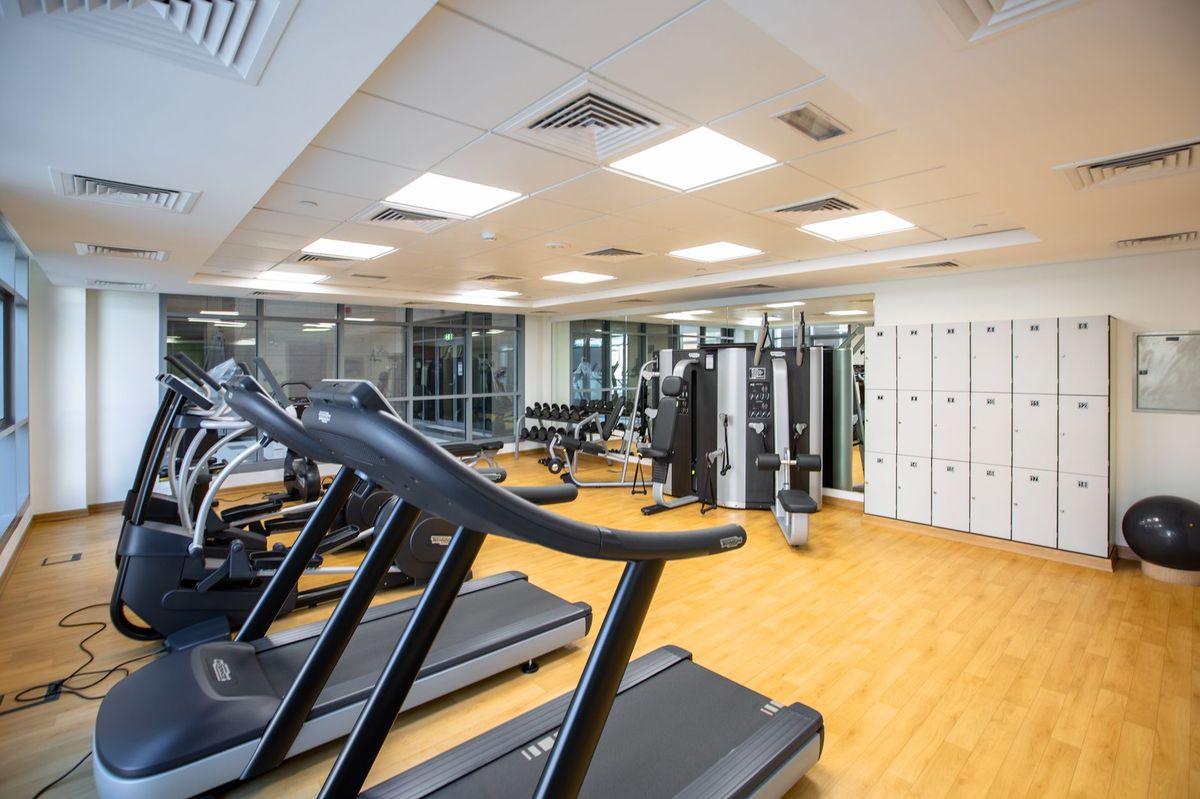
Electrical infrastructure. Fitness centers are electrically demanding. Cardio equipment (treadmills, ellipticals, stationary bikes) requires dedicated circuits with adequate capacity. A 200-treadmill fitness center might need 150+ amps of dedicated electrical service just for cardio equipment. Building electrical systems sized for 150-200 amp service for gym use cost $120,000-$200,000 versus $60,000-$100,000 for office space. Higher electrical cost drives per-square-foot cost up 8-12%.
HVAC and humidity control. Fitness centers have high latent loads (moisture from sweating occupants) requiring sophisticated HVAC with enhanced dehumidification. Standard commercial HVAC is sized for 0.15 CFM per square foot of sensible cooling; gyms need 0.3-0.5 CFM with enhanced humidity control. HVAC cost runs $15-$25/SF versus $8-$12/SF for office, adding 6-10% to total cost.
Flooring and durability. Gym flooring (rubber mats, vinyl composition tile, poured epoxy) must withstand 24/7 impact load and moisture. A durable gym floor costs $8-$12/SF installed. An office building uses $3-$5/SF. Increased flooring cost adds 2-4% to per-square-foot budget.
Locker rooms and wet areas. Basic changing rooms (lockers, sinks, benches) cost $5-$8/SF. Full-amenity locker rooms with showers, saunas, steam rooms, spa amenities cost $12-$18/SF. Expanded wet areas add 3-6% to per-square-foot cost.
Fitness equipment scope. Equipment is the single largest cost variable. A basic gym with standard cardio (treadmills, ellipticals, bikes), free weights, and machines costs $50-$70/SF for equipment and installation. A full-amenity facility with premium brands, extensive equipment, and specialized equipment (rowing, functional fitness, climbing) costs $75-$100/SF. The difference between $60/SF equipment and $85/SF equipment is $450,000 on a 18,000-SF building — dramatically affecting total project cost.
Equipment selection is the owner's decision and is often underestimated in cost budgeting. High-end equipment (Peloton bikes at $3,000 each, premium treadmills at $8,000+) adds significant cost.
Ground-Up vs. Tenant Improvement Economics
Tenant improvement conversions of retail space are typically $120-$160/SF and work when quality base buildings are available. Ground-up construction costs $160-$320/SF depending on amenities. The economics favor TI when:
- Existing structure is sound (no remediation needed)
- Electrical service is adequate (200+ amps available)
- HVAC system can be upgraded or supplemented
- Location is desirable for membership
- Lease terms are favorable ($15-$25/SF annual)
Ground-up construction makes sense when:
- No suitable TI space is available
- The owner seeks a premium positioning requiring full-amenity design
- Long-term ownership justifies the higher capital cost
- Site location justifies the investment
Regional Cost Variation
Gym construction costs vary 30-50% between regions based on labor cost and construction market competition.
High-cost markets (30-50% above national): California, New York, Boston, Seattle. Labor cost premium is the dominant factor. A gym costing $180/SF nationally might cost $225-$270/SF in these markets.
Moderate-cost markets (at national average): Texas, Colorado, Arizona, Florida, Midwest. Competitive gym construction markets with adequate labor supply. Costs align with national benchmark.
Low-cost markets (15-30% below national): Rural areas, South, interior markets. Lower labor costs. A comparable gym costs $125-$155/SF.
Timeline from Design to Opening
Gym projects typically follow this schedule:
- Design and permitting: 2-4 months
- Construction (ground-up): 8-12 months
- Construction (tenant improvement): 4-6 months
- Equipment delivery and installation: 1-2 months
- Operational setup (staff hiring, systems testing): 1-2 months
Total: 12-20 months for ground-up, 7-10 months for tenant improvement.
Your Action Item for This Week
If you're estimating a gym project, confirm three things immediately: (1) ground-up or tenant improvement — the cost and timeline difference is dramatic, (2) equipment scope — get a detailed fitness equipment list from the owner or their consultant, equipment often represents 30-40% of total cost and is the biggest variable, (3) wet area scope — pools, saunas, steam, and spa areas add 20-50% to project cost. Use $180/SF as your baseline for a mid-market ground-up 18,000-SF facility in a moderate market. Compare your estimate against broader commercial construction cost benchmarks. Deduct 30-35% for basic TI conversion. Add 50-75% for full-amenity facilities with pools and spas. Use the estimate generator to organize equipment and MEP line items. Then talk to your HVAC contractor about humidity control design — gym HVAC is significantly different from standard commercial, and under-estimating it is a common mistake.
Frequently Asked Questions
What is the average cost per square foot for a gym?
Gym and fitness center construction cost averages $180/SF for a mid-market 15,000-20,000 SF facility in 2026. Tenant improvements of existing retail run $120-$160/SF. Ground-up facilities run $160-$200/SF for basic gyms and $220-$320/SF for full-amenity facilities with pools and spas.
How much does it cost to build a 10,000 square foot gym?
A 10,000-SF basic gym tenant improvement costs $1.2-$1.6 million. A 10,000-SF ground-up basic gym costs $1.6-$2 million. A 10,000-SF full-amenity gym with pool and spa costs $2.2-$3.2 million.
What is the most expensive part of gym construction?
Fitness equipment typically represents 30-42% of total cost. A mid-market gym with 200+ pieces of cardio and strength equipment costs $900,000-$1.5 million in equipment alone. Building structure and MEP systems represent 40-50% of cost. Everything else (finishes, wet areas, contingency) is 8-20%.
How much do locker rooms cost?
Basic locker rooms with changing areas, lockers, and sinks cost $5-$8/SF. Full-service locker rooms with showers, saunas, steam rooms, and spa amenities cost $12-$18/SF. On an 18,000-SF gym with 1,500 SF of locker room space, basic locker rooms cost $7,500-$12,000 total; full-service locker rooms cost $18,000-$27,000 total.
Do I need a pool in my gym?
Not necessarily. Basic gyms (cardio, strength training, group fitness) operate profitably without pools. Pools require specialized structure (waterproofing, deck, circulation systems) costing $400,000-$700,000 plus ongoing maintenance. Pools work in affluent markets where membership premiums support the capital cost. In competitive price-sensitive markets, pools may not pencil out.
What HVAC capacity does a gym need?
Gyms require higher HVAC capacity than standard commercial buildings due to high latent loads (moisture from occupants). Standard office is 0.15 CFM per SF of outdoor air; gyms need 0.3-0.5 CFM with enhanced dehumidification. A 18,000-SF gym might need 5,400-9,000 CFM of outdoor air capacity versus 2,700 CFM for an office building of similar size. The oversized HVAC system costs $15-$25/SF versus $8-$12/SF for office.