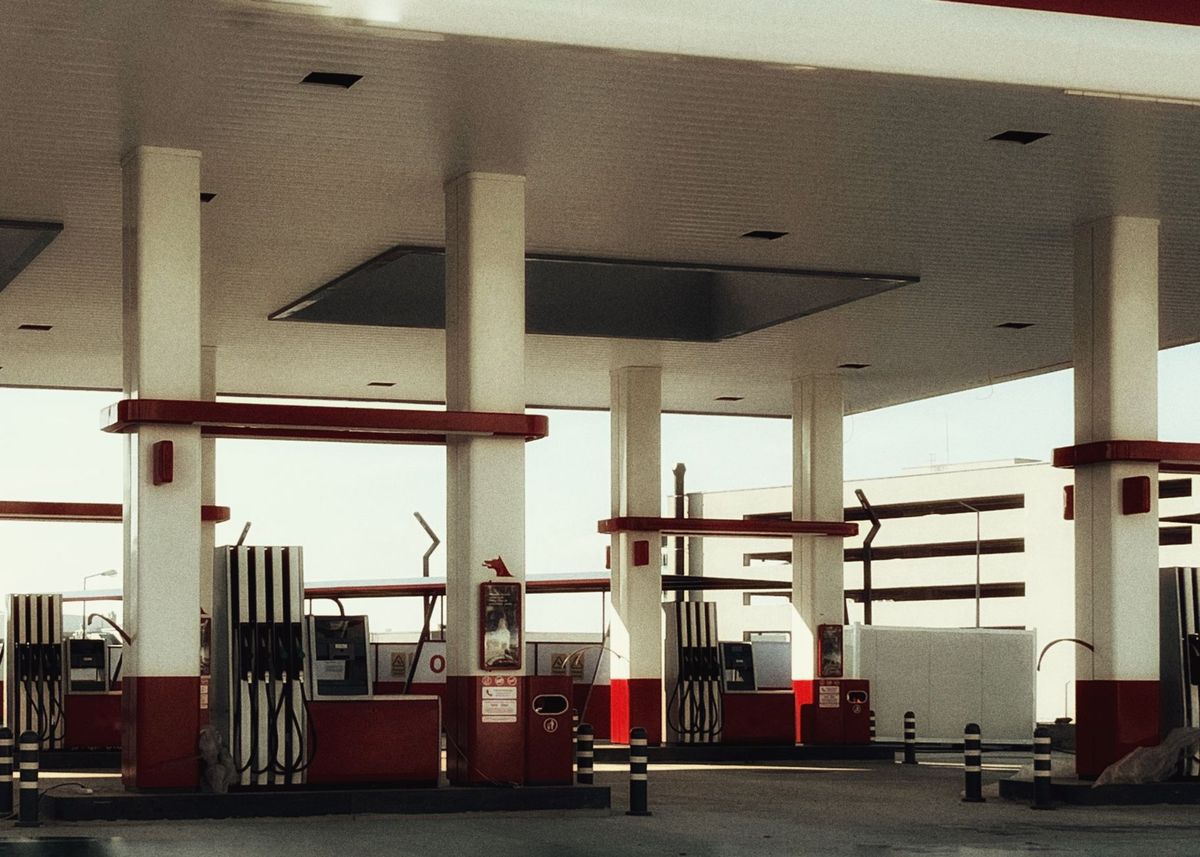
Gas station and convenience store construction cost averaged $2.5 million per location nationally in 2026 for a ground-up build with 12 fuel dispensers, 3,000-4,000 square feet of building, and all underground infrastructure. The range spans $1.8 million for a fuel-only canopy operation (no building) to $4+ million for a large format C-store with fast-casual food service and car wash. I've built seven gas stations in the last five years and watched this cost climb 22% since 2020, driven by underground tank costs, environmental permitting, and mechanical complexity.
Here's the breakdown of gas station construction cost, what drives the budget, and how to think about fueling station projects when land, tanks, and regulatory requirements dominate scope.
Gas Station Formats and Total Project Costs
Gas station construction cost varies dramatically based on operating model and building scope.
Fuel-Only Canopy (No Building)
A fuel-only canopy with no convenience store runs $900,000 to $1.4 million including canopy structure, dispensers, underground tanks, and infrastructure. This format typically serves highway locations or fleet operations where the operator is managing the fueling operation without retail. A 16-dispenser canopy (8 islands) with 2,000 square feet of canopy coverage costs $1.1 million to $1.3 million.
The cost includes:
- Concrete foundation and pad: $80,000-$120,000
- Steel canopy structure: $180,000-$250,000
- Fuel dispensers (16 units): $240,000-$320,000
- Underground storage tanks (2-4 tanks, 10,000-20,000 gallons): $200,000-$300,000
- Piping, electrical, environmental systems: $150,000-$200,000
- Permitting and testing: $60,000-$100,000
- General conditions and contingency: $90,000-$130,000
Fuel-only locations avoid the complexity and cost of a building's HVAC, plumbing, and interior finishes, keeping total cost moderate.
Convenience Store with Fuel (Ground-Up)
A ground-up convenience store with fuel service runs $2.2 to $3.2 million including a 3,500 square foot building, 12-16 fuel dispensers, 20-30 parking spaces, and all underground infrastructure. This is the standard U.S. gas station format — the building includes the retail sales floor, restrooms, and small food prep area.
The cost includes:
- Land site work and utilities: $150,000-$250,000
- Building structure and envelope: $700,000-$950,000
- HVAC and mechanical: $200,000-$300,000
- Electrical and lighting: $150,000-$250,000
- Plumbing and fire suppression: $120,000-$200,000
- Interior finishes: $150,000-$250,000
- Fuel infrastructure (dispensers, tanks, piping): $400,000-$550,000
- Convenience store equipment (coolers, registers, shelving): $80,000-$150,000
- Permitting, testing, commissioning: $100,000-$150,000
- General conditions and contingency: $200,000-$350,000
Total: $2.25 to $3.1 million.
Full-Service C-Store with Food Service
A large-format C-store (4,500-5,000 SF) with hot food service, chicken rotisserie, fountain, and fuel runs $3.2 to $4.5 million. The building is larger, the kitchen is more sophisticated, and the operational complexity drives more infrastructure cost. Labor cost is the biggest variable — franchised C-stores with food service require skilled restaurant crews and higher wages.
Truck Stop or Large-Format Facility
A truck stop with full restaurant, showers, laundry, and large fuel capacity runs $5 to $8+ million. These are industrial-scale operations with 20,000-30,000 square feet of building, restaurant kitchens, and 40+ fuel dispensers. We can skip this — it's a different animal from the standard C-store.
Construction Cost Breakdown for a Standard C-Store
A detailed cost analysis for a 3,500-SF convenience store with 12 fuel dispensers illustrates typical budget allocation:
| Component | Cost | Percentage of Total |
|---|---|---|
| Land prep, utilities, parking | $150,000-$250,000 | 6-10% |
| Building shell (foundation, frame, roof, envelope) | $700,000-$950,000 | 28-38% |
| HVAC and plumbing | $320,000-$500,000 | 13-20% |
| Electrical and lighting | $150,000-$250,000 | 6-10% |
| Interior finishes (flooring, walls, ceiling) | $150,000-$250,000 | 6-10% |
| Restrooms and fixtures | $50,000-$80,000 | 2-3% |
| Kitchen equipment (if food service) | $80,000-$150,000 | 3-6% |
| Fuel dispensers (12 units) | $180,000-$240,000 | 7-10% |
| Underground storage tanks + piping | $200,000-$350,000 | 8-14% |
| Fire suppression and safety | $60,000-$100,000 | 2-4% |
| Convenience store fixtures (coolers, shelving) | $50,000-$80,000 | 2-3% |
| Permits, testing, environmental | $100,000-$150,000 | 4-6% |
| General conditions and contingency | $200,000-$350,000 | 8-14% |
Total: $2.37 to $3.68 million ($677 to $1,051 per square foot for the building).
What Drives Gas Station Construction Cost
Five factors control whether a station lands at $2 million or $3.5 million.
Underground storage tank scope. Fuel storage is the most regulated component of a gas station. Modern tanks must be double-walled (outer tank catches leaks from the inner tank), have corrosion protection, spill containment, and monitoring systems. A typical C-store might have 2-4 tanks totaling 12,000-20,000 gallons. Tank cost is $200,000-$350,000 depending on capacity, material (fiberglass vs. steel), and local regulations. Tank installation requires excavation, protective covers, monitoring wells, and testing — another $80,000-$150,000.
Environmental regulations vary by state and site history. A site with previous fuel contamination (brownfield) requires extensive soil testing and remediation, adding $100,000-$500,000+ to the project cost. A clean site with standard environmental review costs $60,000-$100,000 in permits and testing.
Fuel dispenser count and layout. A station with 12 dispensers costs roughly $180,000-$240,000. Moving to 16 dispensers adds $60,000-$80,000. But dispenser spacing, canopy requirements, and island layout affect site circulation and parking lot design — influencing site work cost. A tight site might require a vertical stacking layout (dispensers on two sides of islands) versus the standard horizontal layout, adding civil engineering cost.
Building footprint and kitchen scope. A 3,000 SF basic C-store is cheaper than 4,000 SF, but the difference is more than just square footage — the kitchen footprint, hot food capacity, and equipment count drive operating cost and building system cost. A station with fryer, chicken rotisserie, fountain, and hot case needs more electrical capacity, more HVAC (kitchen exhaust), better fire suppression, and more complex plumbing than a basic grab-and-go format. Hot food service adds $150,000-$250,000 to building cost.
Canopy design and covered area. A fuel canopy protecting the pump islands costs $180,000-$250,000 depending on span and material. The canopy must span 12 or more feet over the pump islands without interior columns (you can't put a column where cars park). Canopy height is typically 14-16 feet to allow large vehicle clearance. Architectural finishes on the canopy (matching the building) add cost compared to basic steel frame.
Site conditions and remediation. A site with poor soil conditions, high water table, or existing structures requiring demolition adds $50,000-$300,000 to site cost. A brownfield site (contaminated soil) can require $100,000-$600,000 in remediation before tanks can be installed. Use the estimate generator to organize and track environmental and remediation line items across your project timeline.
Environmental and Regulatory Costs
Gas stations are heavily regulated by EPA, state environmental agencies, and local authorities. The permitting and testing budget is significant:
- Environmental site assessment (Phase 1): $5,000-$10,000
- Phase 2 (soil testing if needed): $15,000-$40,000
- Underground storage tank permits and inspections: $20,000-$50,000
- Fire marshal plan review and inspection: $10,000-$30,000
- Building permits and inspections: $15,000-$40,000
- Fuel dispensers certification and testing: $10,000-$20,000
Total permitting and environmental cost: $75,000-$190,000 on a typical project.
Tank removal (if replacing an existing station) adds another $30,000-$80,000 depending on tank condition and soil contamination discovered during removal.
Regional Cost Variation
Gas station construction costs vary 30-50% between regions based on labor cost and local fuel tank regulations.
High-cost markets (30-50% above national): California, New York, Boston, Seattle. Labor cost is the dominant factor. California has strict environmental regulations on tank design and monitoring, increasing infrastructure cost. A C-store costing $2.5 million nationally might cost $3.2-$3.8 million in California.
Moderate-cost markets (at national average): Texas, Colorado, Arizona, Florida, Midwest. These markets see strong fuel station construction. Competitive labor markets and moderate material costs support the $2.5M benchmark.
Low-cost markets (15-25% below national): Rural areas, South, parts of interior West. Lower labor costs and simpler site conditions. A comparable station costs $1.9-$2.1 million.
Timeline from Acquisition to Opening
Gas station projects typically follow this schedule:
- Site acquisition and environmental assessment: 2-4 months
- Design and permitting: 2-3 months
- Environmental remediation (if needed): 1-6 months (depends on contamination)
- Construction: 6-9 months
- Equipment testing and operational startup: 1 month
Total: 12-23 months from acquisition to opening. Environmental issues or tank remediation can extend timeline by several months.
Your Action Item for This Week
If you're quoting a gas station project, do these three things immediately: (1) confirm underground tank scope with the owner — tank removal and remediation can add $100,000-$400,000 if the site has contamination, (2) get an environmental phase 1 assessment started — environmental costs are front-loaded and must be budgeted early, (3) verify fuel dispenser count and canopy requirements — these are site-specific and drive both cost and timeline. Use $2.5 million as your baseline for a 3,500-SF C-store in a moderate market. Adjust up 30-50% for California or coastal markets. Adjust down 15-25% for rural areas. Compare your estimate against the broader commercial construction cost benchmarks. Then add 15-25% for any Phase 2 environmental work, tank removal, or soil remediation.
Frequently Asked Questions
What is the total cost to build a gas station?
A ground-up convenience store with fuel service costs $2.2-$3.2 million nationally in 2026. A fuel-only canopy (no building) costs $900,000-$1.4 million. A large-format C-store with food service costs $3.2-$4.5 million. Cost includes land prep, building, fuel dispensers, underground tanks, environmental permits, and contingency.
What is the biggest cost item in a gas station build?
The building structure (foundation, frame, roof, envelope) is typically 28-38% of total cost. Underground storage tanks, piping, and fuel infrastructure represent 8-14%. Environmental permits and testing are 4-6% of cost but can reach 15-20% if soil remediation is required.
How much do underground fuel tanks cost?
A double-walled 10,000-gallon tank costs $35,000-$55,000. A double-walled 20,000-gallon tank costs $50,000-$80,000. Installation (excavation, protection, monitoring wells) adds another $80,000-$150,000. A typical C-store with 2-3 tanks totals $200,000-$350,000 for tank equipment and installation.
Why is fuel environmental permitting so expensive?
Gasoline and diesel contamination is regulated by EPA and state agencies. Environmental site assessment, tank design certification, spill containment verification, and monitoring well installation are required by law. Tank removal from old sites often discovers soil contamination, triggering Phase 2 environmental work and remediation. Environmental costs can range from $75,000 (clean site) to $500,000+ (contaminated site).
How much does a fuel dispenser cost?
A modern dual-sided fuel dispenser (serving cars on both sides of an island) costs $15,000-$20,000. A typical 12-dispenser station (6 islands) costs $180,000-$240,000. Dispenser installation includes electrical, fuel piping connections, and certification testing.
Can I convert a retail building to a gas station?
Yes, but environmental and structural requirements make it challenging. You need underground tank installation (requires excavation and site work), fuel piping routed to pumps, environmental permits, and typically significant structural modifications. Conversion costs $1.5-$2.5 million and is often comparable to ground-up construction. Conversion is economically sensible only if the existing building shell is sound and you're saving on structural cost.