The math: the FY2026 Military Construction (MILCON) budget request totals $14.2 billion across all service branches and defense agencies, making military construction one of the largest single categories of federal construction spending. The budget funds new construction, renovation, and infrastructure improvements on military installations across all 50 states and overseas locations.
Bottom line: military construction is a massive, well-funded construction market with unique procurement requirements, workforce demands, and quality standards. For contractors willing to navigate the federal acquisition process and invest in security clearances and military-specific construction capabilities, MILCON offers a stable, long-term revenue stream backed by the defense budget.
FY2026 MILCON Budget by Service Branch
The $14.2 billion MILCON request breaks down across the military services and defense agencies: Army at $3.4 billion for barracks, motor pools, training facilities, and installation infrastructure, Navy and Marine Corps at $3.8 billion for pier and wharf construction, aviation facilities, barracks, and shore infrastructure, Air Force at $3.1 billion for flight line facilities, weapons storage, dormitories, and launch facilities, Space Force at $1.2 billion for satellite ground stations, launch infrastructure, and space surveillance facilities, Defense-Wide (SOCOM, DISA, DLA, etc.) at $1.4 billion for special operations facilities, information technology centers, and logistics infrastructure, and NATO Infrastructure at $320 million for US-funded construction at NATO installations.
An additional $1.0 billion is allocated for family housing construction and improvement, and $950 million funds the BRAC (Base Realignment and Closure) account for ongoing facility consolidation.
What's Being Built: Project Types
MILCON projects span an enormous range of building types, each with specific military construction standards (Unified Facilities Criteria, or UFC) that differ from commercial building standards:
Barracks and Dormitories ($3.2 billion). The largest single category, reflecting the military's commitment to improving quality of life for service members. Modern military barracks cost $350 to $550 per SF, featuring individual room or suite-style configurations (replacing open-bay designs), common areas and recreation facilities, secure arms storage, and enhanced fire protection and life safety systems. A typical company-grade barracks housing 200 to 300 soldiers costs $60 to $100 million.
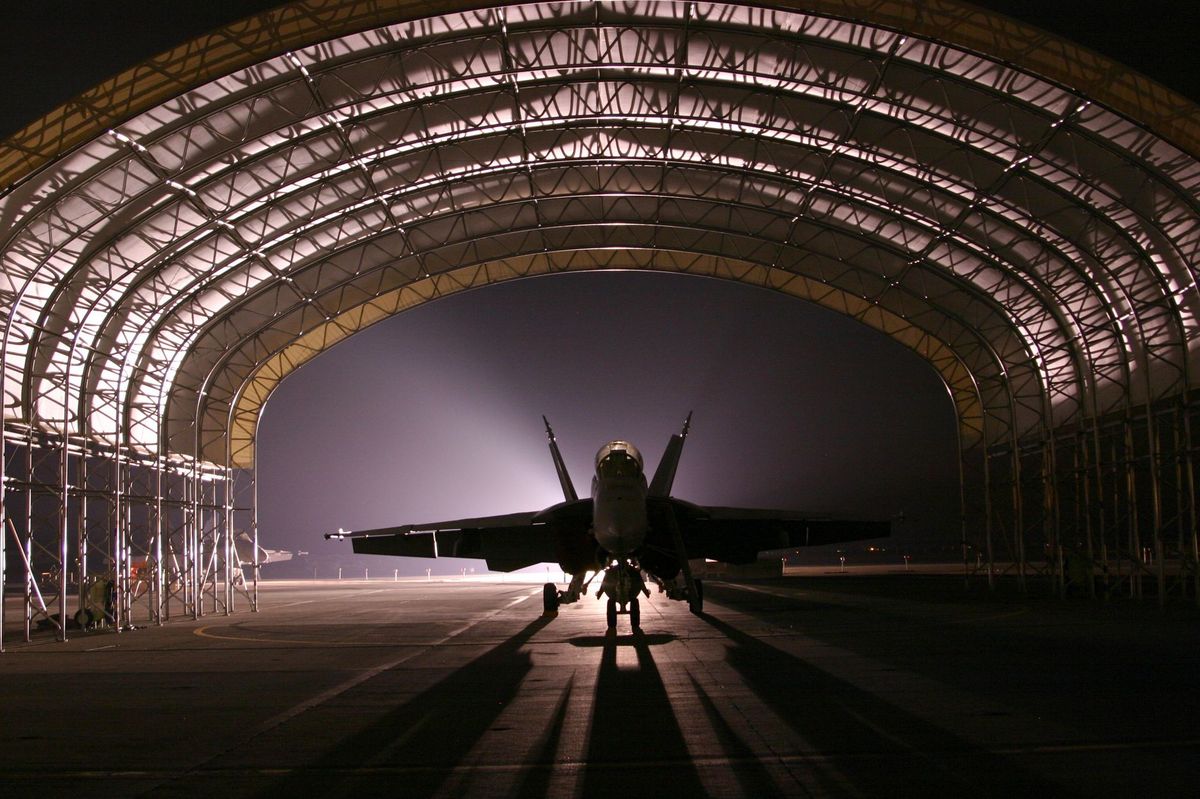
Operations and Training Facilities ($2.8 billion). Mission-specific buildings including aircraft hangars (cost $400 to $700 per SF for standard hangars, $800+ for specialized maintenance hangars), tactical operations centers, simulation and virtual training facilities, and vehicle maintenance facilities. Construction standards include specialized structural requirements (hangar clear spans of 200+ feet), TEMPEST/SCIF construction for classified operations, and hardened construction for force protection.
Infrastructure and Utilities ($2.4 billion). Installation-level infrastructure including roads, utilities (water, sewer, electrical distribution, natural gas), central energy plants, and environmental compliance facilities. Military installation infrastructure is comparable in scope to small-city municipal infrastructure, with the added requirement for anti-terrorism/force protection (AT/FP) compliance in facility design.
Waterfront Construction ($1.8 billion). Navy pier and wharf construction for ship berthing, submarine maintenance, and waterfront support facilities. Naval waterfront construction costs $600 to $1,200 per SF due to the combination of marine construction challenges, blast-resistant design requirements for ammunition-handling areas, and the specialized utility systems required for ship maintenance (shore power at 4,160V, steam for heating, industrial water for cooling, compressed air, and craneage with lift capacity of 50 to 325 tons).
Procurement and Contractor Requirements
MILCON projects are procured through the Army Corps of Engineers (for Army, Air Force, and some defense-wide projects) and the Naval Facilities Engineering Systems Command (NAVFAC) for Navy and Marine Corps projects. Procurement methods include design-bid-build (traditional sealed bidding, used for straightforward projects), design-build (increasingly common for repetitive building types like barracks and maintenance facilities), and Job Order Contracting (JOC) for small repair and renovation projects under $5 million.
Contractor requirements for MILCON work include SAM registration and active cage code, bonding capacity adequate for project size (typically 100% performance and payment bonds), security clearances for workers on classified project areas, experience with Unified Facilities Criteria (UFC) and Anti-Terrorism/Force Protection (AT/FP) standards, Davis-Bacon prevailing wage compliance, and Buy American Act compliance for construction materials.
Business tip: The military construction market is stratified by project size. Small to mid-size contractors ($10 to $100 million annual revenue) compete effectively for projects under $20 million, where the relatively small contract values don't attract the largest national firms. The most reliable entry point to MILCON is the 8(a), HUBZone, or SDVOSB set-aside programs that reserve contracts for qualified small businesses.
Geographic Distribution
MILCON spending is concentrated at major military installations. The top 10 states by FY2026 MILCON allocation include Virginia ($1.8 billion, reflecting Norfolk Naval Base and the Pentagon region), California ($1.2 billion, multiple Navy, Marine, and Air Force bases), Texas ($1.1 billion, Fort Cavazos, Fort Bliss, multiple bases), North Carolina ($950 million, Fort Liberty, Camp Lejeune, multiple bases), Florida ($880 million, multiple Navy and Air Force installations), Georgia ($720 million, Fort Stewart, Robins AFB, Kings Bay), Washington ($680 million, Joint Base Lewis-McChord, naval installations), Hawaii ($620 million, Pearl Harbor, Schofield Barracks), Colorado ($560 million, Fort Carson, Schriever, Peterson), and Maryland ($540 million, Fort Meade, Aberdeen, Andrews).
Workforce and Market Outlook
MILCON construction employs an estimated 85,000 to 100,000 workers on active projects nationally. The workforce spans all building trades plus specialty military construction categories including SCIF (Sensitive Compartmented Information Facility) construction, blast-resistant design construction, and waterfront marine construction.
The MILCON budget has grown steadily from $10 billion annually in FY2020 to $14.2 billion in FY2026, with projections of $15 to $17 billion by FY2030 driven by the National Defense Strategy's emphasis on installation resilience, great power competition facility requirements, and the ongoing need to replace World War II and Cold War-era infrastructure that has reached end of useful life.
Bottom line: MILCON is a $14.2 billion annual market with strong growth trajectory, geographic distribution across all 50 states, and the ultimate funding stability — the national defense budget. Contractors who invest in federal procurement capabilities, security clearances, and military construction standards expertise will find a reliable and growing construction market that provides multi-decade revenue visibility.
Anti-Terrorism/Force Protection (AT/FP) Requirements
Every MILCON project must comply with Department of Defense Unified Facilities Criteria (UFC) 4-010-01, which establishes minimum anti-terrorism standards for all DoD buildings. These requirements add construction cost and complexity across every building type on military installations.
Key AT/FP construction requirements include minimum standoff distances between buildings and uncontrolled roadways (typically 25 to 148 meters depending on building occupancy and construction type), progressive collapse resistance — the structural capability to sustain localized damage without disproportionate collapse of the overall structure. Progressive collapse design requires enhanced structural connections, additional reinforcing steel, and often increased member sizes compared to civilian building codes. Blast-resistant windows and doors using laminated glass with anti-shatter film, tempered glass with blast-rated frames, or in some cases, opaque blast-resistant panels. And hardened utility entrance points preventing vehicle-borne explosive devices from exploiting utility penetrations through the building perimeter.
AT/FP compliance adds 3 to 8% to building construction costs for standard buildings (barracks, offices, maintenance facilities) and 10 to 15% for high-occupancy or critical buildings (command centers, dining facilities, medical centers). The cost premium reflects additional structural steel and concrete, blast-rated glazing and door assemblies, and the perimeter security infrastructure (bollards, barriers, gate systems) required at every building.
SCIF Construction: The Highest Security Standard
Sensitive Compartmented Information Facilities (SCIFs) are constructed to Intelligence Community Directive (ICD) 705 standards, which specify physical security requirements for spaces where classified information is processed, stored, or discussed. SCIF construction on military installations is one of the most specialized and restricted construction categories.
SCIF construction requirements include reinforced concrete, CMU, or steel stud walls with security-rated gypsum board and continuous acoustic barriers, radio frequency (RF) shielding using copper mesh, foil, or conductive coatings to prevent electronic emanation leakage, TEMPEST-rated electrical systems preventing classified information from being intercepted through power line emissions, IDS (Intrusion Detection Systems) including balanced magnetic switches on doors, motion detectors, and glass-break sensors all connected to a continuously monitored alarm system, secure entry vestibules (mantrap configurations) with card reader and PIN or biometric access control, and acoustic protection (STC 50+) preventing speech intelligibility through walls, floors, ceilings, ducts, and penetrations.
SCIF construction costs $150 to $300 per SF above standard construction — meaning that a 10,000 SF SCIF adds $1.5 to $3 million to project costs. All workers on SCIF construction must hold appropriate security clearances, and the construction must be inspected and certified by the Defense Counterintelligence and Security Agency (DCSA) before the space can be accredited for classified use.
Business tip: SCIF construction is one of the most profitable specialty construction niches in the military market due to the extreme barriers to entry (security clearances, specialized knowledge, DCSA relationships). Contractors who invest in obtaining facility clearances and training workers in ICD 705 construction standards gain access to a market with limited competition and premium pricing that reflects the genuine difficulty and responsibility of building these critical national security facilities.
Barracks Modernization: The 1+1 Standard
The single most impactful change in military barracks construction over the past two decades has been the adoption of the "1+1" living standard for unaccompanied enlisted personnel. Under the 1+1 standard, each soldier, sailor, airman, or Marine receives a private bedroom and shares a bathroom with one neighbor — replacing the open-bay sleeping arrangements and communal bathrooms that characterized military barracks for generations.
The 1+1 standard has significant construction cost implications. Each living module requires a private sleeping room (approximately 130 to 165 SF with closet, desk, and bed space), a shared bathroom (approximately 65 to 80 SF with shower, toilet, and vanity), a shared kitchenette or break area for each floor or wing, and common areas including day rooms, laundry facilities, and storage.
The per-bed construction cost for 1+1 barracks ranges from $75,000 to $150,000 depending on location, finish level, and site conditions. A 200-bed barracks costs approximately $15 to $30 million — roughly double the cost of the open-bay designs they replace, but justified by improved quality of life, better retention rates, and reduced behavioral problems associated with lack of privacy.
Naval Waterfront Construction
Navy MILCON includes a category of construction unique among the services: waterfront infrastructure for ship berthing and maintenance. Naval pier and wharf construction combines marine engineering challenges with military security requirements.
Modern Navy pier construction involves steel pipe pile foundations driven 80 to 120 feet into marine sediments, reinforced concrete deck structures designed for heavy crane loads (100 to 325-ton capacity cranes for ship maintenance), shore power connections providing 4,160V three-phase power to berthed vessels (each ship drawing 3 to 10 MW), utility services including potable water, fire main, steam, and compressed air, and force protection features including waterside barriers, surveillance systems, and anti-swimmer detection systems.
Navy pier construction costs $800 to $1,500 per SF of wharf deck area, reflecting the combination of marine construction challenges, military-grade utility systems, and AT/FP security requirements. A single aircraft carrier berth requires approximately 1,200 linear feet of wharf at a cost of $150 to $250 million — making naval waterfront construction among the most expensive construction per linear foot in any category.
MILCON Appropriations Process
Understanding the MILCON funding cycle is essential for contractors planning to pursue military construction work. MILCON projects follow a defined lifecycle from military department identification of facility requirements through project justification and documentation (DD Form 1391), inclusion in the President's budget request to Congress, congressional authorization (in the National Defense Authorization Act) and appropriation, design (typically 12 to 18 months), and construction (12 to 36 months depending on project size and complexity).
The total cycle from requirement identification to construction completion spans 5 to 8 years for major projects. Contractors can track upcoming MILCON opportunities through the annual President's budget request (published each February), congressional committee reports on the NDAA, and the Army Corps of Engineers and NAVFAC pre-solicitation announcements.
Sustainability and Net-Zero Requirements
The Department of Defense has established ambitious sustainability goals that directly affect MILCON construction scope and cost. Executive Order 14057 requires federal agencies to achieve net-zero emissions by 2050, and the DoD is implementing this goal through increasingly stringent energy performance requirements for new military construction.
Current MILCON sustainability requirements include UFC 1-200-02 compliance requiring new buildings to achieve at least 30% energy reduction below ASHRAE 90.1 baseline, rooftop solar-ready construction (structural capacity and electrical infrastructure to support future PV installation), EV-ready parking (conduit and panel capacity for future charging stations), low-impact development (LID) stormwater management using bioretention, permeable pavement, and rain gardens, and water conservation features achieving 20% reduction below baseline fixture water consumption.
These sustainability requirements add 3 to 8% to MILCON construction costs but generate measurable operating savings and contribute to installation energy resilience — an increasingly important military requirement as installations face growing threats from grid disruption.
Several military installations have achieved or are pursuing net-zero energy status, with construction programs including extensive solar PV arrays (often 5 to 50 MW per installation), geothermal heating and cooling systems, building envelope performance exceeding code requirements by 50%+, and microgrids with battery storage providing islanding capability during grid outages.
Before you commit to a budget, run your own numbers with our free construction cost estimator and check quantities with the markup margin calculator.
Frequently Asked Questions
How are military base construction milcon projects funded?
According to the latest industry data, military base construction milcon is showing notable trends in 2026. Current figures indicate $14.2 billion, which represents a significant benchmark for contractors and developers planning projects this year. Regional variations apply, so checking local market conditions remains essential for accurate budgeting.
What is the average cost of military base construction milcon?
The geographic landscape for military base construction milcon is shifting in 2026. Data indicating $3.4 billion underscores the importance of market selection for contractors seeking growth. Western and southeastern states continue to attract disproportionate investment relative to their population share.
Which states are investing the most in military base construction milcon?
Compared to prior periods, military base construction milcon has moved significantly. Current data showing $3.8 billion indicates the direction of the market, and contractors who adjust their strategies accordingly will be better positioned for profitability. Monitoring monthly updates from BLS and Census Bureau data releases is recommended.