The math: convention center construction and expansion has reached $8.4 billion in active projects across the United States, as cities compete to attract the lucrative conventions, trade shows, and events that generate hotel room nights, restaurant spending, and tax revenue. The active pipeline includes 12 new convention center construction projects and 25+ major expansion and renovation projects.
Bottom line: convention center construction is driven by intermunicipal competition for events and the economics of hospitality tax revenue. Cities invest in convention center construction not as a standalone real estate play but as an economic development catalyst — a well-designed convention center generates $3 to $8 in induced spending for every $1 of public investment through hotel, restaurant, transportation, and retail activity.
Major Active Projects
The 10 largest active convention center construction projects illustrate the scale and geographic distribution of this market: Las Vegas Convention Center West Hall expansion at $980 million, Oklahoma City MAPS 4 Convention Center at $340 million, San Francisco Moscone Center ongoing modernization at $550 million, Chicago McCormick Place Lakeside Center renovation at $480 million, Houston George R. Brown Convention Center expansion at $420 million, Nashville Music City Convention Center expansion at $380 million, Seattle Convention Center Summit addition at $1.9 billion (the most expensive convention center project in US history), San Diego Convention Center expansion at $680 million, Austin Convention Center expansion at $1.2 billion, and Phoenix Convention Center expansion at $350 million.
Construction Characteristics
Convention center construction presents unique challenges that differentiate it from other large commercial buildings. Exhibit Hall Construction requires column-free spans of 200 to 400+ feet for flexible exhibit layout, floor load capacity of 350 to 500 PSF to support heavy equipment and vehicles, floor-level utility services (electrical, water, compressed air, telecommunications) at regular intervals via floor boxes or trench systems, and ceiling heights of 30 to 40+ feet for overhead rigging of lighting, signage, and displays.
The structural systems required for these long spans — typically steel trusses, space frames, or cable-stayed structures — cost significantly more than standard column-supported buildings. Exhibit hall construction costs average $400 to $700 per SF, with the roof structure alone accounting for 25 to 35% of the total.
Ballroom and Meeting Space construction requires operable partition walls (acoustically rated at STC 52+) that divide large spaces into multiple smaller rooms, sophisticated audio-visual infrastructure including ceiling-mounted projection, distributed audio, and video conferencing capability in every room, high-capacity HVAC systems designed for maximum occupancy loads (7 to 15 SF per person for banquet seating), and premium interior finishes including ballroom-quality lighting, custom carpet, and architectural wall and ceiling treatments.
Loading and Logistics infrastructure is critical for convention center operations. Exhibit hall loading docks must accommodate 30 to 60 semi-trucks simultaneously during show move-in and move-out, requiring massive loading dock facilities with drive-through capability, heavy-duty dock levelers, and temporary storage areas.
Business tip: Convention center construction is one of the few building types where the general contractor's relationship with the local convention and visitors bureau (CVB) and hospitality industry is as important as the relationship with the owner (typically a city or convention center authority). Understanding how the facility will be marketed and operated influences construction decisions throughout the project.
Funding
Convention center construction is funded primarily through hospitality taxes (hotel/motel occupancy taxes dedicated to convention center bonds), tourism development authority (TDA) revenue, tax increment financing (TIF) districts around the convention center, state and local sales tax revenue, and public-private partnerships for adjacent hotel and retail development. The hospitality tax funding model makes convention center construction somewhat countercyclical — it's typically planned and funded during periods of strong tourism revenue, but may proceed even during downturns because bond obligations must be serviced.
Market Outlook
The convention center construction pipeline is expected to remain robust through 2030 as cities compete for post-pandemic event business and expand facilities to accommodate growing trade show demand. An additional $5 to $8 billion in planned convention center projects are in design and approval phases. For contractors with large-span structural capability, complex MEP systems experience, and willingness to work on politically visible public projects, convention center construction offers premium-priced work with long-duration engagement.
Bottom line: convention center construction is an $8.4 billion market driven by municipal economic development strategy and hospitality tax revenue. The technical demands — long-span structures, heavy floor loads, complex AV systems — create barriers to entry that limit competition and support healthy contractor margins.
Exhibit Hall Construction Details
Exhibit hall construction presents structural engineering challenges that require specialized contractor experience. The defining requirement is column-free floor space — convention exhibit areas must provide uninterrupted floor plates of 100,000 to 500,000+ SF without interior columns, allowing exhibitors maximum flexibility in booth layout and configuration.
Achieving column-free spans of 200 to 400+ feet requires structural systems substantially larger and more expensive than typical commercial construction. Common structural approaches include long-span steel trusses (depths of 8 to 20 feet, spanning 200 to 350 feet) at costs of $35 to $60 per SF of roof area, space frame systems (three-dimensional truss networks providing multi-directional spanning capability) at $40 to $70 per SF, cable-stayed or cable-supported roof systems for the longest spans (350 to 500+ feet), and arched or vaulted roof structures combining structural efficiency with architectural expression.
The floor system must support heavy exhibit equipment including forklifts (up to 30,000 lbs), loaded semi-trucks during move-in (80,000 lbs), and heavy exhibit machinery. Floor design loads of 350 to 500 PSF require reinforced concrete slabs 8 to 12 inches thick on prepared subgrade, with structural expansion joints at 150 to 200-foot intervals to control cracking.
Utility Services. Exhibit halls require extensive floor-level utility services for exhibitors. Construction includes floor boxes at regular intervals (typically on a 30-foot grid) providing 200A electrical service, water and drain connections, compressed air, and telecommunications. These floor boxes are cast into the structural slab with removable covers flush with the finished floor surface. A 300,000 SF exhibit hall may contain 300 to 500 floor boxes — a significant plumbing, electrical, and concrete construction scope.
Loading Dock and Logistics Infrastructure
Convention center loading facilities must accommodate intense periodic use during exhibit move-in and move-out, when 30 to 60 semi-trucks may need simultaneous access to the building. Loading dock construction includes multiple dock positions (typically 1 dock per 5,000 to 10,000 SF of exhibit space) with heavy-duty dock levelers rated for 80,000-lb loads, drive-through capability allowing trucks to enter on one side and exit the other without backing, overhead clearance of 16 to 18 feet for standard trailers and 20+ feet for specialized exhibit vehicles, and heavy-duty floor coatings in loading areas rated for fork truck traffic and truck turning movements.
The drive-through loading configuration requires wide structural bays (typically 80 to 100 feet clear) in the loading area, adding structural cost compared to the standard 30 to 40-foot bays typical of commercial loading docks.
Energy and Sustainability
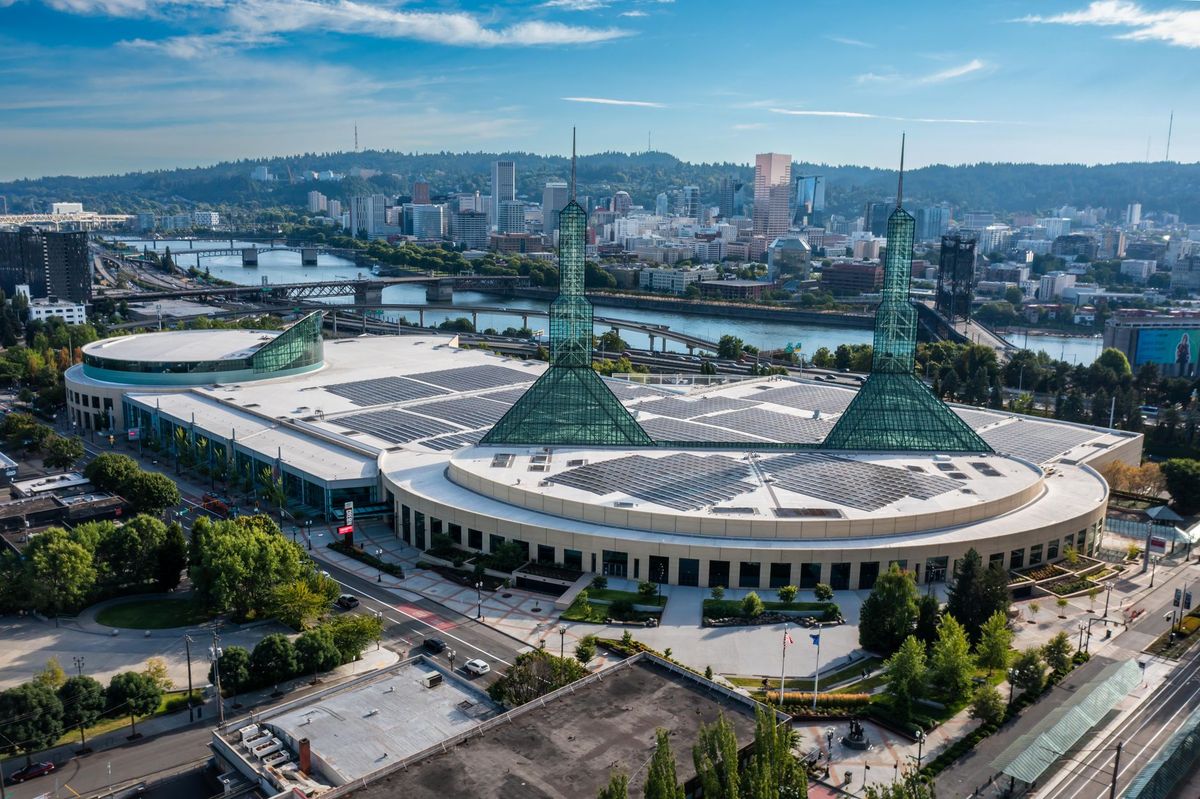
Convention centers are among the most energy-intensive building types due to their large volume, high lighting levels (150 to 200 foot-candles on the exhibit floor), and the extreme HVAC demands of spaces occupied by thousands of people and equipment generating substantial heat loads. Sustainable convention center construction features include high-performance roof insulation (R-30+) to reduce heating and cooling loads across the enormous roof area, LED lighting with daylight harvesting (clerestory windows or skylights), natural ventilation strategies using operable roof monitors or clerestory windows, rooftop solar arrays (the large, unobstructed roof areas of convention centers are ideal for solar installation), and rainwater harvesting from the large roof catchment area.
Hotel and Mixed-Use Integration
Modern convention center projects increasingly include integrated hotel, retail, and entertainment components that create comprehensive convention districts rather than standalone exhibit facilities. This integration creates larger, more complex construction programs but also increases the economic impact and operational viability of the convention center investment.
Headquarters Hotels directly connected to convention centers via enclosed walkways or shared lobbies are critical amenities for attracting major conventions. Headquarters hotel construction typically involves 800 to 2,000 rooms in a full-service tower, with ballroom and meeting space that supplements the convention center's function space. Construction costs for convention headquarters hotels range from $300,000 to $600,000 per room, with total project costs of $300 million to $1 billion for the largest properties.
Recent convention center projects with integrated hotels include the Omni Nashville ($600 million, 800 rooms), the Omni Oklahoma City ($340 million, 605 rooms), and the Hilton Columbus ($175 million, 463 rooms). These projects are typically structured as public-private partnerships, with the city constructing the convention center and providing incentives (land, tax increment financing, operating subsidies) while a private hotel developer constructs and operates the hotel.
For construction firms, integrated convention center-hotel projects offer larger total contract values and longer construction durations than standalone convention center work, but also require experience in both convention and hospitality construction — a combination that not all contractors possess.
Acoustical and Environmental Construction
Convention centers require specialized acoustic and environmental construction to manage the diverse activities that occur simultaneously in different areas of the facility. Exhibit halls generate significant noise from material handling equipment, exhibitor construction, and large crowds — sound levels of 85 to 95 dB are common during active trade shows. Meeting rooms and ballrooms adjacent to exhibit halls require STC 55+ partition assemblies to achieve acceptable speech privacy during presentations and meetings.
HVAC systems must handle extreme load variations — from empty exhibit halls to fully occupied ballrooms and meeting rooms — while maintaining occupant comfort and controlling noise. The HVAC design challenge is compounded by the massive volume of exhibit halls (ceiling heights of 30 to 40+ feet) and the heat loads generated by thousands of occupants, lighting, and exhibitor equipment.
Environmental compliance during convention center construction includes stormwater management for the large impervious roof areas (a 500,000 SF convention center generates approximately 300,000 gallons of runoff per inch of rainfall), indoor air quality management during construction to protect workers and adjacent occupied spaces, and noise and vibration management when construction occurs adjacent to or within operating convention center spaces.
Expansion vs New Construction Economics
The majority of active convention center projects are expansions of existing facilities rather than new construction. Expansion offers several economic advantages including leveraging existing support infrastructure (loading docks, kitchen facilities, utilities, parking), maintaining the convention center's market position by adding capacity without disrupting existing operations, and lower per-SF costs for expansion space (adding exhibit hall to an existing facility costs $300 to $500 per SF versus $400 to $700 per SF for a new standalone facility).
However, expansion construction presents unique challenges. Working adjacent to an operating convention center requires construction phasing that maintains event space availability during construction, noise and vibration management to avoid disrupting events in occupied areas, temporary separation barriers (dust walls, noise barriers) between construction and occupied zones, and coordination with the convention center's event calendar to schedule the noisiest and most disruptive work during periods when adjacent spaces are unoccupied.
These constraints add 10 to 20% to expansion construction costs compared to equivalent greenfield construction, but the overall project cost is still typically lower than new construction because existing support infrastructure is shared between old and new exhibit space.
Technology Infrastructure
Convention centers require robust technology infrastructure to support exhibitor and attendee needs. Construction scope includes high-density WiFi systems capable of supporting 10,000 to 50,000 simultaneous devices (requiring access points at intervals of 1,500 to 2,500 SF, far denser than typical commercial installations), fiber optic backbone distributing high-bandwidth connectivity to every exhibit hall, meeting room, and public space, distributed antenna systems (DAS) providing cellular signal coverage throughout the facility (indoor cellular coverage is essential for attendees and exhibitors), digital signage infrastructure including displays, media players, and content distribution systems throughout public spaces, and power distribution for exhibitor needs including temporary 200A and 400A electrical connections available at floor boxes throughout exhibit halls. Technology infrastructure construction represents 8 to 12% of total convention center construction cost and is one of the most rapidly evolving construction scopes as connectivity demands increase with each passing year.
Frequently Asked Questions
How are convention center construction projects funded?
Industry analysts tracking convention center construction report that 2026 has brought measurable shifts. With data showing $8.4 billion, the trend line suggests continued movement through the remainder of the year. Builders should factor this into both current bids and forward-looking project estimates.
What is the average cost of convention center construction?
Market research on convention center construction shows that geographic concentration matters significantly. With figures reaching $3 in key markets, the opportunities are substantial but location-dependent. States with strong population growth and infrastructure investment tend to see the highest activity levels.
Which states are investing the most in convention center construction?
The trajectory for convention center construction tells an important story when viewed against historical benchmarks. With the latest data showing $8, the trend has clear implications for project feasibility, bidding accuracy, and resource allocation across the construction sector.