$760 per ton. That's where hot-rolled coil steel sits as of March 2026, according to S&P Global Platts — down 8% from the $825/ton average we saw through 2025. If you're a structural contractor, a steel erector, or anyone who touches ferrous metal on a job site, this is the first real pricing relief you've had in three years.
I've been tracking steel costs for my shop because every commercial job we bid has a steel component in the hangers, supports, and structural connections our plumbers install. When steel moves, it ripples through the entire supply chain. Let me break down what this price drop means for your bottom line and how to lock in the advantage before the market shifts again.
Platts HRC Pricing: From $825 to $760 and Why
The S&P Global Platts hot-rolled coil (HRC) benchmark dropped from a 2025 average of $825/ton to $760/ton by the end of Q1 2026. That's a $65/ton reduction that translates directly to lower costs on wide-flange beams, structural tubing, plate steel, and sheet products.
Three factors drove the decline. First, domestic mill capacity expanded. Nucor's Brandenburg, Kentucky plate mill reached full production in late 2025, adding 1.2 million tons per year of capacity. Steel Dynamics Inc. (SDI) expanded its Sinton, Texas flat-rolled mill output by 400,000 tons annually. According to the American Iron and Steel Institute (AISI), total domestic raw steel production capacity now sits at 102 million net tons, up from 97 million in 2024.
Second, demand moderated in the automotive sector. The American Automotive Policy Council reports that U.S. vehicle production dipped 3.2% in 2025, freeing up mill capacity that had been committed to auto sheet.
Third, global steel prices pulled domestic pricing down. The World Steel Association reports China's HRC export price at $480/ton FOB — creating persistent pressure on U.S. pricing even with trade protections in place.
Business tip: If you're bidding structural work right now, get updated mill quotes this week. Many fabricators are still using Q4 2025 pricing in their estimates. You could be leaving $3-5 per square foot of steel structure on the table by not refreshing your numbers.
Section 232 Tariffs: Still in Place, Still Shaping the Market
The Section 232 tariffs — 25% on imported steel — remain in effect in 2026. These tariffs, originally imposed in 2018, have survived multiple administrations and legal challenges. The U.S. International Trade Commission confirmed their continuation through at least 2027 in its most recent review.
What the tariffs mean in practice: imported steel at a global price of $480/ton becomes $600/ton after the 25% tariff. That still undercuts domestic pricing at $760/ton, which is why import volumes remain significant.
According to the U.S. Census Bureau's trade data, steel imports accounted for 22% of domestic consumption in 2025, down from 26% pre-tariff but still a meaningful share. The top import sources are Canada (exempt from Section 232 under USMCA), Brazil, South Korea, and Mexico.
The math: on a typical 500-ton structural steel package for a mid-rise commercial building, the tariff adds approximately $60,000 to the project cost compared to a tariff-free scenario. That cost gets passed through to the GC and ultimately to the owner — but it also means domestic fabricators can price aggressively without being undercut by imports.
For contractors, the tariff stability is actually positive. Price predictability matters more than absolute price level when you're holding a bid for 60-90 days. The worst environment is one where tariff policy might change mid-project. Right now, it's stable.
Structural Steel Cost Per Square Foot: The Number That Matters
Forget per-ton pricing for a minute. What contractors actually need is cost per square foot of building, and that number has improved meaningfully.
According to RSMeans 2026 data, structural steel framing for a typical office building runs $22-28 per square foot — down from $24-31 per square foot in 2025. For warehouse and industrial buildings with lighter structural requirements, the range is $14-18 per square foot, down from $16-20.
These ranges include the fabricated and erected cost — raw steel, fabrication, detailing, connection hardware, erection labor, and equipment. Raw material represents roughly 40-45% of the installed cost, with fabrication at 25-30% and erection labor/equipment at 25-30%.
The math: on a 50,000 square foot office building, the steel price drop saves approximately $100,000-$150,000 on the structural package. That's real money that either improves your margin or makes your bid more competitive.
The American Institute of Steel Construction (AISC) reports that structural steel maintains a 65% market share in non-residential construction over four stories, competing primarily against reinforced concrete. The price drop strengthens steel's position in that competition.
Business tip: Run a comparison on your next mid-rise bid between structural steel and concrete framing. At $760/ton steel, the breakeven with concrete has shifted. Projects that penciled out for concrete six months ago might now favor steel — and steel erection is typically 20-30% faster on schedule.
Rebar Pricing: A Different Story
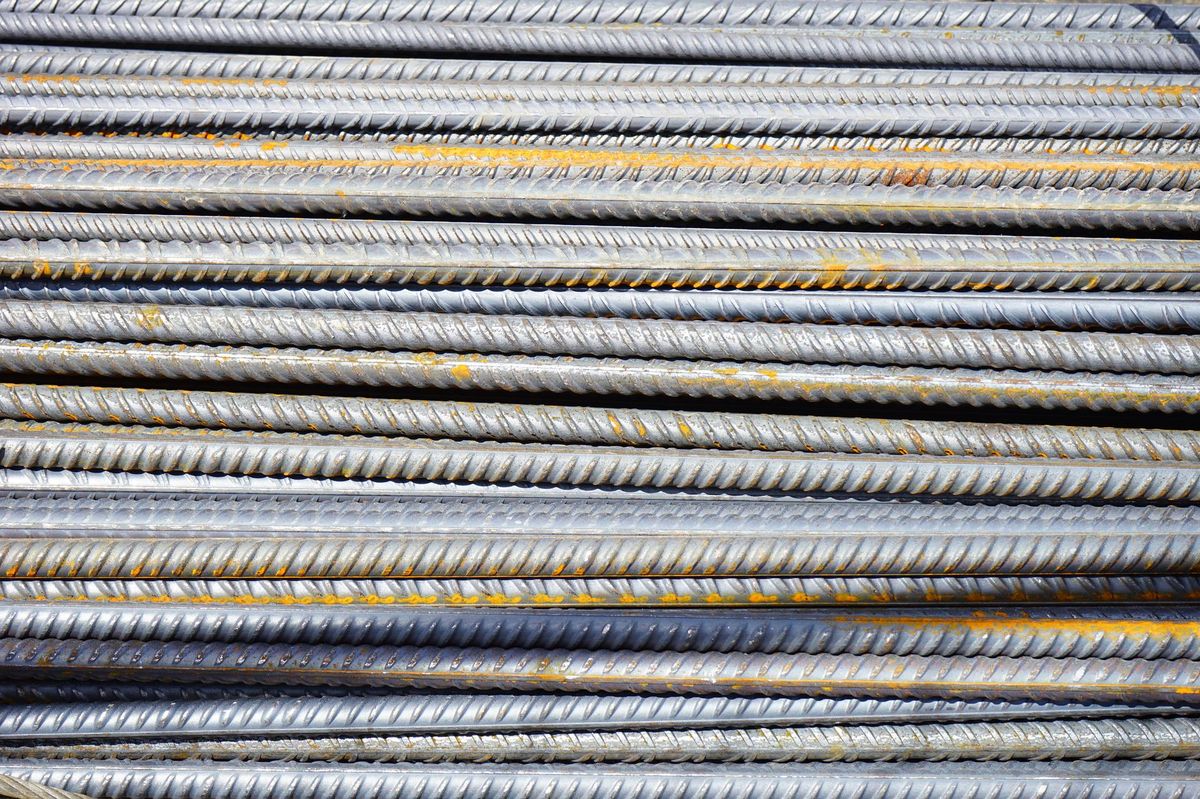
While structural steel prices have dropped, reinforcing steel (rebar) tells a different story. Grade 60 #4 rebar is trading at $820/ton delivered to most metro areas, according to pricing data from MetalMiner — essentially flat from 2025.
The reason for the divergence: rebar demand is being sustained by infrastructure spending. The IIJA-funded highway and bridge projects consume enormous quantities of rebar, and this demand has kept prices firm even as flat-rolled and structural shapes declined. The Federal Highway Administration estimates that active IIJA highway projects require approximately 4.2 million tons of rebar through 2027.
For foundation and flatwork contractors, this means your reinforcing costs haven't benefited from the broader steel price decline. Epoxy-coated rebar, required on most bridge decks and parking structures, runs a 15-20% premium over bare bar, putting it around $960-985/ton.
Welded wire reinforcement (WWR) for slabs-on-grade has held at approximately $1,050/ton, providing modest savings over individual rebar placement in some applications. Fiber reinforcement alternatives (steel fiber at $1.80/lb, synthetic fiber at $0.90/lb) continue to gain traction as cost-competitive alternatives for certain slab applications.
Import vs. Domestic: Where to Source in 2026
The import vs. domestic sourcing decision comes down to three variables: price, lead time, and risk tolerance.
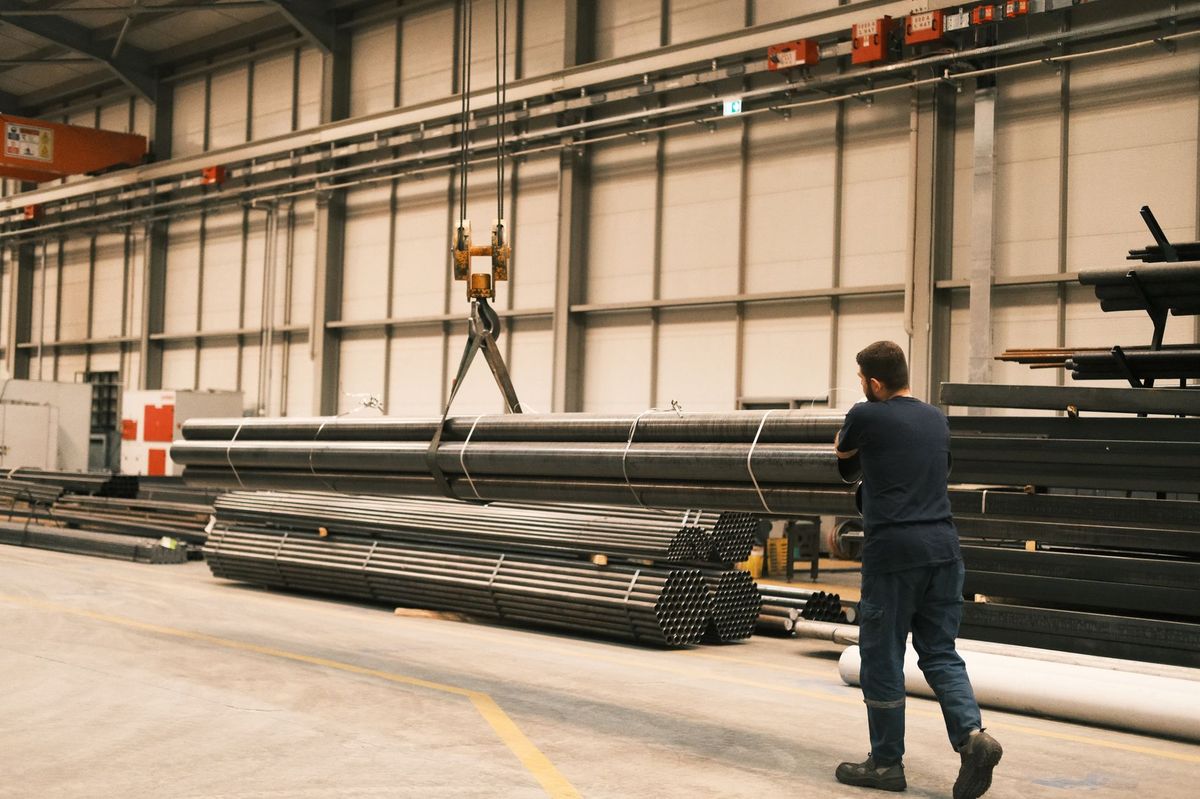
Domestic structural steel from major mills (Nucor, U.S. Steel, SDI, SSAB) offers lead times of 6-10 weeks for standard shapes and 10-14 weeks for custom plate work. Pricing is transparent — you can pull Platts benchmarks and negotiate off the index.
Imported structural steel, primarily from Canada and Turkey for the U.S. market, offers lead times of 12-20 weeks including ocean transit and customs clearance. Pricing is typically $80-120/ton below domestic for equivalent specification material, even after Section 232 tariffs on non-USMCA origins.
According to the Steel Manufacturers Association, domestic mill utilization ran at 76.4% in Q1 2026 — below the 80% level that typically triggers price increases. This means domestic mills have capacity and are competing for volume, keeping the domestic premium over imports relatively narrow.
The math: on a 300-ton structural steel order, going domestic versus import is roughly a $24,000-$36,000 price difference. But the 6-12 week shorter lead time on domestic material is worth approximately $15,000-$30,000 in avoided general conditions costs on most projects. When you factor in schedule value, domestic is close to break-even on total cost.
Business tip: If you have a project with a long enough lead time (6+ months from bid to steel erection), get both domestic and import quotes. Use the import quote as leverage in your domestic negotiation. Most domestic mills will sharpen their pencils by 3-5% if they know you have a competitive alternative.
Inventory Levels and Supply Chain Health
Steel service center inventories sit at 6.8 million net tons as of February 2026, according to the Metals Service Center Institute (MSCI). That's a months-of-supply ratio of 2.4 — healthy by historical standards and up from the dangerously low 1.6 months-of-supply seen during the 2021-2022 supply chain crisis.
Higher inventories benefit contractors in two ways. First, availability improves — you can source standard shapes from service centers in 3-5 business days rather than waiting for a mill heat. Second, pricing competition intensifies when distributors have metal on the ground that they need to move.
The caveat: service centers typically carry a $100-150/ton premium over mill-direct pricing to cover storage, handling, cutting, and delivery. For small orders under 20 tons, service center sourcing is almost always the right call. For orders over 100 tons, mill-direct is worth pursuing for the savings.
Steel fabricator backlogs — the time from contract to shop drawing approval to fabrication start — currently run 8-12 weeks according to AISC's fabricator survey. That's down from the peak of 16-20 weeks in 2022 but still requires early engagement if your project has a tight steel erection window.
How the Price Drop Affects Bid Margins
Here's where the rubber meets the road. If you bid structural steel work — or if steel is a meaningful component of your bids — the 8% price decline creates a margin opportunity, but only if you manage it correctly.
Scenario one: you're bidding new work. Your cost basis has dropped, so you can either hold your price and improve margins by roughly 2-3 percentage points on the steel component, or you can pass through the savings and sharpen your bid to win more work. The right answer depends on your backlog. If backlog is strong (above 6 months), hold your margins. If backlog is thin (below 3 months), buy work.
Scenario two: you have existing contracts with escalation clauses. Most structural steel subcontracts now include material escalation provisions after the wild price swings of 2021-2022. If your contract references an index (Platts HRC is the most common), the 8% decline means you may owe the GC a price decrease on future deliveries. Review your contracts now — don't get surprised by a change order request you didn't anticipate.
Scenario three: you're a GC managing steel subcontractors. This is your opportunity to rebid the steel package on projects that haven't started fabrication. If your steel sub bid the job at $825/ton and steel is now at $760/ton, there's a conversation to be had. According to the material costs analysis, managing material cost exposure is the single biggest margin lever for GCs in 2026.
Business tip: Add a material cost reconciliation clause to every steel-related subcontract. Set a baseline index price (Platts HRC on the date of contract) and agree to adjust plus or minus for movements greater than 5%. This protects both parties and keeps the relationship honest.
What Could Reverse the Price Drop
Steel prices don't move in one direction forever. Three scenarios could push prices back above $800/ton in the second half of 2026.
First, a trade policy change. Any expansion of Section 232 to cover currently exempt countries (Canada, Mexico under USMCA) would immediately tighten domestic supply and push prices up $50-80/ton within 60 days, based on the 2018 precedent.
Second, a surge in infrastructure spending. The IIJA spending curve is steepening, and if state DOTs accelerate their project lettings in Q3-Q4, structural steel and plate demand could spike. The American Road and Transportation Builders Association projects a 14% increase in highway contract lettings for the second half of 2026.
Third, a mill production disruption. U.S. Steel's Mon Valley works and Nucor's Blytheville mill are both scheduled for maintenance outages in Q3 2026. If these coincide with strong demand, spot pricing could jump $40-60/ton temporarily.
The Broader Material Cost Picture
Steel is just one input. To understand your full cost exposure, you need to see how steel fits alongside lumber, concrete, copper, and other material costs that are squeezing margins across the industry.
The Producer Price Index for structural steel shapes (BLS series WPU1017) fell 6.2% year-over-year through February 2026. Compare that to ready-mix concrete (up 11%), copper wire (up 14%), and softwood lumber (up 3%). Steel is the only major construction input that's actually cheaper than a year ago.
This creates an interesting dynamic for value engineering. On projects where you have design flexibility, shifting structural load-carrying elements toward steel and away from concrete can generate savings that weren't available 12 months ago. The breakeven analysis between steel and concrete frames has shifted by roughly $4-6 per square foot in steel's favor since mid-2025.
You can pressure-test these figures for your own project with our free cost estimator and the markup margin calculator.
FAQ: Steel Prices Construction 2026
Will steel prices continue to drop in 2026?
Most analysts expect steel prices to stabilize in the $720-$780/ton range through the second half of 2026. S&P Global Platts' forward curve shows HRC settling around $740/ton by Q4. Significant further declines are unlikely given that domestic mill utilization at 76.4% is approaching the level where producers curtail production to support pricing. Upside risks include trade policy changes and accelerating IIJA spending.
How much does the steel price drop save on a typical commercial building?
On a typical 50,000 square foot commercial building using structural steel framing, the 8% price decline from $825 to $760/ton saves approximately $100,000-$150,000 on the structural steel package. This translates to roughly $2-3 per square foot in total building cost. The savings are most significant on steel-intensive building types like warehouses, distribution centers, and multi-story office buildings.
Should contractors lock in steel prices now or wait for further declines?
Lock in now on any project bidding in the next 90 days. Steel prices at $760/ton represent an 8% discount from 2025 averages and are below the 5-year average of $810/ton. Use fixed-price mill orders with 90-120 day validity for near-term projects. For projects 6+ months out, consider index-based pricing tied to Platts HRC to capture any further decline while protecting against upside moves.
Bottom line: $760/ton steel is a gift. It won't last forever — the IIJA spending curve and potential trade policy shifts both create upside price risk in the second half of the year. If you're bidding structural work, refresh your material quotes this week, run a steel-versus-concrete comparison on your next mid-rise project, and lock in pricing on anything you're fabricating in the next 120 days. Call your steel supplier Monday.