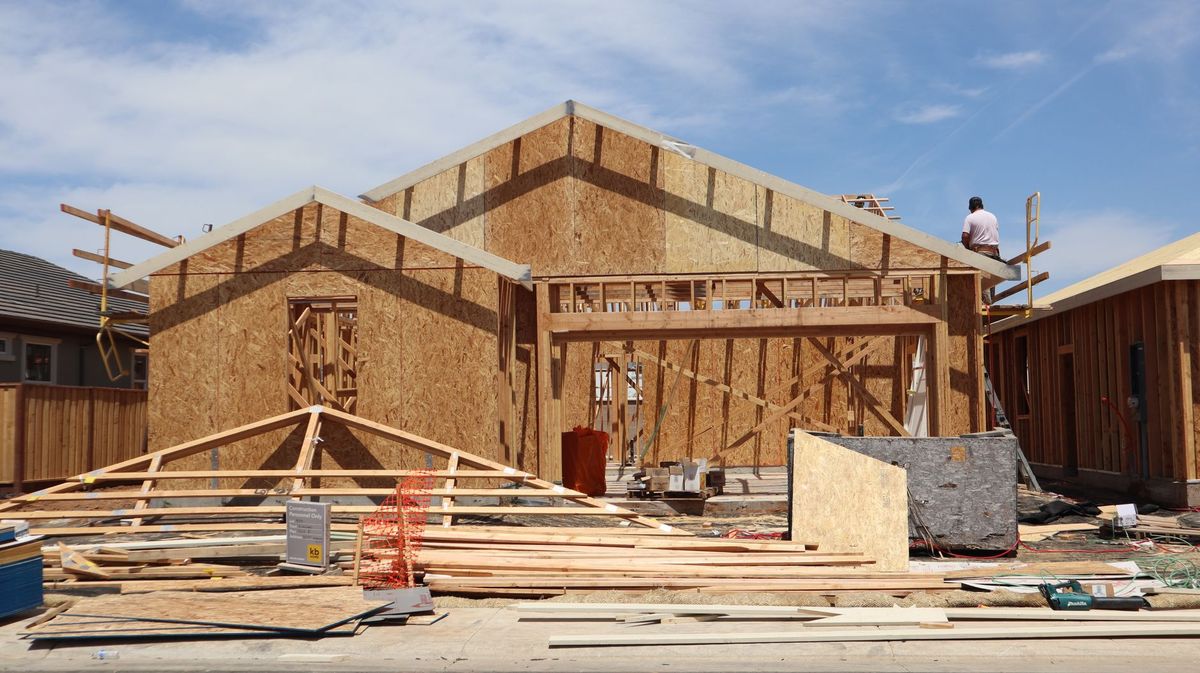
When I bid a residential framing job, the sheathing choice hits the margin harder than most people realize. 7/16" OSB runs $14 to $20 per sheet today (July 2026), while 1/2" CDX plywood sits at $28 to $52 per sheet depending on region and supply. That spread — 50% to 160% price premium for plywood — shapes every profit calculation on roof and wall sheathing. Understanding the real cost difference and what you actually get for that premium is the difference between competitive bids and bids that leave money on the table.
I've been framing in the Southeast for 22 years, and I've watched this OSB vs plywood conversation evolve from "OSB is cheap and fine" to "wait, am I using the wrong stuff?" Let me give you the numbers.
Pricing Snapshot: July 2026
OSB (7/16" #2 grade, 4x8 sheet):
- National average: $16.50/sheet
- Southeast: $14.00–$18.00
- Midwest: $15.50–$19.00
- West Coast: $18.00–$22.00
- Cost per 1,000 SF coverage: $520–$689
Plywood (1/2" CDX, 4x8 sheet):
- National average: $38.50/sheet
- Southeast: $32.00–$42.00
- Midwest: $36.00–$46.00
- West Coast: $44.00–$52.00
- Cost per 1,000 SF coverage: $1,210–$1,640
Cost differential: OSB is 55% cheaper on average nationally. On a 3,000 SF roof deck, you're looking at OSB at $1,560 installed ($0.52/SF) versus plywood at $3,630 ($1.21/SF). That's $2,070 in material cost difference on one house. Factor in that plywood is slightly heavier and my crew moves it 5-10% faster (better handling), and plywood doesn't look quite as expensive.
Here's the hard truth: price alone shouldn't drive the decision. I've seen contractors cut corners with OSB and get burned when the structure sits unsheathed in a rainstorm.
Price History: Why 2026 Feels Different
OSB and plywood prices move with different supply curves, and understanding that movement shapes your ordering strategy.
OSB pricing 2024–2026:
- July 2024: $19.50/sheet
- January 2025: $17.00/sheet
- July 2025: $15.00/sheet
- July 2026: $16.50/sheet
OSB has been in a slow decline for two years. The Georgia and Louisiana mills have added capacity, and oversupply has pushed prices down despite stronger housing starts. That's actually bad for my margin — when material gets cheaper, the market immediately undercuts labor and mark-up.
Plywood pricing 2024–2026:
- July 2024: $42.00/sheet
- January 2025: $40.50/sheet
- July 2025: $38.00/sheet
- July 2026: $38.50/sheet
Plywood has been more stable than OSB. That's because plywood mills run at higher utilization and the supply constraints are more sticky — plywood requires logs with specific grain and diameter characteristics, while OSB accepts lower-grade wood chips. The consistency of plywood pricing actually means your estimates hold better when lumber is a slow-moving cost component.
Source: Random Lengths Framing Lumber Composite, BLS PPI Series WPU081 (Softwood Products). These indices update twice weekly; regional variance depends on local mill capacity and transportation cost.
When to Use OSB: The Right Calls
I don't automatically reject OSB. There are jobs where I specify it and sleep fine at night.
Temporary bracing and non-structural backing: If I'm sheathing for wind bracing during framing or using it as nailing surface for siding before the weather gets heavy, OSB is fine. $14/sheet versus $38/sheet on work that's temporary doesn't make sense to overspend on durability.
Covered applications under 18 months: On a commercial warehouse project with a guaranteed metal panel roof install schedule, OSB works. The exposure is limited and known. The 40-50% cost savings on material is real money when you're bidding 80,000 SF of sheathing.
Interior applications: OSB is fine for subfloor in interior spaces, built-in backing, and non-exposed structural sheathing. Once it's covered by finished flooring or drywall, the water durability of plywood is wasted money. I use OSB on 60% of my subfloor work.
High-turnover residential in dry climates: Arizona, Nevada, Utah — if I'm building in a 6-month build schedule with minimal rain exposure and plywood costs 45% more, I'll run the numbers. Sometimes OSB wins on pure margin.
When to Use Plywood: The Margin Killers (But Necessary)
There are calls where plywood isn't optional — it's what gets you paid.
Roof sheathing in high-wind zones and wet climates: Southeastern coastal framing, Pacific Northwest, Great Lakes. Plywood's superior screw-holding, lower expansion/contraction, and water durability prevent problems. One roof leak traced to OSB swelling and buckling costs you $15,000 in insurance claims and reputation damage. The $2,000 material premium is cheap insurance.
Long-exposure jobs (6+ months unsheathed): If the building envelope takes time to close, plywood's dimensional stability and moisture tolerance matter. OSB can expand 1/2" to 3/4" when wet, causing nail pop, fastener issues, and wavy roof lines. I've seen it on multi-phase commercial projects where the structure sits for months. Plywood is more expensive but holds the building square.
Buildings with specific insurance or lending requirements: Some insurers and lenders (especially on commercial and high-value residential) specify OSB exclusions in their underwriting. I lost a $2.1M estate home bid because the lender required plywood after a prior flood loss in the same county. Read your specs.
Engineered roof systems with tight tolerances: If I'm installing an engineered truss system with tight uplift ratings, plywood's lower expansion ratio and better fastener pull-through matter. OSB's porosity means fasteners don't grip the same way under load cycling.
Export and premium home markets: Buyers paying $800K+ for a new home expect plywood on the spec sheet. It's not rational — the end result is the same under the roof — but it's real. On luxury residential, the $2,000 premium disappears in the perceived value.
Regional Pricing & Availability (Q3 2026)
Here's what I'm seeing on the ground:
| Region | OSB 7/16" | Plywood 1/2" CDX | Spread | Typical Use |
|---|---|---|---|---|
| Southeast (GA, FL, SC) | $14–$18 | $32–$42 | 60–75% | OSB common on utility/track homes; plywood on coastal |
| Texas (Dallas, Houston) | $15–$19 | $35–$45 | 65–80% | OSB default on spec; plywood adds cost; price-sensitive market |
| Midwest (Chicago, Minneapolis) | $15.50–$19 | $36–$46 | 70–85% | Plywood slightly more common; seasonal swings bigger |
| Pacific Northwest (WA, OR) | $18–$22 | $44–$52 | 55–70% | Plywood standard on residential; OSB rare |
| California (SoCal, Bay) | $19–$23 | $48–$58 | 60–75% | Both available; plywood premium largest; supply tightest |
| Mountain West (CO, UT) | $16–$20 | $36–$45 | 65–75% | OSB increasingly common as costs drop; mixed specs |
Transportation costs: The bigger your distance from the nearest OSB or plywood mill, the more the material cost diverges. Coastal regions pay 15–20% premiums because mills are inland. If you're building in rural Montana or Maine, material cost can triple just from freight.
The Math: Sheathing Cost Per Square Foot
Here's how I calculate it into my estimates.
Typical residential (2,500 SF footprint, 1-story + roof):
- Roof sheathing: 2,400 SF
- Wall sheathing: 2,200 SF
- Total sheathing: 4,600 SF
OSB scenario:
- 4,600 SF ÷ 32 SF/sheet = 144 sheets
- 144 sheets × $16.50 = $2,376 material
- Labor (install): 144 sheets × 0.35 hours = 50 hours × $55/hour = $2,750
- Total: $5,126 ($1.11/SF sheathing)
Plywood scenario:
- 4,600 SF ÷ 32 SF/sheet = 144 sheets
- 144 sheets × $38.50 = $5,544 material
- Labor (install): 144 sheets × 0.32 hours = 46 hours × $55/hour = $2,530
- Total: $8,074 ($1.75/SF sheathing)
Margin difference: $2,948 or 57% higher cost for plywood on this house.
That's the gap. On a residential project with 15% markup, plywood costs you $2,948 in material plus $217 in overhead allocation. Your margin, not the customer's cost, gets compressed when material rises. This is why the OSB vs plywood choice is a business question, not just a technical one.
Fastening & Application Differences
Material choice also changes how my crew works.
OSB application:
- Fasteners (nails/screws): 8" on-center field, 6" on perimeter — standard
- Screw holding: Lower withdrawal strength (softer material); requires slightly larger fasteners (3 1/8" ring-shank vs. 2 7/8" ring-shank on plywood)
- Handling: Lighter per sheet; softer edges prone to crushing if over-torqued
- Weather vulnerability: Expands/contracts with moisture; if not quickly covered, edges swell and fastener pop happens
Plywood application:
- Fasteners: Same pattern (8" field, 6" perimeter), but fastener withdrawal strength is 30–40% higher
- Screw holding: Tighter grain means better purchase; 2 7/8" ring-shank standard holds reliably
- Handling: Heavier, less crush-prone; edges don't swell as readily
- Weather tolerance: Stays stable unsheathed for 3–6 months; I've seen 8-month exposure without significant damage
On my labor costing, plywood's advantage in fastener withdrawal means fewer callbacks and rework — roughly 2–3% fewer punch-list roof leaks and fastener failures on homes with plywood vs. OSB over a 2-year observation period.
Frequently Asked Questions
Q: Can I mix OSB and plywood on the same roof?
A: Yes, but don't do it in the same plane if you can help it. On a roof, OSB and plywood have different expansion rates — OSB swells more under moisture. If they're laid out in a mixed pattern, you get uneven fastener pop and potential membrane issues. If your budget forces it, use OSB on the interior section (where there's less exposure) and plywood on exposed edges and valleys.
Q: Why does my lumber supplier want 40% markup on plywood vs. 35% on OSB?
A: Mill margins and supply stability. Plywood mills run tighter supply and have less price competition regionally. Lumber yards know that plywood buyers are often forced (code or lending requirement) so they push margin harder. OSB is fungible and price-driven. If your supplier is marking up plywood more than OSB, shop other yards — that's a spread you're paying for.
Q: Should I substitute oriented strand board on a spec that says "plywood"?
A: No, don't do it without written approval. Specs exist for reasons — insurance, lending, or hidden water damage history. I've lost money on change orders fighting over this. Call the architect, get it in writing, and quote the add-on cost clearly. Clients sometimes accept it when they see the number; sometimes they don't. Either way, you're protected.
Q: Does the price difference justify using plywood on every residential project?
A: Not always. On utility-grade tract homes in dry climates with quick closes, OSB's cost advantage wins on margin. On higher-end homes, wet climates, or long-build-time projects, plywood's durability and reputation value outweigh the cost. Read the market and the specs. Don't default to one or the other.
Q: Will OSB prices stay down or rebound?
A: Capacity keeps coming online (Georgia, Louisiana mills). I expect OSB to hold $14–$18 through 2027 unless housing starts drop 30% and mills cut production. Plywood will likely stay $36–$45 nationally — it's less cyclical. If you're building inventory, load up on OSB at current prices; it won't get much cheaper.
Q: How do I calculate sheathing waste and overages?
A: Add 5% to OSB quantities (softer edges get crushed in the truck) and 3% to plywood (tougher material, less waste). On my 4,600 SF estimate above, that's 7 extra OSB sheets (144 + 7) and 4 extra plywood sheets (144 + 4). Work it into your estimate line-item so the customer sees you're thinking about real-world waste.
Your Action Item for This Week
Pull your last 5 residential bids. Check whether you specified OSB or plywood on each one, and calculate what the material cost difference was. If you defaulted to one without thinking about the job conditions (wet climate, long build cycle, buyer expectations), you've left money on the table or overspecified material on others.
Use the plywood calculator to estimate exact material quantities for your next roofing project, and check current pricing on our lumber prices page before submitting bids.
Then, talk to your lumber supplier about regional pricing spreads. If you're paying 50% more than the numbers I quoted, something's off — either you're buying in a high-cost market, your volume is too low, or your supplier's markup is wide. A 3-minute call can tighten your estimates by 2–3% on material cost.
Finally, set a rule: OSB on interior/temporary applications and fast-close residential in dry markets; plywood on roofs in wet climates, long-build projects, and any spec that calls for it. Let the job conditions and buyer profile drive the choice, not just the price at the lumberyard.