$65 billion. That's the size of the U.S. construction equipment rental market in 2026, according to the American Rental Association — up 9.2% from $59.5 billion in 2025. More than half the equipment on American job sites is now rented, not owned. If you haven't run the buy-versus-rent math on your fleet recently, you're almost certainly leaving money on the table.
I own equipment and I rent equipment. After 18 years of making these decisions for my plumbing shop — mini-excavators, skid steers, trenchers, pipe fusion machines — I can tell you that the answer is never "always buy" or "always rent." It's a utilization equation, and the numbers have shifted dramatically in the last two years. Let me walk you through the real math.
The $65 Billion Market: What's Driving Growth
The American Rental Association (ARA) pegs the 2026 U.S. equipment rental market at $65 billion in revenue, making it the largest rental market in the world. The 9.2% year-over-year growth outpaces construction spending growth (4.8%) by nearly double — meaning rental is gaining share of total equipment deployment.
The rental penetration rate has hit 56% in 2026, according to ARA data. That means 56 cents of every dollar spent on construction equipment access goes to rental rather than ownership. A decade ago, this number was 42%. The trend line is unmistakable — the industry is structurally shifting toward rental.
Three forces are driving this shift. First, equipment costs have risen dramatically. The Producer Price Index for construction machinery (BLS series PCU333120) is up 18% since 2022, making ownership more capital-intensive. Second, labor shortages mean fewer skilled operators, which reduces utilization rates on owned equipment. Third, specialty equipment for growing market segments (data centers, EV battery plants, renewable energy) requires machines most contractors don't want to own permanently.
The math: if your company spends $500,000 annually on equipment (owned and rented combined), and you're at the industry-average 56% rental penetration, you're spending $280,000 on rental. Getting that number right — or wrong — is a six-figure decision.
Business tip: Pull your last 12 months of rental invoices and owned equipment costs (depreciation, maintenance, insurance, storage) into one spreadsheet. Sort by equipment category. You'll almost certainly find machines you're renting that should be owned, and machines you own that should be rented.
The Major Players: Who's Renting to You
The rental market is dominated by three companies that collectively control approximately 38% of U.S. market share. Understanding their positioning helps you negotiate better rates.
United Rentals is the market leader with approximately $14.3 billion in 2025 revenue (their fiscal year) and a fleet of 1.1 million rental units across 1,600 locations. Their acquisition strategy has made them the 800-pound gorilla — they've completed 35 acquisitions since 2020, including the transformative $4.8 billion Ahern Rentals deal in 2024. Their strength is fleet breadth and geographic coverage.
Sunbelt Rentals holds the number two position with approximately $9.8 billion in revenue and 1,250 locations. Owned by Ashtead Group (London-listed), Sunbelt has invested heavily in specialty equipment and climate-controlled solutions. Their specialty segment — power, HVAC, and industrial tools — is growing at 15% annually.
Herc Holdings rounds out the big three with approximately $3.4 billion in revenue and 440 locations. Herc has differentiated on technology, offering telematics-equipped machines and a digital rental platform that some contractors prefer for short-term needs.
Below the big three, regional players like BlueLine Rental, Neff, H&E Equipment Services, and Maxim Crane Works fill geographic and specialty niches. Maxim Crane is particularly notable as the largest crane rental company in North America with a $1.2 billion revenue base.
The math: the top three companies control 38% of a $65 billion market, meaning $40 billion in rental revenue flows through smaller and regional players. This fragmentation gives you negotiating leverage — there's almost always a competitive alternative within your market area.
Buy vs. Rent: The Excavator Case Study
Let's run the numbers on the most common buy-versus-rent decision in construction: the standard excavator. I'll use a Cat 320 (20-ton class) as the example because it's the workhorse of the industry.
Purchase cost: $350,000 for a new Cat 320 GC, per Caterpillar dealer pricing in Q1 2026. With 20% down ($70,000) and financing the balance at 7.5% over 60 months, your monthly payment is approximately $5,620. Add insurance ($350/month), maintenance ($1,200/month average over the ownership period per AEMP cost studies), and storage/transport ($400/month), and your total monthly cost of ownership is approximately $7,570.
Rental cost: $12,000/month for the same Cat 320 from a national rental company on a monthly rate. Weekly rate is approximately $4,200 ($18,200/month equivalent), and daily rate is around $1,400 ($30,800/month equivalent). Long-term rental agreements (6+ months) can bring the monthly rate down to $9,500-$10,500.
The breakeven calculation is straightforward: divide your monthly ownership cost by the monthly rental cost.
$7,570 / $12,000 = 63% utilization breakeven.
If you're using the excavator more than 63% of available working days (roughly 16 days per month or 192 days per year), buying is cheaper than renting at the standard monthly rate. Below 63% utilization, renting wins.
At the long-term rental rate of $10,000/month, the breakeven shifts to 76% utilization — meaning you need to keep the machine working nearly four out of every five available days to justify ownership.
Business tip: Track actual utilization on every piece of equipment you own for 90 days. Use the hour meter — divide actual engine hours by available hours (assume 8 hours per working day, 22 working days per month = 176 available hours). Most contractors who do this exercise for the first time discover their utilization is 15-20 percentage points lower than they assumed.
The Hidden Costs of Ownership That Change the Math
The simple monthly comparison above misses several ownership costs that tilt the equation further toward rental for many contractors.
Capital opportunity cost. The $70,000 down payment on that excavator is capital you can't use elsewhere. If your business generates a 15% return on invested capital (a reasonable target for a well-run contracting firm per FMI Corporation benchmarks), that $70,000 has an opportunity cost of $10,500 per year, or $875/month. Add that to ownership cost and your breakeven utilization rises to 70%.
Residual value risk. A Cat 320 depreciates approximately 15-20% in the first year and 10-12% annually thereafter, according to Ritchie Bros. auction data. After five years, your $350,000 machine is worth roughly $140,000-$165,000. If the market softens — as it did in 2020 when used equipment values dropped 25% — your residual value exposure is significant.
Technology obsolescence. Equipment manufacturers are releasing Tier 4 Final and early Tier 5 emissions-compliant machines with advanced GPS, grade control, and telematics. A machine purchased in 2026 may lack features that become standard — or required — by 2030. Rental lets you access the latest technology without owning the obsolescence risk.
Fleet age trends. The average age of the U.S. construction equipment fleet is 8.2 years, according to the Association of Equipment Manufacturers (AEM). The rental fleet averages 4.8 years. Renting gives you newer, more reliable equipment with better fuel efficiency and safety features.
The math: when you include capital opportunity cost and residual value risk, the true breakeven utilization for owning versus renting a standard excavator is closer to 70-75%, not the 63% that a simple monthly cost comparison suggests.
Equipment Categories: Where Rental Makes Sense and Where It Doesn't
Not all equipment follows the same buy-versus-rent logic. Here's a category-by-category breakdown based on typical utilization patterns and cost structures.
Earthmoving (excavators, dozers, loaders): Rental favors contractors with utilization below 70%. If you're a sitework sub with consistent grading and excavation work, ownership of core machines (your primary excavator and dozer) typically pencils out. Support machines (secondary excavator, wheel loader for material handling) are often better rented. The rental market for excavators alone is approximately $8.2 billion in 2026.
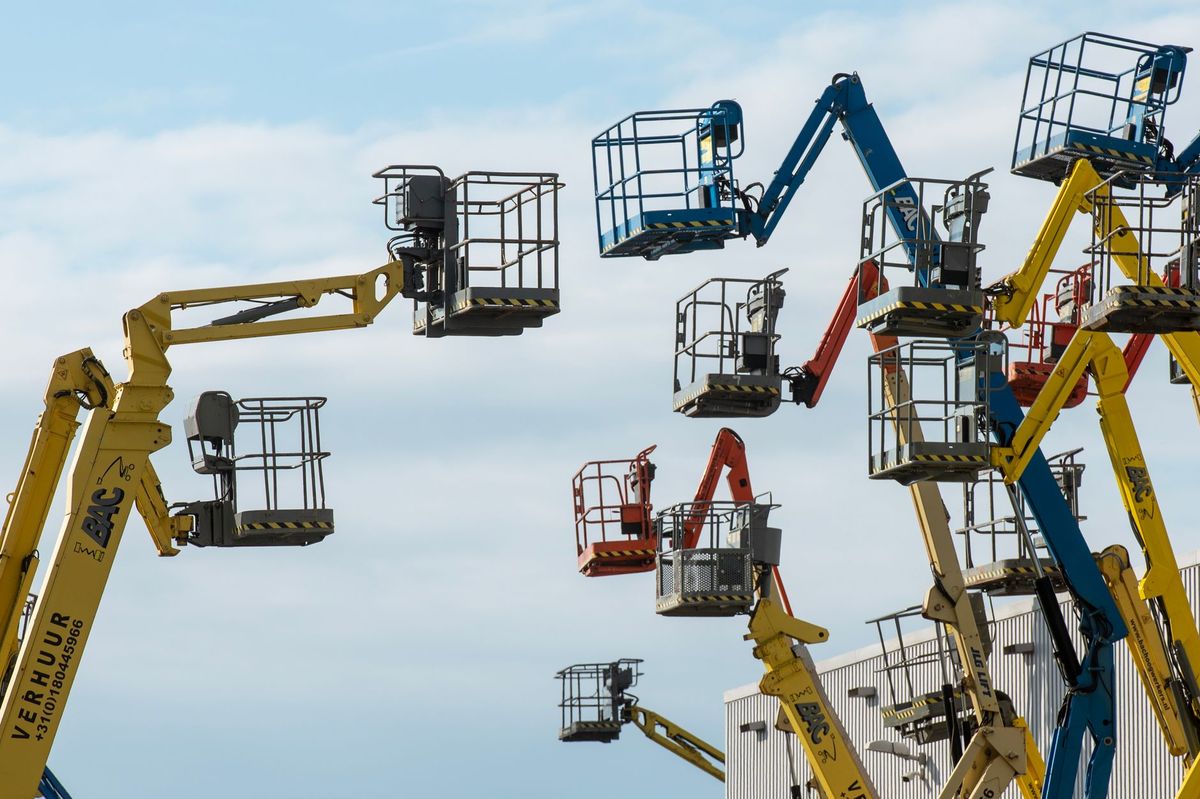
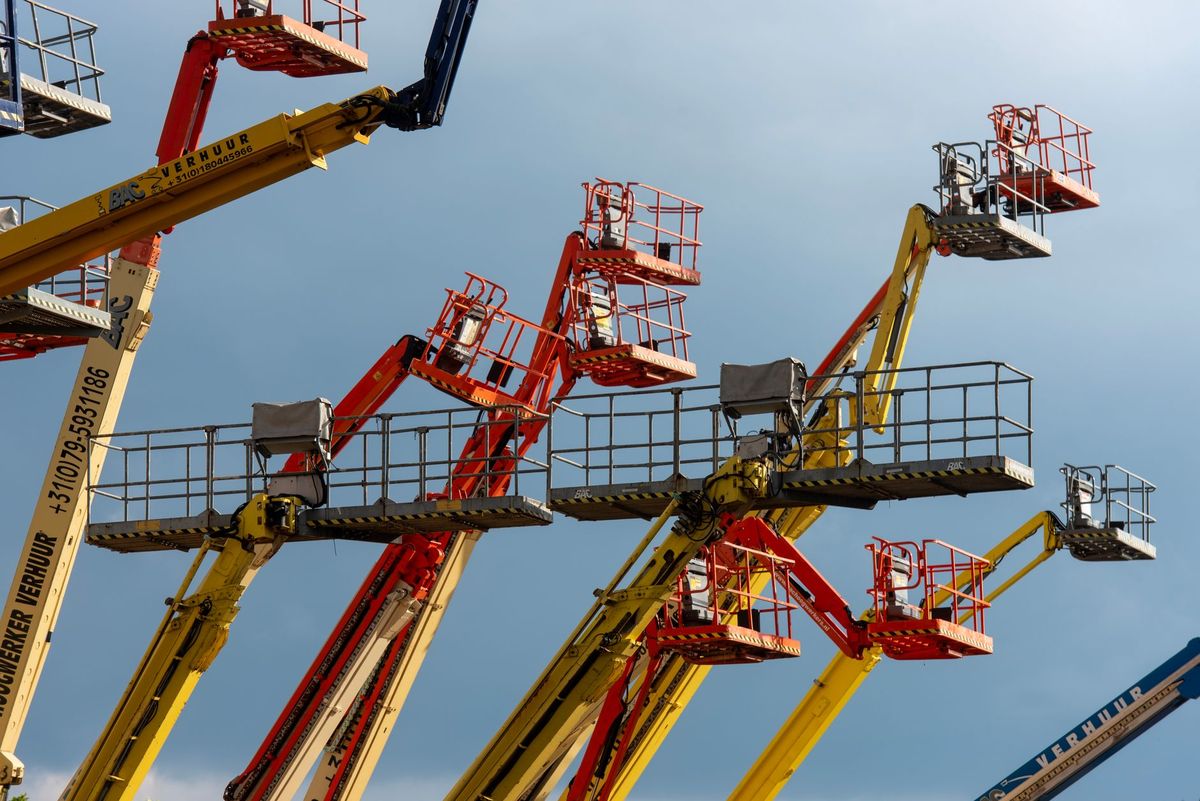
Aerial lifts (boom lifts, scissor lifts): Almost always better to rent unless you're a specialty access contractor. Utilization for most contractors runs 25-40%, well below the ownership breakeven. The aerial lift rental market is approximately $9.5 billion — the single largest rental category. JLG and Genie dominate manufacturing, and rental rates have actually decreased 3% year-over-year due to fleet oversupply.
Cranes: Rental dominates. A 100-ton mobile crane costs $1.2-$1.5 million to purchase and requires a certified operator. Monthly rental with operator runs $45,000-$65,000. Only dedicated crane service companies should own cranes. The crane rental market is approximately $5.8 billion through specialists like Maxim and ALL Crane.
Compact equipment (skid steers, mini-excavators, compact track loaders): The most common ownership category for small to mid-size contractors. A Cat 259D3 compact track loader costs $72,000 and rents for $3,200/month. The ownership breakeven is around 55% utilization — achievable for most contractors who use compact equipment regularly. This is where ownership typically wins.
Specialty equipment (pipe fusion, concrete pumps, directional drills): Rental almost always wins unless you're a specialty contractor in that specific trade. A horizontal directional drill costs $350,000-$800,000 and rents for $15,000-$25,000/month. Utilization for a non-specialty contractor rarely exceeds 20%.
Business tip: Categorize your equipment into "core" (used on most jobs, high utilization) and "support" (used occasionally, variable utilization). Own your core equipment. Rent your support equipment. Review the categorization annually — what's core today might become support if your project mix shifts.
Rental Rate Trends: What You Should Be Paying
Rental rates have increased 5.4% on average across all categories in 2026, according to ARA data. But the increase is uneven — rates for scarce equipment have risen much more than rates for equipment in oversupply.
Here are benchmark monthly rental rates for common equipment categories in Q1 2026, based on data aggregated from national rental companies:
- Standard excavator (20-ton): $12,000/month
- Mini excavator (3.5-ton): $3,800/month
- Skid steer loader: $2,800/month
- Compact track loader: $3,200/month
- 60-foot boom lift: $4,500/month
- 26-foot scissor lift: $1,800/month
- Dozer (D6 class): $14,000/month
- Wheel loader (3-yard): $8,500/month
- Telehandler (8,000 lb): $4,200/month
These are list rates. Negotiated rates for contractors with consistent rental volume (over $100,000/year) run 15-25% below list, according to industry benchmarks. National account programs with United Rentals, Sunbelt, or Herc typically offer 20% discounts with volume commitments.
The math: if you're renting $200,000/year in equipment and paying list rates, negotiating a 20% national account discount saves $40,000 annually. That's a meaningful number for most small and mid-size contractors.
Fleet Management Technology: The Data Advantage
Modern rental equipment comes equipped with telematics — GPS tracking, engine diagnostics, utilization monitoring, and fuel consumption data. This technology, which is standard on nearly all rental fleet equipment from major companies, gives you data you can use to make better fleet decisions.
Utilization tracking through telematics shows you exactly how many hours each rented machine actually operates versus sitting idle. United Rentals' Total Control platform and Sunbelt's proprietary system both provide this data to customers. If your telematics data shows a rented excavator averaging 3.5 engine hours per day on a job where you estimated 6 hours, you're overspending on equipment capacity.
Predictive maintenance alerts from telematics can prevent downtime on both rented and owned equipment. AEM estimates that unplanned equipment downtime costs the average contractor $2,400 per day in lost productivity. Telematics-enabled preventive maintenance reduces unplanned downtime by approximately 25%, per Caterpillar's customer data.
The rental companies are also investing in digital platforms. United Rentals processed 42% of rental transactions digitally in 2025, up from 28% in 2023. Digital ordering reduces rental cycle time (from request to delivery) from an average of 18 hours to 6 hours, per company data.
Business tip: Request telematics access from your rental company on every rented machine. Use the utilization data to right-size your rental orders. If you're renting a 20-ton excavator but telematics shows you're averaging 60% bucket fill, you might be able to downsize to a 14-ton machine and save $2,500/month.
The Tax and Balance Sheet Angle
The buy-versus-rent decision has meaningful tax and financial reporting implications that affect your borrowing capacity and bonding line.
Owned equipment sits on your balance sheet as a fixed asset. You depreciate it over 5-7 years (per IRS MACRS schedules for construction equipment) and can take advantage of Section 179 expensing (up to $1.22 million in 2026) or bonus depreciation (60% in 2026, declining 20% per year under the Tax Cuts and Jobs Act). The equipment debt appears as a liability, affecting your debt-to-equity ratio.
Rented equipment is an operating expense — it hits your income statement but stays off your balance sheet. This improves your debt-to-equity ratio, which directly affects your bonding capacity. Surety companies evaluate your balance sheet when setting bond lines, and a cleaner balance sheet (less equipment debt) can mean a higher bonding line.
The math: if you buy $500,000 in equipment with $400,000 financed, your debt increases by $400,000. If your surety company uses a 10:1 working capital-to-bond-line ratio, that $400,000 in debt effectively reduces your available bonding capacity by $4 million. For contractors pursuing public work or large private projects requiring bonds, this is a strategic consideration that favors rental.
The Surety & Fidelity Association of America reports that 62% of surety underwriters consider equipment financing obligations when evaluating bond applications. Managing your equipment strategy with bonding implications in mind can unlock significantly more project opportunity.
FAQ: Construction Equipment Rental Market 2026
Is it better to buy or rent construction equipment in 2026?
The answer depends on utilization. For most equipment categories, buying makes financial sense above 70-75% utilization (when you include capital opportunity cost and residual value risk). Below that threshold, renting is typically cheaper. Compact equipment (skid steers, mini-excavators) breaks even at lower utilization (55%) due to lower purchase prices. Aerial lifts and cranes almost always favor rental for non-specialty contractors due to typical utilization rates of 25-40%.
How much can I save by negotiating rental rates?
Contractors spending over $100,000/year on equipment rental can typically negotiate 15-25% below list rates through national account programs with major rental companies. On $200,000 in annual rental spending, a 20% negotiated discount saves $40,000. The key leverage points are volume commitment, payment terms (net-10 versus net-30), and multi-year agreements. Always get quotes from at least two national companies and one regional player.
How is the equipment rental market expected to grow?
The ARA projects the U.S. equipment rental market will reach approximately $72 billion by 2028, representing compound annual growth of 5.4%. Growth drivers include IIJA infrastructure spending, rising equipment purchase prices (up 18% since 2022), and increasing rental penetration (projected to reach 60% by 2028). The fastest-growing segments are specialty equipment (power, climate control, industrial tools) at 15% annual growth, and earthmoving at 8% annual growth.
Bottom line: the $65 billion rental market exists because the math works for most contractors on most equipment categories. But "most" isn't "all." Run the utilization breakeven on every piece of equipment you own and every category you rent regularly. Own your core machines above 75% utilization. Rent everything else. Negotiate national account rates if you're spending over $100K/year on rental. And check with your surety company before your next major equipment purchase — the bonding capacity impact might change your decision. Call your rental rep Monday and ask for a rate review.