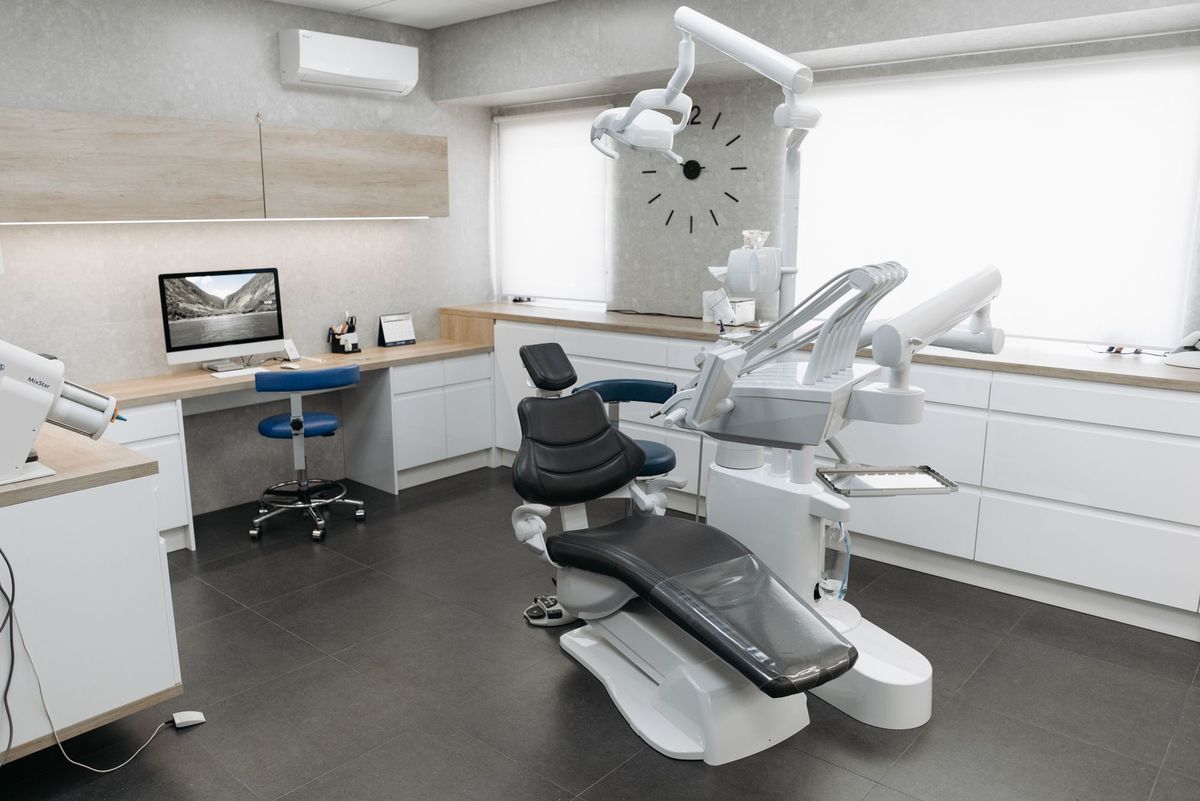
Dental office buildouts are a specialty market that trades on precision, code compliance, and operational infrastructure that most contractors have never seen. When a dentist calls asking about converting a vanilla commercial space into an operatory-ready practice, the numbers run $150 to $300 per square foot depending on condition and finish quality — with $225/SF being a realistic target for a mid-market build in most major metros. The real cost driver isn't fancy finishes; it's the mechanical systems nobody thinks about: vacuum systems, compressed air, water treatment, X-ray shielding, and plumbing stubs for each chair that cost $8,000–$15,000 per operatory before you even touch the walls or flooring.
I've subbed plumbing on three dental office buildouts in the Southeast, and I learned fast that dentistry is a different animal. The MEP coordination is intense, the code compliance is specific (dental boards regulate chair and equipment placement, X-ray protection, waste water handling), and change orders are expensive because moving a single operatory can mean re-running vacuum, compressed air, and water lines across 400 SF of slab or floor structure.
Buildout Cost Breakdown: Where the Money Goes
Let me break down a realistic 2,500 SF dental practice with 4 operatories (typical for a startup or small group practice).
Hard costs (construction materials & labor):
- Demolition/base building prep: $5,000–$10,000 (assume 5-year-old office space, light removal)
- Framing/structural (operatory dividers, walls): $12,500–$20,000 (2–3 internal walls, framing labor)
- MEP rough-in (plumbing, electric, HVAC, vacuum, compressed air): $30,000–$50,000 (most expensive trade; see detail below)
- Drywall/finishing: $10,000–$15,000 (operatory walls, administrative areas)
- Flooring (commercial epoxy or polished concrete in operatories, tile/carpet in admin): $15,000–$25,000
- Cabinetry & built-ins (front desk, sterilization room, storage): $20,000–$35,000
- X-ray shielding & lead-lined doors: $8,000–$15,000
- Final MEP trim & testing: $5,000–$8,000
- Paint, signage, misc.: $5,000–$8,000
Total hard cost: $110,500–$186,000
Soft costs (design, permitting, contingency):
- Architectural/engineering design: $8,000–$15,000 (dental practices require specialized dental CAD, not just standard commercial)
- Permitting & inspections: $2,500–$5,000 (higher than standard office due to medical waste, X-ray, dental board review)
- General contractor overhead (10–15%): $11,000–$28,000
- Contingency (10–15%): $13,000–$30,000
- Furnishings, dental equipment (chairs, lights, delivery systems): $40,000–$80,000 (often owner-supplied, not GC responsibility)
Total soft cost: $74,500–$158,000
Grand total installed: $185,000–$344,000, or $74–$138/SF for the buildout alone
But wait — that's missing the specialty systems. Here's the real cost picture:
MEP Specialty Systems: The Hidden Expense
Dental offices require three separate mechanical systems that standard commercial spaces don't have: vacuum (suction), compressed air, and water treatment. These systems account for 25–40% of the total MEP cost and are completely invisible to a dentist walking the finished space.
Vacuum System (Dental Suction)
Dental chairs require continuous vacuum for suction during procedures. A central vacuum system (shared by multiple operatories) is far cheaper than individual portable units.
Central vacuum system (4 operatories):
- Vacuum pump & tank: $8,000–$12,000
- Piping (copper, 1/2" to 3/4" diameter, running through floor or above-ceiling): $6,000–$10,000 (4 operatories with main lines + distribution)
- Tubing at each operatory (color-coded, wall-mounted): $1,500–$2,500
- Filters, valves, regulators: $2,000–$3,500
- Installation labor (licensed mechanical contractor, 60–80 hours): $4,500–$6,000
- Total vacuum system: $22,000–$34,000 or $5.50–$8.50/operatory
Vacuum line placement is critical — runs must be 3–6 feet from patient's ear level to avoid noise, and they must be pitched downward to drain condensation. Rerouting a single line after rough-in can cost $800–$1,500 in labor and materials.
Compressed Air System
Operatories need high-pressure air for dental handpieces (drills), spray functions, and equipment operation.
Compressed air system (4 operatories):
- Compressor (rotary screw, 5–10 HP): $4,000–$7,000
- Receiver tank: $1,500–$2,500
- Piping (copper, 1/2" to 3/4", same routing as vacuum): $5,000–$8,000
- Moisture separators, filters, regulators: $2,500–$4,000
- Tubing at operatory (color-coded): $1,000–$1,500
- Installation labor (40–60 hours): $3,000–$4,500
- Total compressed air: $17,000–$27,500 or $4.25–$6.88/operatory
Compressed air must be oil-free and dry (moisture ruins handpieces). This drives higher-quality equipment than standard shop air, which accounts for the cost premium over typical industrial compressor setups.
Water Treatment & Distribution
Dental chairs use chilled water for handpiece cooling and require specific water quality to prevent bacterial growth (Legionella risk).
Water treatment system (4 operatories):
- Water purification/chiller unit: $3,000–$6,000
- Tubing & distribution (insulated lines to each operatory): $2,500–$4,000
- Regulators, check valves, strainers: $1,500–$2,500
- Installation labor (20–30 hours): $1,500–$2,250
- Total water system: $8,500–$14,750 or $2.13–$3.69/operatory
Water temperature and quality monitoring is a regulatory requirement in some states. Some practices add automated testing ($1,500–$3,000 extra). Biofilm growth in dental lines is a real compliance issue — cheap shortcuts on water treatment cost money in recall visits and regulatory fines.
Waste Water & Medical Waste Handling
Dental offices produce wastewater with amalgam, blood, and biohazard materials that can't go straight to municipal sewers.
Waste management (4 operatories):
- Amalgam separator (traps mercury): $2,000–$3,500
- Suction line strainers & traps: $1,500–$2,000
- Medical waste container & pickup contract (quarterly): $400–$800/year
- Sharps disposal (needle, blade containers, pickup): $200–$400/year
- Total annual waste: $600–$1,200; equipment $3,500–$5,500
Amalgam separators are required by EPA in most states. Failure to install or maintain them triggers fines up to $2,500/day. This is non-negotiable.
Per-Operatory Economics: The Math
Let me break this down to cost per treatment chair, because dentists think in those terms.
Fully built-out operatory (including proportional share of hallway, sterilization, front desk, MEP):
- Raw space allocation (2,500 SF ÷ 4 operatories): 625 SF/operatory
- Hard construction: 625 SF × $88–$136/SF = $55,000–$85,000/operatory
- Shared MEP (vacuum, air, water): $5,500–$8,700/operatory
- Chair, delivery system, lights (patient-supplied or separate): $15,000–$30,000/operatory
- Total per operatory: $75,500–$123,700
If you're contracting turnkey (including chair and equipment), the cost jumps to $90,000–$140,000 per operatory. If the dentist supplies the chair and equipment separately, you're at $75,000–$100,000 for the buildout alone.
A $3M-revenue practice typically has 4–6 operatories. A $6M practice runs 8–10 operatories. The incremental cost of adding a 5th operatory to a 4-operatory practice is lower than the first 4 because shared infrastructure (reception, sterilization, central systems) is already in place. The 5th operatory costs roughly 60–70% of the first, bringing it down to $45,000–$70,000 due to economies of scale on the buildout.
Cost Variations by Fit-Out Quality & Existing Condition
The $150–$300/SF range assumes mid-market quality and 5–10-year-old base building space. Here's how it moves:
Budget practice (raw shell, Class B space, $150–$180/SF):
- Basic drywall, polished concrete floors, minimal cabinetry
- Stock operatory dividers, builder-grade finishes
- Central systems only (no redundancy or enhanced filtration)
- Minimal cosmetic finish (plain paint, basic lighting)
- 4 operatories in 2,500 SF
Mid-market practice (Class A/B space, some prior medical use, $200–$250/SF):
- Custom cabinetry, finished flooring (epoxy, tile, or polished concrete)
- Upgraded lighting, wall finishes, privacy glass on partitions
- Central systems plus enhanced water treatment
- 4 operatories in 2,500 SF with admin/sterilization
Premium practice (Class A space, turnkey finish, $280–$320/SF):
- Custom cabinetry throughout, premium flooring, architectural detailing
- Designer lighting, color coordination, ADA premium accessibility
- Enhanced MEP (backup compressor, redundant vacuum, specialty water purification)
- Finishes that support high-end positioning (stone, wood, custom millwork)
- 4 operatories in 2,500 SF
Legacy medical space (existing dental/medical buildout to retrofit, $120–$180/SF):
- Most infrastructure already exists (vacuum, compressed air lines, electrical rough-in)
- Demolition of old cabinetry/equipment; refresh of MEP systems
- New finishes, paint, updated styling
- Reuse of core systems reduces cost significantly
Regional Pricing & Market Factors (Q3 2026)
Dental buildout costs swing by region based on labor rates, MEP contractor availability, and local code stringency.
| Region | Low | Mid | High | Key Factor |
|---|---|---|---|---|
| Southeast (Atlanta, Charlotte, Miami) | $150–$180 | $200–$240 | $260–$300 | Growing market, competitive pricing, warm climate (simpler HVAC) |
| Texas (Houston, Dallas, Austin) | $160–$190 | $210–$250 | $270–$310 | High demand, mixed labor costs, sprawling metro areas |
| Midwest (Chicago, Minneapolis) | $140–$170 | $190–$230 | $250–$290 | Lower wage structure, seasonal construction shutdowns, older buildings |
| Northeast (NYC, Boston, Philly) | $180–$220 | $250–$300 | $320–$380 | High union labor, strict codes, expensive real estate, older buildings |
| California (Bay Area, SoCal, LA) | $200–$240 | $280–$340 | $360–$420 | Highest labor costs, seismic requirements, strict environmental codes |
| Mountain West (Denver, Salt Lake) | $140–$170 | $190–$240 | $260–$300 | Moderate labor, newer buildings, lower density markets |
Why coastal markets cost more: Labor union rates for licensed plumbers, electricians, and HVAC techs run 40–60% higher in California, New York, and Massachusetts than in Texas, Georgia, or the Midwest. A licensed dental specialty plumber in San Francisco might charge $150–$200/hour; in Atlanta, $80–$120/hour. On a 300-hour MEP job, that's $21,000–$24,000 in labor difference alone.
Code Compliance & Dentist Board Regulations
This is the part contractors often miss: dental boards regulate the physical buildout, not just building codes.
X-ray shielding requirements:
- Lead-lined walls: 1/16" lead minimum for operatory walls adjacent to offices, 1/8" if adjacent to public areas
- Cost: $60–$100/SF of wall area = $4,000–$8,000 for 4 operatories
- Lead-lined door for X-ray room: $2,000–$4,000
- Testing & certification: $500–$1,200 (required for operatory opening)
Infection control requirements:
- Sterilization room layout per ADA guidelines (must be separated from patient areas)
- Specific flooring requirements (seamless, non-porous)
- Handwashing station in sterilization area (stainless steel, foot-pedal or sensor activation)
- Cost: $8,000–$12,000 of the buildout
Patient privacy requirements:
- Operatories must provide acoustic privacy (sound transmission class 45–50)
- Requires sound-rated drywall, sealed penetrations, proper insulation
- Cost premium: $3,000–$6,000 beyond standard drywall
Emergency oxygen & nitrous oxide systems (if offered):
- Gas line rough-in, safety shutoff valves, wall-mounted regulators
- E-cylinder storage cabinet (locked, per dental board rules)
- Cost: $4,000–$7,000
Accessibility requirements:
- At least one operatory must be wheelchair-accessible
- Accessible restroom with grab bars, lowered sink
- Wider doorways (36" minimum), accessible reception desk
- Cost premium: $5,000–$10,000 above standard build
These regulatory costs are non-negotiable. A dentist who skips them is putting their license and liability at risk. When estimating, check your state's dental board rules — they vary by state and specialty (general vs. oral surgery).
Frequently Asked Questions
Q: Can I build out a dental office in a 1,200 SF space?
A: Technically yes, but it's tight. You need minimum 200 SF per operatory (including storage, sterilization, and patient circulation). A 1,200 SF space handles 4 small operatories, a tiny sterilization area, front desk, and not much else. Most dental practices find 2,500–3,500 SF more functional for 4–5 operatories. If you're forced into 1,200 SF, expect higher cost per SF because fixed costs (sterilization, MEP central systems) don't scale down.
Q: Do I need to hire a dental-specialized architect, or can a standard commercial architect handle it?
A: Hire a dental specialist or ensure your general commercial architect partners with a dental consultant. Dental office design has specific requirements around chair placement, operatory spacing, MEP coordination (vacuum, air, water), privacy, and infection control that a standard architect won't know. A dental-specialist architect costs $8,000–$15,000 extra but prevents $20,000+ in change orders and rework. It's worth it.
Q: What costs am I responsible for vs. the dentist?
A: Clarify in your contract. Typical split:
- GC/Contractor: Construction, finishes, MEP systems, X-ray shielding, cabinetry
- Dentist (or equipment supplier): Chairs, handpieces, lights, delivery systems, monitors, software
- Some GCs offer turnkey where they handle everything; others bid construction only. Either is fine as long as it's clear in writing.
Q: How long does a typical dental buildout take from start to occupancy?
A: 10–16 weeks for a 4-operatory practice in a Class A/B space:
- Design/permitting: 4–6 weeks
- Demolition/rough-in: 2–3 weeks
- Drywall/finish: 2–3 weeks
- Final trim, equipment install, testing: 1–2 weeks
- Walkthrough, punch list, occupancy: 1 week
- Plan 14–20 weeks if the building requires code violations to be cured first.
Q: What's the most common change order issue on dental buildouts?
A: MEP coordination. A single change to operatory location (e.g., "move the chair 6 feet to the left") requires relocating vacuum, compressed air, water, and electrical lines. What sounds like a 2-hour drywall shift becomes a 20-hour MEP rework costing $2,000–$4,000. Lock operatory locations in the design before rough-in starts. If changes are needed later, quote the full cost impact upfront.
Q: How much does it cost to add a 5th operatory to a 4-operatory practice down the line?
A: 50–70% of the cost of the initial 4, or roughly $45,000–$75,000. The MEP infrastructure (central vacuum, compressed air, water systems) is already in place, so you're mainly adding: framing, drywall, flooring, cabinetry, final MEP trim (new line runs from existing central systems). Labor and material for the new operatory itself is lower per SF, but some MEP expansion might be needed if the original central systems are at capacity. Have a MEP engineer evaluate before committing to expansion costs.
Q: Are there financing options for dental buildouts, or does the dentist always pay cash?
A: Dentists often use practice loans or SBA funding to cover buildout costs. Some equipment suppliers (chair manufacturers) offer equipment financing but not construction financing. As a contractor, you're bidding and getting paid on your schedule; the dentist's financing is their problem. Require deposit (25–50%) and stage payments aligned to construction milestones.
Your Action Item for This Week
If you're a general contractor considering dental buildouts as a revenue line, spend 2 hours reviewing your state's dental board regulations online (search "[Your State] State Board of Dentistry"). Download or print the buildout requirements, infection control standards, and X-ray protection rules. Familiar contractors win these bids because they know the code without guessing.
Use the cost estimator tool to model your regional labor rates and overhead, and compare your estimate against the benchmarks in the table above. Check our commercial construction cost reference for broader market context on related buildouts.
Network with a dental-experienced plumber and electrician in your area. Dental offices require specialists — standard MEP contractors often underbid because they don't understand vacuum/air/water requirements. Building relationships with a 2–3 competent subs who know dental work means smoother projects and stronger estimating.
Create a 2,500 SF, 4-operatory cost model for your region using the breakdowns above. Plug in your actual labor rates, material costs, and overhead. This becomes your baseline for bidding. Every project will vary, but having a detailed model prevents underpricing and helps you spot unusual project costs before you commit.
Dental buildouts are steady work in growing markets. They're specialized enough that competition is light once you know the system, and dentists care about quality and code compliance more than price. Get competent at this category, and you've got reliable revenue.