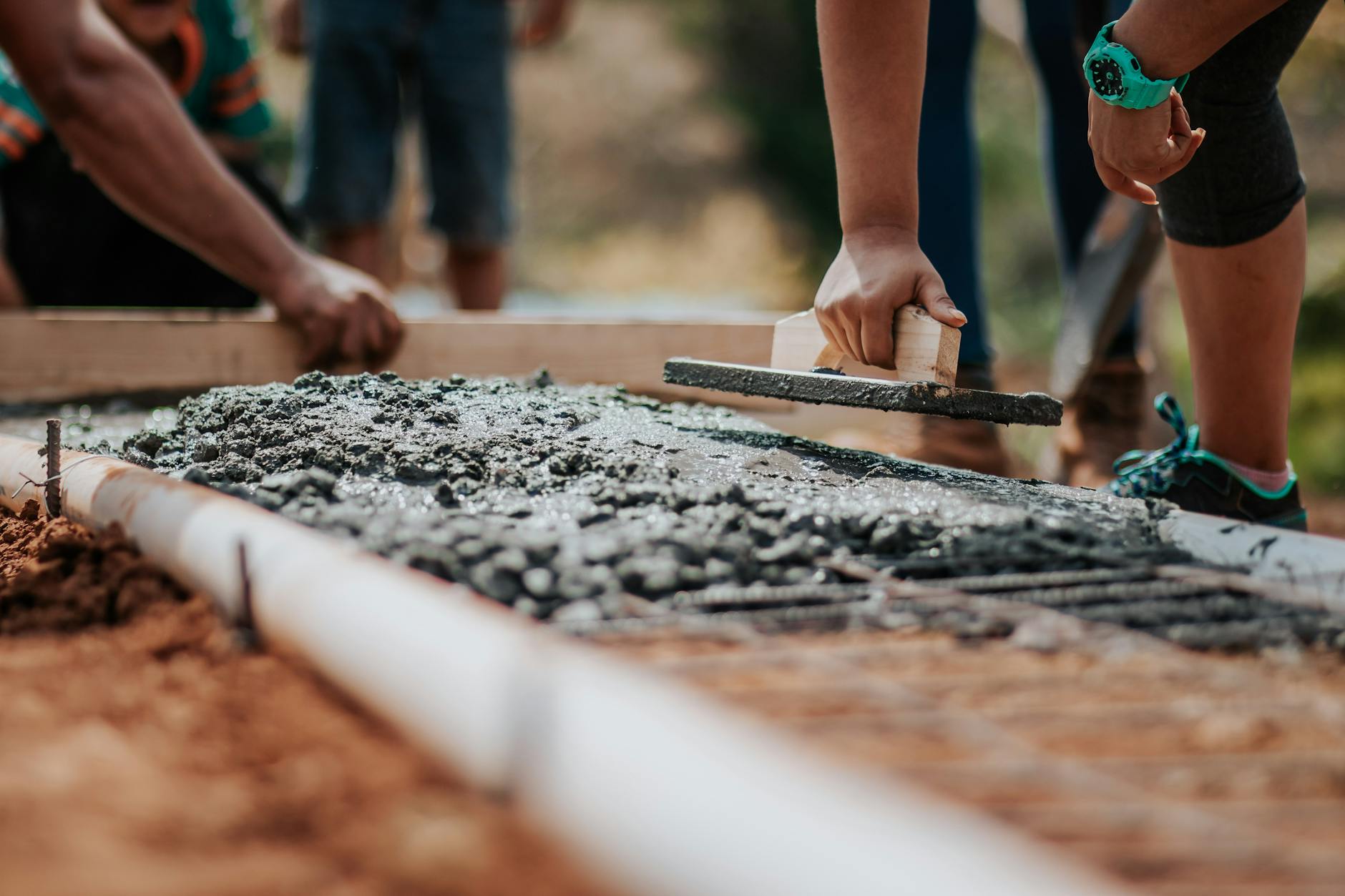
Photo by Rodolfo Quirós
Concrete flatwork pricing gets quoted with a lot of confidence and very little sourcing. A per-square-foot figure for a driveway, patio, or garage slab is the end product of three inputs: what ready-mix costs at your local plant, what your finishers cost per hour, and how much the site fights you. This guide separates what can be documented from public data from what you have to get from your own suppliers, and shows how to turn those inputs into a defensible per-square-foot bid.
The short version: the most recent consumer cost guide we could verify puts a typical concrete driveway at $6 to $16 per square foot installed. Federal price data shows ready-mix concrete prices nearly flat over the past year after a large run-up earlier in the decade. Finisher wages are published by the Bureau of Labor Statistics. Everything else (pump charges, demo, access premiums) is local, and anyone who quotes you a precise national number for those is guessing.
What Published Sources Say Flatwork Costs
There is no government survey of installed residential flatwork prices. The figures that circulate online come from consumer cost guides, which aggregate contractor quotes and rarely publish their methodology. Treat them as a sanity check on your bid, not as a substitute for it.
The LawnStarter concrete driveway cost guide (updated December 27, 2025) gives these figures:
- Typical installed cost: $6 to $16 per square foot, or $1,885 to $6,475 for a whole driveway, with a national average near $3,500
- Standard gray concrete: $4 to $6 per square foot
- Stained concrete: $6 to $12 per square foot
- Stamped concrete: $8 to $15 per square foot
- Rebar or wire mesh reinforcement: adds $1 to $3 per square foot
- Heated driveway systems: add $10 to $30 per square foot
- Removing an existing driveway: typically $1,500 to $2,500
- Adding 2 inches of thickness: raises cost by about 25%
The guide does not state where its numbers come from, and some of its sub-figures do not reconcile neatly with the headline range. That is typical of the category. The useful takeaway is the shape of the market, not the decimals: plain gray slabs sit at the bottom, decorative finishes roughly double the price, and reinforcement, thickness, and site work stack on top.
Patios, garage slabs, sidewalks, and interior slabs follow the same logic. Their per-square-foot cost moves with the same three inputs, adjusted for shape, edge length, and finish. A narrow sidewalk costs more per square foot than an open driveway because the forming and finishing labor is spread over less area. A garage slab with a vapor barrier and reinforcement costs more than a bare driveway of the same size. We have not found a sourced national figure for each of those categories that we would stand behind, so this guide does not print one.
Input 1: Ready-Mix Concrete Prices
The Bureau of Labor Statistics tracks ready-mix concrete through the Producer Price Index. The PPI is an index, not a dollar price per yard, so it tells you direction and magnitude of change, not what your plant will charge.
From the BLS PPI for ready-mix concrete (FRED series WPU1333, index 1982=100, data retrieved October 18, 2026):
| Month | Index value |
|---|---|
| January 2020 | 281.6 |
| September 2021 | 302.0 |
| September 2023 | 371.5 |
| September 2024 | 384.9 |
| September 2025 | 386.3 |
| September 2026 | 395.3 |
That works out to a 2.3% increase from September 2025 to September 2026, and about 31% above September 2021. The index peaked at 396.0 in June 2026 and has held roughly level since. The big increase happened in 2022 and 2023. The past two years have been comparatively calm.
What this means for bidding: escalation risk on ready-mix is lower than it was a few years ago, but the price base is permanently higher. If your unit costs were set in 2021 and only nudged since, they are almost certainly too low. Get a current written quote from your batch plant for the mix you are specifying, including short-load fees, fiber or accelerator upcharges, and any fuel or environmental surcharges. Those line items are where the real per-yard number lives, and none of them show up in a national index.
For a deeper look at concrete material pricing, see our concrete prices guide.
Input 2: Finisher Labor
The BLS Occupational Employment and Wage Statistics survey (May 2025 data, the most recent release) reports for cement masons and concrete finishers (occupation code 47-2051):
- National employment: 206,170
- Mean hourly wage: $28.87
- Median hourly wage: $27.41
- Mean annual wage: $60,050
Those are wages paid to workers, not what a flatwork sub charges per hour. Your burdened cost adds payroll taxes, workers' compensation, insurance, benefits, and (for a sub's quote) overhead and profit. Union and prevailing-wage rates in major metros run well above the national mean. State-level differences are covered in our concrete finisher wages by state breakdown.
To convert wages into a per-square-foot labor cost, you need your own production rate: square feet placed and finished per crew-day on comparable work. That number depends on crew size, finish, access, and weather, and it is the single most important figure in a flatwork estimate. Track it on every job. If you do not have it, you are pricing from someone else's assumptions.
Input 3: Site Conditions and Scope
This is where two bids on the "same" slab end up far apart. Items to price explicitly:
- Access. Direct chute access from the truck versus a pump, buggies, or wheelbarrows. A pump is a separate line item from a pump operator, usually with a minimum charge. Get it quoted.
- Demolition and haul-off. LawnStarter's figure for removing an existing driveway is $1,500 to $2,500. Thickness, reinforcement, and disposal distance swing it.
- Subgrade and base. Excavation, compaction, and base material. A slab is only as good as what it sits on, and base prep is the line item most often left out of low bids.
- Forming. Edge length matters more than area. Curves, steps, and short runs eat labor.
- Reinforcement. Wire mesh, rebar, or fiber in the mix. Each has a different material and labor cost.
- Finish. Broom, exposed aggregate, stamped, colored, or sealed.
- Weather protection. Cold-weather blankets and heat, or hot-weather retarders and curing.
The Material Math, Done Right
Concrete volume is pure geometry, so this part of the estimate can be exact.
One cubic yard is 27 cubic feet. A 4-inch slab is one-third of a foot thick, so one cubic yard covers 81 square feet at 4 inches. Put another way, 100 square feet at 4 inches needs 1.23 cubic yards before waste.
For a 500-square-foot slab at 4 inches:
- 500 × (4 ÷ 12) ÷ 27 = 6.17 cubic yards before waste
- Add a waste and over-excavation allowance that matches your own history (subgrade irregularity is the usual culprit)
- Multiply by your plant's delivered price per yard, plus any short-load or additive charges
At 5 inches the same slab needs 7.72 yards, and at 6 inches it needs 9.26 yards. That is why thickness drives cost so directly: going from 4 to 6 inches adds 50% to the concrete volume before any change in reinforcement.
Our concrete calculator runs this for any slab size, and the how to calculate concrete guide walks through irregular shapes.
Reinforcement, form lumber, curing compound, and sealer are smaller line items. Price them from your supplier's current quote rather than a national average, since all of them vary by region and order size.
How to Build a Per-Square-Foot Bid
A defensible flatwork price comes from the bottom up:
- Concrete: cubic yards (with your waste factor) × local delivered price per yard, plus fees.
- Reinforcement and accessories: from your supplier quote.
- Labor: crew-days (from your production rate) × burdened crew cost per day.
- Equipment: pump, saw, power trowel, compactor, as applicable.
- Site work: demo, haul-off, excavation, base.
- Overhead and profit.
Divide the total by slab area to get your per-square-foot number. Then compare it to the published ranges above. If you land far outside the $6 to $16 band for a plain driveway, find out why. Sometimes the job really is unusual. More often a line item is missing or double-counted.
When comparing subcontractor bids as a GC, normalize them first. Ask every bidder for thickness, mix strength, reinforcement type, base depth and material, curing method, finish, and whether demo, pump, and permits are included. A low number that excludes base prep or reinforcement is not a low number.
A ready-mix escalation clause is still reasonable on jobs with a long gap between contract and pour, even with the PPI near flat over the past year. Tie it to a written supplier quote rather than a percentage you picked.
For a quick assembly-level estimate, start with our construction cost estimator. For a broader look at driveway options and pricing, see the concrete driveway cost guide.
Cold Weather and Scheduling
Cold weather adds real cost: blankets, heated enclosures, heated water, accelerating admixtures, and slower finishing. The industry definition comes from the American Concrete Institute. As summarized in STRUCTURE magazine (September 2017), ACI 306R defines cold weather as when the air temperature has fallen to, or is expected to fall below, 40°F during the protection period. Earlier editions used a test based on three or more consecutive days of low average temperature, so older specs may use different wording. Check which definition your contract references.
Truck scheduling is the other schedule-driven cost. Crews standing idle waiting for a mixer are paid labor producing nothing. Coordinate first-truck arrival with forming and base completion, and confirm spacing between trucks on larger pours.
Frequently Asked Questions
Q: What does concrete flatwork cost per square foot in 2026? A: The LawnStarter driveway cost guide (updated December 27, 2025) puts typical installed driveway cost at $6 to $16 per square foot, with stamped concrete at $8 to $15 per square foot. The guide does not publish its methodology, so use it as a cross-check against a bid built from local ready-mix quotes, your crew's production rate, and site conditions.
Q: Are ready-mix concrete prices still rising? A: Slowly. The BLS Producer Price Index for ready-mix concrete (FRED series WPU1333) rose 2.3% from September 2025 to September 2026, much less than in 2022 and 2023. The index is about 31% above its September 2021 level. It is an index, not a dollar price, so get a current written quote from your plant.
Q: What do concrete finishers earn? A: According to BLS Occupational Employment and Wage Statistics for May 2025, cement masons and concrete finishers earned a mean hourly wage of $28.87 and a median of $27.41. That is the wage paid to the worker. A subcontractor's billed rate also covers burden, overhead, and profit.
Q: Can you pour concrete flatwork in cold weather? A: Yes, with cold-weather procedures. ACI 306R, as summarized in STRUCTURE magazine, treats conditions as cold weather when the air temperature has fallen to, or is expected to fall below, 40°F during the protection period. Typical measures include heated water, accelerators, insulating blankets, and temperature monitoring during curing.
Q: How much does thickness change the cost? A: Concrete volume rises in direct proportion to thickness: a 6-inch slab needs 50% more concrete than a 4-inch slab of the same area. LawnStarter's guide estimates that adding 2 inches raises total driveway cost by about 25%, since labor and forming do not scale up as fast as material.
Q: How do I evaluate competing concrete bids? A: Get each bidder's specs in writing: thickness, mix strength, reinforcement, base preparation, curing method, finish, and what is excluded (demo, pump, permits). Normalize the bids to the same scope before comparing price. A bid that omits base prep or reinforcement is cheaper because it is a different job.